01 / 22

Human Impacts on
Wetlands & Mangroves

Explore how development, pollution, and climate change threaten Earth's most productive coastal ecosystems and why their loss matters globally.

AP Environmental Science

What Are Wetlands?

A wetland is an area where water covers the soil or is present at or near the surface for at least part of the year. Wetlands include marshes, swamps, bogs, and fens. They occupy roughly \(6\%\) of Earth's land surface yet provide ecosystem services far exceeding their area.

Marshes
Dominated by grasses and herbaceous plants; frequently flooded
Swamps
Forested wetlands with standing water; trees and shrubs dominate
Bogs & Fens
Peat-accumulating wetlands; bogs are acidic, fens receive groundwater

What Are Mangroves?

Mangrove forests are salt-tolerant trees and shrubs that grow in tropical and subtropical intertidal zones. Their tangled root systems stabilize shorelines, filter sediment, and create nursery habitat for marine species. Globally, mangroves cover approximately \(150,000\ \text{km}^2\).

Sediment Canopy Prop roots Tidal zone Nursery habitat

Why Do They Matter?

Wetlands and mangroves provide ecosystem services worth an estimated \(\$15 \text{ trillion per year}\) globally. Their loss has cascading effects on biodiversity, climate, and human communities.

Flood Control
Act as natural sponges, absorbing storm surge and reducing downstream flooding
Carbon Storage
Store up to \(3\times\) more carbon per hectare than tropical rainforests in peat soils
Water Filtration
Trap sediments, absorb excess nutrients, and break down pollutants
Biodiversity
Support \(40\%\) of all species; critical nursery grounds for fish and shrimp

Explain how vegetation can reduce wave energy and erosion risk.

Use this illustration to explore the concept described in its caption.
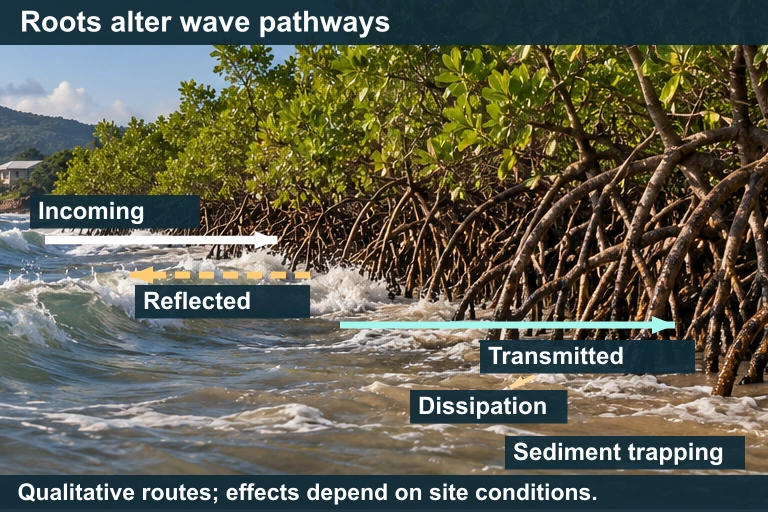
A mangrove fringe and prop roots border waves. Arrows indicate incoming, reflected and transmitted routes, with dissipation and sediment trapping identified among the roots.
Mangrove roots and stems alter wave pathways and can trap sediment. Their protective effect depends on vegetation, water depth, waves and shoreline conditions.

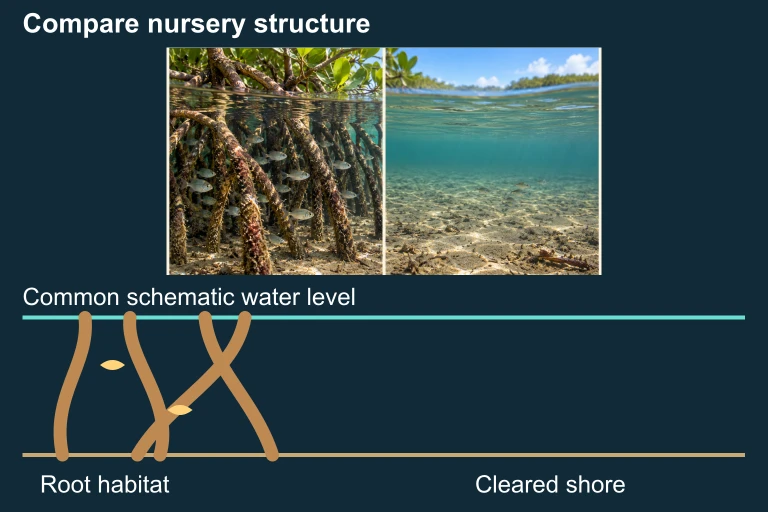
Trace loss of nursery habitat into a conditional recruitment pathway.

Use this illustration to explore the concept described in its caption.
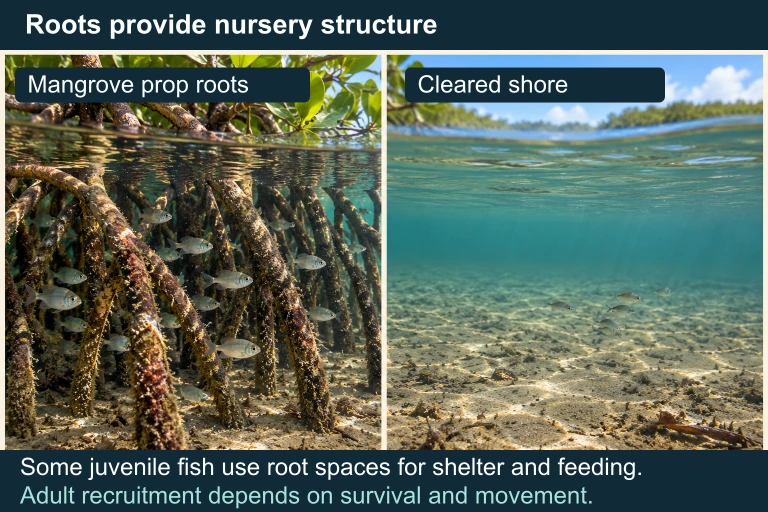
Mangrove roots can provide nursery structure for some juvenile fish; recruitment depends on survival, movement and other conditions.
Matched coastal cross-sections compare juvenile fish among mangrove roots with an exposed cleared shore.
Roots provide structural refuge; benefits to recruitment depend on survival, movement and other conditions.

The Core Problem: Accelerating Loss

0% 25% 50% 75% 100% % Remaining 1900 1950 1970 2000 2020 46% 63% Wetlands Mangroves

Wetlands vs. Mangroves

Wetlands Mangroves
Location Freshwater & coastal, all latitudes Tropical/subtropical coasts
Salinity Fresh, brackish, or salt Salt-tolerant only
Dominant vegetation Grasses, sedges, trees Salt-tolerant trees/shrubs
Key structural feature Saturated soils, standing water Aerial prop roots
Primary human threat Drainage for agriculture Conversion to aquaculture
Carbon storage Peat soils (deep organic layers) Sediment & biomass ("blue carbon")

Major Human Impacts

1
Land conversion: Draining wetlands for agriculture, filling for urban development, and converting mangroves to shrimp farms
2
Pollution: Agricultural runoff (nitrogen, phosphorus), industrial effluents, oil spills, and plastic waste degrade water quality
3
Hydrological alteration: Dams, levees, and channelization change water flow patterns, starving wetlands of water input
4
Climate change: Sea-level rise drowns coastal marshes, increased storm intensity batters mangroves, and warming shifts species ranges
5
Invasive species: Non-native plants like Phragmites and animals like nutria outcompete native wetland species

The Loss Cascade

Human Action Habitat Destruction Water Alteration Pollution Input Biodiversity Decline Nursery habitat lost Flood Risk Increases No natural buffer Water Quality Drops Eutrophication Carbon Release + Economic Loss + Human Displacement

Eutrophication: A Closer Look

Excess nitrogen (N) and phosphorus (P) from agricultural runoff enter wetlands, causing algal blooms. When algae die and decompose, dissolved oxygen plummets, creating hypoxic zones (dead zones). This process is known as eutrophication.

1
Nutrient input: Fertilizer and sewage add excess N and P to waterways
2
Algal bloom: Rapid growth of algae blocks sunlight to submerged plants
3
Decomposition: Dead algae are broken down by aerobic bacteria
4
Oxygen depletion: Bacteria consume dissolved \(\text{O}_2\), creating hypoxic or anoxic conditions
5
Die-off: Fish, invertebrates, and plants die, collapsing the food web

Blue Carbon and Climate Change

Blue carbon refers to carbon captured and stored by coastal ecosystems: mangroves, salt marshes, and seagrass beds. These systems sequester carbon at rates up to 50 times faster per unit area than tropical forests.

Carbon Stored (tonnes C/hectare) 0 250 500 750 1000 Tropical Forest 200 Salt Marsh 600 Mangrove 1000 Seagrass Bed 400

Drainage changes soil oxygen, carbon storage and ground elevation
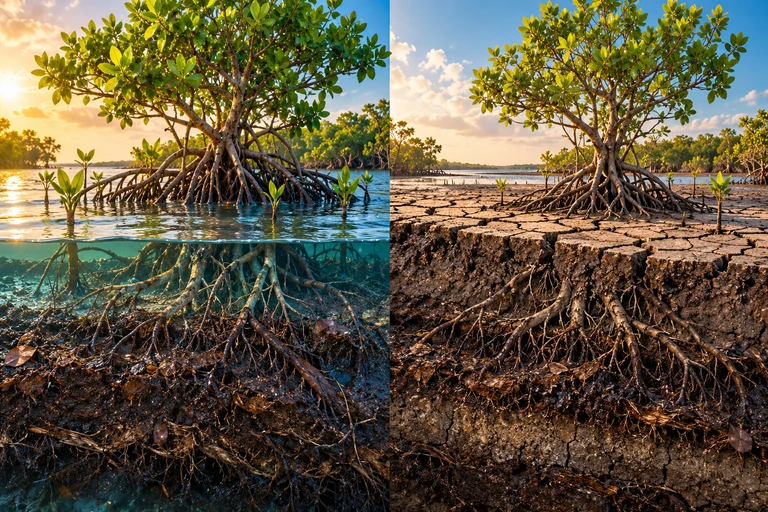
Matched wet and drained mangrove cutaways with visible roots, water and cracked exposed soil.Drainage can increase oxygen access to wetland soils, accelerating aerobic carbon loss and contributing to subsidence. In the carbon-stock example, oxidation of 114,000 tonnes of carbon produces 418,000 tonnes of CO₂ over 20 years.

Drainage alters oxygen access and soil stocks
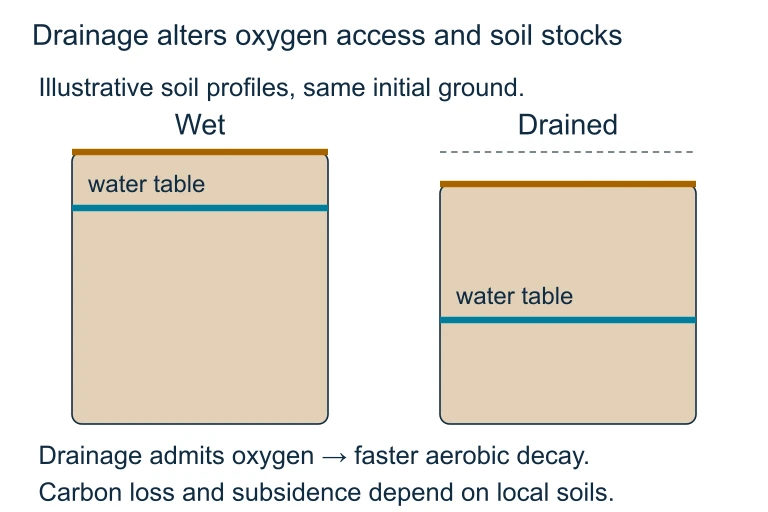
Drainage alters oxygen access and soil stocks. Drainage can increase oxygen access to wetland soils, accelerating aerobic carbon loss and contributing to subsidence. In the carbon-stock example, oxidation of 114,000 tonnes of carbon produces 418,000 tonnes of CO₂ over 20 years.Drainage can increase oxygen access to wetland soils, accelerating aerobic carbon loss and contributing to subsidence. In the carbon-stock example, oxidation of 114,000 tonnes of carbon produces 418,000 tonnes of CO₂ over 20 years.

Carbon stock loss becomes a CO₂ ledger
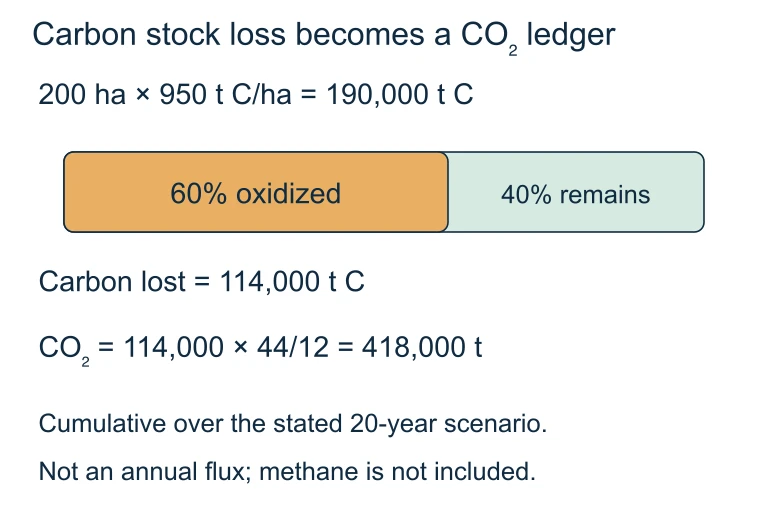
Carbon stock loss becomes a CO₂ ledger. Oxidation of 114,000 tonnes of carbon corresponds to 418,000 tonnes of CO₂ using the mass ratio 44/12. The stated example distributes this loss over 20 years.Oxidation of 114,000 tonnes of carbon corresponds to 418,000 tonnes of CO₂ using the mass ratio 44/12. The stated example distributes this loss over 20 years.

Aquaculture and Mangrove Destruction

Shrimp farming is the single largest driver of mangrove loss worldwide. Between 1980 and 2005, approximately \(38\%\) of global mangrove loss was attributed to aquaculture pond construction, primarily in Southeast Asia.

Before After Shrimp Pond Cleared, excavated Effluent runoff Exposed coastline

Case Study: Louisiana Wetland Loss

Louisiana has lost approximately \(4,833\ \text{km}^2\) of coastal wetlands since the 1930s: an area roughly the size of Delaware. At its peak, the state was losing land at a rate of one football field every 100 minutes.

Cause 1: Levees
Mississippi River levees prevent sediment deposition that naturally rebuilt wetlands
Cause 2: Canals
Oil and gas industry canals allow saltwater intrusion, killing freshwater vegetation
Cause 3: Subsidence
Groundwater and oil extraction causes land to sink below sea level

Hydrology, sediment supply and development control coastal wetland survival
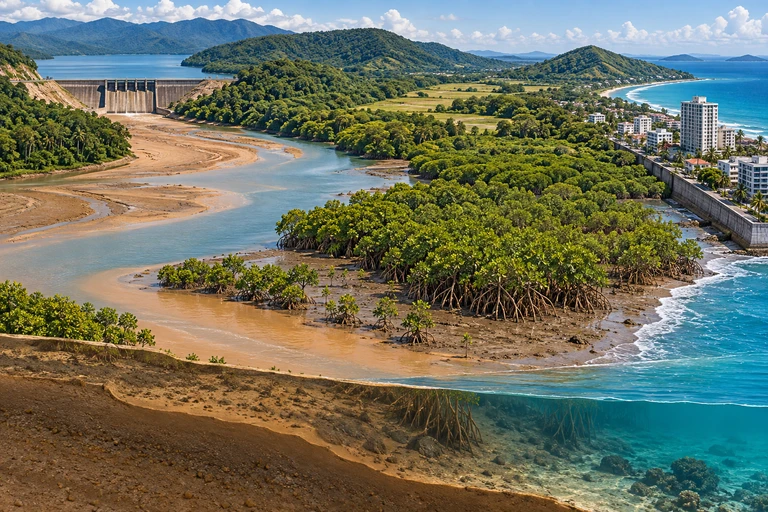
An estuary with dam,mangroves,seawall and open upland accompanies matched coastal profiles showing blocked versus available landward space.Coastal wetland persistence depends on sediment accretion, compaction, subsidence and relative sea-level change. An open migration corridor provides an option that a built barrier can block, but access alone does not ensure persistence.

Coastal wetland survival depends on vertical buildup and landward space.
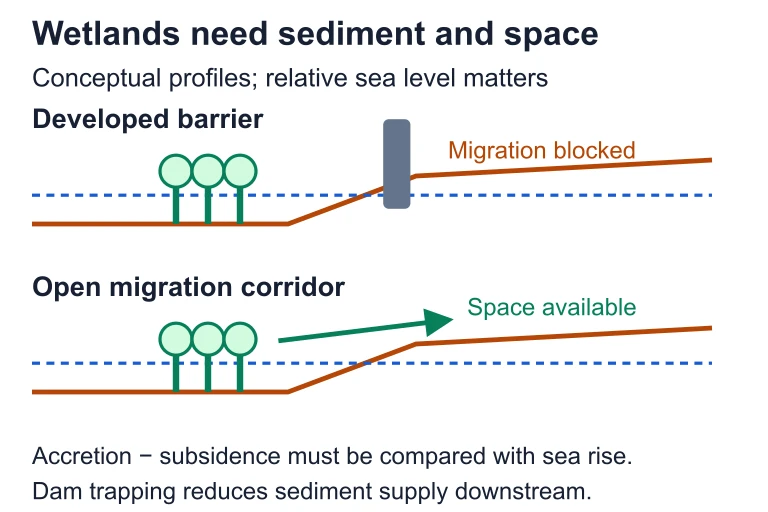
Coastal wetland survival depends on vertical buildup and landward space.. Coastal wetland persistence depends on sediment accretion, compaction, subsidence and relative sea-level change. An open migration corridor provides an option that a built barrier can block, but access alone does not ensure persistence.Coastal wetland persistence depends on sediment accretion, compaction, subsidence and relative sea-level change. An open migration corridor provides an option that a built barrier can block, but access alone does not ensure persistence.

Case Study: Southeast Asian Mangroves

Southeast Asia contains one-third of the world's mangroves but has experienced the highest deforestation rates. The 2004 Indian Ocean tsunami revealed a critical finding.

1
Intact mangroves: Villages behind mangrove forests suffered significantly less damage and fewer casualties from the 2004 tsunami
2
Cleared areas: Coastlines cleared for shrimp aquaculture experienced \(2\) to \(8\) times more damage from the same wave
3
Economic value: Mangrove coastal protection is estimated at \(\$33,000\) per hectare per year in avoided storm damage

How to Analyze Wetland Impacts

Use this framework for AP free-response questions about wetland or mangrove degradation:

1
Identify the stressor: What human activity is affecting the wetland? (e.g., dredging, pollution, development)
2
Trace the ecological mechanism: How does the stressor change water flow, chemistry, or habitat structure?
3
List lost ecosystem services: Which services are reduced? (flood control, filtration, carbon storage, biodiversity)
4
Connect to broader impacts: What are the downstream effects on human communities and global systems?
5
Propose mitigation: What strategies could reduce or reverse the damage? (restoration, policy, sustainable alternatives)

Conservation and Restoration

Ramsar Convention
International treaty designating Wetlands of International Importance; over 2,400 sites in 172 countries
Mitigation Banking
U.S. policy requiring developers who destroy wetlands to create or restore equivalent wetland area elsewhere
Mangrove Replanting
Community-led planting programs in Bangladesh, Vietnam, and Kenya restoring degraded coastlines
Blue Carbon Credits
Carbon market programs that fund mangrove and wetland conservation through carbon offset sales

Common Mistakes

✕ Confusing Wetland Types
Treating all wetlands as identical. Marshes, swamps, bogs, and mangroves have distinct characteristics and face different threats.
✕ Ignoring Indirect Impacts
Focusing only on direct destruction. Upstream dams and nutrient pollution can degrade wetlands without physically removing them.
✕ Forgetting Carbon Release
Not mentioning that destroyed wetlands release stored carbon. This is a key point for FRQ answers about climate feedbacks.

Summary: Threats and Services

Ecosystem Service Human Threat Consequence of Loss
Flood control Drainage, levees, development Increased flood damage
Water filtration Nutrient pollution, dredging Eutrophication, dead zones
Carbon storage Land conversion, peat drainage \(\text{CO}_2\) release, climate feedback
Biodiversity Habitat destruction, invasives Fishery collapse, species loss
Coastal protection Mangrove clearing for aquaculture Storm surge damage, erosion
Shoreline stability Root system removal Accelerated coastal retreat

Question 1 of 5

Which of the following is the primary driver of mangrove loss worldwide?

Question 2 of 5

A farmer applies large amounts of nitrogen-rich fertilizer upstream of a wetland. Which sequence of events most accurately describes the ecological consequence?

Question 3 of 5

The term "blue carbon" refers to carbon stored in which of the following?

Question 4 of 5

How did the construction of levees along the Mississippi River contribute to wetland loss in Louisiana?

Question 5 of 5

A government requires developers who fill wetlands to create replacement wetlands of equal area elsewhere. This policy is best described as: