Human Impacts on
Ecosystems
Explore how human activities disrupt biodiversity, alter biogeochemical cycles, and reshape ecological systems at local and global scales.
What Is an Ecosystem?
An ecosystem is a community of living organisms (biotic factors) interacting with their physical environment (abiotic factors). These interactions drive energy flow and nutrient cycling that sustain all life.
Ecosystem Services
Ecosystems provide critical services that support human survival and well-being. These services have enormous economic and ecological value.
How Humans Disrupt Ecosystems
Transport pathways determine where pollutants reach receptors
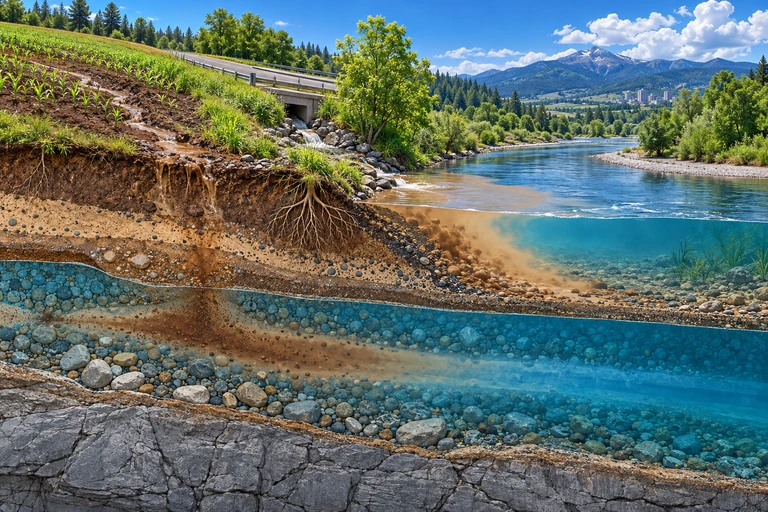 Dissolved pollutants can move with groundwater, while adsorbed pollutants may travel with sediment. Chemical form affects transport and exposure; intake, absorbed dose and tissue concentration are different quantities.
Dissolved and sediment-bound differ
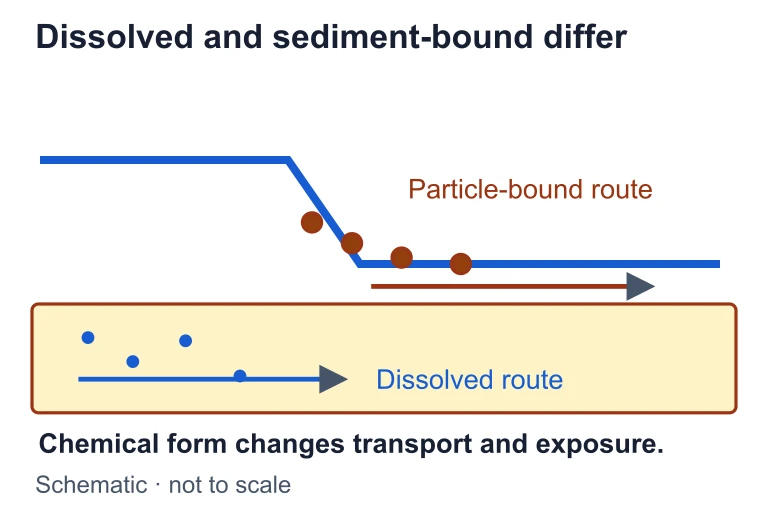 Dissolved pollutants can move with groundwater, while adsorbed pollutants may travel with sediment. Chemical form affects transport and exposure; intake, absorbed dose and tissue concentration are different quantities.
Biodiversity Loss: The Core Crisis
Biodiversity refers to the variety of life at all levels: genetic, species, and ecosystem diversity. Current extinction rates are estimated at 100 to 1,000 times the natural background rate.
The HIPPO Framework
Ecologist E.O. Wilson developed the HIPPO acronym to categorize the five major threats to biodiversity, ranked by severity.
Fragmentation vs. Destruction
| Fragmentation | Destruction | |
|---|---|---|
| Habitat area | Reduced, split into patches | Eliminated entirely |
| Edge effects | Increased significantly | Not applicable |
| Gene flow | Restricted between patches | Completely severed |
| Recovery potential | Possible with corridors | Requires full restoration |
Bioaccumulation & Biomagnification
The Eutrophication Cycle
Greenhouse Effect & Climate Change
Positive Feedback Loops
Positive feedback loops amplify change: the output reinforces the original process, causing runaway effects. These loops make climate change especially dangerous.
How to Analyze Human Impact
Use this step-by-step framework on the AP exam to evaluate any human impact scenario.
Example: Deforestation in the Amazon
Scenario: A region of tropical rainforest is cleared for cattle ranching. Analyze the ecosystem impacts using our framework.
Example: Invasive Cane Toads in Australia
Scenario: Cane toads, introduced in 1935 to control beetles, became one of Australia's most damaging invasive species.
Example: Ocean Acidification
Scenario: As atmospheric \( \text{CO}_2 \) levels rise, oceans absorb approximately 30% of emitted \( \text{CO}_2 \). This lowers ocean pH through the following reaction:
Common Mistakes on the AP Exam
Summary of Human Impacts
| Impact Type | Primary Mechanism | Key Example | Mitigation |
|---|---|---|---|
| Habitat Loss | Land conversion | Amazon deforestation | Protected areas, corridors |
| Pollution | Chemical contamination | DDT biomagnification | Regulation, remediation |
| Invasive Species | Competitive exclusion | Cane toads in Australia | Biosecurity, biocontrol |
| Climate Change | Enhanced greenhouse effect | Arctic ice loss | Emissions reduction |
| Eutrophication | Nutrient overloading | Gulf of Mexico dead zone | Buffer zones, low-input farming |
| Overexploitation | Harvest exceeds reproduction | Atlantic cod collapse | Quotas, marine reserves |
Question 1 of 5
Which of the following best describes biomagnification?
Question 2 of 5
A farmer applies excessive nitrogen fertilizer. Rain washes the fertilizer into a nearby lake. Which sequence of events most likely follows?
Question 3 of 5
The ice-albedo feedback loop is an example of a positive feedback loop because:
Question 4 of 5
In the HIPPO framework, which factor is considered the greatest threat to global biodiversity?
Question 5 of 5
Researcher A: The introduction of wolves to Yellowstone National Park in 1995 triggered a trophic cascade. Wolves reduced elk populations, which allowed willow and aspen to recover along streams. This stabilized riverbanks and improved habitat for beavers, songbirds, and fish.
Researcher B: While wolf reintroduction had some effects on vegetation, the primary driver of riparian recovery was a series of wet years and reduced drought stress. Attributing the entire cascade to wolves oversimplifies a complex system with many interacting variables.
Which of the following, if true, would most strengthen Researcher A's argument?