Geothermal
Energy
Explore the Earth's internal heat as a renewable energy source: how it works, where it's found, and why it matters for a sustainable future.
What Is Geothermal Energy?
Geothermal energy is thermal energy generated and stored within the Earth. The word comes from the Greek geo (earth) and thermos (heat). This heat originates from the formation of the planet and from radioactive decay of isotopes like \( ^{238}\text{U} \), \( ^{232}\text{Th} \), and \( ^{40}\text{K} \) in the mantle and crust.
Earth's Internal Structure
Why Geothermal Matters
The Geothermal Gradient
Types of Geothermal Resources
Hydrothermal vs. Enhanced Systems
| Hydrothermal | Enhanced (EGS) | |
|---|---|---|
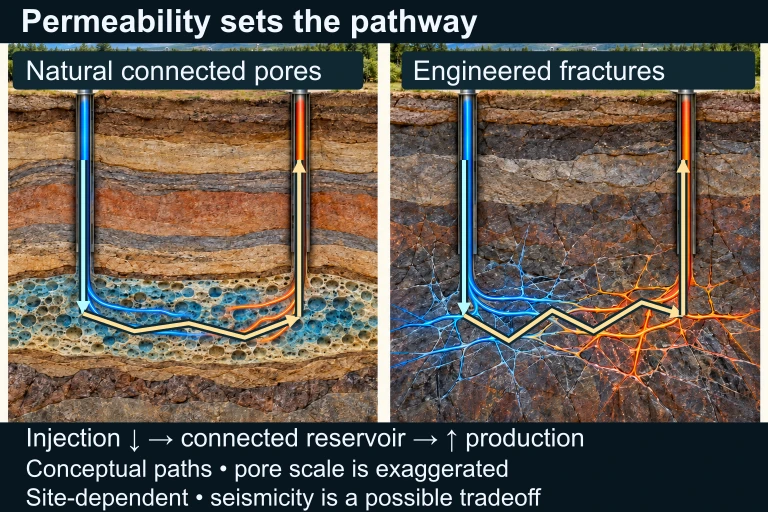
| Water Source | Natural underground reservoir | Injected from surface |
| Rock Permeability | Naturally permeable | Artificially fractured |
| Location | Plate boundaries, volcanic zones | Potentially anywhere |
| Depth | 1-3 km | 3-10 km |
| Technology | Mature, commercial | Emerging, R&D stage |
| Risk | Reservoir depletion | Induced seismicity |
Explain why heat alone does not guarantee an accessible hydrothermal resource.
Use this illustration to explore the concept described in its caption.
How a Geothermal Plant Works
Explain local reservoir management and finite extraction rate.
Use this illustration to explore the concept described in its caption.
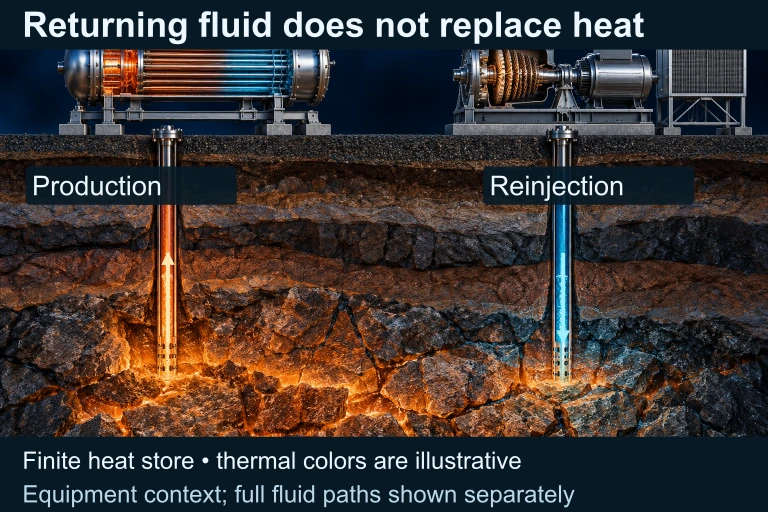
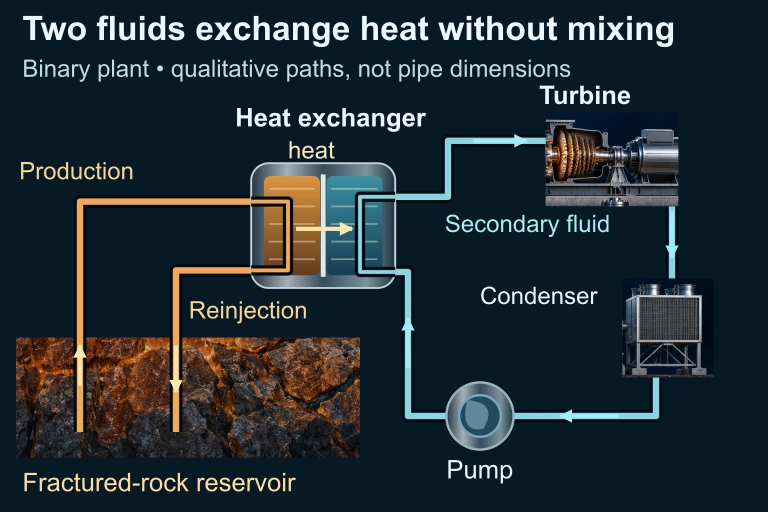
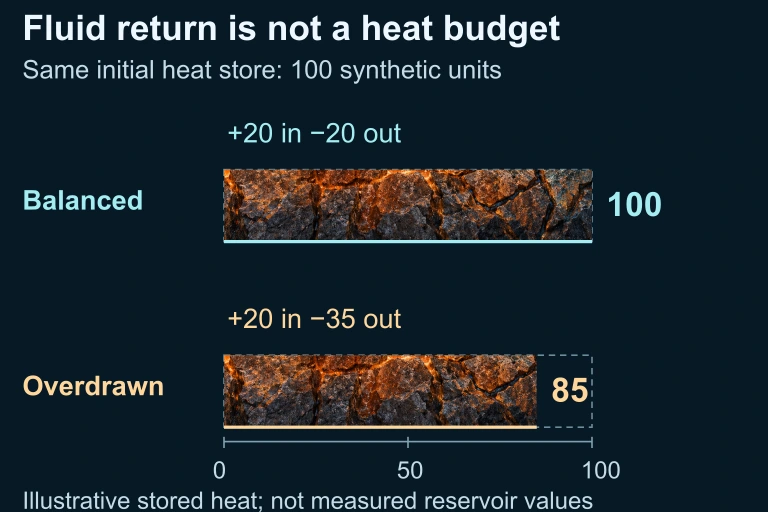
Reservoir management and fluid circuits in geothermal generation
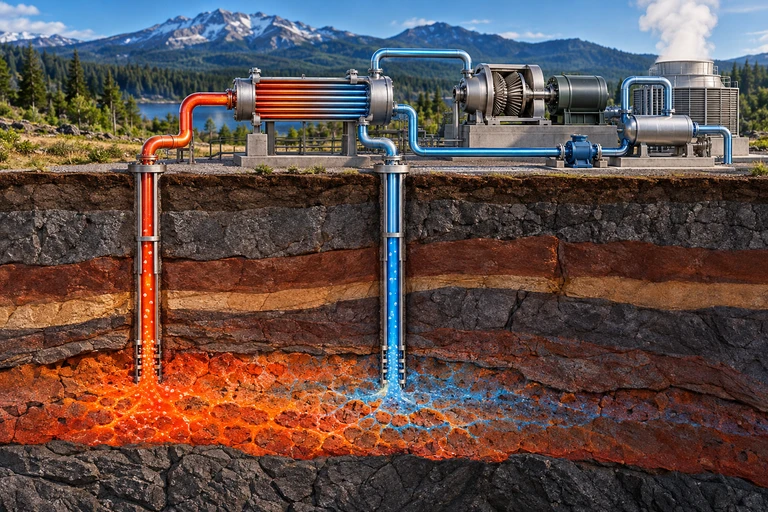
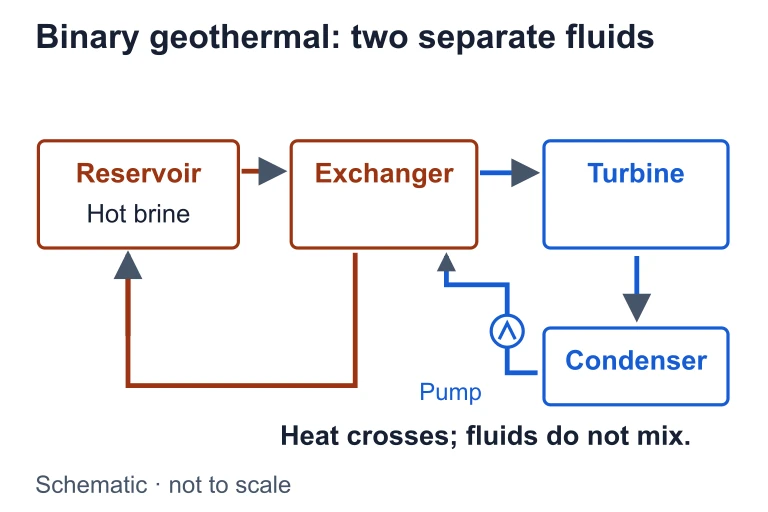
In a binary geothermal plant, brine transfers heat to a separate working fluid and is reinjected. The working fluid drives a turbine, condenses and returns through a pump. Returning fluid does not instantly replace extracted reservoir heat.Binary geothermal: two separate fluids
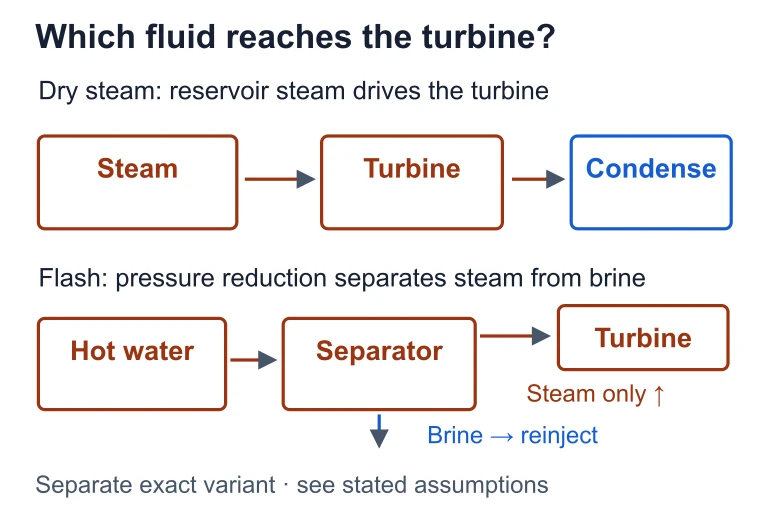
In a binary geothermal plant, brine transfers heat to a separate working fluid and is reinjected. The working fluid drives a turbine, condenses and returns through a pump. Returning fluid does not instantly replace extracted reservoir heat.Which fluid reaches the turbine?
Dry-steam plants send reservoir steam to a turbine. Flash plants reduce the pressure of hot water and separate the resulting steam, while residual brine returns for reinjection.Three Plant Types
Evaluating a Geothermal Site
Example: Temperature at Depth
Problem: A geothermal site has a surface temperature of \( 15\,{}^\circ\text{C} \) and a geothermal gradient of \( 30\,{}^\circ\text{C/km} \). What is the temperature at a depth of \( 4\,\text{km} \)?
Example: Capacity Factor
Problem: A geothermal plant has a rated capacity of \( 50\,\text{MW} \). Over one year, it produces \( 394{,}200\,\text{MWh} \). Calculate its capacity factor.
Example: \( \text{CO}_2 \) Reduction
Problem: A 50 MW geothermal plant replaces a coal plant. Geothermal emits \( 45\,\text{g CO}_2/\text{kWh} \); coal emits \( 820\,\text{g CO}_2/\text{kWh} \). How much \( \text{CO}_2 \) is avoided per year at 90% capacity factor?
Global Geothermal Hotspots
Environmental Benefits & Concerns
Common Mistakes
Geothermal vs. Other Renewables
| Feature | Geothermal | Solar PV | Wind |
|---|---|---|---|
| Capacity Factor | ~90% | 15-25% | 25-45% |
| Baseload? | Yes | No | No |
| \( \text{CO}_2 \) (g/kWh) | ~45 | ~40 | ~11 |
| Land Use (acres/MW) | 1-8 | 5-10 | 30-60 |
| Location Constraint | High | Low | Moderate |
| Intermittent? | No | Yes | Yes |
Question 1 of 5
The primary source of Earth's internal heat that drives geothermal energy is:
Question 2 of 5
A site has a surface temperature of \( 20\,{}^\circ\text{C} \) and a geothermal gradient of \( 40\,{}^\circ\text{C/km} \). At what depth would the temperature first exceed \( 180\,{}^\circ\text{C} \), the minimum for a flash steam plant?
Question 3 of 5
Which type of geothermal power plant is most suitable for a reservoir at \( 130\,{}^\circ\text{C} \)?
Question 4 of 5
The main advantage of geothermal energy over solar and wind energy is that geothermal:
Question 5 of 5
A potential environmental concern specific to Enhanced Geothermal Systems (EGS) that does not apply to conventional hydrothermal plants is: