01 / 21

Generalist & Specialist
Species

Explore how organisms carve out their ecological niches: some thrive on versatility, while others depend on precision and specialization.

AP Environmental Science

What Is an Ecological Niche?

An ecological niche describes the total set of conditions under which an organism lives and reproduces: its habitat, food sources, activity patterns, and interactions with other species. Think of it as an organism's "job description" in an ecosystem.

Niche Breadth: Wide vs. Narrow

Resource Type / Environmental Condition Fitness Generalist Specialist Wide niche breadth Narrow niche breadth

What Are Generalist Species?

Generalist species can survive in a wide variety of habitats, consume many different food types, and tolerate a broad range of environmental conditions. Their flexibility makes them resilient to change.

Raccoon
Eats fruit, insects, fish, garbage: thrives in forests, suburbs, and cities.
Coyote
Found from deserts to cities: eats rodents, fruit, carrion, and pet food.
Cockroach
Survives extreme temperatures, eats almost anything organic.

What Are Specialist Species?

Specialist species depend on a narrow set of resources or conditions. They have evolved precise adaptations that make them highly efficient within their niche but vulnerable to change.

Giant Panda
Diet is 99% bamboo: restricted to temperate broadleaf forests in China.
Koala
Eats only eucalyptus leaves: specialized digestive system detoxifies plant oils.
Orchid Bee
Pollinates specific orchid species: unique body shape fits one flower type.

The Niche Width Continuum

Extreme Specialist Intermediate Extreme Generalist Panda Koala White-tailed Deer Coyote Raccoon Narrow Niche Broad Niche

The Trade-off Principle

Evolutionary Trade-off Generalist + Wide tolerance + Adaptable to change - Less efficient per niche Specialist + Highly efficient + Outcompetes locally - Vulnerable to change Thrives in variable environments Thrives in stable environments

Generalist vs. Specialist: Key Differences

Feature Generalist Specialist
Diet Many food sources One or few food sources
Habitat Range Wide, diverse Narrow, specific
Competitive Ability Moderate across many niches Strong within their niche
Response to Change Resilient: adapt easily Vulnerable: may decline
Extinction Risk Generally lower Generally higher
Examples Rat, crow, raccoon Panda, koala, orchid bee

Predict vulnerability from the breadth of usable resources.

Use this illustration to explore the concept described in its caption.
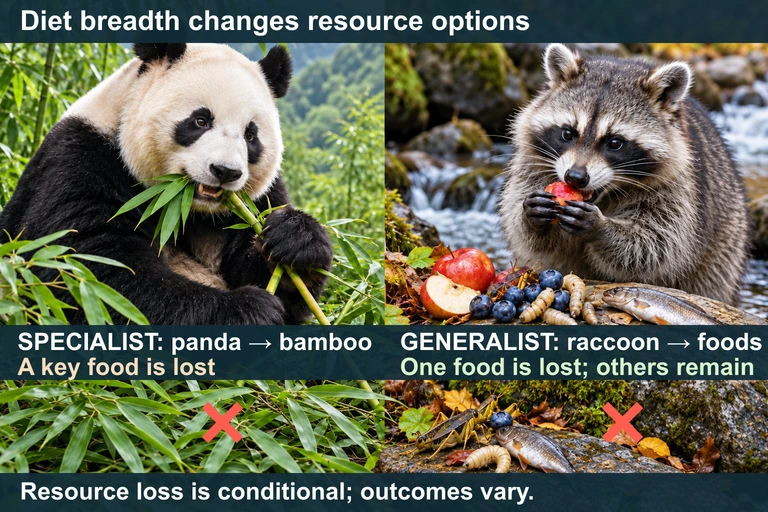
A panda and bamboo appear beside a raccoon and several foods. A crossed resource illustrates a conditional loss: a key panda food is lost, while other illustrated raccoon foods remain.
The panda and raccoon examples compare diet breadth. Losing one resource affects a specialist menu differently from a broader menu without proving a universal survival outcome.

Why This Matters for Conservation

Understanding whether a species is a generalist or specialist helps ecologists predict vulnerability to extinction and design effective conservation strategies.

1
Habitat loss disproportionately harms specialists because they cannot shift to alternative resources.
2
Climate change favors generalists that tolerate a broad temperature range.
3
Invasive generalists (e.g., rats, starlings) can outcompete native specialists for limited resources.
4
Conservation priority often targets specialists because their extinction risk is inherently higher.

Habitat fragmentation, corridors and gene flow
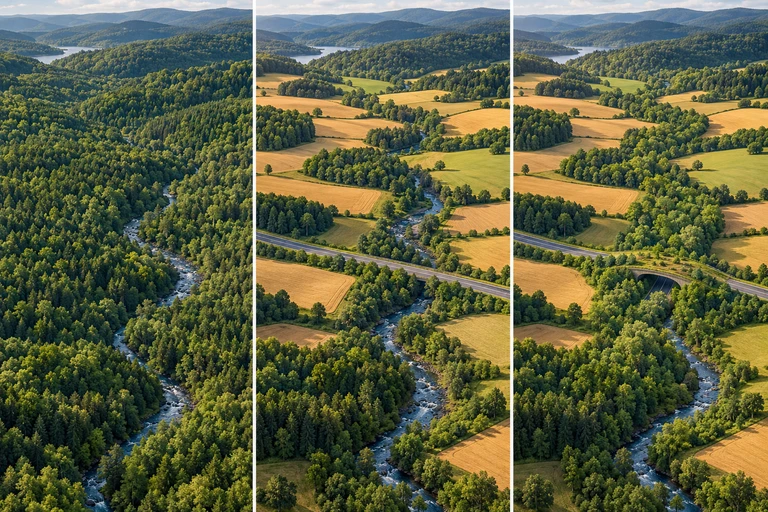
Three qualitative forest landscapes show continuous woodland, fragmented woodland and a restored vegetated road crossing.A pine specialist needs suitable habitat structure and resources along a route. A narrow strip of young trees can differ from a corridor containing mature cavity resources and suitable understory.

Habitat structure is species-specific
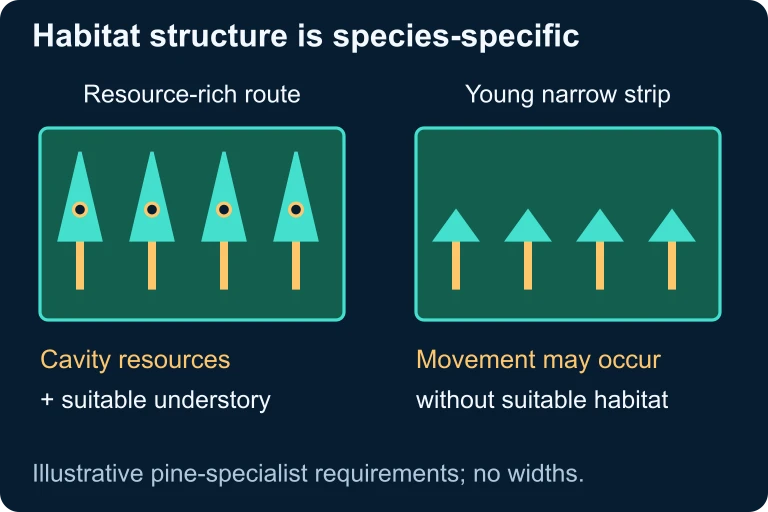
Habitat structure is species-specific. A habitat route must supply the structures and resources needed by the specialist. Compare a mature, resource-rich corridor with a narrow strip of young trees.A habitat route must supply the structures and resources needed by the specialist. Compare a mature, resource-rich corridor with a narrow strip of young trees.

How to Classify a Species

1
Identify the diet: Does the species eat many food types (generalist) or depend on one or few (specialist)?
2
Examine habitat range: Is it found across many biomes, or restricted to a specific ecosystem?
3
Check environmental tolerance: Can it survive wide temperature, moisture, and pH ranges?
4
Assess behavioral flexibility: Can it adjust activity patterns, nesting, or migration in response to change?
5
Place on the continuum: Combine all factors to position the species along the generalist-specialist spectrum.

Example 1: The American Crow

American Crow Insects Seeds & Grain Carrion Human Food Waste Eggs & Nestlings Habitat: forests, farmland, suburbs, cities

Example 2: The Monarch Butterfly

Monarch Butterfly Milkweed (Asclepias) Larval food source Toxin for defense Egg-laying site Decline of milkweed = decline of monarchs

Example 3: Invasive Generalists Displacing Specialists

Resource Spectrum Population Native Specialist Invasive Generalist Overlap = competitive pressure

Response to Environmental Change

Stable Environment Generalist Specialist Both thrive Disruption Changed Environment Adapts Declines Generalist persists; specialist suffers Real-World Examples Coyotes expanded range as forests converted to farmland Polar Bears losing sea-ice habitat: specialist hunting strategy fails

Common Mistakes to Avoid

✕ Binary Thinking
Treating generalist/specialist as two fixed categories rather than a continuous spectrum. Many species are intermediate.
✕ Confusing Habitat with Diet
A species can be a habitat generalist but a dietary specialist (e.g., a bat species living in many biomes but eating only fruit).
✕ Generalist = "Better"
Generalists are not superior: in stable conditions, specialists often outcompete generalists within their niche.

Summary Comparison

Generalist Strengths
Flexible diet, wide habitat range, resilient to disturbance, lower extinction risk, expands into new areas.
Specialist Strengths
Peak efficiency, strong competitor in niche, unique adaptations, fills precise ecological roles.

Question 1 of 5

Which of the following is the best example of a specialist species?

Question 2 of 5

A forest is converted to agricultural land. Which prediction is most accurate?

Question 3 of 5

A species has a narrow niche breadth. What does this imply about its ecological strategy?

Question 4 of 5

Why might an invasive generalist species be particularly harmful to native specialist species?

Question 5 of 5

A student claims that all generalist species have lower extinction risk than all specialist species. Which statement best evaluates this claim?