Fuel Types
and Uses
Explore how fossil fuels, nuclear energy, and renewable sources power our world: their chemistry, energy output, and environmental trade-offs.
What Is a Fuel?
A fuel is any material that stores potential energy in its chemical or nuclear bonds and can be made to release it as heat or work through reactions like combustion or fission.
On the AP Environmental Science exam, you need to distinguish between nonrenewable fuels (formed over millions of years) and renewable fuels (replenished on human timescales).
The Three Pillars of Energy
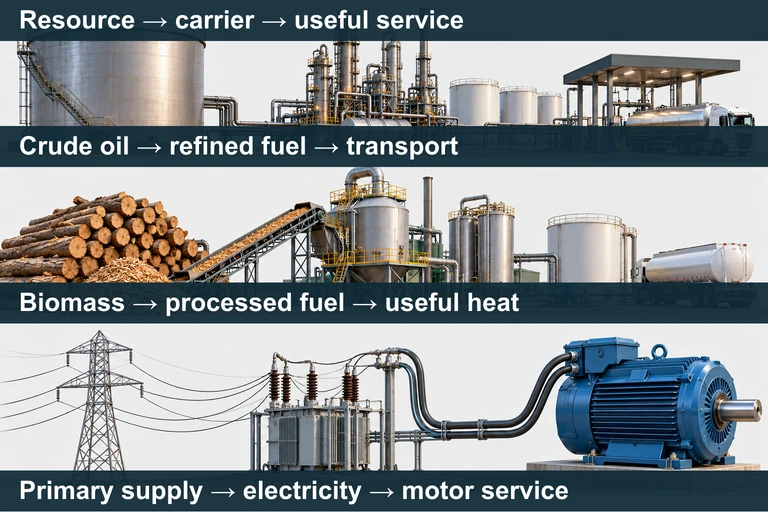
Classify fuel use by conversion chain and delivered service.
Use this illustration to explore the concept described in its caption.
How Fossil Fuels Form
Because fossil fuels take millions of years to form, they are classified as nonrenewable: we consume them far faster than geological processes can replace them.
The Combustion Reaction
When hydrocarbons burn in oxygen, they release energy, carbon dioxide, and water. The general equation for a hydrocarbon fuel is:
For example, methane (natural gas) combustion:
Key AP takeaway: every fossil fuel combustion reaction produces \(\text{CO}_2\), which is the primary greenhouse gas driving anthropogenic climate change.
Energy Density Comparison
Fossil Fuel Types in Detail
Nuclear Fission
Renewable Energy Sources
Nonrenewable vs Renewable
| Nonrenewable | Renewable | |
|---|---|---|
| Formation time | Millions of years | Days to decades |
| Examples | Coal, oil, gas, uranium | Solar, wind, hydro, biomass |
| \(\text{CO}_2\) emissions | High (fossil) or low (nuclear) | Low to zero |
| Energy density | High | Low to moderate |
| Reliability | On-demand (dispatchable) | Often intermittent |
| Major drawback | Pollution, finite supply | Storage, land use, cost |
Environmental Impacts of Fossil Fuels
How to Evaluate a Fuel Source
Example: Coal vs Natural Gas
A power plant burns 1,000 kg of fuel per hour. Compare the \(\text{CO}_2\) output of coal vs natural gas, given:
Example: EROI Analysis
Energy Return on Investment (EROI) measures how much energy a fuel delivers compared to how much energy is needed to extract and process it:
A high EROI means a fuel is efficient to extract. Consider these values:
Example: Capacity Factor
A wind farm has a rated capacity of \(200\;\text{MW}\) but operates at an average capacity factor of \(35\%\). How much energy does it produce in one year?
Common Mistakes
Summary Table
| Fuel | Type | Energy Density | \(\text{CO}_2\) per MJ | Primary Use |
|---|---|---|---|---|
| Coal | Fossil | 24 MJ/kg | ~0.096 kg | Electricity |
| Oil | Fossil | 46 MJ/kg | ~0.073 kg | Transport |
| Natural Gas | Fossil | 55 MJ/kg | ~0.050 kg | Heat, Elec. |
| Uranium | Nuclear | Very high | ~0 kg | Electricity |
| Solar/Wind | Renewable | N/A (flow) | ~0 kg | Electricity |
| Biomass | Renewable | 16 MJ/kg | ~0.10 kg* | Heat, Fuel |
Question 1 of 5
Which fuel source produces the least \(\text{CO}_2\) per unit of energy during electricity generation?
Question 2 of 5
Nuclear energy is classified as nonrenewable because:
Question 3 of 5
A solar farm has a rated capacity of \(500\;\text{MW}\) and a capacity factor of \(25\%\). How much energy does it produce in one year?
Question 4 of 5
An energy source has an EROI of \(1.3{:}1\). Which of the following is most likely this fuel?
Question 5 of 5
Which statement about biomass energy is most accurate?