Fossil Fuels
Energy from the Past
Explore the formation, extraction, and environmental impact of coal, oil, and natural gas: the carbon-based energy sources that power modern civilization.
What Are Fossil Fuels?
Fossil fuels are hydrocarbons formed from the remains of ancient organisms buried under heat and pressure over millions of years. They store chemical energy in carbon-hydrogen bonds that releases as thermal energy during combustion.
The Three Major Types
How Fossil Fuels Form
Coalification and petroleum maturation are distinct pathways
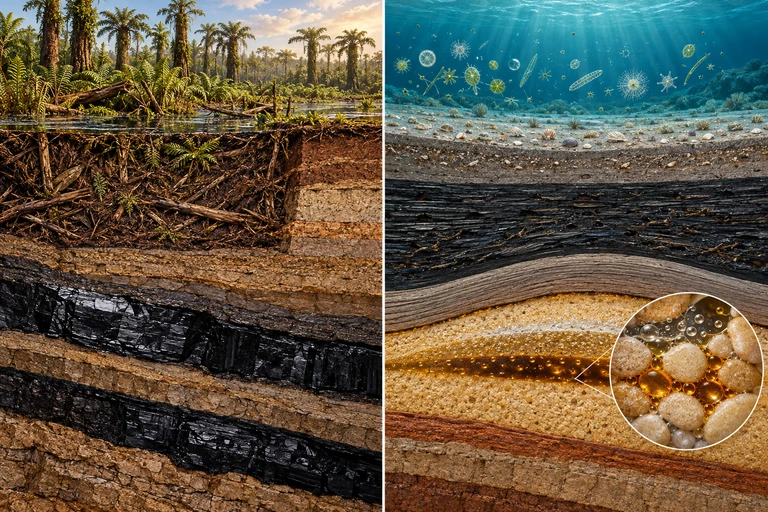 Plant-rich peat can progress through coal ranks with burial and heating. Organic-rich aquatic sediment can instead form source-rock kerogen that generates oil and gas, which may migrate into porous reservoir rock beneath a seal.
Distinct coal and petroleum formation
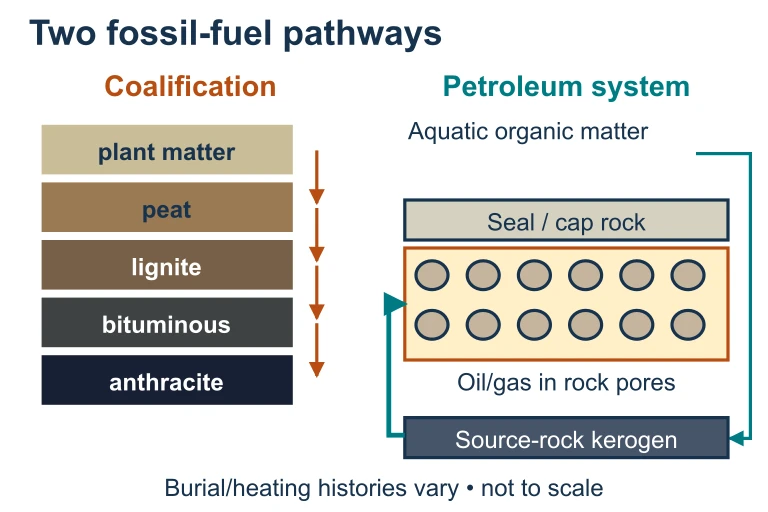 Plant-rich peat can progress through coal ranks with burial and heating. Organic-rich aquatic sediment can instead form source-rock kerogen that generates oil and gas, which may migrate into porous reservoir rock beneath a seal.
Fossil Fuels and the Carbon Cycle
Combustion Chemistry
Coal Rank and Quality
Conventional vs Unconventional Extraction
Extraction risks arise from distinct surface and subsurface pathways
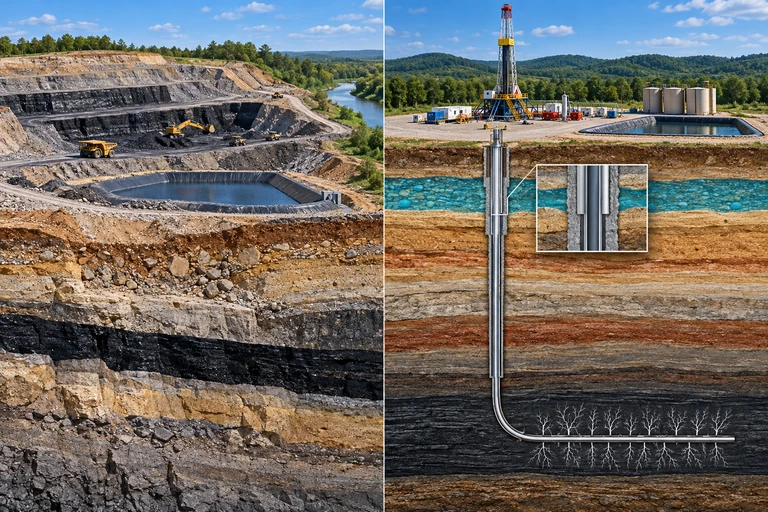 Surface mining can expose sulfides to oxygen and water, enabling acid generation. At a shale well, surface spills and failures of casing or cement create distinct potential contamination pathways.
Conditional extraction pathways
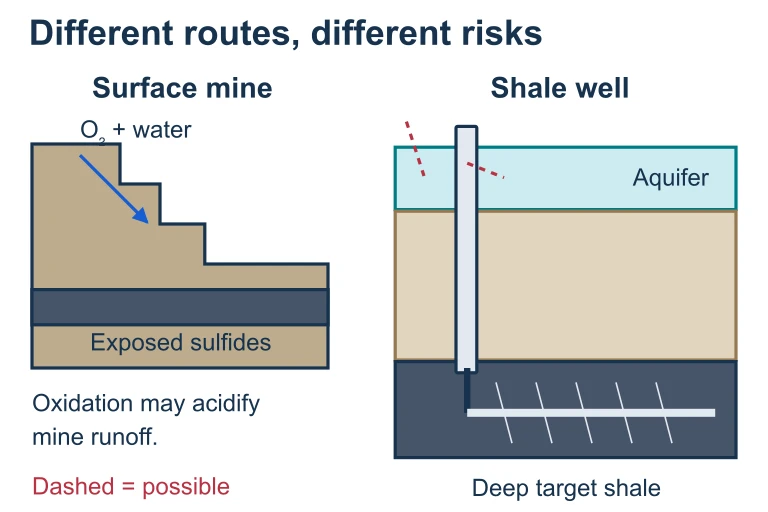 Surface mining can expose sulfides to oxygen and water, enabling acid generation. At a shale well, surface spills and failures of casing or cement create distinct potential contamination pathways.
Environmental Impacts
\(\mathrm{CO}_2\) Emissions by Fuel Type
How to Analyze Fossil Fuel Problems
Example: Emissions Calculation
A power plant burns 500 tonnes of coal per day. Coal produces approximately 2.86 tonnes of \(\mathrm{CO}_2\) per tonne of coal burned. How much \(\mathrm{CO}_2\) does the plant release annually?
Example: Fuel Switching Savings
If the same power plant switches from coal (96 kg \(\mathrm{CO}_2\)/GJ) to natural gas (56 kg \(\mathrm{CO}_2\)/GJ) while producing the same energy output, what percentage reduction in \(\mathrm{CO}_2\) emissions is achieved?
Example: EROI Analysis
Energy Return on Investment (EROI) measures how much energy is gained for every unit invested in extraction. A higher EROI means more net energy.
Common Mistakes
Fossil Fuel Comparison
| Property | Coal | Oil | Natural Gas |
|---|---|---|---|
| State | Solid | Liquid | Gas |
| Primary use | Electricity | Transportation | Heating / Electricity |
| \(\mathrm{CO}_2\) per GJ | ~96 kg | ~73 kg | ~56 kg |
| EROI (conventional) | ~18:1 | ~15:1 | ~10:1 |
| Key pollutants | \(\mathrm{SO}_2\), \(\mathrm{NO}_x\), ash | \(\mathrm{NO}_x\), VOCs | \(\mathrm{CH}_4\) leaks |
| Extraction | Mining | Drilling / Fracking | Drilling / Fracking |
Question 1 of 5
Which fossil fuel produces the most \(\mathrm{CO}_2\) per unit of energy when burned?
Question 2 of 5
What does EROI measure?
Question 3 of 5
A factory switches from coal to natural gas, producing the same amount of energy. Approximately what percentage reduction in \(\mathrm{CO}_2\) emissions can it expect?
Question 4 of 5
Why is burning fossil fuels different from biological respiration in terms of the carbon cycle?
Question 5 of 5
Which of the following is an environmental concern specific to hydraulic fracturing (fracking) that is NOT a major concern with conventional drilling?