Eutrophication
Nutrient Overload in Aquatic Systems
Explore how excess nutrients trigger algal blooms, deplete dissolved oxygen, and devastate aquatic ecosystems: the process called eutrophication.
What Is Eutrophication?
Eutrophication is the process by which a body of water becomes progressively enriched with mineral and organic nutrients, especially nitrogen (\( \text{N} \)) and phosphorus (\( \text{P} \)). This excess nutrient input triggers rapid algal growth, which depletes dissolved oxygen and degrades water quality.
The Two Key Nutrients
Sources of Nutrient Pollution
The Eutrophication Cascade
Eutrophication causes hypoxia through respiration
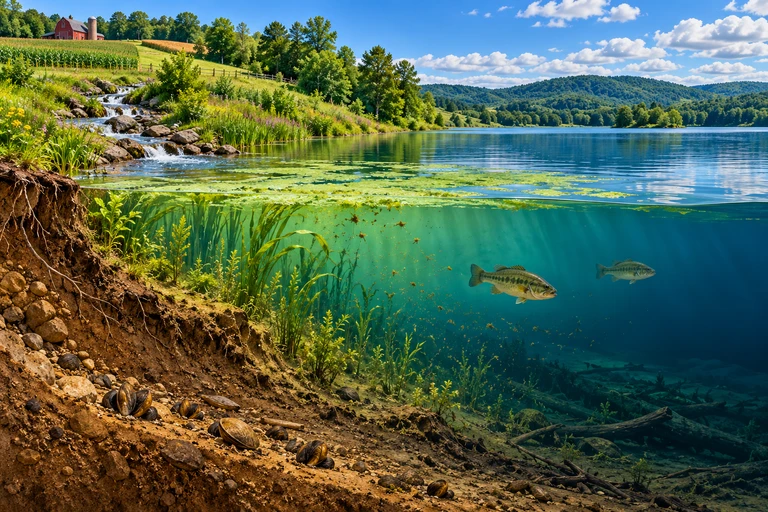 Nutrient enrichment can increase algal production. Aerobic decomposition of sinking organic matter consumes dissolved oxygen, while mixing can replenish it. Hypoxia develops when oxygen demand exceeds replenishment.
Eutrophication oxygen mechanism
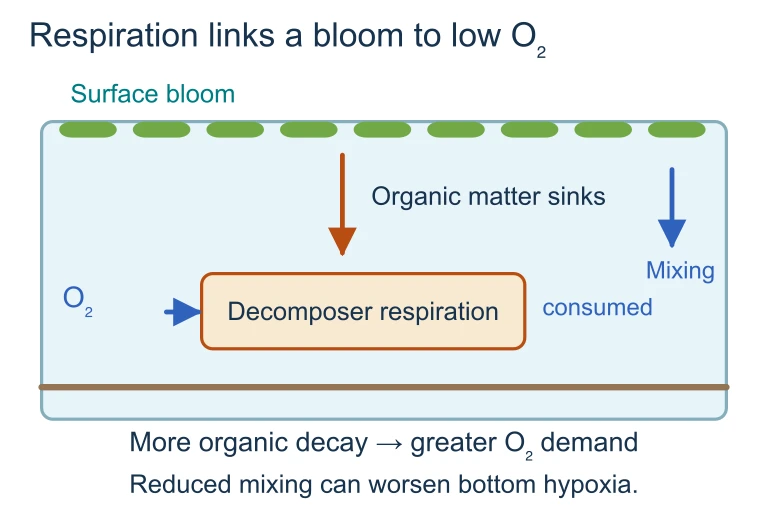 Nutrient enrichment can increase algal production. Aerobic decomposition of sinking organic matter consumes dissolved oxygen, while mixing can replenish it. Hypoxia develops when oxygen demand exceeds replenishment.
The Formal Process of Eutrophication
Natural vs. Cultural Eutrophication
| Natural Eutrophication | Cultural Eutrophication | |
|---|---|---|
| Timescale | Centuries to millennia | Years to decades |
| Cause | Weathering, natural erosion, leaf litter | Fertilizers, sewage, urban runoff |
| Rate | Gradual, slow accumulation | Rapid, accelerated nutrient loading |
| Reversibility | Natural lake aging process | Reversible if nutrient inputs are reduced |
| AP Focus | Background concept | Primary exam topic |
Dissolved \( \text{O}_2 \) and BOD Relationship
Trophic States of Lakes
How to Analyze Eutrophication
Example: Farm Runoff Scenario
A farmer applies nitrogen and phosphorus fertilizers to a cornfield adjacent to a freshwater lake. After heavy rain, nutrient-rich runoff flows into the lake.
Example: The Gulf of Mexico Dead Zone
The Mississippi River drains 41% of the continental U.S., carrying agricultural runoff loaded with nitrogen and phosphorus into the Gulf of Mexico. Each summer, a hypoxic zone forms that can exceed 15,000 km².
Example: Nutrient Loading Calculation
A wastewater treatment plant discharges \( 5 \times 10^6 \) liters/day with a phosphorus concentration of \( 2 \text{ mg/L} \). Calculate the daily \( \text{P} \) loading.
Solutions and Remediation
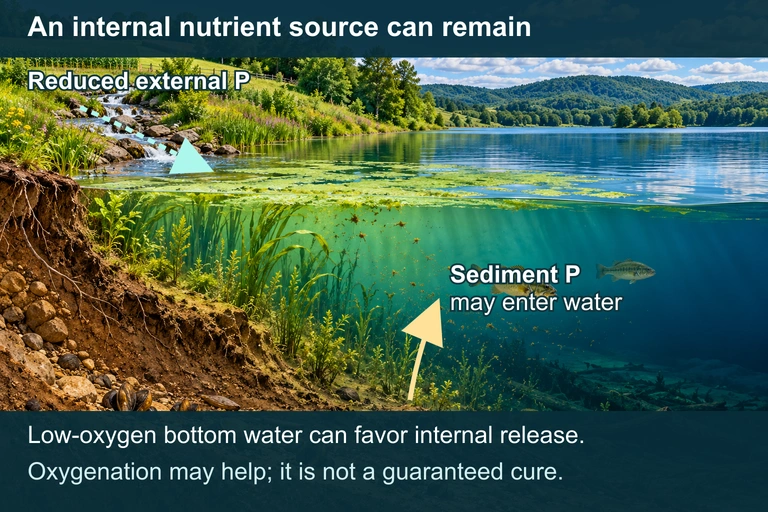
Explain delayed recovery and distinguish external from internal loading.
Use this illustration to explore the concept described in its caption.
Common Mistakes
Summary Comparison
| Indicator | Oligotrophic | Eutrophic |
|---|---|---|
| Nutrient levels | Low | High |
| Dissolved \( \text{O}_2 \) | High | Low |
| BOD | Low | High |
| Water clarity | Clear (high Secchi depth) | Murky (low Secchi depth) |
| Chlorophyll-a | Low | High |
| Biodiversity | Diverse cold-water species | Few tolerant warm-water species |
| Example | Lake Tahoe | Lake Erie (historically) |
Question 1 of 5
Which nutrient is typically the limiting factor for algal growth in freshwater lakes?
Question 2 of 5
What directly causes dissolved oxygen depletion during eutrophication?
Question 3 of 5
A lake has a dissolved oxygen concentration of 1.5 mg/L and thick green surface mats. Which term best describes this condition?
Question 4 of 5
The Gulf of Mexico Dead Zone is primarily caused by which type of pollution and limiting nutrient?
Question 5 of 5
Which remediation strategy most directly reduces phosphorus loading from agricultural runoff into a freshwater lake?