Energy from
Biomass
Explore how organic matter is converted into usable energy, the role of photosynthesis and combustion, and the environmental trade-offs of biomass as a renewable resource.
What is Biomass?
Biomass is any organic material derived from living or recently living organisms. It stores chemical energy originally captured from sunlight through photosynthesis. When we burn wood, ferment corn, or decompose manure, we are releasing that stored solar energy.
The Photosynthesis Connection
All biomass energy ultimately originates from solar radiation. Plants capture sunlight and convert it to chemical energy stored in glucose via the photosynthesis reaction:
This glucose is then polymerized into cellulose, starch, and lignin: the structural molecules that store energy in biomass. When biomass is burned or decomposed, this reaction essentially runs in reverse, releasing the stored energy as heat.
Why Biomass Matters
The Biomass Energy Cycle
Biomass Conversion Pathways
Different feedstocks require different conversion equipment
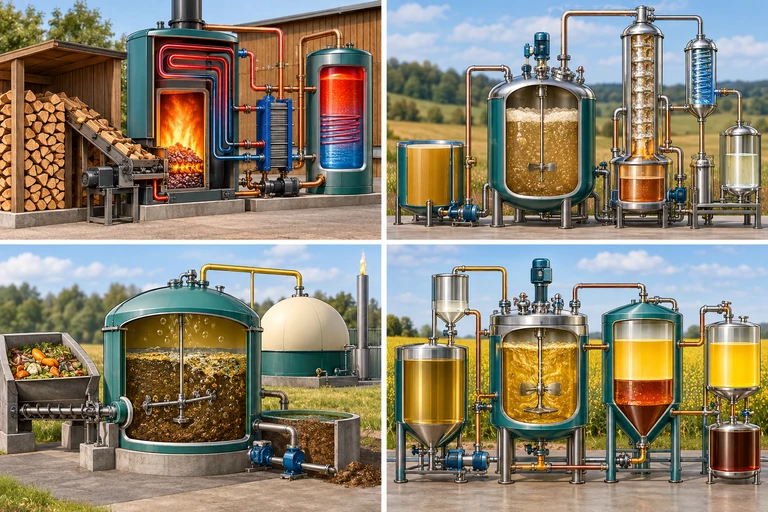 Different biomass feedstocks require different conversion processes. Anaerobic digestion produces biogas containing methane and CO₂; fermentation and transesterification follow different pathways, and cellulosic materials require preparation before their sugars can be fermented.
Different feedstocks require different conversion equipment
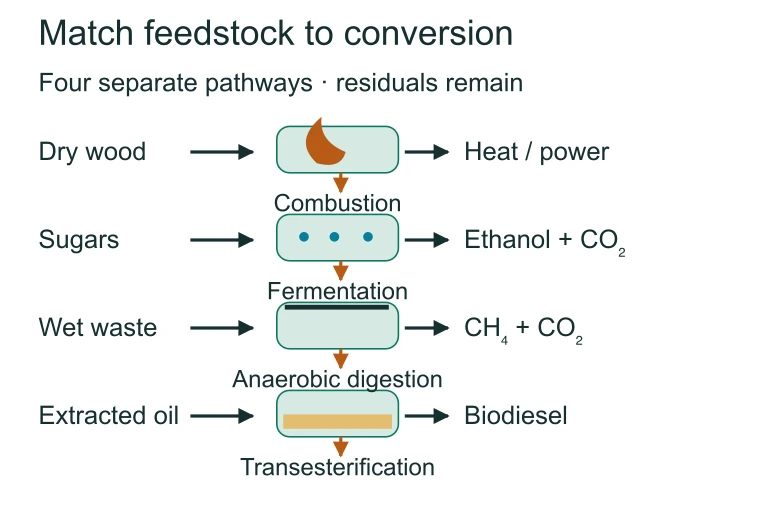 Different biomass feedstocks require different conversion processes. Anaerobic digestion produces biogas containing methane and CO₂; fermentation and transesterification follow different pathways, and cellulosic materials require preparation before their sugars can be fermented.
Biomass vs Fossil Fuels
| Biomass | Fossil Fuels | |
|---|---|---|
| Carbon Source | Recent atmospheric \(\text{CO}_2\) | Ancient carbon (millions of years) |
| Renewability | Renewable (years to decades) | Non-renewable |
| Net \(\text{CO}_2\) Impact | Potentially neutral (if replanted) | Adds new \(\text{CO}_2\) to atmosphere |
| Energy Density | Lower (10-20 MJ/kg) | Higher (30-55 MJ/kg) |
| Supply Chain | Local, distributed | Global, centralized |
Energy Density of Biomass Fuels
The Combustion Reaction
When biomass burns, the stored chemical energy is released as heat and light. The general combustion equation for organic matter:
For glucose (a simplified biomass model):
This is exactly the reverse of photosynthesis: the energy stored by plants is returned. On the AP exam, you must recognize this relationship.
Ethanol Fermentation
Fermentation is a biological conversion pathway where yeast breaks down sugars into ethanol and carbon dioxide. This produces a liquid biofuel used as a gasoline additive (E10, E85).
How to Evaluate Biomass Energy
Example 1: Wood Energy
A household burns 500 kg of dry wood per winter. Wood has an energy density of approximately 16 MJ/kg. How much energy is released?
Example 2: Ethanol Yield
A farm produces 10,000 kg of corn grain. Corn yields approximately 0.40 L of ethanol per kg. Ethanol's energy density is 21.1 MJ/L. How much energy can be produced?
Example 3: EROEI Analysis
Energy Return on Energy Invested (EROEI) measures how much energy a fuel delivers relative to the energy required to produce it:
An EROEI below 1 means the fuel consumes more energy to produce than it delivers. Corn ethanol's 1.3:1 ratio makes it barely net-positive, while sugarcane ethanol (8:1) and wood pellets (10:1) perform much better.
Common Mistakes
Summary of Biomass Methods
| Method | Input | Output | Efficiency |
|---|---|---|---|
| Direct Combustion | Wood, crop waste | Heat, electricity | \(65\text{-}80\%\) |
| Gasification | Wood chips, waste | Syngas | \(70\text{-}80\%\) |
| Fermentation | Corn, sugarcane | Ethanol | \(35\text{-}50\%\) |
| Anaerobic Digestion | Manure, food waste | Biogas (\(\text{CH}_4\)) | \(40\text{-}60\%\) |
| Pyrolysis | Biomass (no oxygen) | Bio-oil, biochar | \(50\text{-}70\%\) |
Question 1 of 5
Which chemical reaction is the reverse of photosynthesis and is the basis for energy release from biomass?
Question 2 of 5
Biomass energy is considered potentially carbon-neutral because:
Question 3 of 5
A factory burns 2,000 kg of wood pellets (energy density: \(18 \text{ MJ/kg}\)) at 75% efficiency. How much usable energy is produced?
Question 4 of 5
Which of the following is the greatest environmental concern associated with large-scale corn ethanol production?
Question 5 of 5
A fuel source has an EROEI of 0.8. What does this mean?