Energy Flow & the
10% Rule
Trace how energy moves through ecosystems, why only \(\approx 10\%\) transfers between trophic levels, and what this means for food webs and ecological pyramids.
What is Energy Flow?
Energy flow describes the one-way transfer of energy through an ecosystem: from the sun to producers, then to consumers, and finally lost as heat at every step. Unlike nutrients, energy does not cycle: it enters, passes through, and exits.
Understanding Trophic Levels
Why is Energy Lost at Each Level?
At every trophic level, organisms use most of the energy they consume for life processes. Only a fraction gets stored in biomass that the next level can eat. The rest is lost as:
A bite branches into growth, waste and heat
 Suppose a consumer ingests 1,000 kcal: 330 kcal leaves in feces, 570 kcal supports respiration, and 100 kcal becomes new biomass. The 10% ratio of production to ingestion is gross growth efficiency; whole-trophic transfer efficiency uses a different system boundary.
Consumer energy partition
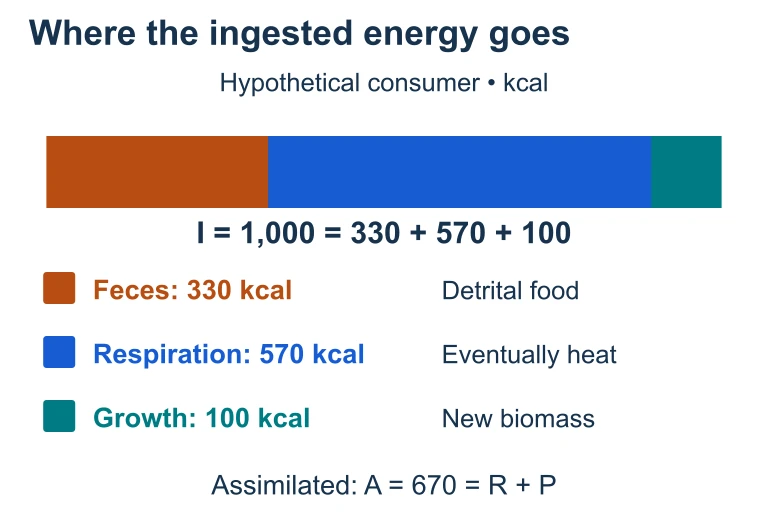 Suppose a consumer ingests 1,000 kcal: 330 kcal leaves in feces, 570 kcal supports respiration, and 100 kcal becomes new biomass. The 10% ratio of production to ingestion is gross growth efficiency; whole-trophic transfer efficiency uses a different system boundary.
The 10% Rule: Core Principle
Mathematically, if a trophic level has energy \(E\), the next level receives approximately:
The Energy Pyramid
GPP vs. NPP: Key Distinction
Tracing Energy Flow Through a Food Chain
How to Apply the 10% Rule
Example 1: Simple Food Chain
A grassland ecosystem starts with 20,000 kcal of energy at the producer level. How much energy is available to a secondary consumer?
Example 2: Reverse Calculation
A hawk (tertiary consumer) needs 50 kcal of energy per day. How much energy must be available at the producer level to sustain it?
Example 3: Ecological Efficiency Varies
Real ecosystems do not always transfer exactly \(10\%\). Suppose a marine food chain has an ecological efficiency of \(15\%\) between levels. With 8,000 kcal at producers, what reaches a secondary consumer?
Types of Ecological Pyramids
Common Mistakes
Summary Comparison
| Energy Flow | Nutrient Cycling | |
|---|---|---|
| Direction | One-way (sun → heat) | Cyclical (recycled) |
| Source | Solar radiation | Earth's crust, atmosphere |
| Lost at each level? | Yes: \(\approx 90\%\) as heat | No: recycled by decomposers |
| Pyramid shape | Always upright | N/A (no pyramid) |
| Measured in | kcal or kJ per area per time | grams or moles per area |
| Key rule | 10% Rule | Conservation of matter |
Question 1 of 5
If producers in an ecosystem fix 50,000 kcal of energy, approximately how much energy is available to tertiary consumers?
Question 2 of 5
Which of the following best explains why top predators are rare in most ecosystems?
Question 3 of 5
A wolf needs 200 kcal/day. If the wolf is a tertiary consumer, how much producer energy is needed to sustain it daily?
Question 4 of 5
Which ecological pyramid can never be inverted?
Question 5 of 5
If a grassland's GPP is 12,000 kcal and producers use 4,000 kcal for respiration, what is the NPP available to primary consumers?