Energy
Conservation
Understand how energy flows through systems, the laws of thermodynamics, and why reducing energy waste is critical for a sustainable future.
What is Energy?
Energy is the capacity to do work or transfer heat. In environmental science, we track how energy enters ecosystems, transforms between forms, and ultimately dissipates. Energy cannot be created or destroyed: it can only change form.
Energy in Environmental Systems
Why Conservation Matters
Humans consume energy at a massive scale, primarily from fossil fuels. The environmental consequences include climate change, air pollution, habitat destruction, and resource depletion. Energy conservation: using less energy to accomplish the same tasks: is one of the most effective strategies for reducing these impacts.
The Laws of Thermodynamics
Energy Efficiency Equation
Conservation vs. Efficiency
| Conservation | Efficiency | |
|---|---|---|
| Definition | Using less energy overall | Getting more output per unit input |
| Example | Turning off lights when leaving | Replacing incandescent with LED |
| Behavioral? | Yes: requires habit change | No: technology-driven |
| Cost | Free or very low | Upfront investment needed |
| Goal | Both reduce total energy consumption and environmental impact | |
How to Apply Conservation
Example: LED vs. Incandescent
A household replaces a 60 W incandescent bulb (used 5 hours/day) with a 10 W LED that produces the same light. How much energy is saved per year?
Example: Efficiency Calculation
A coal power plant burns coal containing 1,000 MJ of chemical energy. The plant produces 350 MJ of electrical energy. What is its efficiency?
Example: Trophic Energy Loss
A grassland receives 10,000 kcal of solar energy. Using the 10% rule, how much energy is available to a tertiary consumer?
Renewable vs. Nonrenewable
Tracking Energy Flow
Strategies at Every Scale
Cogeneration captures an otherwise rejected thermal stream
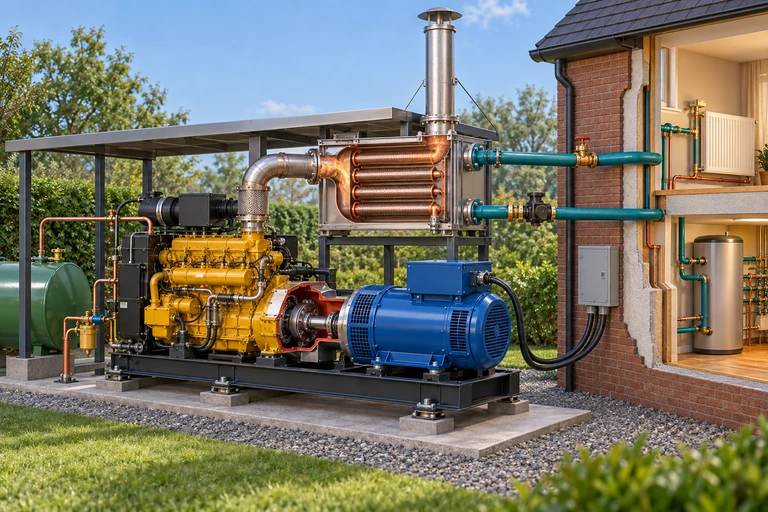 Suppose CHP converts 100 kWh of fuel into 30 kWh of electricity and 50 kWh of useful heat. Separate electricity generation at 30% efficiency and heat production at 80% efficiency require 162.5 kWh for the same services. Recovered heat must match demand in temperature, place and time.
CHP: recover heat in a separate useful loop
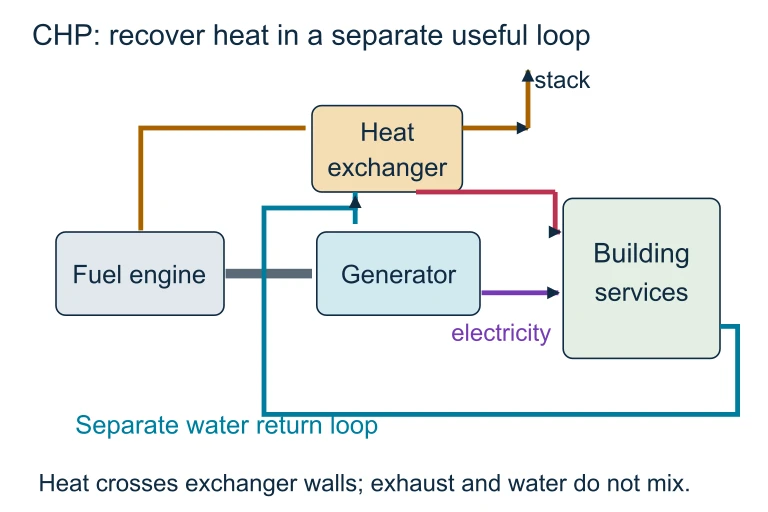 Suppose CHP converts 100 kWh of fuel into 30 kWh of electricity and 50 kWh of useful heat. Separate electricity generation at 30% efficiency and heat production at 80% efficiency require 162.5 kWh for the same services. Recovered heat must match demand in temperature, place and time.
Compare equal useful services, not unequal outputs
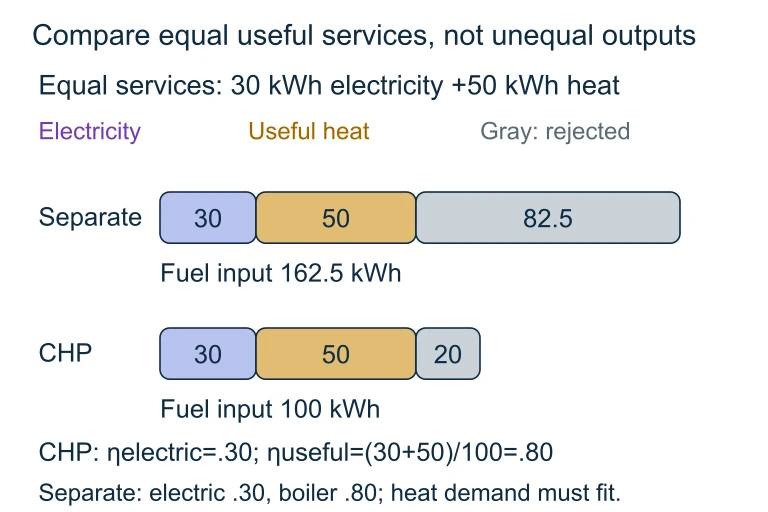 Suppose CHP converts 100 kWh of fuel into 30 kWh of electricity and 50 kWh of useful heat. Separate electricity generation at 30% efficiency and heat production at 80% efficiency require 162.5 kWh for the same services. Recovered heat must match demand in temperature, place and time.
Common Mistakes
Summary Table
| Concept | Key Idea | Example |
|---|---|---|
| 1st Law | Energy is conserved | Chemical → thermal + kinetic |
| 2nd Law | Entropy always increases | Waste heat from engines |
| Efficiency | \(\frac{E_{\text{out}}}{E_{\text{in}}} \times 100\%\) | Coal plant at 35% |
| 10% Rule | ~10% transferred per level | 10,000 → 1,000 → 100 kcal |
| Conservation | Reduce total use (behavior) | Turning off lights |
| Efficiency upgrade | More output per input (tech) | LED replacing incandescent |
Question 1 of 5
Which of the following is an example of energy conservation rather than energy efficiency?
Question 2 of 5
A natural gas power plant produces 540 MJ of electricity from 900 MJ of fuel. What is the plant's efficiency?
Question 3 of 5
If producers in an ecosystem fix 20,000 kcal of energy, approximately how much energy is available to a secondary consumer according to the 10% rule?
Question 4 of 5
The Second Law of Thermodynamics explains which of the following environmental observations?
Question 5 of 5
A family replaces five 100 W incandescent bulbs with five 15 W LEDs, each used 6 hours/day. If electricity costs $0.12/kWh, approximately how much do they save per year?