Endocrine
Disruptors
Explore how synthetic chemicals interfere with hormone signaling, threaten wildlife and human health, and why this topic is critical for the AP Environmental Science exam.
What Is the Endocrine System?
The endocrine system is a network of glands that produce hormones: chemical messengers carried by the bloodstream to regulate growth, metabolism, reproduction, and behavior. Even tiny concentrations (parts per billion or trillion) can trigger large biological responses.
What Are Endocrine Disruptors?
Endocrine disruptors (EDCs) are exogenous chemicals that interfere with hormone synthesis, secretion, transport, binding, or elimination. They can mimic, block, or alter the body's natural hormones even at extremely low doses.
Why Endocrine Disruptors Matter
Endocrine disruptors are found in pesticides, plastics, personal care products, and industrial chemicals. They enter water, soil, and food chains. Effects are seen across every level of biological organization.
Follow exposure from effluent to reproductive endpoints
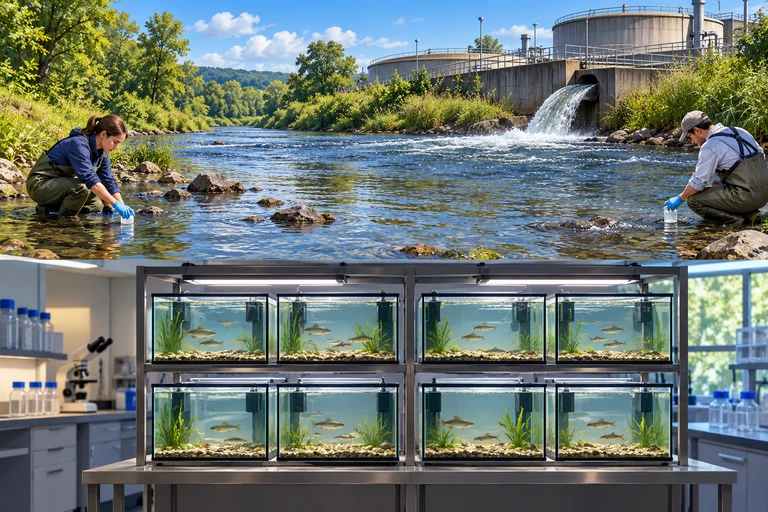 Field samples can reveal an association between exposure and reproductive endpoints. In a controlled comparison with three tanks per group, tanks are the independent treatment units; fish within a tank share the treatment environment.
Separate field association from a test
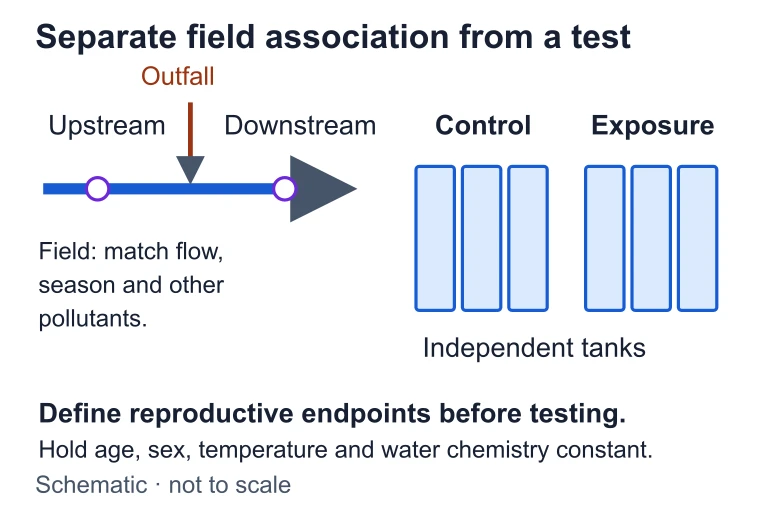 Field samples can reveal an association between exposure and reproductive endpoints. In a controlled comparison with three tanks per group, tanks are the independent treatment units; fish within a tank share the treatment environment.
Three Mechanisms of Disruption
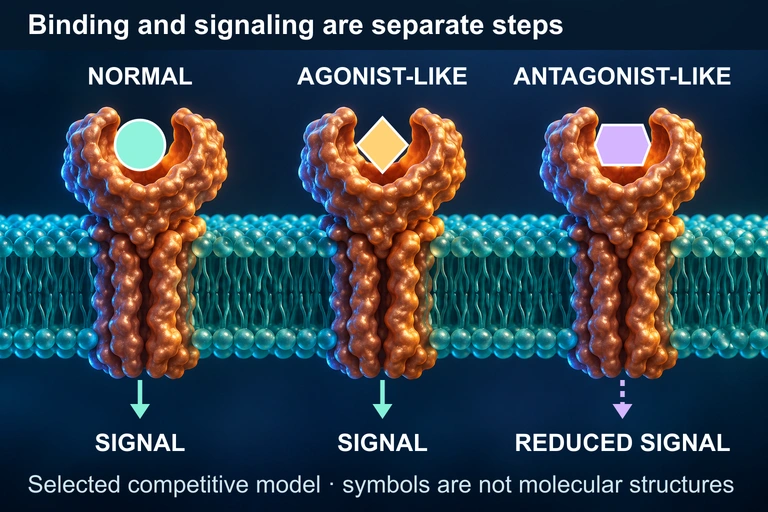
Compare activation and inhibition without confusing chemical identity with visual resemblance.
Use this illustration to explore the concept described in its caption.
Non-Monotonic Dose-Response
Traditional toxicology assumes "the dose makes the poison": higher dose equals greater effect. Endocrine disruptors often show a non-monotonic dose-response curve, meaning low doses can cause effects that higher doses do not.
Bioaccumulation vs Biomagnification
| Bioaccumulation | Biomagnification | |
|---|---|---|
| Definition | Build-up of a substance within one organism over its lifetime | Increasing concentration of a substance up the food chain |
| Scale | Individual organism | Ecosystem / trophic levels |
| Cause | Organism absorbs faster than it can excrete | Predators consume many prey, each carrying a load |
| Example | Mercury in a single tuna fish | DDT: \(0.000003\) ppm in water → \(25\) ppm in osprey |
| AP APES Relevance | Explains persistent organic pollutants (POPs) | Explains why top predators are most affected |
Major Endocrine Disruptors to Know
Case Study: DDT and Eggshell Thinning
BPA: Estrogen Mimicry
Case Study: Atrazine and Frogs
Researcher Tyrone Hayes demonstrated that exposure to atrazine at concentrations as low as \(0.1\) parts per billion caused male frogs to develop female characteristics, including producing eggs. This is far below the EPA limit of \(3\) ppb for drinking water.
How to Identify EDC Problems
On the AP exam, you may be given a scenario and asked to identify the EDC pathway. Use this checklist:
Worked Example: Lake Apopka
Scenario: In Lake Apopka, Florida, a pesticide spill in 1980 released dicofol (containing DDT/DDE). Researchers found that male alligators had abnormally small reproductive organs and reduced testosterone levels.
Worked Example: Biomagnification Factor
Problem: DDT concentration in lake water is \(0.000003\) ppm. In osprey tissue, it measures \(25\) ppm. Calculate the biomagnification factor (BMF).
Worked Example: Threshold Analysis
Scenario: A study finds that atrazine causes feminization in frogs at \(0.1\) ppb. The EPA's Maximum Contaminant Level (MCL) for atrazine in drinking water is \(3\) ppb. Analyze whether the regulatory standard is protective.
Common Mistakes
Summary: Key EDCs at a Glance
| Chemical | Mechanism | Primary Effect | Status |
|---|---|---|---|
| DDT / DDE | Blocks androgens | Eggshell thinning, demasculinization | Banned (U.S. 1972) |
| BPA | Mimics estrogen | Reproductive, developmental effects | Restricted in some products |
| Atrazine | Alters enzyme (aromatase) | Feminization of male amphibians | Banned in EU, used in U.S. |
| PCBs | Mimics / alters thyroid hormones | Thyroid dysfunction, neurotoxicity | Banned (U.S. 1979) |
Question 1 of 5
Which of the following best describes the mechanism by which BPA acts as an endocrine disruptor?
Question 2 of 5
A pesticide concentration is \(0.01\) ppm in lake water and \(50\) ppm in a top predator fish. What is the biomagnification factor?
Question 3 of 5
Atrazine causes feminization in male frogs at \(0.1\) ppb. The EPA's drinking water standard is \(3\) ppb. Which statement best explains why this is a concern?
Question 4 of 5
Which of the following is an example of bioaccumulation rather than biomagnification?
Question 5 of 5
Rachel Carson's Silent Spring primarily raised public awareness about the environmental effects of which endocrine-disrupting chemical?