01 / 21

Ecosystem
Services

Discover how natural ecosystems provide life-sustaining benefits to humanity: from clean air and water to climate regulation, pollination, and beyond.

AP Environmental Science

What Are Ecosystem Services?

Ecosystem services are the benefits that humans freely obtain from natural ecosystems and their processes. These include everything from the oxygen you breathe to the soil that grows your food. Without functioning ecosystems, human civilization could not survive.

The Four Categories of Ecosystem Services

Provisioning
Direct products obtained from ecosystems: food, fresh water, timber, fiber, fuel, genetic resources
Regulating
Benefits from regulation of ecosystem processes: climate control, flood prevention, water purification, disease regulation
Cultural
Non-material benefits: recreation, ecotourism, spiritual value, aesthetic beauty, education, sense of place
Supporting
Foundational processes that enable all others: nutrient cycling, soil formation, primary production, water cycling

Why Ecosystem Services Matter

In 1997, Robert Costanza and colleagues estimated the total value of global ecosystem services at approximately \(\$33\) trillion per year: comparable to the entire global GDP at the time. Updated estimates now exceed \(\$125\) trillion per year. These values are often invisible because no one sends nature a paycheck.

The Ecosystem Services Framework

Ecosystem Services Provisioning Food, water, timber Fuel, genetic resources Regulating Climate, flood, water purification, disease Cultural Recreation, spiritual Aesthetic, education Supporting Nutrient cycling, soil formation, productivity Human Well-Being

One landscape produces services through different mechanisms
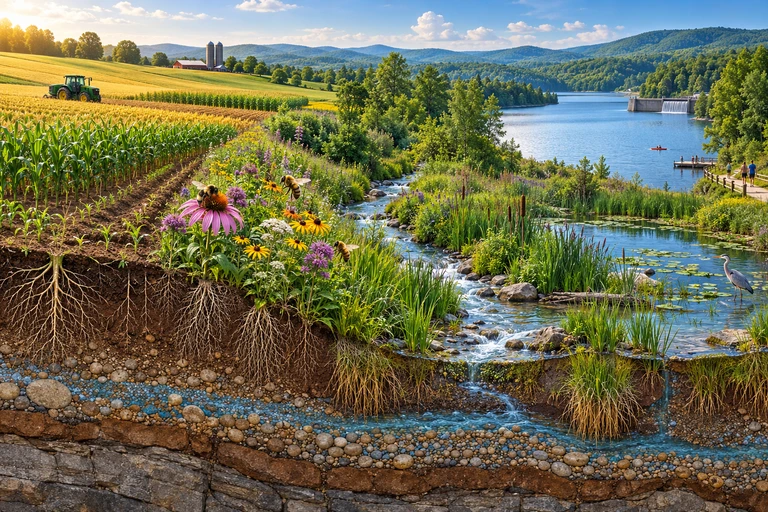
Integrated farm, flowering margin, wetland stream and reservoir with a soil-and-root cutaway and recreation area.Soil processes support production, while pollination, flow attenuation, harvest and recreation provide different ecosystem-service pathways. Avoid double-counting supporting processes and the final benefits they enable.

One landscape, different service pathways
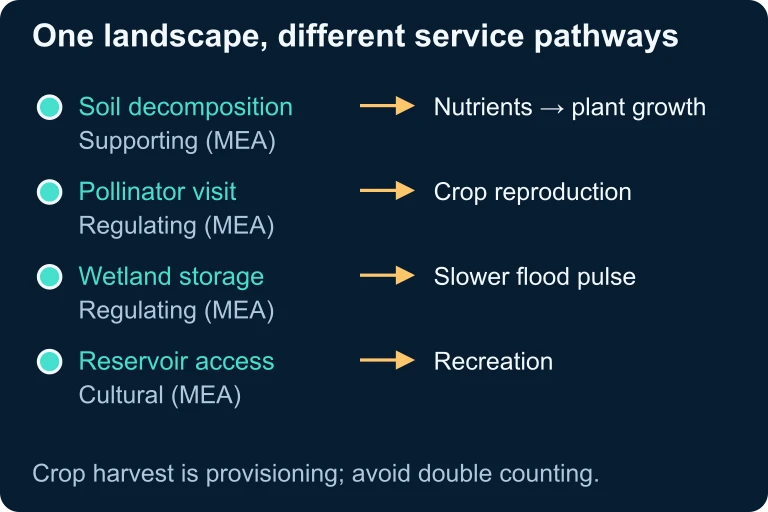
One landscape, different service pathways. Soil processes support production, while pollination, flow attenuation, harvest and recreation provide different ecosystem-service pathways. Avoid double-counting supporting processes and the final benefits they enable.Soil processes support production, while pollination, flow attenuation, harvest and recreation provide different ecosystem-service pathways. Avoid double-counting supporting processes and the final benefits they enable.

Provisioning Services in Detail

1
Food: Wild fisheries, agriculture dependent on pollinators, wild game, edible plants, and aquaculture all rely on ecosystem productivity.
2
Fresh Water: Watersheds filter and store water. Wetlands act as natural reservoirs that recharge aquifers and regulate flow.
3
Raw Materials: Timber, fibers, biofuels, and medicinal compounds (over 50% of pharmaceuticals derive from natural compounds).
4
Genetic Resources: Wild relatives of crop species provide genes for disease resistance and climate adaptation in agriculture.

Regulating Services in Detail

Climate Regulation
Forests absorb \(\text{CO}_2\) and release \(\text{O}_2\). Oceans act as massive carbon sinks. Vegetation moderates local temperatures.
Water Purification
Wetlands filter sediment, excess nutrients, and toxins. Riparian buffers prevent agricultural runoff from reaching waterways.
Pollination
Over 75% of global food crops depend on animal pollination. Bees, butterflies, and bats are critical pollinators.

Explain the physical basis and limits of a flood-regulation service.

Use this illustration to explore the concept described in its caption.
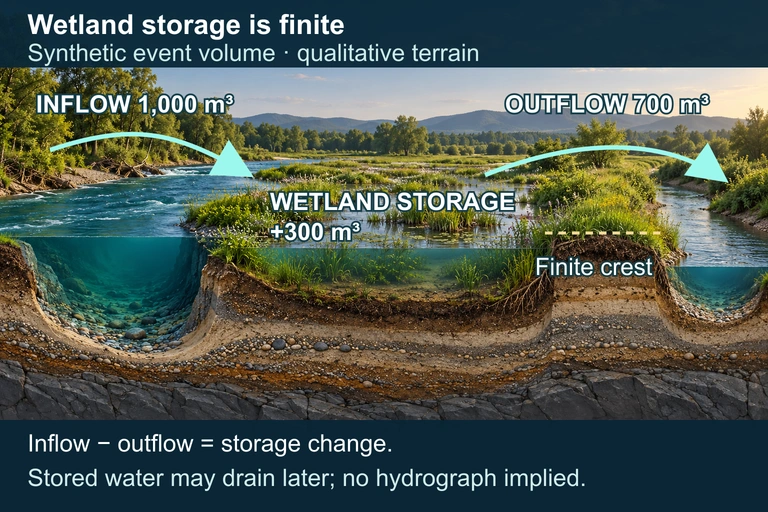
A wetland storage illustration shows1000 m³ entering,700 m³ leaving and300 m³ temporarily stored, with finite overflow capacity; stored water can drain later.
A wetland can temporarily store floodwater and reduce downstream peaks. Storage is finite, and water can later return through outlets or overflow.

Goods vs. Services: Key Distinction

Ecosystem Goods Ecosystem Services
Definition Tangible products harvested from nature Processes and conditions that benefit humans
Examples Timber, fish, fresh water, crops Pollination, flood control, carbon sequestration
Visibility Easy to quantify and market Often invisible until degraded
Market value Usually priced in markets Rarely priced: treated as "free"
Category Subset of provisioning Includes regulating, cultural, supporting

Supporting vs. Regulating: The Tricky Pair

Students often confuse these two categories because both involve ecosystem processes rather than tangible products. The key distinction is directness:

Supporting
Indirect foundation. These processes underpin all other services but do not directly benefit humans. Example: nutrient cycling enables plant growth, which then provides food.
Regulating
Direct regulation. These processes directly protect or benefit humans. Example: wetlands filtering water provides clean drinking water directly.

How to Identify and Classify Services

1
Name the benefit: What specific advantage does the ecosystem provide? (e.g., "clean drinking water")
2
Is it a tangible product? If yes, it is provisioning (food, water, timber, fiber).
3
Is it a direct process benefit? If the ecosystem process directly protects or benefits humans (flood control, air purification, pollination), it is regulating.
4
Is it non-material? Recreation, spiritual value, education, aesthetic beauty: these are cultural.
5
Is it a foundational process? Nutrient cycling, soil formation, primary production, water cycling: these are supporting services that enable all others.

Example 1: Coral Reef Services

Coral Reef Ecosystem Provisioning: Fish, shellfish Regulating: Coastal protection Wave energy absorption Cultural: Tourism, diving, beauty Supporting: Nutrient cycling, habitat for biodiversity

Example 2: Forest Ecosystem Services

A single hectare of tropical rainforest demonstrates all four categories simultaneously:

Provisioning
Timber, non-timber forest products (rubber, nuts, medicines), fresh water from watersheds
Regulating
Carbon sequestration (absorbs \(\approx 2.4\) billion tonnes \(\text{CO}_2\text{/yr}\) globally), erosion prevention, local climate moderation
Cultural
Ecotourism revenue, indigenous spiritual sites, scientific research, nature photography
Supporting
Soil formation from leaf litter decomposition, nutrient cycling, photosynthesis (primary production)

Example 3: Wetland Economic Valuation

Suppose a city must decide between preserving a 500-hectare wetland or draining it for development. How do we quantify the ecosystem services lost?

1
Water purification: The wetland filters \(12\) million gallons/day. Replacement cost of a treatment plant: \(\$80\) million.
2
Flood control: The wetland absorbs storm runoff, preventing \(\$15\) million/year in flood damage.
3
Carbon storage: Wetland peat stores \(\approx 200\) tonnes C/hectare. Releasing that carbon would cost \(\$2.5\) million in carbon offset equivalents.
4
Recreation and tourism: Birdwatching, fishing, and hiking generate \(\$3\) million/year locally.

Threats to Ecosystem Services

Service Degradation Habitat Loss Pollution Climate Change Overexploitation Invasive Species

The Millennium Ecosystem Assessment found that 60% of ecosystem services examined were being degraded or used unsustainably. The five major drivers are shown above, with habitat loss being the most significant threat globally.

Common Mistakes on the AP Exam

✕ Confusing Supporting and Regulating
Nutrient cycling is supporting (it enables other services). Water purification is regulating (it directly benefits humans). Ask: "Does this directly help people?"
✕ Forgetting Cultural Services
Students often list only tangible benefits. Remember that recreation, spiritual value, and aesthetic beauty are legitimate ecosystem services with real economic value.
✕ Treating "Biodiversity" as a Service
Biodiversity itself is not an ecosystem service: it is a property of ecosystems that supports ecosystem services. High biodiversity increases ecosystem resilience.

Summary Comparison Table

Category Definition Key Examples Testable Fact
Provisioning Tangible products from ecosystems Food, water, timber, fuel Most easily valued in markets
Regulating Direct process benefits Pollination, flood control, carbon storage Most commonly tested on AP exam
Cultural Non-material benefits Tourism, spiritual value, education Hardest to quantify economically
Supporting Foundational processes Nutrient cycling, soil formation Enables all other categories

Question 1 of 5

Bees pollinating apple trees in an orchard is an example of which type of ecosystem service?

Question 2 of 5

Which of the following is classified as a supporting ecosystem service?

Question 3 of 5

New York City invested \(\$1.5\) billion in watershed protection to avoid building a water filtration plant. This decision best illustrates which concept?

Question 4 of 5

A student argues that biodiversity is an ecosystem service. Which statement best explains why this classification is incorrect?

Question 5 of 5

Which pair correctly matches the ecosystem service with its category?