Ecological
Tolerance
Understand how organisms survive within ranges of environmental conditions and what happens when conditions push beyond their limits.
What is Ecological Tolerance?
Every organism can survive only within a certain range of environmental conditions: temperature, salinity, pH, moisture, light, and more. This range is called the organism's tolerance range.
Key Terminology
The Tolerance Curve
Limiting Factors and Tolerance
A limiting factor is any environmental condition that restricts the growth, abundance, or distribution of an organism. The factor for which the organism has the narrowest tolerance range is the most critical.
Competition restricts occupied habitat along a tidal gradient
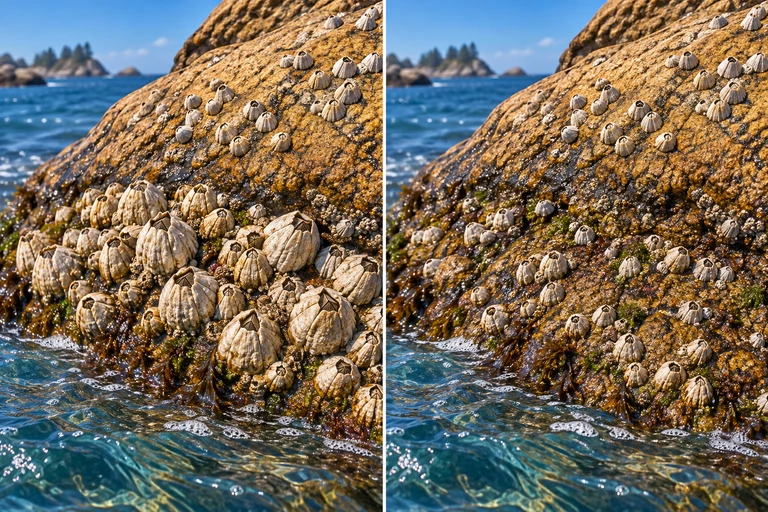 In the barnacle comparison, competition restricts Chthamalus to the upper intertidal. Removing its competitor permits occupancy farther down the shore while the upper desiccation limit remains. This examines one dimension of a multidimensional niche.
Intertidal competition range projection
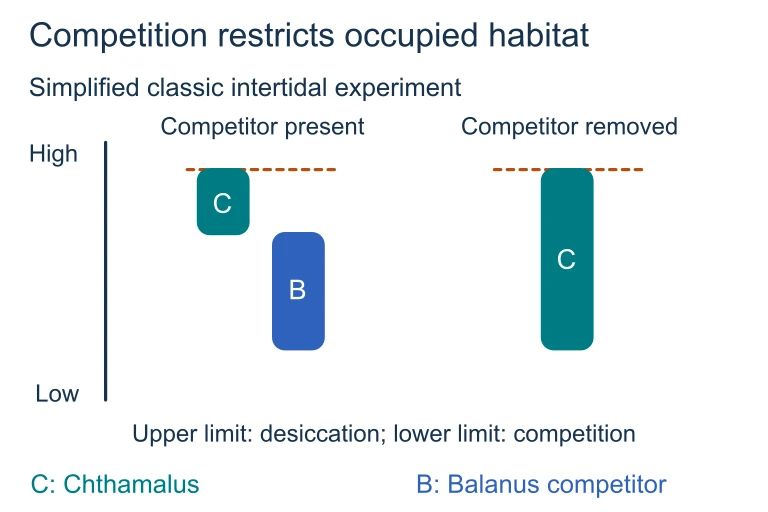 In the barnacle comparison, competition restricts Chthamalus to the upper intertidal. Removing its competitor permits occupancy farther down the shore while the upper desiccation limit remains. This examines one dimension of a multidimensional niche.
Stenotolerant vs. Eurytolerant
The Prefix System
Scientists use Greek prefixes steno- (narrow) and eury- (wide) combined with the environmental factor to describe tolerance:
| Factor | Narrow Tolerance | Wide Tolerance |
|---|---|---|
| Temperature | Stenothermal | Eurythermal |
| Salinity | Stenohaline | Euryhaline |
| Moisture | Stenohydric | Euryhydric |
| Food/Diet | Stenophagic | Euryphagic |
Shelford's Law of Tolerance
Mathematically, if we define performance \( P \) as a function of environmental variable \( x \):
A stenotolerant species has a small \( \sigma \), while a eurytolerant species has a large \( \sigma \).
Acclimation vs. Adaptation
How to Analyze Tolerance
Example: Brook Trout Temperature Tolerance
Example: Salmon and Salinity
Salmon are euryhaline: they tolerate a wide range of salinity. They hatch in freshwater (\(0 \text{ ppt}\)), migrate to the ocean (\(35 \text{ ppt}\)), and return to freshwater to spawn.
Example: Dissolved Oxygen as a Limiting Factor
A lake ecosystem contains trout, bass, and carp. Each species has a different tolerance for dissolved oxygen (DO):
| Species | Minimum DO (mg/L) | Optimum DO (mg/L) | Classification |
|---|---|---|---|
| Trout | \(6.0\) | \(9.0\) | Stenotolerant |
| Bass | \(4.0\) | \(7.5\) | Moderate |
| Carp | \(1.5\) | \(6.0\) | Eurytolerant |
Indicator Species and Tolerance
Because stenotolerant species can only survive within a narrow range, their presence or absence tells us about environmental conditions. These are called indicator species.
Common Mistakes
Summary Comparison
| Concept | Stenotolerant | Eurytolerant |
|---|---|---|
| Tolerance Range | Narrow | Wide |
| Curve Shape | Tall, narrow bell | Short, wide bell |
| \( \sigma \) Value | Small | Large |
| Sensitivity | High (vulnerable to change) | Low (resilient to change) |
| Indicator Use | Good bioindicators | Poor bioindicators |
| Examples | Trout, coral, orchids | Rats, cockroaches, carp |
Question 1 of 5
An organism that can tolerate a wide range of temperatures would be classified as:
Question 2 of 5
A pond experiences eutrophication, causing dissolved oxygen to drop from \(8 \text{ mg/L}\) to \(3 \text{ mg/L}\). Which organism is most likely to disappear first?
Question 3 of 5
According to Shelford's Law of Tolerance, an organism's distribution is most limited by:
Question 4 of 5
Lichens disappear from trees near a factory. This most likely indicates that lichens are:
Question 5 of 5
A fish species gradually adjusts its gill function over two weeks when moved from freshwater to brackish water. This is an example of: