Ecological
Succession
Explore how ecosystems change over time, from bare rock to complex forests, through predictable stages of community development.
What Is Ecological Succession?
Ecological succession is the process by which the structure of a biological community changes over time. Species replace one another in a largely predictable sequence as environmental conditions shift, ultimately leading toward a stable climax community.
Why Does Succession Matter?
Key Terms to Know
Two Types: Primary vs. Secondary
Primary Succession in Detail
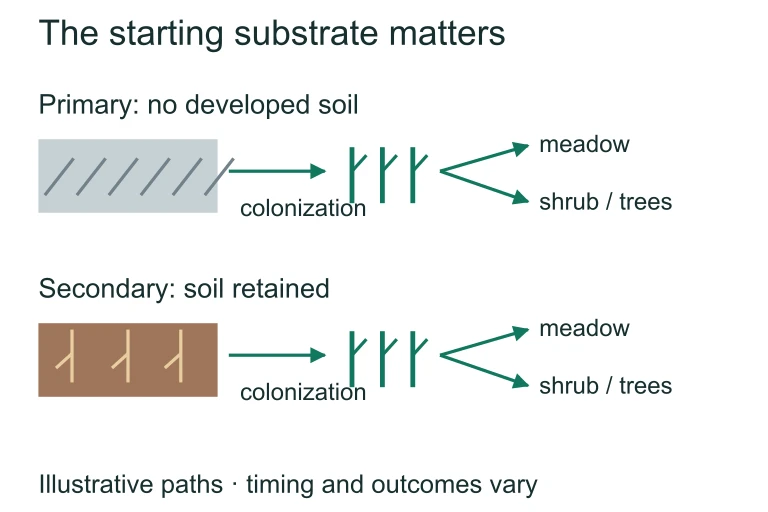
Primary succession occurs on newly exposed surfaces where no soil exists: cooled lava flows, retreating glaciers, or newly formed islands. The process is slow because soil must be created from scratch.
Secondary Succession in Detail
Secondary succession occurs where a community has been disturbed but soil remains intact: after wildfires, logging, hurricanes, or abandoned farmland. It proceeds much faster than primary succession.
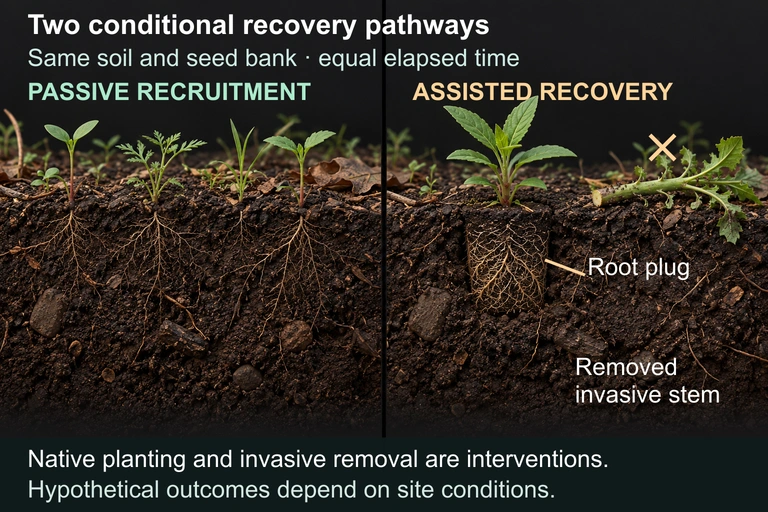
Explain how seed access and interventions can change succession.
Use this illustration to explore the concept described in its caption.
Succession depends on soil and biological legacies
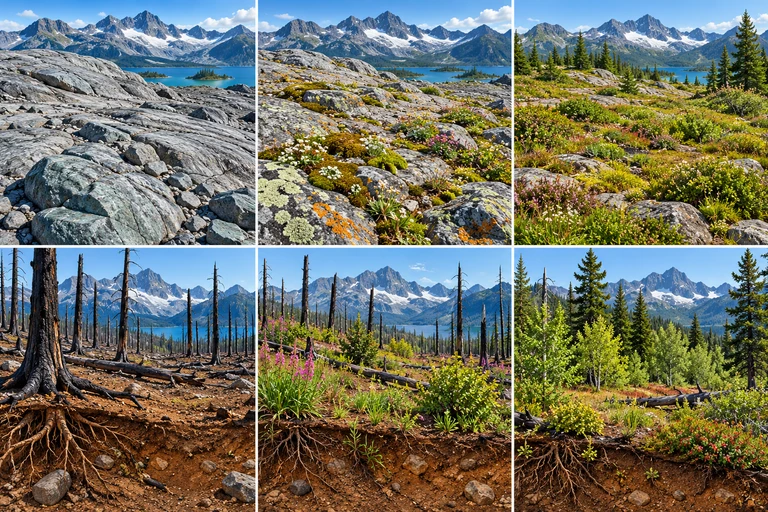
Bare substrate and retained soil create different starting conditions for succession. Colonization and later communities depend on climate, dispersal, surviving organisms and further disturbance.Succession depends on soil and biological legacies
Bare substrate and retained soil create different starting conditions for succession. Colonization and later communities depend on climate, dispersal, surviving organisms and further disturbance.Disturbance regime and recovery are separate dimensions
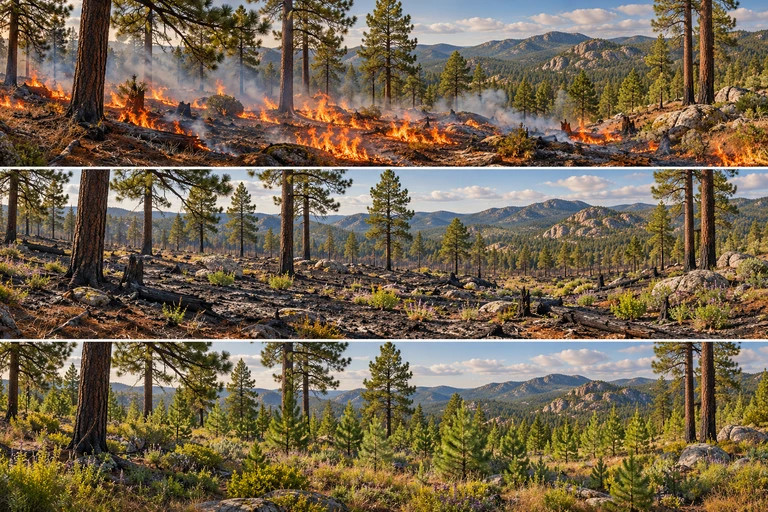
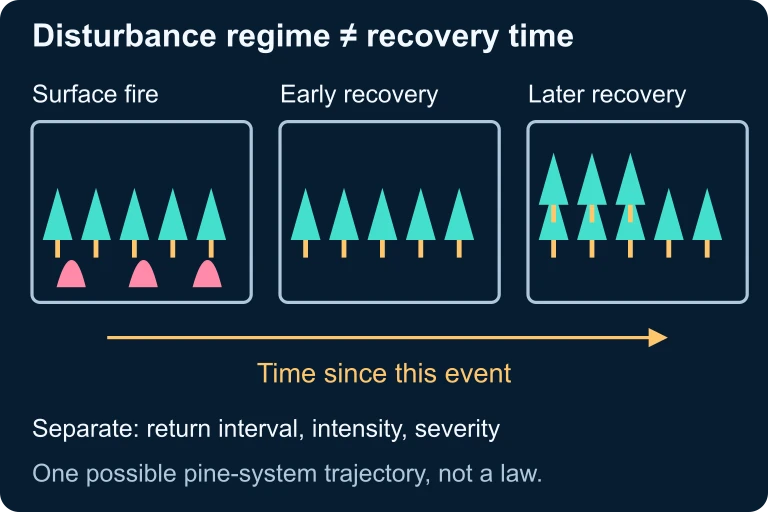
Return interval, fire intensity, ecological severity and time since a fire describe different properties of a disturbance. A single event and its recovery sequence cannot establish a frequency–diversity relationship.Disturbance regime ≠ recovery time
Return interval, fire intensity, ecological severity and time since a fire describe different properties of a disturbance. A single event and its recovery sequence cannot establish a frequency–diversity relationship.Primary vs. Secondary: Side by Side
| Feature | Primary | Secondary |
|---|---|---|
| Starting condition | No soil present | Soil intact |
| Pioneer species | Lichens, mosses | Grasses, weeds |
| Timeframe | Hundreds to thousands of years | Decades to centuries |
| Trigger examples | Volcanic eruption, glacial retreat | Fire, logging, farming |
| Soil formation | Must be created from scratch | Already exists with seed bank |
| Speed to climax | Very slow | Relatively fast |
Biodiversity Trends During Succession
The Climax Community
The climax community is the final, relatively stable stage of succession. It is determined primarily by the region's climate (temperature and precipitation). Different biomes have different climax communities.
How to Identify the Succession Type
Example: Mount St. Helens
Example: Abandoned Farmland
Example: Aquatic Succession
Models of Succession
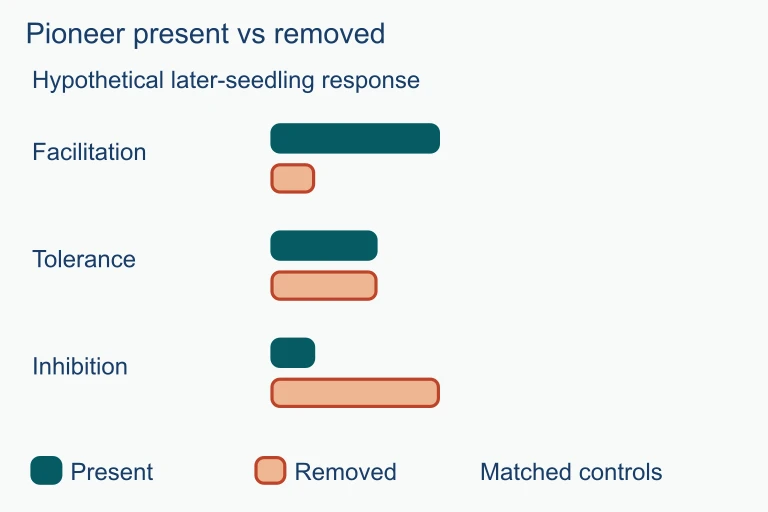
A seedling’s neighbors can help, tolerate or inhibit
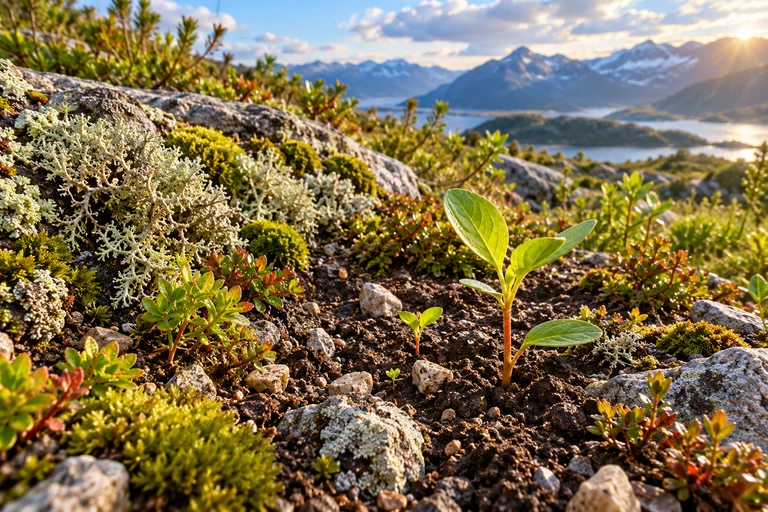
Compare how a seedling responds when neighboring plants improve conditions, have little effect on establishment, or inhibit it. These patterns distinguish facilitation, tolerance and inhibition.Pioneer present vs removed
Compare how a seedling responds when neighboring plants improve conditions, have little effect on establishment, or inhibit it. These patterns distinguish facilitation, tolerance and inhibition.Common Mistakes
Question 1 of 5
A volcanic island rises from the ocean, creating a surface of cooled lava with no soil. What type of succession will occur?
Question 2 of 5
A forest fire destroys all above-ground vegetation, but the soil and root systems remain intact. Which pioneer organisms are most likely to colonize first?
Question 3 of 5
Which statement best describes the facilitation model of succession?
Question 4 of 5
A retreating glacier exposes bare rock in Alaska. Over 200 years, ecologists observe the following sequence: lichens, mosses, fireweed, alder, spruce forest. What is the climax community?
Question 5 of 5
Secondary succession typically proceeds faster than primary succession. Which of the following best explains why?