01 / 21

Ecological
Footprints

Measure humanity's demand on the biosphere: how much biologically productive land and water is needed to sustain a population's consumption and absorb its waste.

AP Environmental Science

What Is an Ecological Footprint?

An ecological footprint quantifies the total area of biologically productive land and water required to produce the resources a person, city, or nation consumes and to absorb the waste it generates. It is measured in global hectares (gha): one gha represents one hectare of land with world-average biological productivity.

Six Components of the Footprint

Carbon
Forest area needed to sequester \(\text{CO}_2\) emissions from fossil fuels
Cropland
Land for growing food, fiber, oil crops, and rubber
Grazing
Pasture for raising livestock for meat, dairy, and wool
Forest
Timber and wood products: lumber, paper, firewood
Fishing
Marine and freshwater areas needed to support fish harvest
Built-up
Infrastructure: roads, buildings, dams, and reservoirs

Identify the spatial boundary hidden by an urban consumption total.

Use this illustration to explore the concept described in its caption.
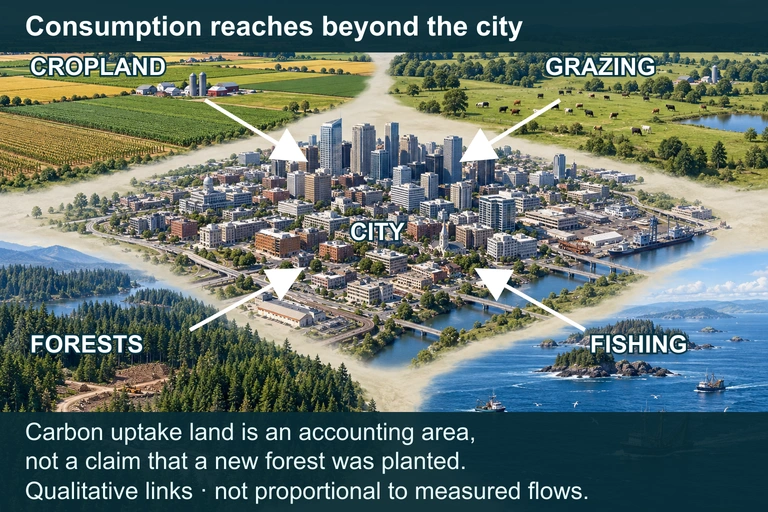
A central city receives consumption-related flows from cropland, grazing land, forest and fishing grounds; carbon uptake is separately labeled as an accounting-area demand.
Urban consumption depends on productive landscapes beyond the city boundary. These category windows show connections rather than measured land areas.

Why Ecological Footprints Matter

Ecological footprints translate abstract sustainability goals into a single, comparable number. They let scientists, policymakers, and individuals ask: "Are we living within Earth's means?"

1
Track overshoot: Global footprint currently exceeds biocapacity by about 75%, meaning we use \(1.75\) Earths' worth of resources per year.
2
Compare nations: A U.S. resident averages \(\approx 8\) gha; a resident of India averages \(\approx 1.2\) gha.
3
Guide policy: Identify the largest demand sectors and target interventions where they will have the greatest impact.

The Core Equation

The total footprint sums across all six components. For a nation of population \(N\), the per-capita footprint is \(\text{EF}_\text{pc} = \dfrac{\text{EF}_\text{total}}{N}\).

Ecological Overshoot Visualized

Global Hectares (billions) Year 1960 1980 2000 2020 5 10 15 20 ~1970 Ecological Footprint Biocapacity OVERSHOOT

Footprint vs. Biocapacity

Ecological Footprint
Demand side: the land and water area a population requires to produce resources and absorb waste at current technology and management levels.
Biocapacity
Supply side: the capacity of ecosystems to regenerate what people demand: food, fiber, timber, space for infrastructure, and carbon absorption.

Ecological Footprint vs. Carbon Footprint

Ecological Footprint Carbon Footprint
Unit Global hectares (gha) Tonnes \(\text{CO}_2\text{e}\)
Scope All resource demands (6 categories) Greenhouse gas emissions only
Compares to Biocapacity (land supply) Emission budgets / targets
Relationship Carbon footprint is the largest component (~60%) of the ecological footprint

How to Calculate a Footprint

1
Gather consumption data: Collect annual amounts consumed for each resource category (food, energy, goods, etc.).
2
Convert to land area: Divide consumption \(P\) by the national yield \(Y_N\) to get hectares needed.
3
Apply yield factor (YF): Adjust for how your nation's productivity compares to the world average.
4
Apply equivalence factor (EQF): Convert different land types to a common unit (global hectares).
5
Sum all categories: Add up cropland, grazing, forest, fishing, carbon, and built-up land footprints for the total EF.

Example 1: Per-Capita Footprint

A country of 50 million people has a total ecological footprint of \(3.5 \times 10^8\) gha. What is its per-capita footprint?

Example 2: Cropland Footprint

A nation consumes 90 million tonnes of wheat annually. National yield is \(3.0\) tonnes/ha, the yield factor is \(YF = 1.2\), and the cropland equivalence factor is \(EQF = 2.5\).

Example 3: Deficit or Reserve?

Country A 5.4 gha Footprint 2.1 gha Country B 1.8 gha Footprint 3.2 gha DEFICIT: -3.3 gha RESERVE: +1.4 gha

Factors That Increase a Footprint

High meat consumption
Livestock require grazing land, feed cropland, and produce methane: roughly \(5\times\) the land per calorie vs. plants.
Fossil fuel dependence
Burning coal, oil, and gas inflates the carbon component, the single largest slice at \(\approx 60\%\) of the total footprint.
Urban sprawl
Low-density development paves over productive land and forces car-dependent transport, boosting both built-up and carbon footprints.

Strategies to Reduce a Footprint

1
Shift to renewable energy: Solar and wind have near-zero carbon footprints during operation, drastically cutting the carbon component.
2
Plant-rich diets: Replacing beef with legumes can cut food-related footprint by up to 75%.
3
Compact urban design: Dense, walkable cities reduce per-capita energy use and built-up land demand.
4
Increase agricultural yields: Better technology and sustainable intensification raise \(Y_N\), shrinking the cropland footprint.

Common Mistakes

✕ Confusing EF with carbon footprint
Carbon footprint measures only greenhouse gas emissions. The ecological footprint is broader: it includes all six land-use categories.
✕ Ignoring equivalence factors
One hectare of cropland is not equal to one hectare of ocean. Without EQF, different land types cannot be meaningfully compared or summed.
✕ Treating biocapacity as fixed
Biocapacity changes with technology, land management, and climate. Assuming it is constant leads to inaccurate deficit/reserve calculations over time.

Summary Comparison

Ecological Footprint Biocapacity
Measures Human demand on nature Nature's supply / regeneration
Unit Global hectares (gha) Global hectares (gha)
Key inputs Consumption, yield, YF, EQF Available area, yield, YF, EQF
If EF > BC Ecological deficit: overshoot
If EF < BC Ecological reserve: sustainability
Largest component Carbon footprint (\(\approx 60\%\)) Forest land (carbon sink)

Question 1 of 5

An ecological footprint is measured in global hectares (gha). What does one global hectare represent?

Question 2 of 5

A nation has a per-capita ecological footprint of \(4.8\) gha and a per-capita biocapacity of \(2.0\) gha. Which statement is correct?

Question 3 of 5

Which component typically accounts for the largest share of a high-income nation's ecological footprint?

Question 4 of 5

A farmer increases wheat yield from \(3.0\) to \(4.5\) tonnes/ha through better irrigation and seed varieties. How does this affect the nation's cropland footprint for wheat, assuming consumption stays the same?

Question 5 of 5

Which action would most effectively reduce a household's ecological footprint?