01 / 22

Earth's
Atmosphere

Explore the structure, composition, and energy dynamics of the atmosphere that sustains life on our planet.

AP Environmental Science

What Is the Atmosphere?

Earth's atmosphere is a thin layer of gases held in place by gravity. It extends roughly 600 km above the surface, though \(99\%\) of its mass lies within the first 30 km.

Atmospheric Composition

\(\text{N}_2\) : Nitrogen
\(78.08\%\) of dry air. Inert, essential for biological nitrogen fixation.
\(\text{O}_2\) : Oxygen
\(20.95\%\) of dry air. Supports aerobic respiration and combustion.
\(\text{Ar}\) : Argon
\(0.93\%\) of dry air. Noble gas with no significant biological role.

Why the Atmosphere Matters

1
UV Shield: The ozone layer (\(\text{O}_3\)) absorbs \(\approx 97\text{-}99\%\) of harmful UV-B and UV-C radiation.
2
Temperature Regulation: Greenhouse gases maintain Earth's average surface temperature at roughly \(15\,{}^\circ\text{C}\) instead of \(-18\,{}^\circ\text{C}\).
3
Weather and Water Cycle: The troposphere circulates moisture, enabling precipitation and the hydrologic cycle.
4
Meteor Protection: Friction with atmospheric molecules incinerates most incoming space debris before it reaches the surface.

Layers of the Atmosphere

Troposphere Stratosphere Mesosphere Thermosphere Exosphere 0 km 12 km 50 km 85 km 600 km Weather, 75% of mass Ozone layer, jets fly here Meteors burn up Aurora, ISS orbits Fades into space Tropopause Stratopause Mesopause Thermopause

Travel upward through a thin atmospheric skin
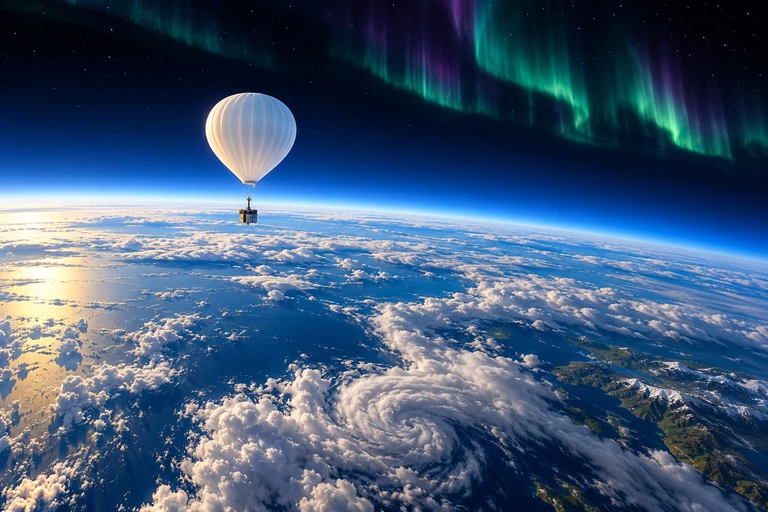
A curved Earth horizon with clouds,balloon and aurora accompanies an exact schematic lower-atmosphere temperature profile and separate high-altitude note.Temperature changes direction across atmospheric layers because the dominant absorption and heating processes differ. Layer boundaries are associated with those changes in the temperature profile.

Temperature can reverse with height
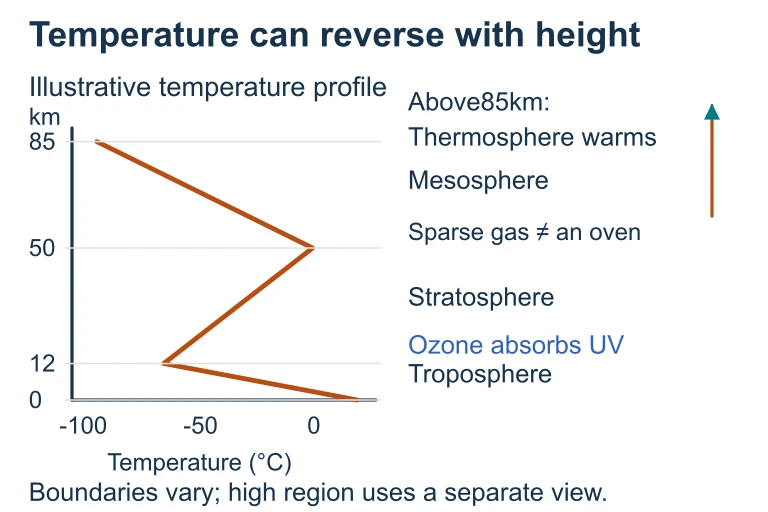
Temperature can reverse with height. Temperature changes direction across atmospheric layers because the dominant absorption and heating processes differ. Layer boundaries are associated with those changes in the temperature profile.Temperature changes direction across atmospheric layers because the dominant absorption and heating processes differ. Layer boundaries are associated with those changes in the temperature profile.

Temperature Profile by Layer

Altitude (km) Temperature 0 12 50 85 120 -100 -50 0 50 100 Tropo. Strato. Meso. Thermo.

The Greenhouse Effect

Sun Shortwave radiation Earth's Surface Atmosphere (GHGs) IR (longwave) Some escapes Re-radiated ~30% reflected

Energy Balance Equation

Earth maintains a long-term radiative equilibrium described by:

\(S\)
Solar constant: \(\approx 1361 \;\text{W/m}^2\)
\(\alpha\)
Albedo: fraction of sunlight reflected (\(\approx 0.30\))
\(T_e\)
Effective emission temperature (\(\approx 255\;\text{K}\))
\(\sigma\)
Stefan-Boltzmann constant: \(5.67 \times 10^{-8}\;\text{W/m}^2\text{K}^4\)

Weather vs. Climate

Weather Climate
Definition Short-term atmospheric conditions Long-term average patterns
Timescale Hours to days Decades to centuries
Predictability ~10-day forecast limit Statistical trends are robust
Driven by Air masses, fronts, pressure Solar input, GHGs, ocean currents
Example "It will rain tomorrow" "Summers average \(30\,{}^\circ\text{C}\)"

The Ozone Layer

Ozone (\(\text{O}_3\)) is concentrated in the stratosphere at \(15\text{-}35\;\text{km}\). It absorbs UV-B and UV-C via the Chapman Cycle:

Global Circulation Cells

0° 30°N 60°N 30°S 60°S Hadley Ferrel Polar Hadley Ferrel Polar Trade Winds Westerlies Polar E.

How to Analyze Atmospheric Problems

1
Identify the layer: Which atmospheric layer is the question about? Each has distinct temperature and composition characteristics.
2
Check the energy flow: Is the question about incoming solar (shortwave) or outgoing terrestrial (longwave/IR) radiation?
3
Consider feedbacks: Positive feedbacks amplify change (ice-albedo), negative feedbacks stabilize (increased radiation at higher \(T\)).
4
Apply the equation: Use \(S(1-\alpha)\pi R^2 = \sigma T_e^4 \cdot 4\pi R^2\) to solve for unknowns like \(T_e\) or albedo changes.
5
Connect to policy: Link science to real-world actions (Montreal Protocol, Paris Agreement, carbon taxes).

Example: Albedo and Energy

If Earth's albedo increased from \(\alpha = 0.30\) to \(\alpha = 0.35\), how would the effective temperature change?

1
Simplify the energy balance: Cancel \(\pi R^2\) to get \(\displaystyle T_e = \left[\frac{S(1-\alpha)}{4\sigma}\right]^{1/4}\)
2
Current: \(\displaystyle T_e = \left[\frac{1361 \times 0.70}{4 \times 5.67 \times 10^{-8}}\right]^{1/4} \approx\) \(255\;\text{K}\)
3
New: \(\displaystyle T_e = \left[\frac{1361 \times 0.65}{4 \times 5.67 \times 10^{-8}}\right]^{1/4} \approx\) \(250\;\text{K}\)

Example: Doubling \(\text{CO}_2\)

Climate sensitivity is defined as the equilibrium warming from a doubling of \(\text{CO}_2\). The IPCC estimates this at \(1.5\text{-}4.5\,{}^\circ\text{C}\) with a best estimate near \(3\,{}^\circ\text{C}\).

Direct Effect
Doubling \(\text{CO}_2\) alone adds \(\approx 3.7\;\text{W/m}^2\) of radiative forcing, producing \(\sim 1.1\,{}^\circ\text{C}\) warming.
Feedbacks
Water vapor (positive), ice-albedo (positive), and cloud feedbacks amplify warming to \(\sim 3\,{}^\circ\text{C}\) total.

Example: Lapse Rate Calculation

The environmental lapse rate in the troposphere averages \(6.5\,{}^\circ\text{C/km}\). If the surface temperature is \(25\,{}^\circ\text{C}\), what is the temperature at \(4\;\text{km}\)?

Dry Adiabatic
\(\Gamma_d = 9.8\,{}^\circ\text{C/km}\): rate for unsaturated air rising without heat exchange.
Moist Adiabatic
\(\Gamma_m \approx 5\text{-}6\,{}^\circ\text{C/km}\): slower cooling because condensation releases latent heat.

Common Mistakes

Confusing Ozone Hole with Greenhouse Effect
The ozone hole is about UV protection, not warming. CFCs deplete ozone; \(\text{CO}_2\) drives warming. Different problems, different solutions.
Thinking \(\text{N}_2\) or \(\text{O}_2\) Are Greenhouse Gases
Diatomic molecules like \(\text{N}_2\) and \(\text{O}_2\) do not absorb IR. Only molecules with 3+ atoms (or asymmetric bonds) are GHGs.
Mixing Up Layers' Temperature Trends
Troposphere cools with altitude; stratosphere warms. Students often reverse these or forget the mesosphere cools again.

Atmospheric Layers Summary

Layer Altitude (km) Temp. Trend Key Feature
Troposphere 0-12 Decreases Weather, 75% mass
Stratosphere 12-50 Increases Ozone layer
Mesosphere 50-85 Decreases Meteors burn up
Thermosphere 85-600 Increases Aurora, ISS orbit
Exosphere >600 Variable Fades into space

Question 1 of 5

Which layer of the atmosphere contains the ozone layer and experiences a temperature increase with altitude?

Question 2 of 5

Without the greenhouse effect, Earth's average surface temperature would be approximately:

Question 3 of 5

Which of the following is not a greenhouse gas?

Question 4 of 5

Using the environmental lapse rate of \(6.5\,{}^\circ\text{C/km}\), if the ground temperature is \(20\,{}^\circ\text{C}\), what is the approximate temperature at \(3\;\text{km}\) altitude?

Question 5 of 5

The Montreal Protocol was designed to address which environmental issue?