Clearcutting
Forests & Ecosystems
Explore the environmental science behind clearcutting: its methods, ecological impacts, and how it compares to sustainable forestry practices.
What Is Clearcutting?
Clearcutting is a forestry practice in which all or nearly all trees in a designated area are harvested at once, regardless of species, size, or age. The result is a completely deforested tract of land.
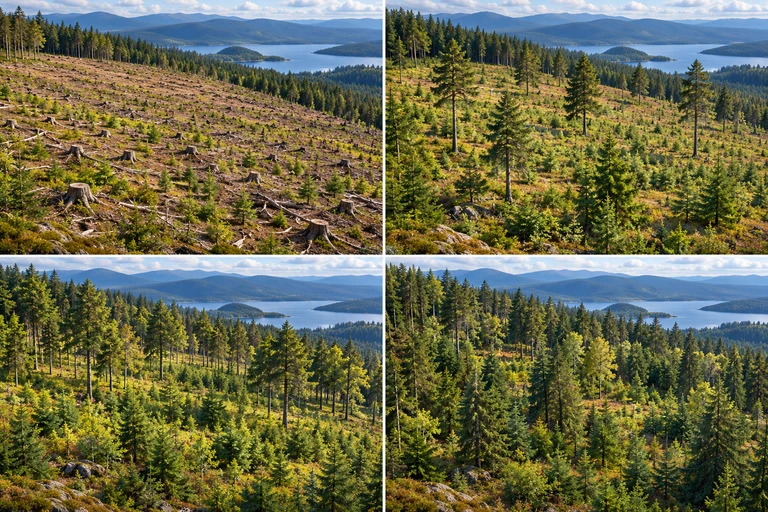
Before and After a Clearcut
Why Clearcutting Matters
Ecological Impacts
Canopy removal alters coupled watershed pathways
 Canopy removal changes interception, transpiration, soil exposure and runoff pathways. Rainfall, slope, roads, residual cover and management affect the outcome; a connected riparian buffer can retain shade and intercept some flows.
Canopy removal affects interception and uptake while roads and ground cover influence runoff and sediment.
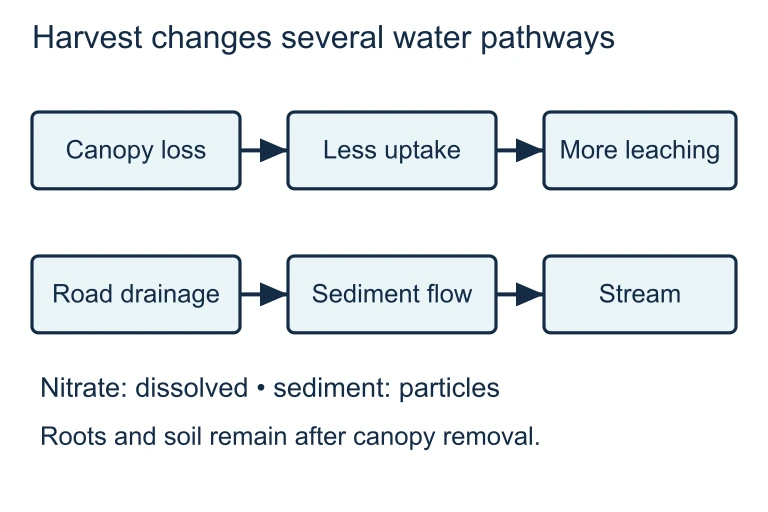 Canopy removal changes interception, transpiration, soil exposure and runoff pathways. Rainfall, slope, roads, residual cover and management affect the outcome; a connected riparian buffer can retain shade and intercept some flows.
Carbon Balance and Clearcutting
Clearcutting vs Selective Logging
| Clearcutting | Selective Logging | |
|---|---|---|
| Trees Removed | All trees | Targeted trees only |
| Canopy Cover | 0% remaining | 50-80% remaining |
| Soil Erosion | Severe | Minimal |
| Biodiversity Impact | High loss | Low loss |
| Economic Cost | Low (efficient) | Higher (labor-intensive) |
| Regeneration Time | Decades-centuries | Continuous |
Forestry Harvesting Methods
Harvest methods retain different canopy and regeneration structures
 Harvest methods differ in retained canopy and regeneration. Shelterwood uses staged removal; selection can maintain several age classes when species and site conditions support it.
Retention and regeneration differ
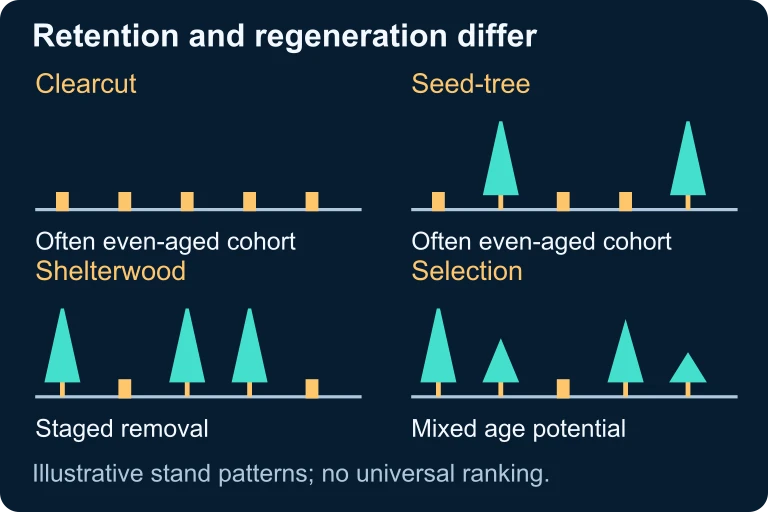 Harvest methods differ in retained canopy and regeneration. Shelterwood uses staged removal; selection can maintain several age classes when species and site conditions support it.
How to Evaluate Clearcutting
Example: Soil Erosion Impact
A 50-hectare forest is clearcut on a hillside. Annual rainfall is 1200 mm. Studies show that deforested slopes lose soil at \(15 \text{ tonnes/ha/year}\) compared to \(1.5 \text{ tonnes/ha/year}\) for forested slopes.
Example: Carbon Release
A mature temperate forest stores approximately \(200 \text{ tonnes C/ha}\) in biomass and \(100 \text{ tonnes C/ha}\) in soil organic matter. If 30 hectares are clearcut and 60% of the biomass carbon is released as \(\text{CO}_2\) within 5 years:
Example: Biodiversity Loss
Lost Ecosystem Services
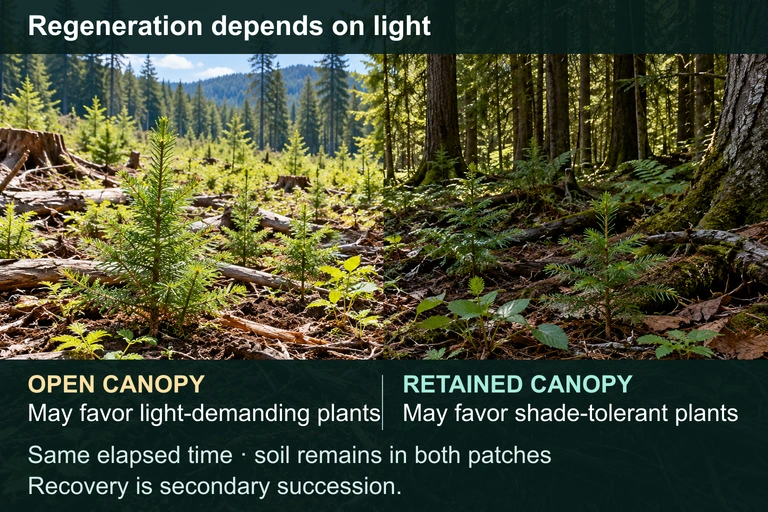
Succession After Clearcutting
Justify why harvest suitability depends on species and site.
Use this illustration to explore the concept described in its caption.
Common Mistakes
Summary of Harvesting Methods
| Method | Disturbance | Cost | Recovery |
|---|---|---|---|
| Clearcutting | Very High | Low | Slow (decades) |
| Selective Cutting | Low | High | Fast |
| Shelterwood | Moderate | Moderate | Moderate |
| Strip Cutting | Moderate | Moderate | Faster |
Question 1 of 5
Which of the following is the primary economic advantage of clearcutting over selective logging?
Question 2 of 5
After a forest is clearcut, the ecological recovery process that follows is best described as:
Question 3 of 5
A mature forest stores \(200 \text{ tonnes C/ha}\). If 40 hectares are clearcut and 50% of the biomass carbon is released, how many tonnes of \(\text{CO}_2\) are emitted? (Molar mass ratio: \(\frac{44}{12}\))
Question 4 of 5
Which harvesting method involves removing trees in narrow strips adjacent to intact forest to minimize erosion and edge effects?
Question 5 of 5
A student argues that clearcutting has no benefits and should always be replaced by selective logging. Which of the following best challenges this claim?