Aquaculture
Farming the Waters
Explore the science, sustainability, and environmental impacts of raising aquatic organisms for food, restoration, and commerce.
What Is Aquaculture?
Aquaculture is the controlled cultivation of aquatic organisms: fish, shellfish, algae, and aquatic plants. It encompasses everything from freshwater tilapia ponds in Southeast Asia to offshore salmon cages in Norway.
Aquaculture now produces over 50% of all fish consumed globally, surpassing wild-capture fisheries for human food.
Why Aquaculture Matters
Types of Aquaculture Systems
Open net pens, ponds and recirculation expose different pathways
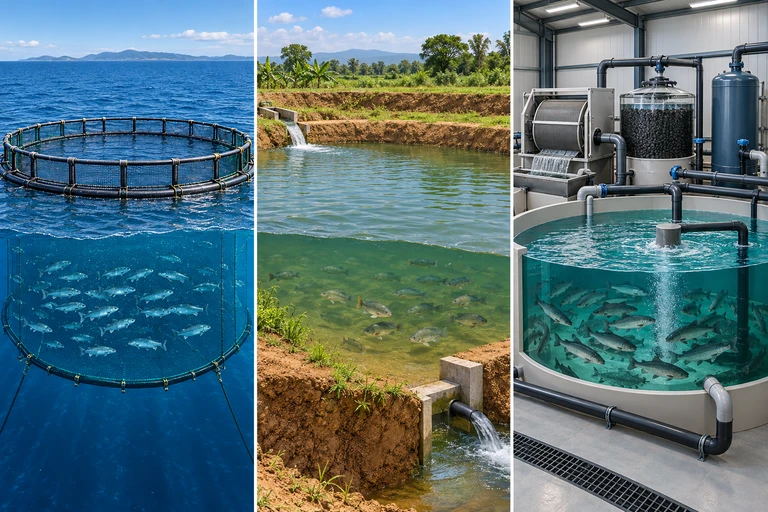 Open pens exchange water with the sea. Pond effluent depends on management, while recirculating systems capture solids and use biofiltration. Recirculation still requires makeup water, energy and waste handling.
Compare actual water,waste and escape pathways.
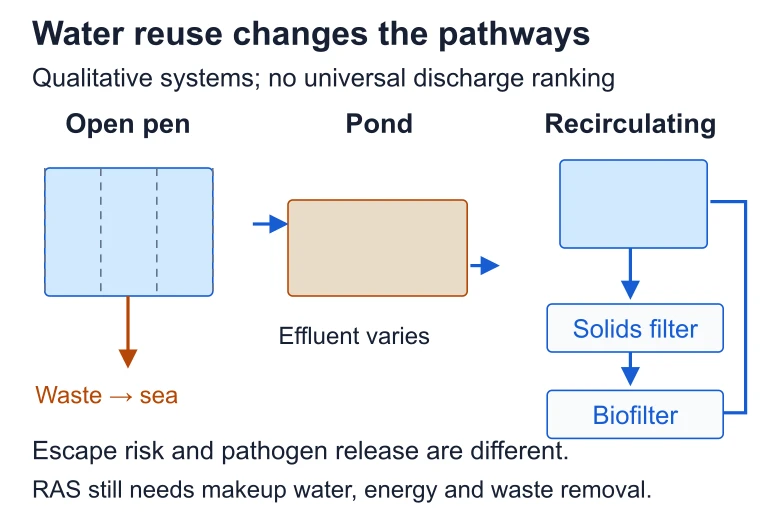 Open pens exchange water with the sea. Pond effluent depends on management, while recirculating systems capture solids and use biofiltration. Recirculation still requires makeup water, energy and waste handling.
Core Principle: Carrying Capacity
Every aquaculture system has a carrying capacity: the maximum population an environment can sustain without degradation. Exceeding it leads to disease, waste accumulation, and ecosystem collapse.
The Feed Conversion Ratio
A key efficiency metric in aquaculture is the Feed Conversion Ratio (FCR): how much feed is needed to produce one unit of body mass.
Aquaculture vs. Wild-Capture
| Aquaculture | Wild-Capture | |
|---|---|---|
| Source | Farmed, controlled | Harvested from wild |
| Sustainability | Renewable if managed | Risk of overfishing |
| Bycatch | Minimal to none | Significant problem |
| Habitat Impact | Localized pollution risk | Bottom trawling damage |
| Feed Source | Requires fishmeal/soy | Natural food web |
| Disease Risk | Higher (dense populations) | Lower (dispersed) |
Environmental Impacts
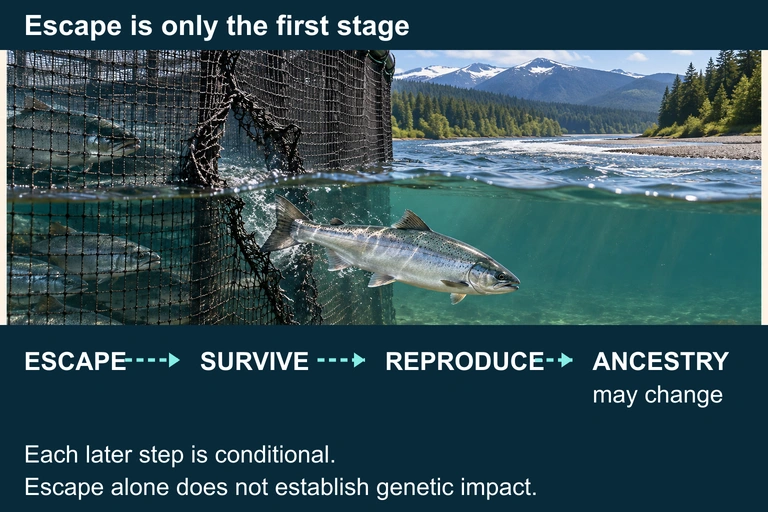
Explain why escape and genetic introgression are separate steps.
Use this illustration to explore the concept described in its caption.
The Eutrophication Cycle
Sustainable Solutions
Integrated multi-trophic nutrient recovery
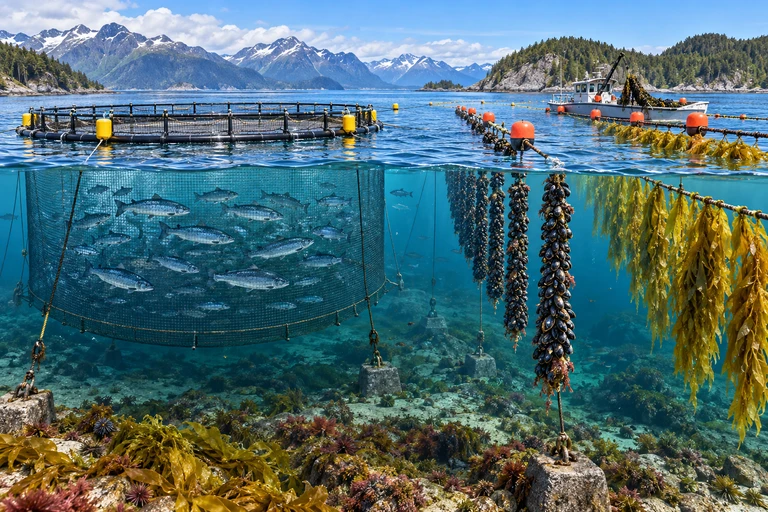 Fed fish release particulate organic matter and dissolved nutrients. Shellfish and seaweed recover different forms of material, so their placement and growth determine how much is retained in harvested biomass.
Different waste, different consumers
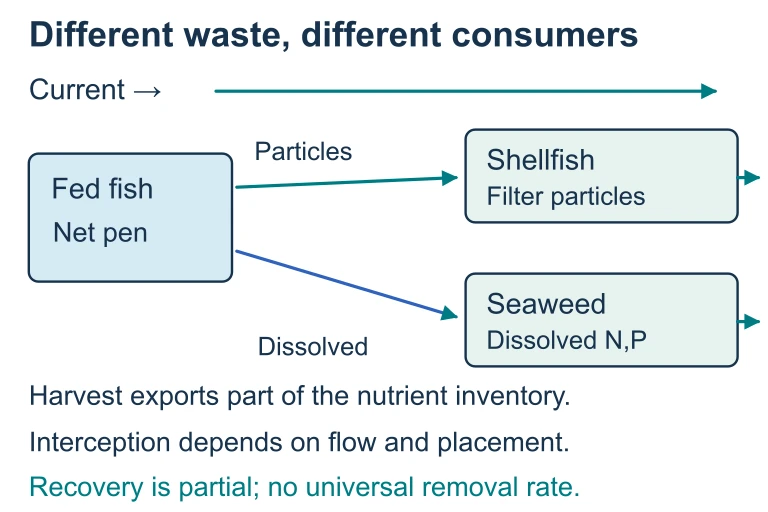 Fed fish release particulate organic matter and dissolved nutrients. Shellfish and seaweed recover different forms of material, so their placement and growth determine how much is retained in harvested biomass.
How IMTA Works
How to Evaluate an Operation
Example: Shrimp Farm in Thailand
A coastal shrimp farm converts 50 hectares of mangrove forest into aquaculture ponds. It uses antibiotics, imports fishmeal feed, and discharges untreated water.
Example: Salmon RAS in Norway
An indoor RAS facility raises Atlantic salmon using recirculated, filtered water. It uses plant-based feed supplements and treats all waste before discharge.
Example: Oyster Restoration Aquaculture
Chesapeake Bay farmers raise native Eastern oysters. Each adult oyster filters \( \approx 190 \) liters of water per day, improving water clarity and quality.
Common Mistakes
Aquaculture Systems Compared
| Open Ponds | Net Pens | RAS | IMTA | |
|---|---|---|---|---|
| Cost | Low | Medium | High | Medium |
| Escape Risk | Low | High | None | Moderate |
| Pollution | Moderate | High | Very Low | Low |
| Water Use | High | Open ocean | Minimal | Open ocean |
| Energy Use | Low | Low | High | Low |
Question 1 of 5
A shrimp farm that clears mangrove forest to create ponds would most directly cause which environmental impact?
Question 2 of 5
Which metric measures the efficiency of converting feed into animal biomass?
Question 3 of 5
In an IMTA system, seaweed is grown alongside salmon pens primarily to:
Question 4 of 5
Which is a significant disadvantage of Recirculating Aquaculture Systems (RAS) compared to open net pens?
Question 5 of 5
A scientist argues that farming tilapia is more environmentally sustainable than farming salmon. Which reasoning best supports this claim?