Biological
Adaptations
Explore how organisms evolve structural, behavioral, and physiological traits that enhance survival and reproduction in their environments.
What Is an Adaptation?
An adaptation is a heritable trait that has evolved through natural selection because it increases an organism's fitness: the ability to survive and reproduce in a specific environment.
In AP Environmental Science, understanding adaptations helps explain biodiversity patterns, niche specialization, species interactions, and how populations respond to environmental change.
Three Types of Adaptations
How Adaptations Interconnect
Natural Selection Drives Adaptations
Adaptation vs. Acclimation vs. Evolution
| Adaptation | Acclimation | Evolution | |
|---|---|---|---|
| Level | Population | Individual | Population |
| Heritable? | Yes | No | Yes |
| Timescale | Generations | Days to weeks | Generations+ |
| Mechanism | Natural selection | Phenotypic plasticity | Multiple mechanisms |
| Example | Thick arctic fur | Tanning in sunlight | Allele frequency shift |
Fitness and Selective Pressure
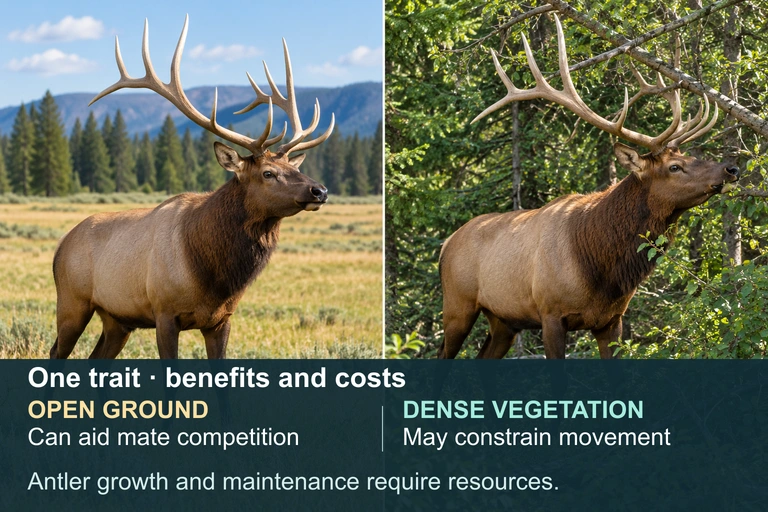
In ecology, fitness measures an organism's reproductive success relative to others in the population. It is influenced by selective pressures: environmental factors that favor certain traits.
Explain how one trait can have both fitness benefits and costs.
Use this illustration to explore the concept described in its caption.
Structural Adaptations: Body Design
Mangrove structures solve distinct environmental constraints
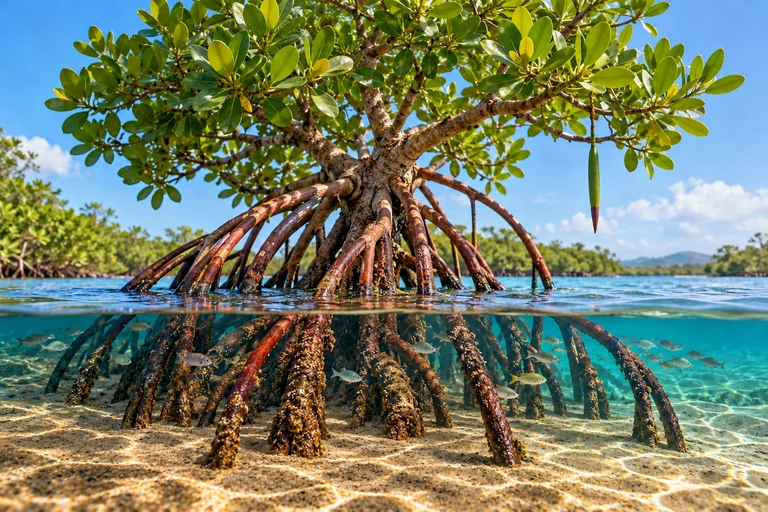
This red-mangrove-type example combines connected prop roots with an attached developing propagule. Mangrove species vary in root architecture and salt handling; vivipary is a developmental trait.Mangrove traits solve different constraints
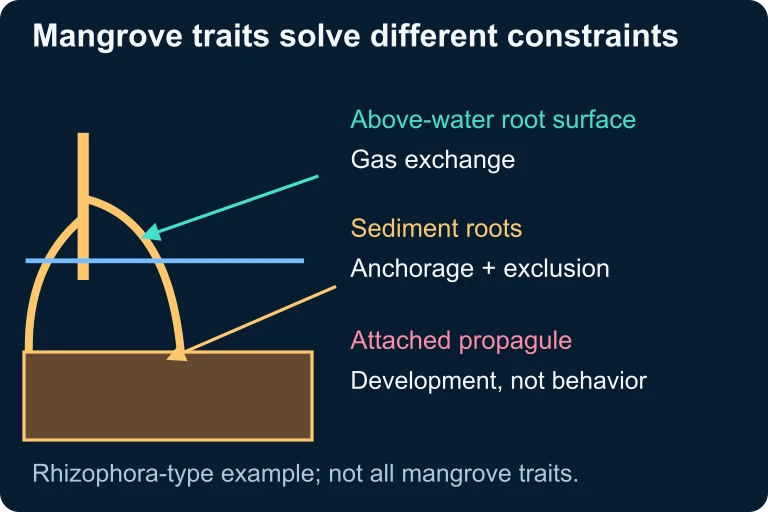
This red-mangrove-type example combines connected prop roots with an attached developing propagule. Mangrove species vary in root architecture and salt handling; vivipary is a developmental trait.Behavioral Adaptations: Actions for Survival
Physiological Adaptations: Internal Chemistry
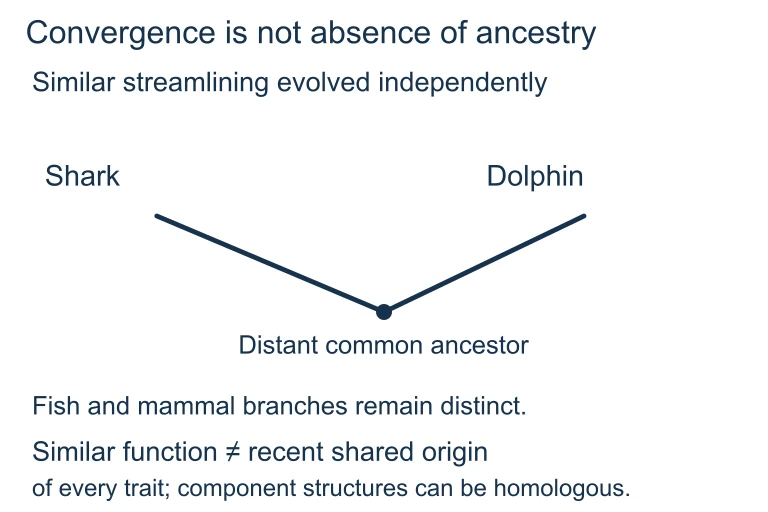
Convergent vs. Divergent Evolution
Convergence versus divergence in trait evolution
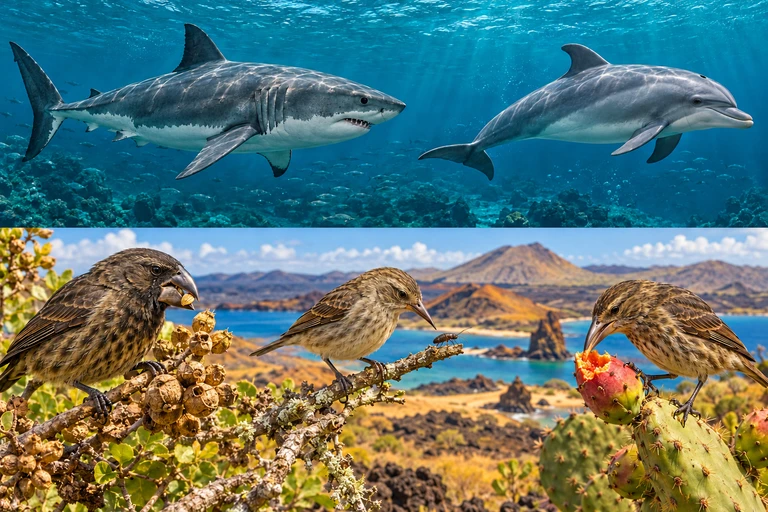
Streamlined aquatic body shapes evolved independently in the distinct shark and dolphin lineages. Finch beak differences instead illustrate divergence among descendants of a common ancestor.Convergence is not absence of ancestry
Streamlined aquatic body shapes evolved independently in the distinct shark and dolphin lineages. Finch beak differences instead illustrate divergence among descendants of a common ancestor.How to Identify an Adaptation
Example 1: The Peppered Moth
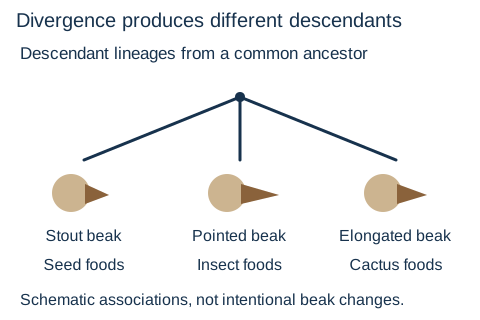
Example 2: Galapagos Finch Beaks
Common ancestry, different beak traits
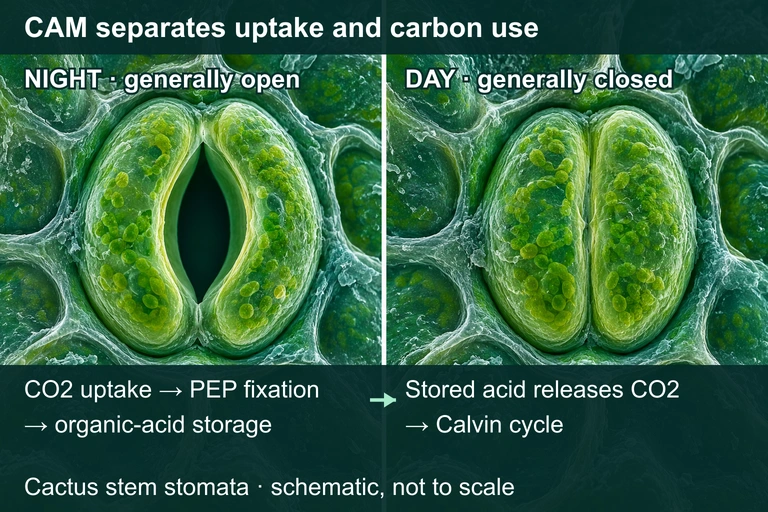
Example 3: CAM Photosynthesis
Explain a physiological adaptation through timing rather than external shape alone.
Use this illustration to explore the concept described in its caption.
Common Mistakes
Summary: Adaptation Types at a Glance
| Structural | Behavioral | Physiological | |
|---|---|---|---|
| Definition | Physical body features | Heritable actions | Internal processes |
| Observability | Easily visible | Requires observation | Often invisible |
| Example (animal) | Polar bear fur | Bird migration | Snake venom |
| Example (plant) | Cactus spines | Heliotropism | CAM photosynthesis |
| Timescale | Many generations | Many generations | Many generations |
| Heritable? | Yes | Yes | Yes |
Question 1 of 5
A population of lizards lives on dark volcanic rock. Over many generations, the population shifts from predominantly light-colored to predominantly dark-colored. Which best explains this shift?
Question 2 of 5
Which of the following is an example of a physiological adaptation?
Question 3 of 5
Sharks (fish) and dolphins (mammals) both have streamlined bodies and fins, despite being distantly related. This is an example of:
Question 4 of 5
A student says: "Cacti developed thick stems to store water because they needed to survive in the desert." What is wrong with this statement?
Question 5 of 5
Which factor is most essential for a trait to be considered an adaptation rather than simple acclimation?