Acid Rain
Causes, Chemistry & Consequences
Explore how sulfur dioxide and nitrogen oxides transform into acidic precipitation, disrupt ecosystems, and what solutions exist to combat this environmental threat.
What Is Acid Rain?
Acid rain refers to any form of precipitation: rain, snow, sleet, fog, or dry deposition: that has a pH below 5.6. Normal rainwater is slightly acidic because atmospheric \(\text{CO}_2\) dissolves to form carbonic acid:
The term was first coined by Scottish chemist Robert Angus Smith in 1872, but the phenomenon gained global attention in the 1960s and 1970s as industrial pollution intensified.
Primary Pollutants
The pH Scale and Acid Rain
The Chemistry of Acid Rain
Once released, \(\text{SO}_2\) and \(\text{NO}_x\) react with water, oxygen, and other chemicals in the atmosphere to form sulfuric acid and nitric acid:
Atmospheric Pathway
Acid deposition from source to receiving watershed
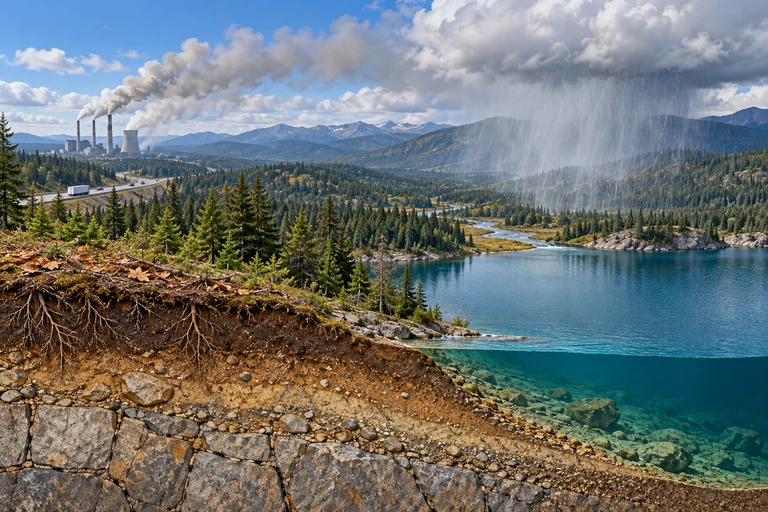 Atmospheric oxidation produces acids and sulfate or nitrate products. Wet deposition and dry gas or particle deposition both deliver material to watersheds; later rain can mobilize dry deposits.
Acid deposition from source to receiving watershed
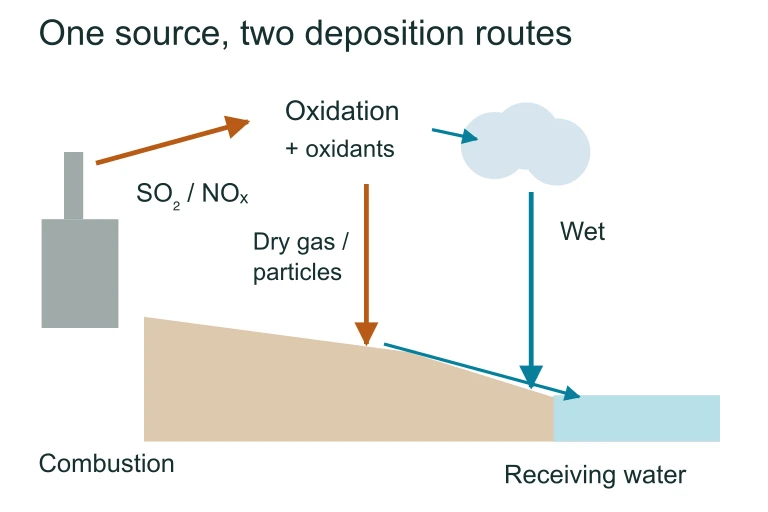 Atmospheric oxidation produces acids and sulfate or nitrate products. Wet deposition and dry gas or particle deposition both deliver material to watersheds; later rain can mobilize dry deposits.
Wet vs. Dry Deposition
| Wet Deposition | Dry Deposition | |
|---|---|---|
| Form | Rain, snow, sleet, fog | Particulates, gases, aerosols |
| Mechanism | Acids dissolve in water droplets | Gravity settles particles on surfaces |
| Proportion | ~50% of total acid deposition | ~50% of total acid deposition |
| Becomes acidic when | Already acidic on contact | Reacts with moisture on surfaces |
| Travel distance | Can travel hundreds of km | Typically closer to emission source |
Ecological Effects
Buffering Capacity of Soils & Lakes
A region's vulnerability to acid rain depends on the buffering capacity of its underlying geology. Buffers neutralize added acid, preventing pH from dropping dramatically.
Aluminum Mobilization
Sources: Anthropogenic vs. Natural
How to Analyze an Acid Rain Scenario
Example: Calculating Acidity
A lake's pH drops from 6.0 to 4.0 due to acid rain. How many times more acidic has the lake become?
Example: Regional Vulnerability
Two regions receive equal amounts of acid rain. Region A sits on limestone bedrock, while Region B sits on granite. Which suffers greater ecological damage?
Equal deposition, contrasting buffering and soil effects
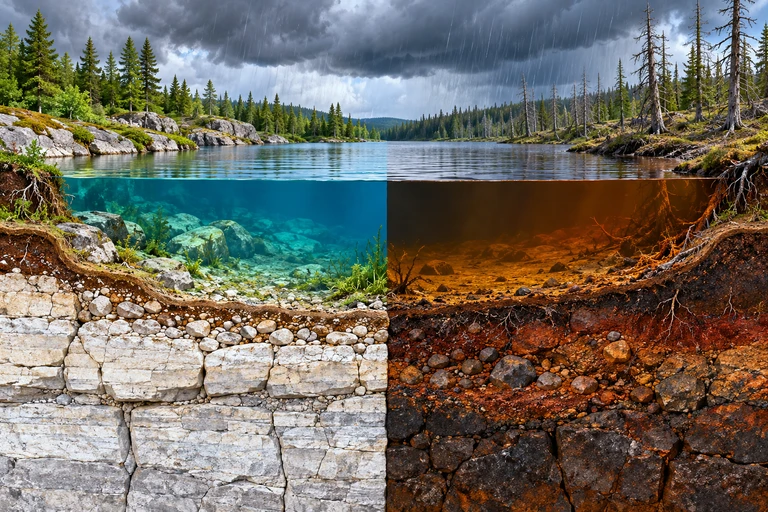 Equal acid deposition can produce different responses because buffering capacity differs. Carbonate minerals can neutralize hydrogen ions, while acidification can mobilize aluminum and leach soil nutrients.
Equal acid input, different neutralization
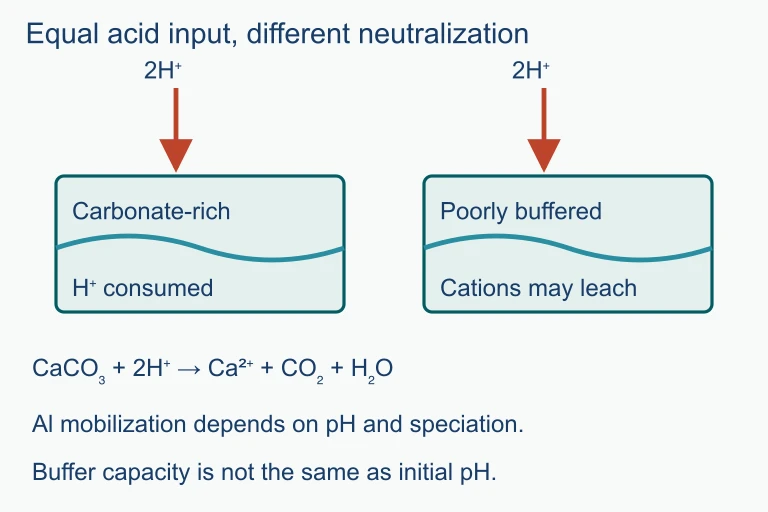 Equal acid deposition can produce different responses because buffering capacity differs. Carbonate minerals can neutralize hydrogen ions, while acidification can mobilize aluminum and leach soil nutrients.
Example: Policy in Action
The US Clean Air Act Amendments of 1990 established a cap-and-trade system for \(\text{SO}_2\). By 2010, \(\text{SO}_2\) emissions fell by approximately 67% from 1990 levels.
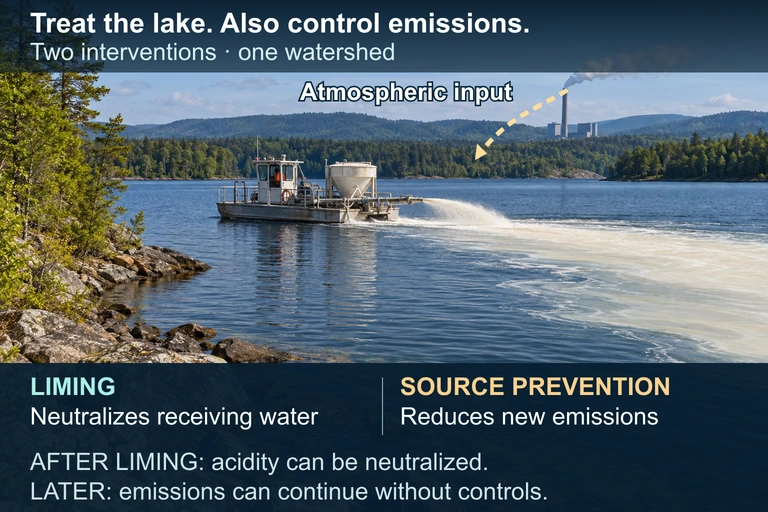
Distinguish source prevention from temporary receiving-water remediation.
Use this illustration to explore the concept described in its caption.
Common Mistakes
Question 1 of 5
Which two acids are the primary components of acid rain?
Question 2 of 5
If a lake's pH decreases from 5.0 to 3.0, by what factor has the hydrogen ion concentration increased?
Question 3 of 5
A region with granite bedrock receives acid rain. Compared to a region with limestone bedrock, the granite region will most likely experience:
Question 4 of 5
Which of the following best explains why acid rain is considered a transboundary pollution problem?
Question 5 of 5
The US Clean Air Act Amendments of 1990 reduced \(\text{SO}_2\) emissions primarily through which mechanism?