AP Environmental Science • Land and Water Use

The Tragedy of the Commons

Why shared resources face overexploitation when individual incentives conflict with collective sustainability.

A sprouting plant framed by Earth and recycling symbols.
Inside this lesson 10 sections 5 questions 7 figures

SECTION 1

Historical Context & Motivation

The idea that shared resources are vulnerable to overuse is hardly new; medieval English villages confronted the problem every time farmers grazed livestock on communal pastures. However, the concept gained its modern formulation when ecologist Garrett Hardin published his landmark 1968 essay in Science, titled "The Tragedy of the Commons." Hardin argued that when a resource is open to all users with no regulation, each rational individual will increase their own consumption even though collective overuse leads to the resource's degradation or collapse. This tension between individual rationality and collective sustainability remains one of the most important frameworks in environmental science and policy.

1833 • Lloyd's Pamphlet

British economist William Forster Lloyd first described the logic of common-pasture overgrazing in a pair of lectures at Oxford, planting the intellectual seed for the concept.

1968 • Hardin's Essay

Garrett Hardin published "The Tragedy of the Commons" in Science, framing population growth and resource depletion as consequences of unregulated access to shared resources.

1990 • Ostrom's Counterpoint

Political scientist Elinor Ostrom published Governing the Commons, demonstrating that communities can self-organize to manage shared resources sustainably without privatization or government mandate.

2009 • Nobel Recognition

Ostrom became the first woman to receive the Nobel Prize in Economics, recognized for her empirical work on common-pool resource governance across diverse cultures.

The central question the tragedy of the commons poses is deceptively simple: if no single user bears the full cost of overusing a shared resource, what prevents every user from taking as much as possible? Answering that question requires understanding the nature of common-pool resources, the incentive structures that drive exploitation, and the policy mechanisms—from regulation to community agreements—that can avert collapse.

SECTION 2

Core Principles & Definitions

To analyze the tragedy of the commons rigorously, it is essential to distinguish among different categories of goods based on two properties: excludability (whether users can be prevented from accessing the resource) and rivalrousness (whether one person's use diminishes the resource for others). A common-pool resource is rivalrous but non-excludable—fish in international waters, for example, are depleted by each harvest yet difficult to fence off from other fishers. This combination creates the conditions for tragedy.

1

Common-Pool Resources (CPR)

Resources that are rivalrous (depletable) yet non-excludable: open-ocean fisheries, groundwater aquifers, atmospheric carbon capacity, and shared grazing lands.
2

Free-Rider Problem

Each user has an incentive to consume more while relying on others to restrain themselves. Because benefits are private and costs are distributed, restraint is individually irrational.
3

Externalities

The costs of overuse—habitat loss, pollution, species decline—are not borne by the individual user alone but are spread across all users and future generations, creating negative externalities.
4

Carrying Capacity Link

Every commons has a sustainable yield threshold. When aggregate demand exceeds the resource's regeneration rate, stocks decline—mirroring the ecological concept of carrying capacity.
5

Governance Solutions

Privatization, government regulation, or community-based management (Ostrom's approach) can realign incentives so individual choices support long-term sustainability of the shared resource.
✦

KEY TAKEAWAY

Imagine a shared office refrigerator with free snacks. If nobody monitors it, a few people load up their bags while the majority find empty shelves. Each "rational" individual maximizes personal snack intake, but collective welfare crashes. The tragedy of the commons operates identically—except the refrigerator is a fishery, a forest, or the atmosphere, and the consequences are ecological collapse rather than a missed lunch.

SECTION 3

Visual Explanation — The Overgrazing Model

Tragedy of the Commons — Pasture Overgrazing ModelNumber of Cattle on CommonsResource Quality / Grass SupplySustainable Yield ThresholdOptimal pointGrass supply (resource)Individual profit/cowSustainable thresholdFew cattleMany cattleSUSTAINABLE ZONEGrass regenerates fasterTRAGEDY ZONEOvergrazing → collapse
The green curve represents grass supply (resource quality), which declines as more cattle are added. The dashed pink curve shows individual profit per cow, which initially rises but eventually falls as the commons degrades. The yellow threshold line marks the point beyond which harvesting exceeds regeneration, entering the tragedy zone.

The diagram above captures Hardin's central insight in graphical form. To the left of the sustainable yield threshold, the pasture regenerates grass faster than the herd consumes it—an ecologically stable equilibrium. Each additional cow adds marginal profit to its owner while spreading the cost of slightly reduced grass quality across every herder. To the right of the threshold, aggregate consumption outpaces regeneration. The resource enters a declining spiral: lower grass quality reduces the value of each cow, yet each herder still has an incentive to add one more animal because the individual benefit of that extra cow exceeds the individual's share of the degradation cost. The result is a predictable, collectively irrational collapse of the resource.

SECTION 4

The Incentive Mechanism — Why Rational Actors Overuse

Although the tragedy of the commons is not typically expressed through formal equations on the AP Environmental Science exam, a simple cost-benefit framework clarifies why the tragedy is structurally inevitable absent intervention. Consider a herder deciding whether to add one more cow to a communal pasture shared by n herders.

INDIVIDUAL BENEFIT

Benefittoherder=+1cow′sfullrevenueBenefit to herder = +1 cow's full revenue

The herder gains the entire sale value of the additional animal's milk or meat.

SHARED COST

Costtoherder=(Totaldegradationfrom+1cow)÷nCost to herder = (Total degradation from +1 cow) ÷ n

The environmental damage (grass depletion, soil compaction) is shared among all n herders, so each individual bears only 1/n of the total cost.

NET INDIVIDUAL INCENTIVE

Net=Fullrevenue−(Degradation÷n)Net = Full revenue − (Degradation ÷ n)

As long as the full revenue exceeds the herder's fractional share of the degradation, the rational choice is to add the cow. Because n is large, this condition almost always holds—even when total degradation greatly exceeds total revenue.

The critical insight is that benefits are privatized while costs are socialized. When every herder follows this logic simultaneously, the pasture is overloaded beyond its maximum sustainable yield. This structural asymmetry between private gain and shared loss is what makes the tragedy so persistent across different resource types—from atmospheric carbon emissions to groundwater extraction to open-access fisheries.

💡

AP Exam Tip

FRQ prompts frequently ask you to identify the tragedy of the commons in a novel scenario. Look for two features: (1) the resource is shared and non-excludable, and (2) each user's individual incentive leads to overuse. Then connect the scenario to a specific solution type—regulation, privatization, or community management.

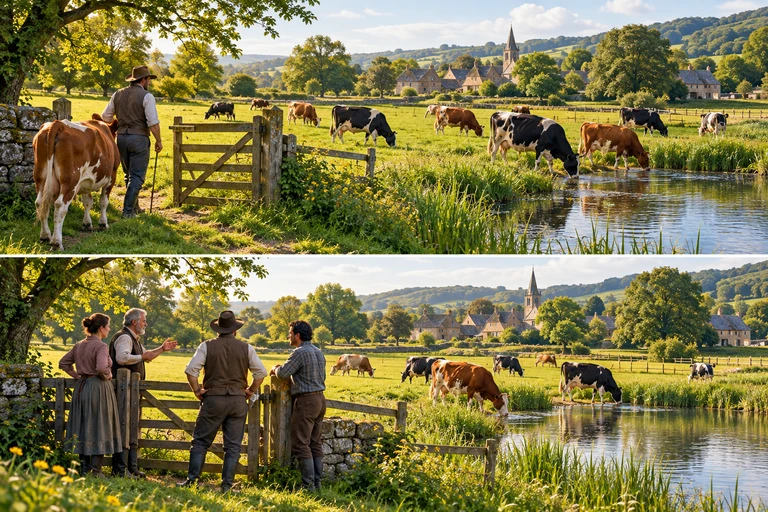
Two matched pasture views show a herder considering an extra cow and neighbors discussing shared access beside a watering area.Suppose twenty users equally share a 20-unit degradation cost while the acting user receives an 8-unit benefit. The private and total costs differ. Rules for a governed commons can change those incentives.
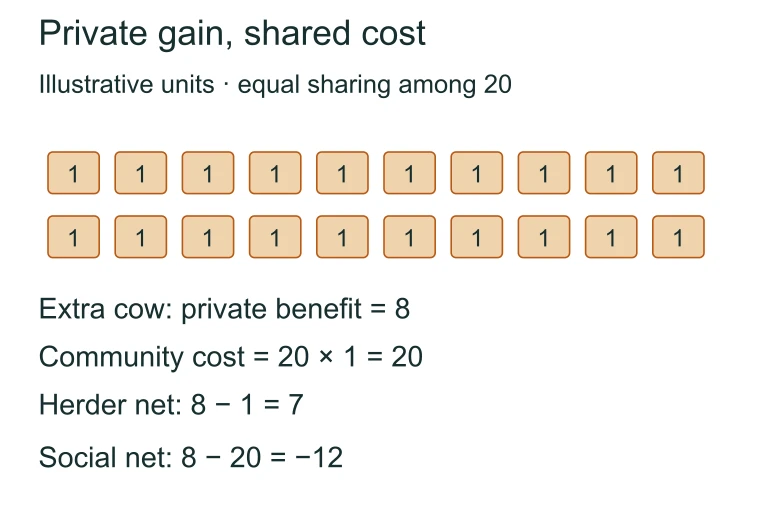
The twentieth share of one extra cow. Suppose twenty users equally share a 20-unit degradation cost while the acting user receives an 8-unit benefit. The private and total costs differ. Rules for a governed commons can change those incentives.Suppose twenty users equally share a 20-unit degradation cost while the acting user receives an 8-unit benefit. The private and total costs differ. Rules for a governed commons can change those incentives.

SECTION 5

Real-World Cases of the Tragedy of the Commons

The tragedy of the commons is not merely an abstract thought experiment; it has played out—and continues to play out—across a wide range of environmental domains. Examining specific cases helps connect the theoretical framework to tangible ecological and economic consequences that appear regularly on the AP Environmental Science exam.

Tragedy of the Commons — Five Case Studies🐟 Ocean FisheriesOpen-access fishing → overharvestExample: Atlantic cod collapseSolution: catch quotas, ITQs🌳 DeforestationShared forests cleared for profitExample: Amazon slash-and-burnSolution: REDD+, community forestry💨 Air Pollution / CO₂Atmosphere as open dumping groundExample: global climate changeSolution: cap-and-trade, carbon tax💧 Groundwater DepletionShared aquifer → over-pumpingExample: Ogallala Aquifer drawdownSolution: water rights, metering🚗 Traffic CongestionRoads as non-excludable resourceExample: urban rush-hour gridlockSolution: congestion pricing, transitAll share the same structural incentive: individual benefit > individual cost of overuse
Five major real-world examples of the tragedy of the commons, each showing the shared resource, a well-known case, and the governance solution typically proposed. All share the same underlying incentive structure.

The Atlantic cod fishery off the Grand Banks of Newfoundland is perhaps the most cited ecological tragedy of the commons. For centuries, cod stocks seemed limitless, but modern trawling technology allowed harvests to exceed the species' reproductive rate. By 1992, the population had collapsed to roughly one percent of its historical biomass, prompting a moratorium that devastated fishing communities. The Ogallala Aquifer beneath the U.S. Great Plains faces a parallel dynamic: thousands of irrigators each pump water at rates that are individually small but collectively exceed recharge, drawing down a resource that accumulated over millions of years. In the atmospheric domain, carbon dioxide emissions represent a global-scale commons problem—each nation benefits from fossil-fuel combustion while distributing the cost of climate change across all nations and generations.

SECTION 6

Worked Example — A Shared Fishery

The following scenario illustrates how to apply the tragedy-of-the-commons framework to a quantitative problem, the type of analysis that could appear in an FRQ asking you to propose a solution involving calculations.

Overfishing in Lake Clearwater

  1. 1

    Step 1 — Identify the Scenario

    Lake Clearwater supports a fish population with a maximum sustainable yield (MSY) of 10,000 kg per year. There are 20 independent fishing boats, and each currently harvests 600 kg/year.
  2. 2

    Step 2 — Calculate Total Current Harvest

    Total harvest = 20 boats × 600 kg/boat = 12,000 kg/year.
    12,000 kg/year — exceeds MSY by 2,000 kg
  3. 3

    Step 3 — Determine Sustainable Quota per Boat

    To bring the total harvest down to the MSY: Per-boat quota = 10,000 kg ÷ 20 boats = 500 kg/boat/year.
    500 kg per boat per year
  4. 4

    Step 4 — Explain the Tragedy Dynamic

    Without a quota, each boat's incentive is to increase harvest. Catching one extra kilogram generates full revenue for that fisher but distributes the ecological cost across all 20 fishers (each bears only 1/20 of the degradation). Because the individual benefit exceeds the individual cost, every boat has reason to increase its catch—leading to a collective harvest that degrades the fish population below replacement level.
  5. 5

    Step 5 — Propose a Solution

    A regulatory agency could implement individual transferable quotas (ITQs) capping each boat at 500 kg/year. This internalizes the externality: the quota forces each fisher to bear the cost of their harvest. Alternatively, a fishing license fee that funds stock monitoring would couple private use to public cost. The overshoot of 2,000 kg must be eliminated to maintain the fishery's long-term viability.
    ITQ of 500 kg/boat aligns individual incentives with MSY

SECTION 7

Comparing Solutions to the Tragedy

Multiple governance strategies have been proposed and tested to prevent or reverse the tragedy of the commons. Each carries distinct strengths and limitations. Understanding these trade-offs is essential for the FRQ, where you may be asked to evaluate a proposed solution for a given scenario.

Solution TypeStrengthsLimitations
Government Regulation (quotas, bans, permits)Enforceable across all users; can set science-based limits; applies uniformlyRequires monitoring and enforcement funding; can be politically influenced; may lack local flexibility
Privatization (assign property rights)Owners have direct incentive to conserve their own resource; aligns long-term profit with sustainabilitySome resources (air, oceans) cannot be easily divided; may create inequity; ignores cultural commons traditions
Community Management (Ostrom's approach)Leverages local knowledge; rules evolve with conditions; builds social trust and cooperationWorks best in small, stable communities; harder to scale to global commons like the atmosphere
Market-Based Instruments (cap-and-trade, taxes)Economically efficient; lets market find lowest-cost reductions; generates revenue for restorationRequires accurate valuation of externalities; can be regressive; political opposition to new taxes
International Treaties (Montreal Protocol, Paris Agreement)Only mechanism for global commons; can create binding targets; mobilizes collective actionEnforcement is voluntary among sovereign nations; free-rider problem persists at national level

Comparison of five major approaches to solving the tragedy of the commons

✦

KEY TAKEAWAY

No single solution is universally optimal. Just as an engineer selects the right material for a specific load, environmental policymakers must match the governance tool to the resource's scale, the community's capacity, and the urgency of the threat. The AP exam rewards students who can justify why a particular solution fits a given scenario rather than simply naming one.

SECTION 8

Beyond Hardin — Ostrom & Modern Perspectives

While Hardin's model remains foundational, subsequent scholarship—especially the work of Elinor Ostrom—has challenged the assumption that tragedy is inevitable. Ostrom studied hundreds of common-pool resource systems worldwide (irrigation networks in Nepal, lobster fisheries in Maine, forest management in Japan) and identified conditions under which communities self-govern successfully. Her research yielded eight design principles for stable commons management, including clearly defined boundaries, rules adapted to local conditions, collective decision-making, effective monitoring, graduated sanctions for rule-breakers, and accessible conflict-resolution mechanisms.

FeatureHardin's Model (1968)Ostrom's Framework (1990)
Key assumptionUsers are selfish, isolated actors who cannot communicate or cooperateUsers can communicate, build trust, and create enforceable rules collaboratively
Predicted outcome without interventionInevitable resource collapseCollapse is possible but not inevitable; many communities self-organize successfully
Preferred solutionExternal control: government regulation or privatizationPolycentric governance: nested layers of local, regional, and national rules
Scale of applicabilityUniversal claim, often applied to global commonsMost robust at local-to-regional scale; global commons remain challenging

Hardin vs. Ostrom: contrasting frameworks for commons governance

The AP Environmental Science course increasingly reflects this more nuanced view. Exam questions may present scenarios where community-based management has either succeeded or failed, and students are expected to analyze the conditions that determine outcomes. Looking forward, emerging commons challenges—space debris, deep-sea mining, and artificial-intelligence training data—will test whether these governance frameworks can adapt to resources that previous generations never imagined sharing.

SECTION 9

Practice Problems

Question 1: CONCEPTUAL

Which of the following best explains why the tragedy of the commons occurs? A. Government regulations prevent individuals from using shared resources efficiently. B. The individual benefit of exploiting a shared resource exceeds the individual cost, leading to collective overuse. C. Shared resources are always non-renewable, so any use leads to depletion. D. Private ownership of all resources inevitably leads to environmental degradation.
Show answer
Correct answer: B. The tragedy of the commons arises because each individual captures the full benefit of using a shared resource while bearing only a fraction of the degradation cost, creating a structural incentive for overuse. A is incorrect because government regulations are a proposed solution, not a cause. C is incorrect because the tragedy applies to renewable common-pool resources (fisheries, forests) where sustainable use is possible; the issue is overuse, not inherent non-renewability. D is incorrect because privatization actually gives owners an incentive to conserve—the tragedy specifically concerns non-excludable (shared) resources, not privately owned ones.

Question 2: BASIC CALCULATION

A communal grazing pasture can sustainably support 200 cattle. Ten herders share the pasture, and each currently has 25 cattle. What is the maximum number of cattle each herder could add while keeping the total at the sustainable limit? A. 0 cattle B. 5 cattle C. 20 cattle D. 25 cattle
Show answer
Correct answer: A. Current total = 10 herders × 25 cattle = 250 cattle. The sustainable limit is 200, so the pasture is already overloaded by 50 cattle. No herder can add any cattle; in fact, each would need to reduce their herd by 5 to reach the sustainable threshold of 20 cattle per herder. B (5 each) would bring the total to 300, worsening the tragedy. C (20 each) would yield 450 total, far exceeding capacity. D (25 each) would double the herd to 500 total—catastrophic overgrazing.

Question 3: INTERMEDIATE

A coastal city shares an offshore fishery with three neighboring cities. The fishery has a maximum sustainable yield of 40,000 metric tons per year. City A harvests 12,000 mt, City B harvests 11,000 mt, City C harvests 9,000 mt, and City D harvests 13,000 mt. A regional agency proposes reducing each city's harvest proportionally to bring the total to the MSY. A. City D's new quota would be approximately 11,556 mt. B. City D's new quota would be 10,000 mt. C. City D's new quota would be approximately 12,444 mt. D. City D's new quota would be 13,000 mt because they should not have to reduce.
Show answer
Correct answer: A. Total current harvest = 12,000 + 11,000 + 9,000 + 13,000 = 45,000 mt. The proportional reduction factor = MSY ÷ current total = 40,000 ÷ 45,000 ≈ 0.889. City D's quota = 13,000 × 0.889 ≈ 11,556 mt. B (10,000) assumes an equal-share approach (40,000 ÷ 4), not proportional reduction. C is a miscalculation. D is incorrect because maintaining City D's harvest at 13,000 would require other cities to absorb all the reduction, and the scenario specifies proportional reduction.

Question 4: APPLIED

Design an investigation to determine whether a community-managed irrigation system in a semi-arid region is experiencing a tragedy of the commons. (a) State a testable hypothesis about water use and crop yield in the shared irrigation system. (1 pt) (b) Describe the data you would collect, including at least two specific variables and how they would be measured. (2 pts) (c) Explain how you would determine whether the irrigation system's use exceeds its sustainable capacity. (1 pt) (d) Identify one confounding variable and explain how you would control for it. (1 pt)
Show answer
Rubric (5 points): (a) 1 pt: A testable hypothesis linking water withdrawal to sustainability. Example: "If the total water withdrawal by farmers from the shared canal exceeds the aquifer recharge rate, then downstream crop yields will decline over successive growing seasons." The hypothesis must include an independent variable (withdrawal rate), a dependent variable (yield or water level), and a predicted direction of change. (b) 2 pts (1 per variable, max 2): Variable 1: Volume of water withdrawn per farm per month, measured using flow meters at each diversion point. Variable 2: Aquifer or canal water level, measured weekly using monitoring wells or gauge stations. Additional credit-worthy variables include crop yield per hectare, soil moisture content, or water quality (salinity from over-extraction). (c) 1 pt: Compare the total measured withdrawal rate across all farms to the measured or estimated recharge rate of the aquifer/canal system. If total withdrawal consistently exceeds recharge (i.e., water levels show a declining trend over multiple seasons), the system is being used beyond its sustainable capacity. (d) 1 pt: Confounding variable: annual precipitation variation. Control: collect rainfall data from a nearby weather station and normalize water-level trends against precipitation to distinguish drought effects from over-extraction effects. Alternatively, compare yield trends between farms with metered access (controlled) and unmetered access.

Question 5: CRITICAL THINKING

A country's government discovers that its largest freshwater lake is losing volume at a rate of 3% per year because surrounding agricultural operations are diverting water for irrigation. The lake currently holds 50 km³ of water and receives 1.2 km³ of annual inflow from rivers and precipitation. Agricultural diversions currently total 2.7 km³/year. (a) Calculate the net annual change in lake volume and confirm the percentage loss. Show your work. (1 pt) (b) Calculate the maximum sustainable diversion rate if the lake's volume is to remain stable. (1 pt) (c) Propose TWO specific policy solutions that could reduce diversions to a sustainable level. For each, explain how it addresses the tragedy of the commons. (2 pts) (d) Evaluate which of your two solutions would be more effective if the farming community has low trust in the central government. Justify your reasoning using Ostrom's framework. (1 pt)
Show answer
Rubric (5 points): (a) 1 pt: Net annual change = inflow − diversions = 1.2 km³ − 2.7 km³ = −1.5 km³/year. Percentage loss = 1.5 ÷ 50 × 100 = 3.0%. This confirms the stated rate. Must show subtraction and division for full credit. (b) 1 pt: For the lake to remain stable, diversions must equal inflow: maximum sustainable diversion = 1.2 km³/year. Any diversion above this rate produces a net loss. Current diversions must be reduced by 2.7 − 1.2 = 1.5 km³/year (a 55.6% reduction). (c) 2 pts (1 per solution): Solution 1: Water-use permits—the government issues permits totaling 1.2 km³/year allocated proportionally among farms. This addresses the tragedy by making the cost of overuse excludable: farmers without permits cannot legally divert water. Solution 2: A water-pricing system (per-cubic-meter fee) that increases as total extraction approaches the sustainable limit. This internalizes the externality by making each farmer pay the true cost of their water use, reducing the gap between private benefit and social cost. (d) 1 pt: In a low-trust environment, a community-managed quota system (aligned with Ostrom's principles) would likely be more effective than top-down government permits. Ostrom's framework shows that when resource users participate in rule-making, monitor compliance themselves, and apply graduated sanctions, they are more likely to comply because they perceive the rules as legitimate. Government-imposed permits may face noncompliance, corruption, or evasion where institutional trust is low.

SUMMARY

Lesson Summary

Summary

The tragedy of the commons, first formalized by Garrett Hardin in 1968, describes how common-pool resources—those that are rivalrous yet non-excludable—face degradation when individual incentives to consume exceed the individual share of the collective degradation cost. Classic examples include ocean fisheries, groundwater aquifers, shared forests, and the atmosphere as a carbon sink.

Solutions fall into several categories: government regulation (quotas, permits), privatization (assigning property rights), community-based management (Elinor Ostrom's design principles), and market-based instruments (cap-and-trade, taxes). The key quantitative relationship is comparing total extraction rate against maximum sustainable yield; when extraction exceeds regeneration, resource collapse follows. On the AP exam, always identify the commons, explain the incentive asymmetry, and justify a solution that realigns private costs with social costs.

Varsity Tutors • AP Environmental Science • The Tragedy of the Commons