

SECTION 1
Historical Context & Motivation
Nitrogen comprises approximately 78% of Earth's atmosphere, yet for centuries scientists struggled to explain why this seemingly abundant element so frequently limits biological productivity. The paradox is striking: organisms are bathed in a nitrogen-rich atmosphere, but most cannot access atmospheric dinitrogen (N2) because of its remarkably stable triple covalent bond. Understanding how nitrogen moves between the atmosphere, biosphere, hydrosphere, and lithosphere became one of the great achievements of 19th- and 20th-century chemistry and ecology, ultimately reshaping agriculture, industrial policy, and our comprehension of biogeochemical cycling.
1772 • Isolation of Nitrogen Gas
1838 • Boussingault's Soil Studies
1888 • Discovery of Root Nodule Bacteria
1909 • The Haber-Bosch Process
1970s–Present • Nitrogen Pollution Era
The central question the nitrogen cycle addresses is deceptively simple: how does inert atmospheric N2 become biologically available nitrogen, cycle through living systems, and ultimately return to the atmosphere? Understanding this cycle is essential for the AP Environmental Science exam because it connects ecosystem energetics, soil science, water quality, climate change, and agricultural policy into a single coherent framework.
SECTION 2
Core Principles & Definitions
The nitrogen cycle is a biogeochemical cycle — meaning that nitrogen is transformed by both living organisms (bio-) and abiotic chemical reactions (geo-/chemical) as it moves among environmental reservoirs. Unlike the carbon cycle, which relies heavily on photosynthesis and respiration, the nitrogen cycle is dominated by microbial metabolism. Specialized bacteria and archaea catalyze nearly every major transformation. The cycle can be organized into five major processes, each converting nitrogen from one chemical form to another.
Nitrogen Fixation
Nitrification
Assimilation
Ammonification (Mineralization)
Denitrification
KEY TAKEAWAY
SECTION 3
The Nitrogen Cycle — Visual Overview
Notice the cyclic structure of the diagram: nitrogen enters the biologically available pool primarily through fixation (①) and exits via denitrification (⑤). The internal loop — nitrification → assimilation → death/excretion → ammonification — represents the rapid recycling of nitrogen within ecosystems. On the AP exam, you will need to identify which processes are aerobic versus anaerobic, which organisms are responsible for each step, and how human activities (fertilizer application, fossil fuel combustion, cultivation of legumes) alter the relative rates of these transformations. Pay particular attention to the fact that nitrification requires oxygen while denitrification occurs under anaerobic conditions, such as waterlogged soils and aquatic sediments.
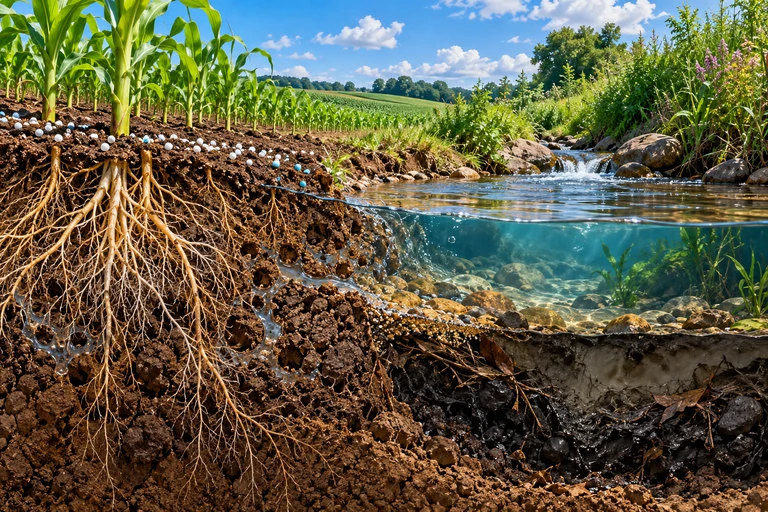 Aerobic nitrification converts ammonium through nitrite to nitrate. Nitrogen can then enter plant organic matter or follow a low-oxygen denitrification route. These are alternative routes for a tagged atom.
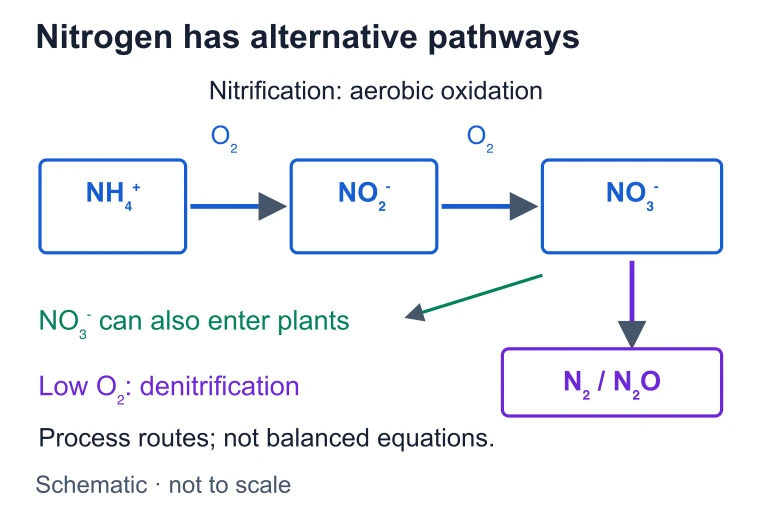 Aerobic nitrification converts ammonium through nitrite to nitrate. Nitrogen can then enter plant organic matter or follow a low-oxygen denitrification route. These are alternative routes for a tagged atom.
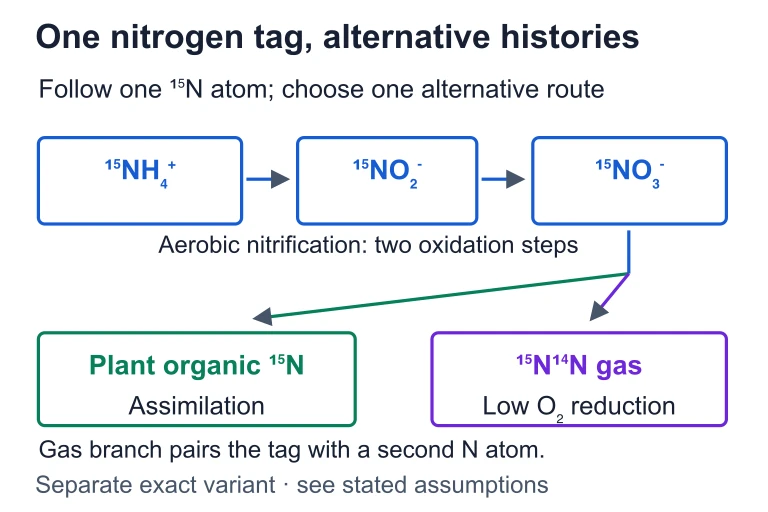 Follow a ¹⁵N tag through ammonium, nitrite and nitrate. Uptake into plant organic nitrogen and denitrification are alternative routes; in the depicted N₂ molecule the tagged atom pairs with a separate ¹⁴N atom.
SECTION 4
Mechanisms of Each Transformation
Nitrogen Fixation — Breaking the Triple Bond
The N≡N triple bond has a bond dissociation energy of approximately 945 kJ/mol, making it one of the strongest bonds in nature. Biological nitrogen fixation is catalyzed by the enzyme nitrogenase, which requires 16 ATP per molecule of N₂ fixed — a substantial energetic investment. Free-living bacteria (e.g., Azotobacter in soil, cyanobacteria in aquatic systems) and symbiotic bacteria (Rhizobium in legume root nodules) perform this reaction. Abiotic fixation occurs through lightning (which provides energy to split N₂) and through the industrial Haber-Bosch process, which operates at temperatures around 400–500°C and pressures of 150–300 atm.
BIOLOGICAL NITROGEN FIXATION
This reaction is catalyzed by the nitrogenase enzyme complex. The enzyme is irreversibly inactivated by O₂, which is why nitrogen-fixing organisms require anaerobic microsites or protective structures like root nodules.
Nitrification — A Two-Step Oxidation
Nitrification is a strictly aerobic process carried out by chemoautotrophic bacteria that derive energy from oxidizing inorganic nitrogen compounds. In the first step, Nitrosomonas (and related ammonia-oxidizing archaea) convert ammonium to nitrite. In the second step, Nitrobacter converts nitrite to nitrate. Because nitrate (NO₃⁻) carries a negative charge, it is highly mobile in soil water and susceptible to leaching — the process by which dissolved ions are washed out of the soil profile by percolating water, often entering streams and groundwater.
NITRIFICATION (TWO STEPS)
Both steps are exergonic and release energy used by the bacteria for chemosynthesis. Note that oxygen is required; nitrification is inhibited in waterlogged or compacted soils.
Denitrification — Closing the Loop
Denitrification is the only major pathway that removes reactive nitrogen from ecosystems and returns it to the atmosphere as N₂ or N₂O. It is carried out by facultative anaerobic bacteria (e.g., Pseudomonas, Paracoccus) that use NO₃⁻ as a terminal electron acceptor in place of O₂ when oxygen is limited. Wetlands, waterlogged soils, and deep aquatic sediments are hotspots for denitrification — a fact with significant implications for nutrient management and constructed wetland design.
DENITRIFICATION
Intermediate products include NO₂⁻, NO, and N₂O. The greenhouse gas nitrous oxide (N₂O) is released when denitrification is incomplete, which is increasingly common in nitrogen-enriched agricultural soils.
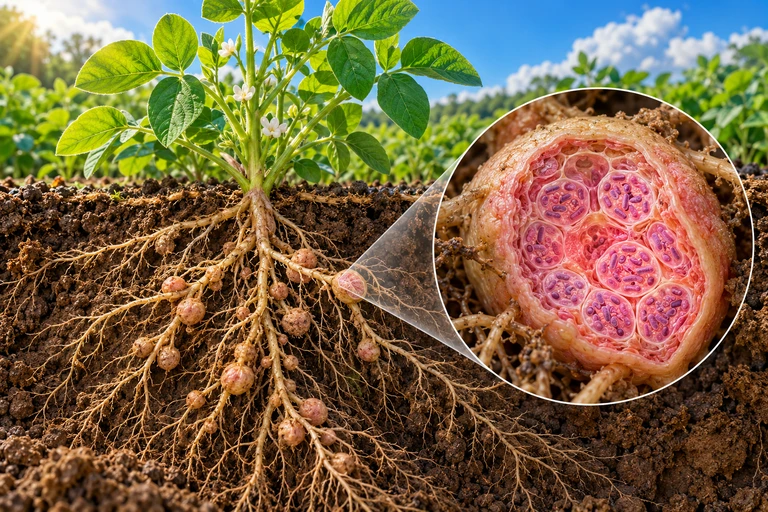 Legume nodules house living microbial symbionts. Plant carbon supports microbial nitrogen fixation, while oxygen regulation protects nitrogenase and still permits respiration.
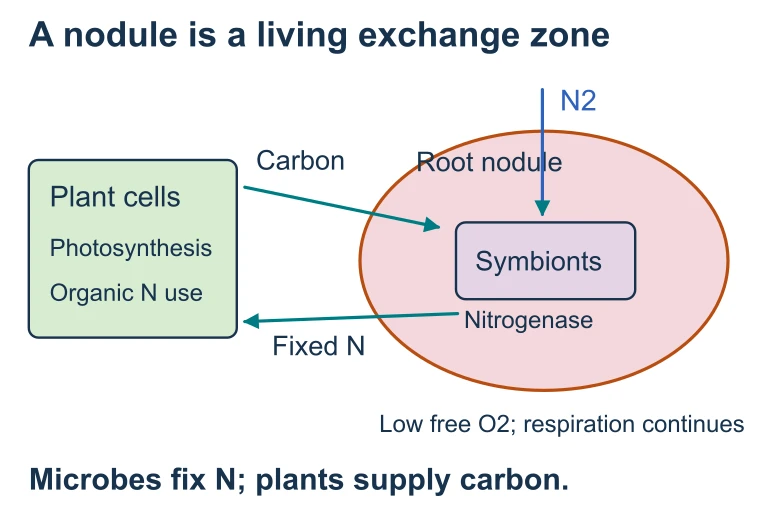 Legume nodules house living microbial symbionts. Plant carbon supports microbial nitrogen fixation, while oxygen regulation protects nitrogenase and still permits respiration.
SECTION 5
Human Alteration of the Nitrogen Cycle
Humans have approximately doubled the annual rate of nitrogen fixation on Earth. Before industrialization, biological fixation contributed roughly 100–140 Tg N/year (Tg = teragrams = 10¹² g). Today, anthropogenic sources add an additional 150+ Tg N/year through synthetic fertilizer production (Haber-Bosch), cultivation of nitrogen-fixing crops (legumes, rice paddies), and combustion of fossil fuels (which generates nitrogen oxides, NOₓ). This massive perturbation has cascading consequences that are central to the APES curriculum.
| Human Activity | Nitrogen Form Released | Environmental Consequence |
|---|---|---|
| Synthetic fertilizer application | NH₄⁺, NO₃⁻ (via nitrification) | Eutrophication of lakes, rivers, and coastal zones; groundwater contamination |
| Fossil fuel combustion | NOₓ (NO, NO₂) | Photochemical smog, acid deposition (HNO₃), respiratory illness |
| Cultivation of legumes / rice | NH₃ / NH₄⁺ | Increased soil N; downstream eutrophication when excess leaches |
| Animal feedlot operations | NH₃ (volatilized), NO₃⁻ (leached) | Atmospheric N deposition, groundwater pollution, hypoxic dead zones |
| Wastewater discharge | NH₄⁺, NO₃⁻, organic N | Algal blooms, oxygen depletion, biodiversity loss in receiving waters |
Major anthropogenic sources of reactive nitrogen and their environmental consequences
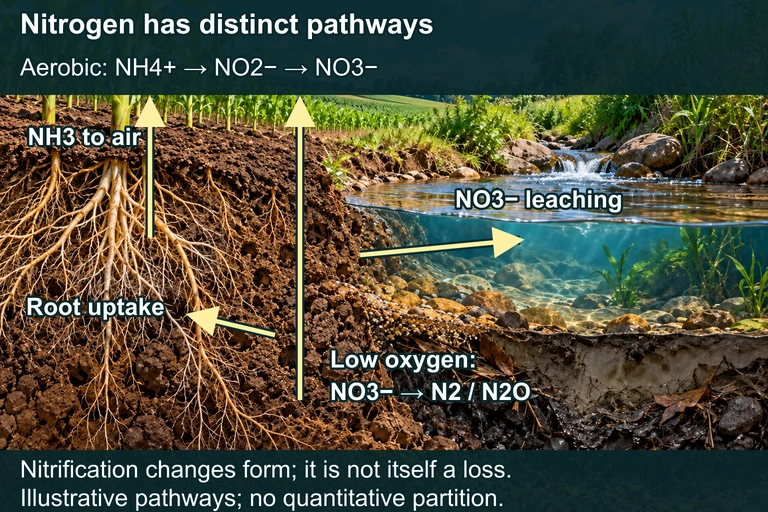 Fertilizer nitrogen can enter plants, leach as nitrate, volatilize as ammonia or leave through gaseous nitrogen pathways. Aerobic nitrification changes chemical form; denitrification occurs under suitable low-oxygen conditions. The arrows are qualitative and no loss partition is implied.
SECTION 6
Worked Example — Nitrogen Budget of an Agricultural Field
A common APES application involves calculating the nitrogen balance of an ecosystem or agricultural system. Understanding inputs and outputs allows us to predict whether reactive nitrogen is accumulating (potentially causing pollution) or being depleted (potentially limiting crop yields).
Nitrogen Budget for a 100-Hectare Soybean/Corn Rotation
- 1
Step 1 — Identify Nitrogen Inputs
A farmer applies 150 kg N/ha of synthetic fertilizer to a 100-hectare field annually. The field also receives approximately 5 kg N/ha from atmospheric deposition (wet and dry) and 10 kg N/ha from biological fixation by a soybean rotation crop.Total input = (150 + 5 + 10) × 100 ha = 16,500 kg N/year - 2
Step 2 — Identify Nitrogen Outputs
Crop harvest removes 120 kg N/ha (nitrogen in grain and biomass). Denitrification accounts for approximately 15 kg N/ha. Ammonia volatilization from the soil surface removes about 8 kg N/ha.Total output (non-leaching) = (120 + 15 + 8) × 100 ha = 14,300 kg N/year - 3
Step 3 — Calculate the Surplus
The nitrogen surplus represents the amount of reactive nitrogen that is either stored in soil organic matter or lost via leaching and runoff into waterways.Surplus = 16,500 − 14,300 = 2,200 kg N/year (22 kg N/ha) - 4
Step 4 — Interpret the Result
A surplus of 22 kg N/ha means that for every hectare, 22 kg of reactive nitrogen is unaccounted for by crop uptake, denitrification, or volatilization. This nitrogen is primarily lost through nitrate leaching into groundwater and surface runoff into adjacent streams — both of which contribute to eutrophication. Reducing fertilizer application, optimizing timing (applying fertilizer when crops are actively growing), and maintaining cover crops can decrease this surplus.22 kg N/ha surplus → potential for significant nitrate leaching and downstream eutrophication
SECTION 7
Comparing Nitrogen Cycle Processes
The AP exam frequently tests your ability to distinguish between the five major nitrogen cycle processes. The following table synthesizes the conditions, organisms, chemical transformations, and ecosystem significance of each process, providing a high-yield comparison for exam review.
| Process | Oxygen Requirement | Key Organisms | Transformation | Ecosystem Role |
|---|---|---|---|---|
| Fixation | Anaerobic microsite (nitrogenase is O₂-sensitive) | Rhizobium, Azotobacter, cyanobacteria | N₂ → NH₃ / NH₄⁺ | Primary input of bioavailable N |
| Nitrification | Strictly aerobic | Nitrosomonas, Nitrobacter | NH₄⁺ → NO₂⁻ → NO₃⁻ | Produces plant-available NO₃⁻; increases leaching risk |
| Assimilation | N/A (metabolic uptake) | Plants, algae, fungi, bacteria | NH₄⁺ / NO₃⁻ → organic N | Incorporates N into biomass; drives food webs |
| Ammonification | Aerobic or anaerobic | Decomposer bacteria, fungi | Organic N → NH₄⁺ | Recycles N from dead matter back into soil pool |
| Denitrification | Strictly anaerobic | Pseudomonas, Paracoccus | NO₃⁻ → N₂ / N₂O | Primary removal of reactive N; returns N₂ to atmosphere |
Summary comparison of the five major nitrogen cycle processes
KEY TAKEAWAY
SECTION 8
Connections to Other Biogeochemical Cycles & Advanced Topics
The nitrogen cycle does not operate in isolation — it is tightly coupled to the carbon cycle, the phosphorus cycle, and the hydrological cycle. Nitrogen fixation and assimilation require carbon skeletons (organic compounds) to incorporate fixed nitrogen into amino acids, so the rate of carbon fixation (photosynthesis) often limits nitrogen assimilation. Conversely, nitrogen availability frequently limits net primary productivity, particularly in terrestrial ecosystems — a concept known as nitrogen limitation. In marine and freshwater systems, phosphorus is often the primary limiting nutrient, but nitrogen co-limitation is common in coastal estuaries where both nutrients enter from agricultural runoff.
| Feature | Nitrogen Cycle | Phosphorus Cycle | Carbon Cycle |
|---|---|---|---|
| Major reservoir | Atmosphere (N₂) | Lithosphere (rock phosphate) | Atmosphere (CO₂) and ocean |
| Gaseous phase? | Yes — N₂, N₂O, NH₃, NOₓ | No — sedimentary cycle only | Yes — CO₂, CH₄ |
| Role of microbes | Dominant — fixation, nitrification, denitrification | Moderate — mycorrhizal uptake | Major — decomposition, methanogenesis |
| Primary human disruption | Haber-Bosch; fossil fuel combustion | Mining phosphate rock; detergents | Fossil fuel combustion; deforestation |
| Limiting nutrient in | Terrestrial systems (generally) | Freshwater systems (generally) | Not typically limiting |
Comparison of nitrogen, phosphorus, and carbon biogeochemical cycles
Looking ahead, advanced environmental science coursework explores the concept of planetary boundaries — the safe operating limits for Earth systems. According to the Stockholm Resilience Centre's 2009 framework (updated in 2015 and 2023), the biogeochemical nitrogen flow boundary has already been exceeded by a factor of approximately 2–3. This framing connects the nitrogen cycle to global sustainability policy, international environmental agreements, and the emerging field of Earth System Science — topics you may encounter in college-level environmental studies or ecology courses.
SECTION 9
Practice Problems
Question 1: CONCEPTUAL
- A. They convert atmospheric N₂ into ammonium (NH₄⁺) through biological nitrogen fixation.
- B. They oxidize ammonium (NH₄⁺) to nitrite (NO₂⁻) as the first step of nitrification.
- C. They reduce nitrate (NO₃⁻) to atmospheric N₂ through denitrification.
- D. They decompose organic nitrogen in dead organisms to release ammonium through ammonification.
Show answer (B)
Question 2: BASIC CALCULATION
- A. 1,750 kg N
- B. 3,500 kg N
- C. 7,000 kg N
- D. 10,000 kg N
Show answer (B)
Question 3: INTERMEDIATE
- A. Nitrification; aerobic, well-drained soil conditions
- B. Ammonification; warm temperatures and abundant organic matter
- C. Denitrification; anaerobic (low-oxygen) conditions in waterlogged soils
- D. Nitrogen fixation; presence of symbiotic bacteria in root nodules
Show answer (C)
Question 4: APPLIED
4 ptsShow answer
Question 5: CRITICAL THINKING
4 ptsShow answer
SUMMARY
The Nitrogen Cycle — Summary
Summary
The nitrogen cycle describes the transformations of nitrogen among its atmospheric, terrestrial, and aquatic reservoirs through five major processes. Nitrogen fixation converts inert N₂ into biologically available NH₃/NH₄⁺ via nitrogenase-producing bacteria or the industrial Haber-Bosch process. Nitrification (aerobic, by Nitrosomonas and Nitrobacter) oxidizes NH₄⁺ to NO₃⁻, the form most readily taken up by plants during assimilation. Ammonification recycles organic nitrogen from dead organisms and waste back to NH₄⁺. Finally, denitrification (anaerobic, by Pseudomonas and relatives) reduces NO₃⁻ back to N₂, completing the cycle.
Human activities have approximately doubled global nitrogen fixation rates, primarily through synthetic fertilizer production and fossil fuel combustion. Excess reactive nitrogen drives the nitrogen cascade — a chain of environmental impacts including eutrophication (algal blooms and aquatic dead zones), acid deposition (HNO₃ from NOₓ), and climate change (N₂O is approximately 300 times more potent than CO₂ as a greenhouse gas). On the AP exam, focus on matching each process to its organisms, oxygen requirements, and environmental significance, and on analyzing how human perturbations create downstream ecological consequences.