

SECTION 1
Historical Context & Motivation
The idea that Earth's atmosphere acts as a thermal blanket is not a recent discovery—it stretches back nearly two centuries to the dawn of quantitative climate science. In the early nineteenth century, natural philosophers began asking a deceptively simple question: why is Earth's surface warmer than a simple radiative equilibrium calculation would predict? The answer, which we now call the greenhouse effect, involves the selective absorption and re-emission of infrared radiation by certain atmospheric gases. Understanding the historical trajectory of this concept is essential for appreciating both its scientific robustness and the policy urgency it now commands.
1824 • Fourier's Heat Hypothesis
1859 • Tyndall's Laboratory Proof
1896 • Arrhenius Quantifies Climate Sensitivity
1958 • Keeling Curve Begins
1988 • IPCC Established
From Fourier's initial qualitative insight to the IPCC's modern assessment reports, the greenhouse effect has evolved from a theoretical curiosity into the central mechanism driving contemporary climate policy. The core question that unites all of these milestones remains: How do trace atmospheric gases regulate the energy balance of an entire planet, and what happens when human activity alters their concentrations?
SECTION 2
Core Principles & Definitions
The greenhouse effect operates through a well-defined chain of radiative interactions between the Sun, Earth's surface, and the atmosphere. To fully grasp this process, you need to internalize several foundational concepts that appear repeatedly on the AP Environmental Science exam, including the distinction between incoming shortwave and outgoing longwave radiation, the role of specific gas molecules, and the difference between the natural and enhanced greenhouse effects.
Insolation & Shortwave Radiation
Terrestrial Longwave Radiation
Greenhouse Gases (GHGs)
Natural vs. Enhanced Effect
Radiative Forcing
KEY TAKEAWAY
SECTION 3
Visual Explanation — Earth's Energy Budget
Several details in this diagram merit emphasis for exam preparation. First, note that the atmosphere is largely transparent to shortwave visible light but partially opaque to outgoing longwave infrared radiation—this asymmetry is the crux of the greenhouse mechanism. Second, the 33 °C warming (from −18 °C to +15 °C) attributed to the natural greenhouse effect is a figure commonly tested on the AP exam. Third, the balance between absorbed and emitted energy defines the planet's radiative equilibrium; when additional GHGs disturb this equilibrium, the planet must warm until outgoing energy once again matches incoming energy at the top of the atmosphere.
SECTION 4
Mathematical Framework — Radiation & Energy Balance
Although the AP Environmental Science exam does not require deriving climate models from first principles, a quantitative understanding of the Stefan-Boltzmann law and simple energy-balance calculations strengthens conceptual understanding and may appear in calculation-based free-response questions. Two equations are particularly relevant: the Stefan-Boltzmann law for thermal emission and the simplified planetary energy balance used to estimate equilibrium temperature.
STEFAN-BOLTZMANN LAW
E = radiant energy flux (W/m²), σ = Stefan-Boltzmann constant (5.67 × 10⁻⁸ W·m⁻²·K⁻⁴), T = surface temperature in kelvins (K). This law states that the total energy emitted per unit area by a blackbody is proportional to the fourth power of its absolute temperature.
PLANETARY ENERGY BALANCE (SIMPLIFIED)
S = solar constant (≈ 1361 W/m²), α = planetary albedo (≈ 0.30 for Earth), the factor of 4 accounts for the ratio of Earth's cross-sectional area to its total surface area, Tₑ = effective radiating temperature of the planet. Solving for Tₑ yields approximately 255 K (−18 °C), which is the temperature Earth would have without the greenhouse effect.
GLOBAL WARMING POTENTIAL (GWP)
GWP compares the cumulative radiative forcing of 1 kg of a greenhouse gas to 1 kg of CO₂ over a time horizon H (commonly 100 years). aᵢ = radiative efficiency of gas i, Cᵢ(t) = time-dependent atmospheric concentration after a pulse emission. For exam purposes, know the approximate 100-year GWP values: CH₄ ≈ 28, N₂O ≈ 265, CFCs > 1,000.
EXAM TIP
SECTION 5
Major Greenhouse Gases — Sources, Lifetimes & GWP
Not all greenhouse gases contribute equally to the enhanced greenhouse effect. Their relative importance depends on three factors: concentration in the atmosphere, radiative efficiency (how strongly they absorb IR per molecule), and atmospheric lifetime (how long they persist before being removed by chemical reactions or uptake). The table below summarizes the key properties of the most significant anthropogenic greenhouse gases, which is essential reference material for the AP exam.
| Greenhouse Gas | Chemical Formula | Primary Anthropogenic Sources | Atmospheric Lifetime | 100-yr GWP |
|---|---|---|---|---|
| Carbon dioxide | CO₂ | Fossil fuel combustion, deforestation, cement production | Variable (centuries to millennia) | 1 (reference) |
| Methane | CH₄ | Livestock (enteric fermentation), rice paddies, landfills, natural gas leakage | ≈ 12 years | 28 |
| Nitrous oxide | N₂O | Agricultural fertilizers, industrial processes, combustion | ≈ 114 years | 265 |
| Chlorofluorocarbons | CFCs | Refrigerants, aerosol propellants (now regulated by Montreal Protocol) | 45–1,700 years | 4,660–10,200 |
| Water vapor | H₂O | Evaporation (natural feedback, not directly controlled by emissions) | ≈ 9 days | N/A (feedback gas) |
Major greenhouse gases and their key properties relevant to the AP Environmental Science exam.
A critical distinction for the AP exam concerns water vapor. Although H₂O is the most abundant greenhouse gas and responsible for the largest fraction of the natural greenhouse effect, it functions primarily as a positive feedback rather than a forcing agent. As temperatures rise due to CO₂-driven warming, evaporation increases, which adds more water vapor to the atmosphere, amplifying the initial warming. Because water vapor's atmospheric residence time is only about 9 days (it precipitates out rapidly), its concentration is controlled by temperature rather than by direct human emissions, which is why it is classified as a feedback gas rather than a driver.
SECTION 6
Worked Example — CO₂ Equivalent Emissions
Many AP Environmental Science free-response questions require you to convert emissions of various greenhouse gases into CO₂ equivalents using Global Warming Potential (GWP). The following worked example walks through a common problem type involving a small dairy farm.
Calculating CO₂ Equivalent Emissions from a Dairy Farm
- 1
Step 1 — Identify Given Values
A dairy farm emits 500 metric tons of CO₂ per year from energy use, 20 metric tons of CH₄ per year from enteric fermentation, and 2 metric tons of N₂O per year from manure management. The 100-year GWP values are: CO₂ = 1, CH₄ = 28, N₂O = 265. - 2
Step 2 — Apply the CO₂eq Formula
For each gas, multiply the mass emitted by its GWP to convert to CO₂ equivalents: CO₂eq = mass of gas × GWP. - 3
Step 3 — Calculate Each Gas
CO₂ contribution: 500 metric tons × 1 = 500 metric tons CO₂eq. CH₄ contribution: 20 metric tons × 28 = 560 metric tons CO₂eq. N₂O contribution: 2 metric tons × 265 = 530 metric tons CO₂eq.CO₂: 500 t CO₂eq | CH₄: 560 t CO₂eq | N₂O: 530 t CO₂eq - 4
Step 4 — Sum Total CO₂eq Emissions
Total = 500 + 560 + 530 = 1,590 metric tons CO₂eq per year.Total annual emissions = 1,590 metric tons CO₂eq - 5
Step 5 — Interpret the Result
Although the farm emits far less CH₄ and N₂O by mass than CO₂, these gases contribute more warming per kilogram. Methane alone accounts for 560/1,590 ≈ 35% of the farm's total CO₂eq footprint despite representing only about 3.8% of the mass emitted. This illustrates why targeting non-CO₂ greenhouse gases can yield significant climate benefits.CH₄ ≈ 35% of total warming impact despite being < 4% of emissions by mass
SECTION 7
Feedbacks, Limitations & Common Misconceptions
The greenhouse effect does not operate in isolation—it is modulated by a network of climate feedbacks that can either amplify (positive feedback) or dampen (negative feedback) the initial temperature change. Understanding these feedbacks is critical for interpreting model projections and answering AP exam questions about climate sensitivity, tipping points, and uncertainty.
| Feedback Mechanism | Type | How It Works |
|---|---|---|
| Water vapor feedback | Positive | Warming → more evaporation → more atmospheric H₂O → stronger IR absorption → more warming. |
| Ice-albedo feedback | Positive | Warming → ice/snow melts → lower albedo → surface absorbs more solar radiation → more warming. |
| Permafrost thaw | Positive | Warming → permafrost thaws → releases stored CO₂ and CH₄ → increased GHG concentrations → more warming. |
| Blackbody radiation (Planck response) | Negative | Warming → surface emits more IR (E ∝ T⁴) → increased energy loss to space → opposes further warming. |
| Cloud feedback | Uncertain | Low clouds reflect sunlight (cooling), high clouds trap IR (warming). Net effect depends on cloud type, altitude, and distribution—the largest source of uncertainty in climate models. |
Key climate feedback mechanisms and their effect on greenhouse warming.
COMMON MISCONCEPTION
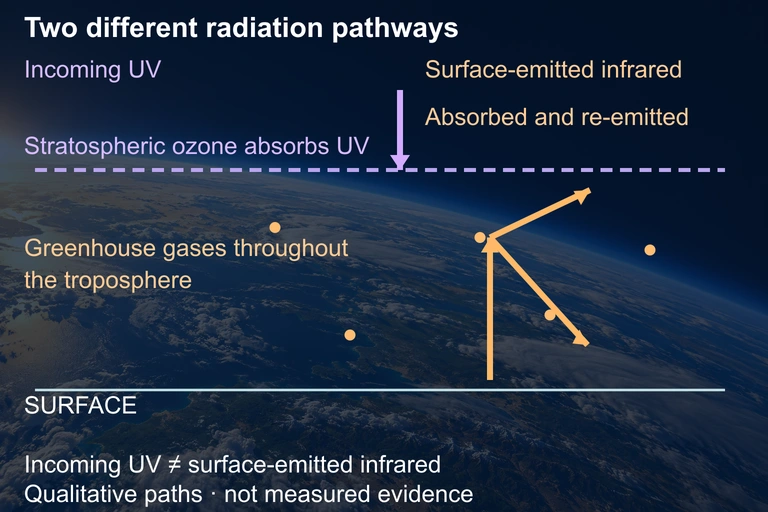 Ozone shielding mainly concerns absorption of incoming ultraviolet radiation in the stratosphere. Greenhouse warming concerns infrared absorption and emission by gases distributed through the atmosphere, including the troposphere. Lines and markers are schematic, not solid atmospheric layers.
SECTION 8
Connections to Climate Change & Policy
The greenhouse effect is the physical mechanism underlying anthropogenic climate change, but the full picture involves additional layers of complexity studied in advanced atmospheric science and Earth system modeling. On the AP Environmental Science exam, you should be prepared to connect the greenhouse effect to broader topics such as ocean acidification, sea-level rise, shifting biome boundaries, and international policy frameworks. This section maps the foundational concepts from this lesson onto those advanced and applied topics.
| Foundational Concept (This Lesson) | Advanced / Applied Topic | Exam Relevance |
|---|---|---|
| Radiative forcing from CO₂ | Climate sensitivity (°C per doubling of CO₂) | FRQ may ask you to interpret graphs of projected warming under different emission scenarios (RCPs or SSPs). |
| CO₂ absorption by oceans | Ocean acidification (CO₂ + H₂O → H₂CO₃) | Tested as a secondary impact of elevated atmospheric CO₂; connects to coral reef decline and marine food webs. |
| Enhanced greenhouse effect → warming | Thermal expansion & ice sheet melt → sea-level rise | Multiple-choice and FRQ questions about coastal impacts and environmental justice. |
| GWP and CO₂ equivalents | Carbon footprint analysis & emissions trading (cap-and-trade) | Calculation FRQs may involve converting CH₄ or N₂O emissions to CO₂eq and proposing mitigation strategies. |
| Positive feedbacks (ice-albedo, water vapor) | Tipping points and climate thresholds | Critical thinking questions about non-linear system behavior and irreversible changes. |
Mapping foundational greenhouse effect concepts to advanced topics and exam contexts.
International policy frameworks represent a direct application of greenhouse science to governance. The Paris Agreement (2015) aims to limit warming to well below 2 °C above preindustrial levels, with a stretch target of 1.5 °C, by requiring nationally determined contributions (NDCs) to reduce GHG emissions. The Kyoto Protocol (1997) was the first treaty to set binding emission targets for industrialized nations using CO₂ equivalents calculated from the same GWP framework covered in this lesson. When the AP exam asks about proposed solutions or policy evaluations, linking your answer back to the underlying physics of radiative forcing demonstrates the interdisciplinary thinking that earns full credit.
SECTION 9
Practice Problems
Question 1: CONCEPTUAL
- A. The ozone layer absorbs ultraviolet radiation and converts it to heat in the troposphere.
- B. Greenhouse gases absorb outgoing longwave infrared radiation and re-emit some of it back toward Earth's surface.
- C. Earth's magnetic field traps solar wind particles that contribute additional thermal energy to the lower atmosphere.
- D. Volcanic activity continuously adds heat from Earth's interior, raising the mean surface temperature by 33 °C.
Show answer (B)
Question 2: BASIC CALCULATION
- A. 43 metric tons CO₂eq
- B. 280 metric tons CO₂eq
- C. 420 metric tons CO₂eq
- D. 4,200 metric tons CO₂eq
Show answer (C)
Question 3: INTERMEDIATE
- A. Increased ocean temperatures lead to greater evaporation, adding more water vapor (a greenhouse gas) to the atmosphere.
- B. Warmer temperatures cause permafrost to thaw, releasing stored methane and carbon dioxide into the atmosphere.
- C. Higher atmospheric CO₂ concentrations stimulate increased plant growth, which removes more CO₂ from the atmosphere through photosynthesis.
- D. Melting of sea ice allows more heat absorption by dark ocean water, further accelerating ice loss in adjacent regions.
Show answer (C)
Question 4: APPLIED
4 ptsShow answer
Question 5: CRITICAL THINKING
4 ptsShow answer
SUMMARY
Lesson Summary
Summary
The greenhouse effect is the process by which certain atmospheric gases—principally CO₂, CH₄, N₂O, H₂O, and O₃—absorb outgoing longwave infrared radiation emitted by Earth's surface and re-emit a portion of it back downward, raising the equilibrium surface temperature by approximately 33 °C (from −18 °C to +15 °C). This natural mechanism makes Earth habitable, but the enhanced (anthropogenic) greenhouse effect—driven by fossil fuel combustion, deforestation, agriculture, and industrial processes—is increasing GHG concentrations beyond natural levels, producing a positive radiative forcing that warms the global climate.
Key quantitative tools include the Stefan-Boltzmann law (E = σT⁴), the planetary energy balance equation, and Global Warming Potential (GWP) for converting emissions of different gases to CO₂ equivalents. Critical positive feedbacks—including the water vapor, ice-albedo, and permafrost thaw feedbacks—amplify initial warming, while the Planck (blackbody) response provides a stabilizing negative feedback. For the AP exam, remember to distinguish the greenhouse effect from ozone depletion, apply GWP calculations accurately, and connect the physics of radiative forcing to real-world policy solutions such as the Paris Agreement and cap-and-trade systems.