

SECTION 1
Historical Context & Motivation
Forests have been exploited for millennia, but the scale and speed of industrial-era logging pushed many forest ecosystems toward collapse. In North America, the late nineteenth century witnessed wholesale clear-cutting of old-growth forests from the Great Lakes region to the Pacific Northwest, stripping entire watersheds of tree cover and triggering devastating erosion, flooding, and wildlife declines. Similar patterns unfolded across Europe during the Industrial Revolution, where centuries of deforestation left landscapes that bore little resemblance to their original forested state. These ecological and economic crises forced governments and scientists to ask a fundamental question: could timber extraction be managed so that forests replenish themselves rather than disappear?
1891 • Forest Reserve Act (U.S.)
1905 • U.S. Forest Service Founded
1964 • Wilderness Act
1993 • Forest Stewardship Council (FSC) Founded
2015 • UN Sustainable Development Goals
The historical arc from unchecked exploitation to certified stewardship reveals a central tension in environmental science: how do societies extract renewable resources at rates that ecosystems can sustain? Sustainable forestry attempts to answer that question through science-based harvest limits, silvicultural techniques, and legal frameworks that balance economic demand with ecological function.
SECTION 2
Core Principles & Definitions
Sustainable forestry rests on the principle that the rate of timber harvest must not exceed the rate at which a forest can regenerate. This deceptively simple idea encompasses a wide array of ecological, economic, and social considerations. At its core, the concept demands that managers treat the forest as a renewable resource — one that can regenerate if harvested wisely — rather than a nonrenewable commodity to be mined until exhausted. The following grid outlines the foundational principles that underpin sustainable forestry practices worldwide.
Maximum Sustainable Yield (MSY)
Ecosystem-Based Management
Silvicultural Techniques
Rotation Interval
Certification & Governance
KEY TAKEAWAY
SECTION 3
Harvest Methods Compared
Different silvicultural approaches fall along a spectrum from maximum disturbance to minimal disturbance. The diagram below compares four major harvesting methods — clear-cutting, seed-tree, shelterwood, and selective cutting — illustrating the percentage of canopy removed and the resulting forest structure after each operation. Understanding these methods is essential because AP Environmental Science frequently tests the ecological trade-offs associated with each.
Each harvesting method has distinct ecological consequences. Clear-cutting maximizes short-term timber yield but increases soil erosion, eliminates habitat continuity, and can alter local hydrology. Selective cutting, by contrast, preserves forest structure and biodiversity but yields less timber per harvest cycle and demands more sophisticated planning. Sustainable forestry does not categorically reject any single method; rather, it selects the technique best suited to the site's ecology, the species' regeneration requirements, and the management objectives — always within the constraint that long-term forest productivity is maintained.
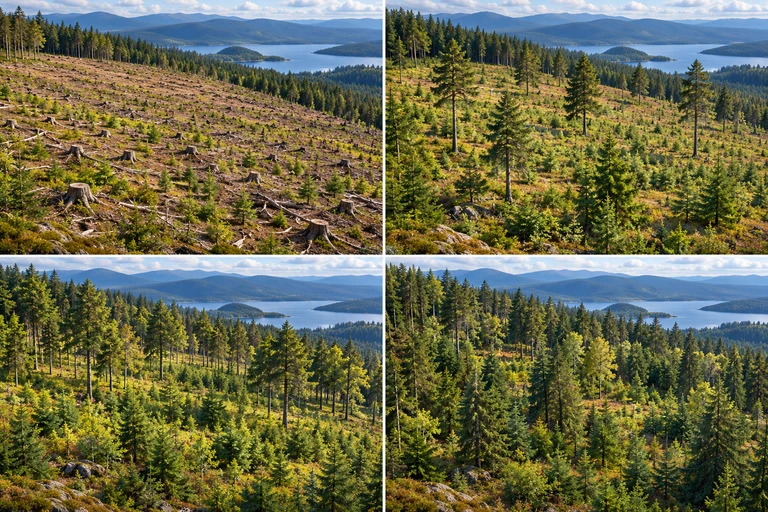 Harvest methods differ in retained canopy and regeneration. Shelterwood uses staged removal; selection can maintain several age classes when species and site conditions support it.
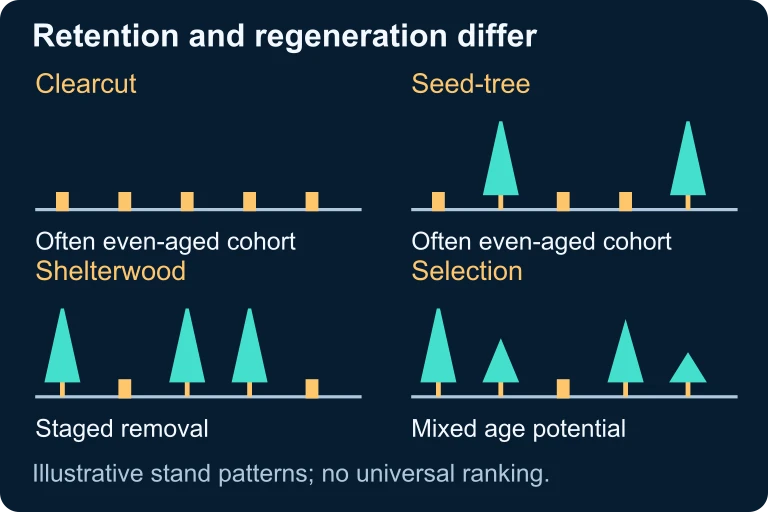 Harvest methods differ in retained canopy and regeneration. Shelterwood uses staged removal; selection can maintain several age classes when species and site conditions support it.
SECTION 4
Mathematical Framework — Sustainable Yield
Quantifying sustainability requires converting ecological concepts into measurable targets. Two key calculations appear on the AP Environmental Science exam: the annual allowable cut and the rotation period. Both rely on knowing the forest's growth rate and standing volume.
ANNUAL ALLOWABLE CUT (AAC)
Where AAC is the maximum volume of timber (m³ or board-feet) that may be harvested per year, Total Standing Volume is the merchantable wood in the entire forest, and Rotation Period is the number of years required for a harvested stand to regrow to harvestable size.
SUSTAINABLE HARVEST CONDITION
A forest is managed sustainably when the volume removed each year does not exceed the net annual growth — the total new wood added by living trees minus natural mortality. If Annual Harvest > Net Annual Growth, the standing stock declines over time.
PERCENT CHANGE IN FOREST AREA
This general formula is used on the AP exam to quantify deforestation or reforestation rates over a given time interval. A negative result indicates net forest loss.
AP EXAM TIP
SECTION 5
Ecosystem Services of Forests
Sustainable forestry is justified not only by timber economics but by the enormous range of ecosystem services that intact forests provide. These services are typically grouped into four categories: provisioning, regulating, supporting, and cultural. The diagram below visualizes these services and their interdependencies, reinforcing why sustainable harvest practices must account for far more than board-feet of lumber.
Of particular relevance to the AP exam is the role of forests as carbon sinks. Through photosynthesis, trees fix atmospheric CO₂ into organic carbon stored in trunks, roots, and soil. A mature temperate forest stores roughly 100–200 metric tons of carbon per hectare. When forests are clear-cut or burned, this carbon is released back into the atmosphere, contributing to climate change. Sustainable forestry practices — particularly selective cutting with long rotation periods — maintain high carbon stocks while still permitting economic use, making them a critical climate mitigation strategy.
 Canopy removal changes interception, transpiration, soil exposure and runoff pathways. Rainfall, slope, roads, residual cover and management affect the outcome; a connected riparian buffer can retain shade and intercept some flows.
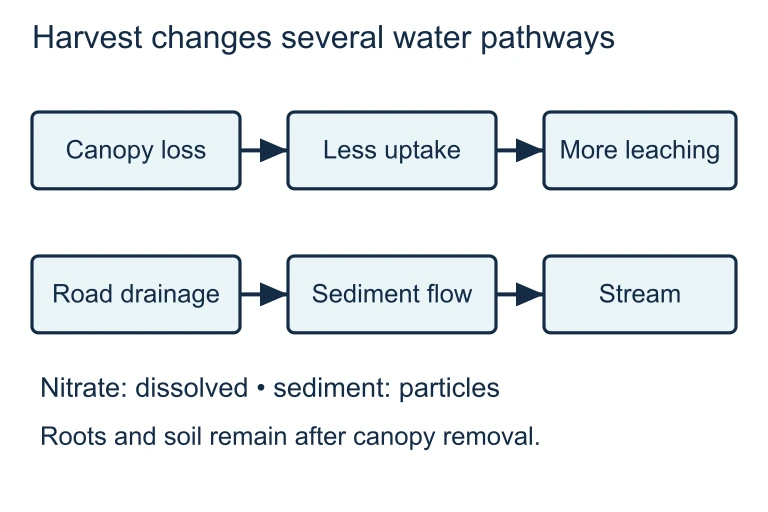 Canopy removal changes interception, transpiration, soil exposure and runoff pathways. Rainfall, slope, roads, residual cover and management affect the outcome; a connected riparian buffer can retain shade and intercept some flows.
SECTION 6
Worked Example — Annual Allowable Cut
The following worked example mirrors the type of quantitative analysis you may encounter on the AP Environmental Science free-response section. It integrates the AAC formula with sustainability reasoning.
Calculating the Annual Allowable Cut for a National Forest
- 1
Step 1 — Identify Given Values
A national forest contains 5,000 hectares of harvestable timberland. Forest inventory data show an average standing volume of 200 m³ per hectare. The dominant tree species requires 50 years to reach harvestable maturity (rotation period). Find the annual allowable cut in m³.Total standing volume = 5,000 ha × 200 m³/ha = 1,000,000 m³ - 2
Step 2 — Apply the AAC Formula
Using AAC = Total Standing Volume ÷ Rotation Period:AAC = 1,000,000 m³ ÷ 50 years = 20,000 m³/year - 3
Step 3 — Interpret the Result
The forest manager may harvest up to 20,000 m³ of timber per year. This means that each year, 1/50th of the total forest area (100 hectares) could theoretically be harvested if the entire stand were cut in rotation. Over 50 years, every hectare would be harvested once and have time to regrow to maturity. - 4
Step 4 — Check Sustainability
Verify that the annual harvest does not exceed the net annual growth. If net annual growth across the forest is measured at 25,000 m³/year, then 20,000 m³/year < 25,000 m³/year, meaning the harvest rate is sustainable. If the net annual growth were only 15,000 m³/year, the proposed AAC would be unsustainable and would need to be reduced or the rotation period lengthened.20,000 m³/year < 25,000 m³/year → Harvest is sustainable
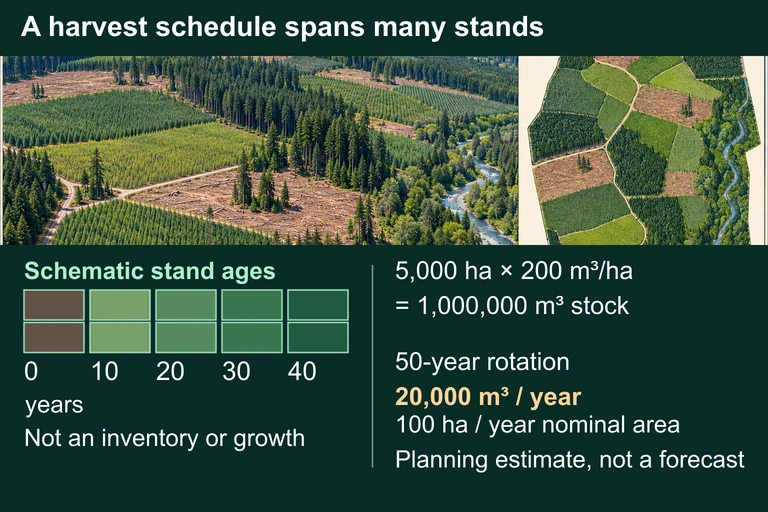 The example’s 1,000,000 m³ standing volume divided by a 50-year rotation gives an idealized 20,000 m³ annual allowable cut. This arithmetic is distinct from measured growth and cannot alone establish ecological sustainability. The 5,000 ha excludes reserve area.
SECTION 7
Strengths & Limitations of Harvesting Methods
No single harvesting method is universally "best." Each technique has trade-offs that depend on species ecology, terrain, economic context, and management goals. The table below summarizes these trade-offs — a frequent topic on AP multiple-choice questions.
| Method | Strengths | Limitations |
|---|---|---|
| Clear-Cutting | Economically efficient; simple to plan and execute; benefits shade-intolerant species that regenerate in full sunlight | Maximum soil erosion and sedimentation; loss of biodiversity and habitat; aesthetic degradation; large carbon release |
| Seed-Tree | Retains natural seed sources for regeneration; slightly less erosion than clear-cutting | Remaining seed trees are vulnerable to wind throw; still removes most canopy and habitat structure |
| Shelterwood | Provides shade for seedling establishment; moderate erosion control; maintains some habitat continuity | Requires multiple harvest entries over years, increasing road disturbance; intermediate economic returns |
| Selective Cutting | Preserves canopy structure and biodiversity; minimal erosion; continuous forest cover; sustained carbon storage | Lowest timber yield per entry; logging damage to residual trees; requires skilled foresters; not suited to shade-intolerant species |
Comparison of four major silvicultural harvesting methods
KEY TAKEAWAY
SECTION 8
Policy Frameworks & Certification Systems
Sustainable forestry principles are translated into practice through national laws and international certification systems. Understanding these governance mechanisms is important for the AP exam because free-response questions sometimes ask students to propose policy-level solutions to deforestation or habitat loss.
| Framework / Certification | Scope | Key Requirements |
|---|---|---|
| Forest Stewardship Council (FSC) | International; voluntary market-based certification | Maintains old-growth areas; protects endangered species habitat; ensures fair labor practices; requires chain-of-custody tracking from forest to consumer |
| Sustainable Forestry Initiative (SFI) | North America; voluntary certification | Reforestation after harvest; protection of water quality; wildlife habitat conservation; public reporting of harvest data |
| National Forest Management Act (NFMA, 1976) | U.S. federal law | Mandates biodiversity maintenance on national forests; requires Environmental Impact Statements for major timber sales; limits clear-cut size |
| REDD+ | International; UN-sponsored | Reducing Emissions from Deforestation and forest Degradation; provides financial incentives to developing nations that reduce forest loss and associated carbon emissions |
Major policy and certification frameworks for sustainable forestry
These frameworks represent a spectrum from voluntary market mechanisms to binding legal requirements. FSC certification is often considered the gold standard because it incorporates social, economic, and ecological criteria, and its chain-of-custody system allows consumers to verify that wood products come from responsibly managed forests. However, critics note that certification systems can be costly for small landowners in developing countries, potentially excluding the very communities where deforestation pressures are greatest. Looking forward, integrating carbon markets with forest certification — as REDD+ attempts — could provide the financial incentives necessary to scale sustainable forestry practices in tropical regions where deforestation rates remain alarmingly high.
SECTION 9
Practice Problems
Question 1: CONCEPTUAL
- A. Selective cutting removes all trees above a minimum diameter, eliminating competition for light.
- B. Selective cutting preserves canopy structure and habitat heterogeneity, allowing species that depend on mature forest conditions to persist.
- C. Selective cutting increases the amount of sunlight reaching the forest floor, which benefits all native plant species.
- D. Selective cutting produces higher timber yields per harvest cycle, making it the most economically efficient method.
Show answer (B)
Question 2: BASIC CALCULATION
- A. 2,000 m³/year
- B. 20,000 m³/year
- C. 200,000 m³/year
- D. 32,000,000 m³/year
Show answer (B)
Question 3: INTERMEDIATE
- A. −20%; 7.68 million hectares
- B. −25%; 7.2 million hectares
- C. −20%; 7.2 million hectares
- D. −25%; 7.68 million hectares
Show answer (A)
Question 4: APPLIED
4 ptsShow answer
Question 5: CRITICAL THINKING
4 ptsShow answer
SUMMARY
Lesson Summary
Summary
Sustainable forestry is the practice of managing forests so that the rate of timber harvest does not exceed the rate of natural regeneration, ensuring that forests continue to provide ecological, economic, and social benefits indefinitely. The core quantitative tool is the annual allowable cut (AAC), calculated as total standing volume divided by the rotation period, and sustainability is verified by confirming that the annual harvest stays at or below the net annual growth. Four major silvicultural methods — clear-cutting, seed-tree, shelterwood, and selective cutting — differ in their canopy removal intensity, ecological impact, and economic efficiency, and sustainable management selects the method that best matches the site's ecological context.
Beyond timber, forests provide critical ecosystem services including carbon sequestration, water purification, soil stabilization, biodiversity support, and cultural value. Governance frameworks such as the Forest Stewardship Council (FSC) certification and international programs like REDD+ translate sustainability principles into enforceable standards. On the AP Environmental Science exam, expect to calculate percent changes in forest area, determine annual allowable cuts, evaluate the sustainability of harvest rates using data tables, and compare the trade-offs of different harvesting methods in free-response scenarios.