

SECTION 1
Historical Context & Motivation
For most of human history, agriculture relied on practices that were inherently sustainable: small-scale, diversified, and dependent on natural nutrient cycling. The Neolithic Revolution approximately 10,000 years ago marked the transition from hunter-gatherer societies to settled farming communities, initiating humanity's long and complex relationship with land management. Early agricultural techniques such as crop rotation, fallowing, and intercropping evolved independently across civilizations—from the Fertile Crescent to Mesoamerica—because farmers recognized through observation that soil fertility declined under continuous monoculture. These indigenous and traditional practices constituted an empirical form of what we now call sustainable agriculture.
The trajectory shifted dramatically in the twentieth century with the advent of industrialized farming. The Green Revolution of the 1950s–1970s introduced high-yield crop varieties, synthetic fertilizers, and chemical pesticides that dramatically boosted food production—global grain yields more than doubled between 1960 and 2000. While these advances averted widespread famine, they also generated profound environmental externalities: soil degradation, water pollution from agricultural runoff, loss of biodiversity, and a heavy dependence on fossil fuel inputs. By the late twentieth century, scientists, policymakers, and farmers began to question whether the industrial model could persist without undermining the ecological systems on which agriculture ultimately depends.
~10,000 BCE • Neolithic Revolution
1940s–1970s • The Green Revolution
1962 • Silent Spring Published
1990 • USDA Organic Standards Initiated
2015 • UN Sustainable Development Goals
The central question driving this topic is both ecological and ethical: How can humanity produce enough food for a projected 9.7 billion people by 2050 without irreversibly depleting soil, water, and biodiversity? Sustainable agriculture represents the set of practices designed to address this challenge by integrating ecological principles into food production systems.
SECTION 2
Core Principles & Definitions
The USDA defines sustainable agriculture as an integrated system of plant and animal production practices that will, over the long term, satisfy human food and fiber needs, enhance environmental quality and the natural resource base, make the most efficient use of nonrenewable resources, sustain the economic viability of farm operations, and enhance the quality of life for farmers and society as a whole. This definition captures the three interconnected pillars that structure sustainable approaches: environmental health, economic profitability, and social equity. A truly sustainable system must perform well across all three dimensions simultaneously.
Soil Conservation
Water Stewardship
Biodiversity Preservation
Nutrient Management
Economic & Social Viability
KEY TAKEAWAY
SECTION 3
Visual Explanation: The Sustainable Agriculture System
The diagram above emphasizes a fundamental insight about sustainable agriculture: it is not a single technique but rather an integrated systems approach. Each of the five components reinforces the others. For example, maintaining soil health through cover cropping directly improves water infiltration, reducing the need for irrigation. Similarly, promoting biodiversity through polyculture and habitat corridors supports natural pest predators, reducing dependence on synthetic pesticides and thereby protecting water quality. When one component is neglected, the entire system becomes more vulnerable—much as removing a single pillar weakens an entire structure. This interconnectedness is precisely what distinguishes sustainable agriculture from conventional approaches that tend to optimize for a single variable (yield) while externalizing environmental costs.
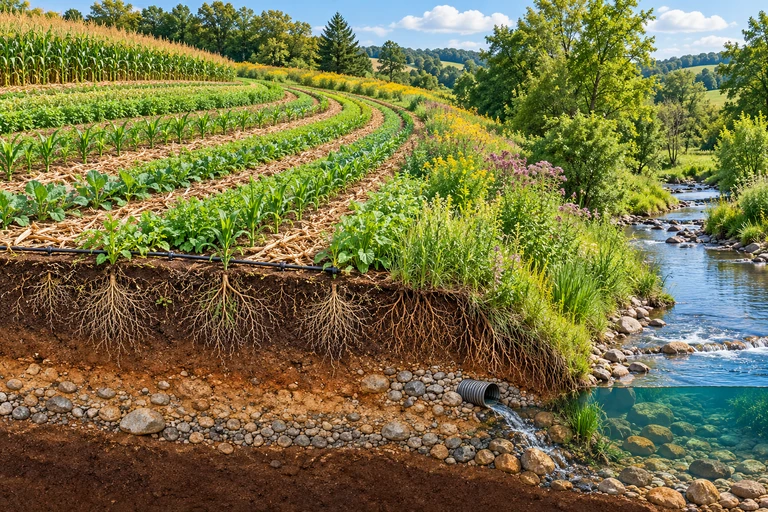 A riparian strip can intercept surface runoff, while a buried drain may bypass it. Practices that reduce erosion and sediment-bound transport can affect dissolved nutrient pathways differently.
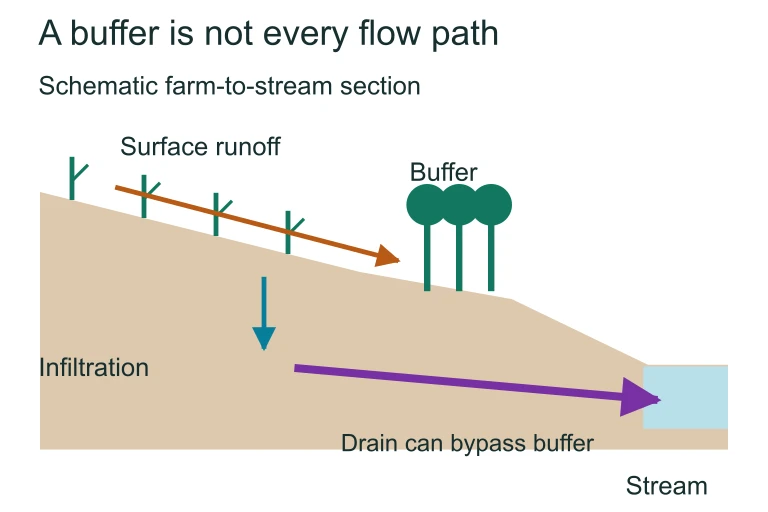 A riparian strip can intercept surface runoff, while a buried drain may bypass it. Practices that reduce erosion and sediment-bound transport can affect dissolved nutrient pathways differently.
SECTION 4
How It Works: Key Practices in Depth
Integrated Pest Management (IPM)
Integrated Pest Management is a tiered approach to pest control that prioritizes ecological methods over chemical interventions. IPM begins with prevention—selecting pest-resistant crop varieties and using crop rotation to break pest life cycles. The second tier involves biological control, introducing or conserving natural predators such as ladybugs (which consume aphids) or parasitoid wasps. Chemical pesticides are used only as a last resort, applied in targeted rather than broadcast fashion, and selected for minimal non-target toxicity. This graduated strategy can reduce pesticide use by 50–70% while maintaining effective pest suppression, as documented in numerous field studies across tropical and temperate agroecosystems.
Crop Rotation & Polyculture
Crop rotation involves alternating the types of crops grown on a given field across seasons or years. A classic rotation might cycle corn (a nitrogen-demanding grass) with soybeans (a nitrogen-fixing legume that harbors Rhizobium bacteria in root nodules), followed by a cover crop like clover or rye. This practice disrupts pest and disease cycles, reduces the need for synthetic nitrogen fertilizer, and improves soil structure. Polyculture—growing multiple crop species simultaneously on the same field—takes this principle further by mimicking natural ecosystem diversity. The Three Sisters system of indigenous American agriculture (corn, beans, and squash grown together) exemplifies polyculture: corn provides a trellis for bean vines, beans fix atmospheric nitrogen, and squash leaves shade the soil, suppressing weeds and retaining moisture.
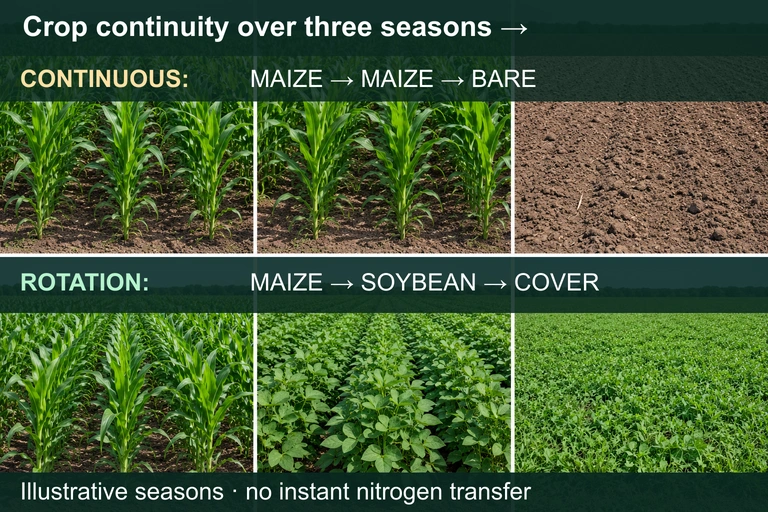 Changing crops across seasons can interrupt host continuity and alter soil cover. Nitrogen fixed by a legume may reach later crops through turnover and other pathways rather than an immediate direct transfer.
Soil Conservation Techniques
No-till farming eliminates conventional plowing, leaving crop residues on the soil surface. This protects soil aggregates from destruction by rain impact, reduces erosion rates by up to 90%, preserves mycorrhizal fungal networks, and decreases CO₂ release from disturbed soil organic matter. Contour plowing involves tilling along the natural contour lines of a slope rather than up and down the gradient, creating ridges that slow water runoff and trap sediment. Terracing—constructing stepped, level platforms on steep hillsides—achieves similar goals at a larger scale. Windbreaks (rows of trees or shrubs planted along field edges) reduce wind erosion, moderate microclimates, and provide habitat for beneficial organisms. Together, these practices address the sobering statistic that conventional agriculture erodes topsoil at rates 10–100 times faster than natural soil formation.
Water Management Strategies
Drip irrigation delivers water directly to the root zone through a network of tubes and emitters, achieving water-use efficiency of 90–95% compared to approximately 60% for conventional flood irrigation. Riparian buffer zones—strips of native vegetation maintained along waterways adjacent to agricultural fields—intercept sediment, nutrients, and pesticides before they enter surface water. Studies have demonstrated that well-designed riparian buffers can remove 50–90% of nitrogen and phosphorus from agricultural runoff. Additionally, rainwater harvesting and constructed wetlands further reduce the demand on groundwater and surface water sources while treating agricultural wastewater.
SECTION 5
Conventional vs. Sustainable Methods
Understanding sustainable agriculture requires a clear comparison with the conventional (industrial) agriculture model it seeks to improve upon. The following diagram and table present these two paradigms side by side, highlighting differences in inputs, ecological impacts, and long-term viability.
| Dimension | Conventional Agriculture | Sustainable Agriculture |
|---|---|---|
| Energy Input | High fossil-fuel dependence (synthetic fertilizers, mechanized tillage, transport) | Lower external energy; emphasis on renewable inputs and on-farm nutrient cycling |
| Soil Erosion | Accelerated by tillage; topsoil loss 10−100× natural rate | Minimized via no-till, contour plowing, terracing, cover crops |
| Water Quality | Nutrient runoff causes eutrophication and hypoxic zones (e.g., Gulf of Mexico dead zone) | Riparian buffers, precision fertilization, and wetland treatment reduce nutrient loading |
| Greenhouse Gas Emissions | Significant N₂O from synthetic N fertilizer; CO₂ from tillage and machinery | Reduced N₂O via efficient N use; carbon sequestration in soil organic matter |
| Long-Term Yield Trend | Declining as soil degrades; requires increasing input to maintain output | Stable or improving as soil health builds over time |
Detailed comparison of environmental impacts: conventional vs. sustainable agriculture
SECTION 6
Worked Example: Irrigation Efficiency & Water Savings
Quantitative reasoning is essential on the AP Environmental Science exam. The following worked example demonstrates how to calculate water savings when a farm transitions from flood irrigation to drip irrigation—a common sustainable practice.
IRRIGATION EFFICIENCY
Flood irrigation efficiency ≈ 60%. Drip irrigation efficiency ≈ 90%. The difference represents water that is saved from evaporation, runoff, or deep percolation below the root zone.
Calculating Water Savings from Switching to Drip Irrigation
- 1
Step 1 — Identify Given Values
A farm has 200 hectares of cropland. Each hectare requires 5,000 m³ of water per growing season to be delivered to the root zone. The farm currently uses flood irrigation (60% efficient) and is considering switching to drip irrigation (90% efficient). - 2
Step 2 — Calculate Total Water Applied Under Flood Irrigation
If only 60% of applied water reaches the crops, we need to determine total water applied. Total water applied = Water needed ÷ Efficiency = 5,000 m³ ÷ 0.60 = 8,333 m³ per hectare. For 200 hectares: 8,333 × 200 = 1,666,600 m³ total.Flood irrigation total: 1,666,600 m³ - 3
Step 3 — Calculate Total Water Applied Under Drip Irrigation
With 90% efficiency: Total water applied = 5,000 m³ ÷ 0.90 = 5,556 m³ per hectare. For 200 hectares: 5,556 × 200 = 1,111,200 m³ total.Drip irrigation total: 1,111,200 m³ - 4
Step 4 — Calculate Water Savings
Water saved = 1,666,600 − 1,111,200 = 555,400 m³ per growing season. Percent reduction = (555,400 ÷ 1,666,600) × 100 ≈ 33.3%.The farm saves approximately 555,400 m³ of water per season—a 33.3% reduction in total water use. - 5
Step 5 — Interpret the Result
This volume of saved water is equivalent to filling approximately 222 Olympic-sized swimming pools. Beyond volume savings, drip irrigation also reduces nutrient leaching into groundwater because less water percolates below the root zone, carrying dissolved fertilizers with it. This calculation illustrates a quantitative link between sustainable irrigation practices and both water conservation and water quality improvement.
SECTION 7
Benefits, Challenges, & Trade-Offs
Sustainable agriculture offers compelling long-term benefits, but it is important for AP students to appreciate the genuine trade-offs and challenges that have slowed its adoption. The following table presents a balanced assessment.
| Benefits | Challenges |
|---|---|
| Reduces soil erosion and builds organic matter, maintaining long-term productivity | Transition period of 3–5 years during which yields may temporarily decline as soil recovers |
| Conserves water and improves water quality by reducing nutrient and pesticide runoff | Higher initial capital costs for infrastructure (e.g., drip irrigation systems, cover crop seed) |
| Preserves biodiversity, supporting ecosystem services like pollination and natural pest control | Requires more specialized knowledge and active management compared to chemical-intensive approaches |
| Reduces greenhouse gas emissions and can sequester carbon in soil organic matter | Government subsidies often still favor conventional agriculture, creating an uneven economic playing field |
| Decreases dependence on fossil-fuel-derived inputs, improving economic resilience to energy price fluctuations | Scaling sustainable methods to feed global populations remains an active area of research and debate |
Benefits and challenges of sustainable agriculture adoption
KEY TAKEAWAY
SECTION 8
Policy Frameworks & Future Directions
Sustainable agriculture does not exist in a policy vacuum. Government programs, international agreements, and market forces all shape whether farmers adopt sustainable practices. On the AP Environmental Science exam, you should be able to connect agricultural practices to the broader policy landscape.
| Policy / Concept | Description | Relevance to Sustainable Agriculture |
|---|---|---|
| U.S. Farm Bill | Omnibus legislation renewed approximately every 5 years; includes conservation title programs like CRP and EQIP | Provides financial incentives for soil conservation, buffer zones, and conservation tillage adoption |
| USDA Organic Certification | National standard prohibiting synthetic pesticides and fertilizers; requires 3-year transition period | Creates market premium for organic products, incentivizing reduced chemical use |
| UN SDGs (2015) | 17 global goals; SDG 2 (Zero Hunger) and SDG 15 (Life on Land) directly address agriculture | Frames sustainable agriculture as essential for global food security and ecosystem preservation |
| Carbon Markets | Emerging systems that compensate farmers for carbon sequestered in soil via cover cropping and no-till | Creates new revenue stream that makes sustainable practices more economically competitive |
| Genetically Modified Organisms (GMOs) | Crops engineered for pest resistance (Bt crops), drought tolerance, or enhanced nutritional value | Controversial—may reduce pesticide use but raise concerns about biodiversity, seed monopolies, and gene flow to wild relatives |
Key policies and concepts shaping sustainable agriculture
Looking forward, several emerging approaches seek to push sustainable agriculture beyond its current limitations. Agroforestry integrates trees and shrubs into crop and livestock systems, providing shade, windbreaks, and additional income from timber or fruit while sequestering carbon. Precision agriculture uses GPS, remote sensing, and data analytics to apply inputs (water, fertilizer, pesticides) at variable rates across a field, optimizing resource use and minimizing waste. Regenerative agriculture goes beyond sustainability—aiming not merely to maintain but to actively restore degraded ecosystems through practices that rebuild soil carbon, increase biodiversity, and improve watershed function. These forward-looking approaches represent the evolving frontier of how humanity reconciles food production with planetary health.
AP EXAM TIP
SECTION 9
Practice Problems
Question 1: CONCEPTUAL
- A. Polyculture; it increases total crop yield per hectare by growing multiple species simultaneously
- B. Crop rotation; it disrupts pest and disease cycles while restoring soil nitrogen through legume fixation
- C. Contour plowing; it reduces soil erosion by planting along the natural slope of the land
- D. Integrated pest management; it replaces chemical pesticides with natural pest predators
Show answer (B)
Question 2: BASIC CALCULATION
- A. 167,000 m³
- B. 278,000 m³
- C. 333,000 m³
- D. 500,000 m³
Show answer (B)
Question 3: INTERMEDIATE
- A. 67.5 kg
- B. 90.0 kg
- C. 112.5 kg
- D. 337.5 kg
Show answer (A)
Question 4: APPLIED
4 ptsShow answer
Question 5: CRITICAL THINKING
4 ptsShow answer
SUMMARY
Summary
Summary
Sustainable agriculture is an integrated systems approach that balances environmental health, economic profitability, and social equity. Core practices include crop rotation (alternating crops to restore soil nutrients and break pest cycles), no-till farming (protecting soil structure and reducing erosion), drip irrigation (achieving 90% water-use efficiency versus 60% for flood methods), integrated pest management (prioritizing biological control over synthetic pesticides), polyculture (increasing on-farm biodiversity), and riparian buffer zones (filtering 50–90% of nitrogen and phosphorus from agricultural runoff before it reaches waterways).
These practices address the major environmental impacts of conventional industrial agriculture—including soil erosion, eutrophication from nutrient runoff, biodiversity loss, and greenhouse gas emissions—while maintaining the productive capacity needed to feed a growing world population. Policy frameworks like the U.S. Farm Bill conservation programs, organic certification standards, and the UN Sustainable Development Goals create incentives for adoption, while emerging approaches like regenerative agriculture, precision agriculture, and agroforestry represent the frontier of sustainable food production. For the AP exam, remember to connect specific practices to specific environmental outcomes and to acknowledge the real trade-offs—especially the transition-period yield decline—that accompany sustainable conversion.