

SECTION 1
Historical Context & Discovery
The story of stratospheric ozone depletion is one of the most consequential narratives in modern environmental science, tracing an arc from mid-twentieth-century industrial chemistry to a planetary-scale atmospheric crisis and, ultimately, to an unprecedented international policy response. Ozone (O3) in the stratosphere—the atmospheric layer extending roughly 15 to 50 km above Earth's surface—absorbs the majority of incoming ultraviolet-B (UV-B) radiation, shielding living organisms from DNA damage, cataracts, and suppressed immune function. When scientists discovered that synthetic chemicals were systematically destroying this protective layer, the finding triggered alarm in the scientific community and among policymakers worldwide.
The chemicals at the center of the crisis are chlorofluorocarbons (CFCs), a family of stable, non-toxic, non-flammable compounds invented in the 1930s for use as refrigerants, aerosol propellants, and industrial solvents. Their very stability—the quality that made them commercially attractive—turned out to be their greatest environmental liability, because it allowed them to persist long enough to drift into the stratosphere, where intense UV radiation breaks them apart, releasing chlorine atoms that catalytically destroy ozone molecules.
1930 • CFCs Commercialized
1974 • Molina-Rowland Hypothesis
1985 • Antarctic Ozone Hole Detected
1987 • Montreal Protocol Signed
2023 • Recovery on Track
This timeline reveals a recurring pattern in environmental science: a commercially beneficial substance is adopted before its long-term ecological consequences are understood, rigorous scientific research eventually identifies the harm, and political action—when it occurs—can be remarkably effective. The central question this lesson addresses is: What chemical mechanisms drive ozone depletion, why is the Antarctic particularly vulnerable, and how do international policies mitigate the problem?
SECTION 2
Core Principles of Ozone Chemistry
Understanding ozone depletion requires familiarity with the natural balance that maintains stratospheric ozone, the catalytic chemistry that disrupts it, and the atmospheric conditions that amplify the damage. The following foundational ideas provide the conceptual scaffolding for the rest of this lesson.
Chapman Cycle
Catalytic Destruction
Polar Stratospheric Clouds (PSCs)
Ozone-Depleting Substances (ODS)
UV Radiation & Biological Harm
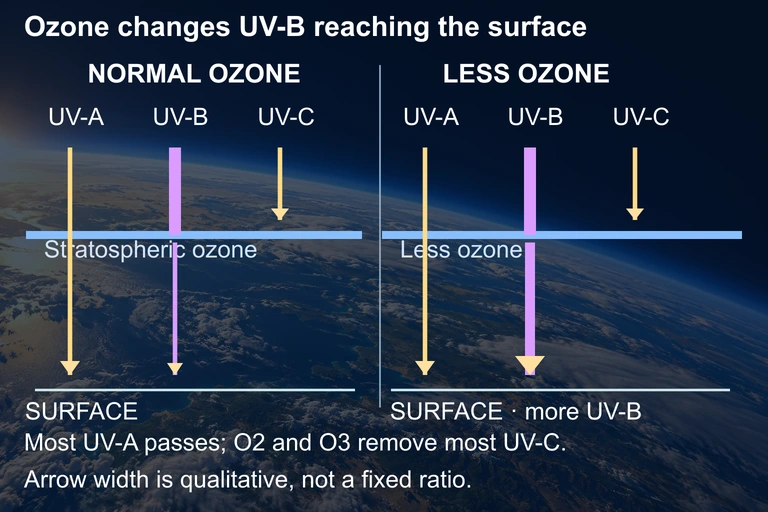 Stratospheric ozone absorbs part of incoming UV-B, while most UV-A reaches the surface and most UV-C is removed by oxygen and ozone. Reduced ozone can increase UV-B transmission without being a greenhouse-gas pathway. Arrow widths are qualitative and not visible ultraviolet light or calibrated transmission.
KEY TAKEAWAY
SECTION 3
Visualizing the Ozone Destruction Cycle
The diagram below illustrates the catalytic cycle by which a free chlorine atom destroys ozone. Follow the cycle from the photolysis of a CFC molecule through the regeneration of atomic chlorine, noting how each step converts ozone into ordinary oxygen while the chlorine catalyst persists.
The net reaction shown in the purple box at the bottom of the diagram is key: one molecule of ozone and one atom of free oxygen are converted into two molecules of ordinary diatomic oxygen, with no net consumption of chlorine. This catalytic efficiency explains why even relatively small atmospheric concentrations of CFCs—measured in parts per trillion—can produce measurable ozone loss. The concept of a chain reaction is essential here: a single chlorine atom has an atmospheric residence time of one to two years in the stratosphere, during which it can participate in roughly 100,000 ozone-destroying cycles before it is eventually sequestered in a reservoir species such as HCl or ClONO2.
SECTION 4
Chemical Mechanisms & the Antarctic Ozone Hole
While the catalytic chlorine cycle operates globally, ozone depletion is most severe over Antarctica during austral spring (September–November). This dramatic phenomenon—the Antarctic ozone hole—arises from a unique combination of meteorological and chemical conditions that do not exist to the same extent elsewhere on Earth.
Key Reactions
CFC PHOTOLYSIS
hν represents an ultraviolet photon with sufficient energy (wavelength < 230 nm). The resulting free chlorine radical (Cl·) initiates catalytic ozone destruction.
HETEROGENEOUS SURFACE REACTION ON PSCs
Polar stratospheric cloud (PSC) surfaces convert inactive chlorine reservoir species into molecular chlorine (Cl2), which is readily photolyzed into two reactive Cl· atoms when sunlight returns in spring.
ClO DIMER CYCLE (DOMINANT ANTARCTIC MECHANISM)
In the polar stratosphere, low atomic oxygen concentrations favor ClO dimer formation. The dimer (Cl2O2) is photolyzed, regenerating Cl atoms. Net: 2 O₃ → 3 O₂.
Why Antarctica?
- Polar vortex isolation: The strong circumpolar winds during winter isolate Antarctic stratospheric air from warmer mid-latitude air, preventing mixing that would dilute reactive chlorine.
- Extreme cold: Stratospheric temperatures drop below −78 °C, enabling the formation of polar stratospheric clouds whose surfaces host heterogeneous reactions that activate chlorine.
- Denitrification: PSC particles sediment out of the stratosphere, removing nitrogen oxides (NOₓ) that would otherwise sequester chlorine in the inactive reservoir species ClONO₂.
- Spring sunlight trigger: When sunlight returns in September, it photolyzes the accumulated Cl₂, initiating explosive ozone loss over a period of weeks.
AP Exam Tip
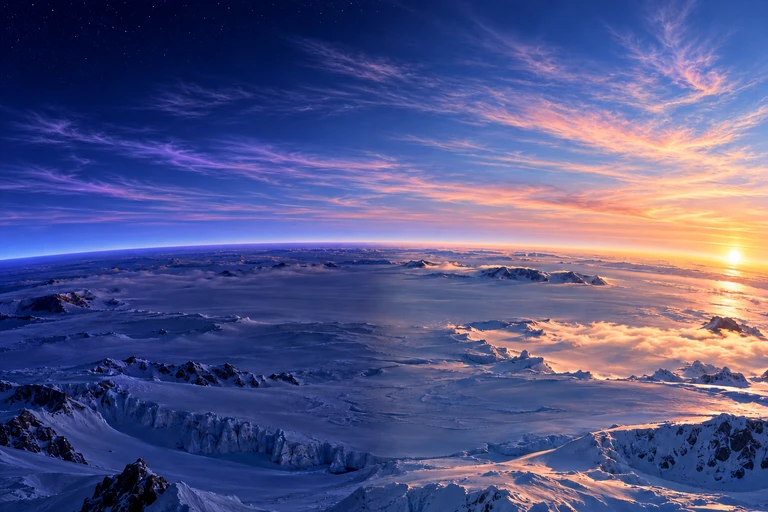 Antarctic winter cold and polar stratospheric clouds prepare chlorine chemistry before sunlight returns. Spring light activates reactive chlorine that contributes to ozone loss.
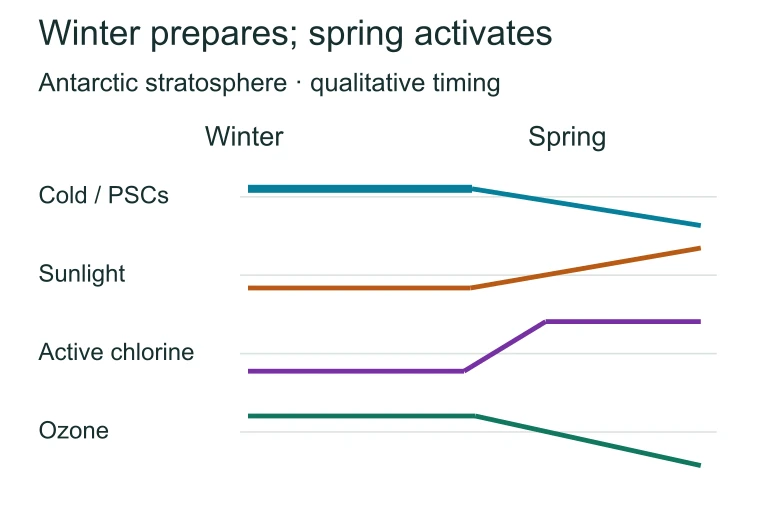 Antarctic winter cold and polar stratospheric clouds prepare chlorine chemistry before sunlight returns. Spring light activates reactive chlorine that contributes to ozone loss.
SECTION 5
Ozone-Depleting Substances & Ozone Depletion Potential
Not all ozone-depleting substances are equally destructive. Scientists quantify each compound's relative threat using a metric called Ozone Depletion Potential (ODP), which compares the steady-state ozone loss caused by emission of a given mass of the substance to that caused by the same mass of CFC-11 (trichlorofluoromethane, CFCl₃), the reference compound with an ODP of 1.0. Higher ODP values indicate greater ozone-destroying capacity per unit mass emitted.
| Substance | Formula | ODP | Atmos. Lifetime (yr) | Primary Use |
|---|---|---|---|---|
| CFC-11 | CFCl₃ | 1.0 | 52 | Foam blowing agent |
| CFC-12 | CF₂Cl₂ | 1.0 | 100 | Refrigerant, aerosol |
| Halon-1301 | CBrF₃ | 10.0 | 65 | Fire suppression |
| HCFC-22 | CHClF₂ | 0.055 | 12 | Transitional refrigerant |
| Methyl bromide | CH₃Br | 0.6 | 0.7 | Soil fumigant |
Selected ozone-depleting substances regulated under the Montreal Protocol
Notice that atmospheric lifetime and ODP are related but not identical concepts. A substance with a long atmospheric lifetime has more opportunity to reach the stratosphere and participate in ozone destruction, but ODP also depends on the number of halogen atoms per molecule and whether those atoms are chlorine (less efficient per atom) or bromine (roughly 45 times more efficient at destroying ozone per atom). This is why halon-1301, despite having only one bromine atom, carries an ODP of 10.0.
SECTION 6
Worked Example — Calculating Equivalent CFC-11 Emissions
Environmental scientists often express releases of various ODS in terms of CFC-11 equivalent tonnes. This normalization uses ODP to compare the ozone-destroying impact of different substances on a common scale. The worked example below illustrates this calculation.
Problem
CFC-11 EQUIVALENT
where massi is the mass emitted of substance i in tonnes, and ODPi is its ozone depletion potential relative to CFC-11.
Total CFC-11 Equivalent Emissions
- 1
Step 1 — Identify Given Values
CFC-12: mass = 500 tonnes, ODP = 1.0. Halon-1301: mass = 40 tonnes, ODP = 10.0. - 2
Step 2 — Calculate CFC-12 Contribution
CFC-12 contribution = 500 tonnes × 1.0 = 500 CFC-11 equiv. tonnes.500 CFC-11 equiv. tonnes - 3
Step 3 — Calculate Halon-1301 Contribution
Halon-1301 contribution = 40 tonnes × 10.0 = 400 CFC-11 equiv. tonnes.400 CFC-11 equiv. tonnes - 4
Step 4 — Sum for Total
Total = 500 + 400 = 900 CFC-11 equiv. tonnes.900 CFC-11 equivalent tonnes - 5
Step 5 — Interpret the Result
Even though only 40 tonnes of Halon-1301 were released (compared to 500 tonnes of CFC-12), the halon accounts for 44% of total ozone-depleting impact because its ODP is ten times higher. This illustrates why regulations prioritize substances with high ODP, not just high production volumes.
SECTION 7
The Montreal Protocol — Strengths & Limitations
The Montreal Protocol (1987) is widely regarded as the most successful international environmental agreement in history. It established legally binding phase-out schedules for CFCs, halons, carbon tetrachloride, and other ODS, with differentiated timelines for developed and developing nations. Subsequent amendments—London (1990), Copenhagen (1992), Beijing (1999), and the Kigali Amendment (2016)—have progressively expanded the list of controlled substances and accelerated phase-out dates.
| Strengths | Limitations |
|---|---|
| Universal ratification — the only UN treaty ratified by all 198 member states. | Illegal trade in CFCs persists, especially in developing countries with older refrigeration infrastructure. |
| Measurable results — atmospheric CFC concentrations have declined steadily since the mid-1990s. | Some replacement substances (HFCs) have ODP of zero but are potent greenhouse gases with high GWPs. |
| Multilateral Fund provides financial support to developing nations for compliance. | Ozone recovery is slow due to long atmospheric lifetimes of CFCs already emitted (50–100 years). |
| Adaptive design — amendments allow adding new substances and accelerating schedules. | Climate change may cool the stratosphere further, potentially enhancing PSC formation and delaying Antarctic recovery. |
| The 2016 Kigali Amendment extends the treaty to phase down HFCs, linking ozone and climate policy. | Exemptions for critical uses (e.g., methyl bromide in agriculture) create loopholes that slow total phase-out. |
Strengths and limitations of the Montreal Protocol
KEY TAKEAWAY
SECTION 8
Connection to Climate Change & Broader Global Change
Ozone depletion and climate change are often taught as separate topics, but they are interconnected in several important ways. CFCs are themselves potent greenhouse gases—CFC-12, for example, has a Global Warming Potential (GWP) of approximately 10,200 over 100 years. By phasing out CFCs, the Montreal Protocol inadvertently achieved a significant climate co-benefit, preventing warming estimated at 0.5–1.0 °C by mid-century. However, the replacement of CFCs with HFCs created a new climate concern, because HFCs, while having zero ODP, carry substantial GWPs. The 2016 Kigali Amendment addresses this by phasing down HFC production.
| Feature | Ozone Depletion | Climate Change |
|---|---|---|
| Atmospheric layer affected | Stratosphere (15–50 km) | Troposphere (0–15 km), with radiative effects throughout |
| Primary pollutants | CFCs, halons, HCFCs, methyl bromide | CO₂, CH₄, N₂O, HFCs, black carbon |
| Mechanism | Catalytic destruction of O₃ by halogen radicals | Enhanced greenhouse effect trapping longwave radiation |
| Number of sources | Relatively few industrial sources | Virtually all economic sectors |
| Policy response | Montreal Protocol — universally ratified, effective | Paris Agreement — voluntary NDCs, enforcement challenges |
| Substitute availability | Viable alternatives (HCFCs, HFCs, HFOs) exist | Requires fundamental energy system transformation |
Comparing ozone depletion and climate change as global atmospheric issues
Another important connection is that increasing greenhouse gas concentrations warm the troposphere but cool the stratosphere, which could promote the formation of polar stratospheric clouds and temporarily slow ozone recovery over the poles. Additionally, nitrous oxide (N2O)—primarily from agricultural fertilizer use—is now the single largest remaining emission of an ozone-depleting substance not controlled by the Montreal Protocol, because its regulation falls under climate treaties instead. These cross-cutting issues are frequently tested on the AP exam and illustrate the interconnected nature of global change topics.
SECTION 9
Practice Problems
Question 1: CONCEPTUAL
- A. CFCs are emitted primarily in the Southern Hemisphere, so they concentrate over Antarctica.
- B. The polar vortex isolates Antarctic stratospheric air, and extreme cold enables polar stratospheric clouds whose surfaces convert reservoir chlorine into reactive forms.
- C. Ozone naturally forms only at the equator and must be transported to the poles, where it arrives in reduced quantities.
- D. Antarctica lacks volcanic aerosols that protect ozone at lower latitudes.
Show answer (B)
Question 2: BASIC CALCULATION
- A. 225 CFC-11 equivalent tonnes
- B. 450 CFC-11 equivalent tonnes
- C. 2,200 CFC-11 equivalent tonnes
- D. 2,250 CFC-11 equivalent tonnes
Show answer (B)
Question 3: INTERMEDIATE
- A. HFCs were discovered to have unexpectedly high ozone depletion potentials, undermining the original treaty.
- B. HFCs have zero ODP but very high global warming potentials, making them significant contributors to climate change as their use expanded.
- C. HFCs react with methane in the troposphere, increasing ground-level ozone pollution in urban areas.
- D. HFCs decompose into bromine radicals that deplete stratospheric ozone more efficiently than chlorine.
Show answer (B)
Question 4: APPLIED
4 ptsShow answer
Question 5: CRITICAL THINKING
4 ptsShow answer
SUMMARY
Lesson Summary
Summary
Stratospheric ozone shields Earth's surface from harmful UV-B radiation and is maintained by the Chapman cycle of natural formation and destruction. Anthropogenic chlorofluorocarbons (CFCs) and other ozone-depleting substances (ODS) release halogen radicals in the stratosphere that catalytically destroy ozone—a single chlorine atom can eliminate roughly 100,000 ozone molecules. The Antarctic ozone hole forms because the polar vortex isolates frigid air and enables polar stratospheric clouds to activate chlorine reservoirs. Substances are compared using Ozone Depletion Potential (ODP), with bromine-containing halons carrying the highest values.
The Montreal Protocol (1987) established binding phase-out schedules for ODS and is the most successful international environmental treaty, achieving universal ratification and measurable atmospheric recovery. Replacement chemicals (HFCs) solved the ozone problem but introduced climate concerns due to high global warming potentials, prompting the 2016 Kigali Amendment. The ozone story demonstrates how rigorous science, public awareness, and international cooperation can address a global environmental crisis—and serves as both a model and a contrast for ongoing efforts to mitigate climate change.