

SECTION 1
Historical Context & Motivation
For most of human history, sewage—the combined wastewater from households, industries, and stormwater systems—was discharged directly into rivers, lakes, and coastal waters with no treatment whatsoever. The consequences were devastating: cholera and typhoid epidemics killed tens of thousands in rapidly urbanizing cities, fish kills depleted downstream food sources, and waterways became anoxic cesspools incapable of supporting aquatic life. The field of sewage treatment arose from the urgent need to break the link between human waste and waterborne disease while simultaneously protecting aquatic ecosystems from excessive organic loading.
1854 • John Snow & Cholera Mapping
1914 • Activated Sludge Process Invented
1948 • U.S. Federal Water Pollution Control Act
1972 • Clean Water Act (CWA)
1990s–Present • Tertiary & Nutrient Removal
The central question sewage treatment addresses is straightforward yet ecologically critical: how can we reduce the biochemical oxygen demand (BOD), pathogen load, nutrient concentrations, and suspended solids in wastewater before it re-enters natural water bodies? Each stage of the treatment train targets a different category of contaminant, and understanding this staged approach is essential for the AP Environmental Science exam.
SECTION 2
Core Principles & Definitions
Sewage treatment is organized around a progressive sequence of physical, biological, and chemical processes. Each stage removes a particular class of pollutants, and the effluent quality improves as wastewater advances through the treatment train. The AP exam expects you to distinguish among primary, secondary, and tertiary treatment, as well as to understand the environmental implications when treatment is incomplete or absent.
Biochemical Oxygen Demand (BOD)
Primary Treatment (Physical)
Secondary Treatment (Biological)
Tertiary / Advanced Treatment
Sludge (Biosolids) Management
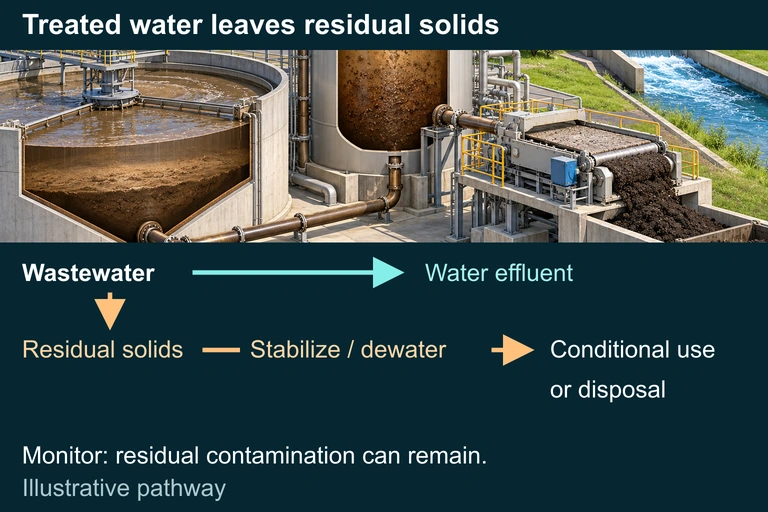 Treating wastewater separates residual solids that still need management. Stabilization, dewatering and subsequent use or disposal address different concerns; validated treatment reduces rather than universally eliminates pathogens.
SECTION 3
The Sewage Treatment Train — Visual Overview
The diagram above illustrates the standard treatment sequence mandated by the Clean Water Act for publicly owned treatment works (POTWs) in the United States. Notice how each successive stage targets progressively finer and more dissolved contaminants: primary treatment removes settleable solids through gravity, secondary treatment harnesses aerobic microbial metabolism to break down dissolved organics, and tertiary treatment uses chemical or advanced biological processes to strip nitrogen and phosphorus—the nutrients most responsible for cultural eutrophication. A key AP exam point is that the CWA requires at minimum secondary treatment, which reduces BOD to 30 mg/L or less.
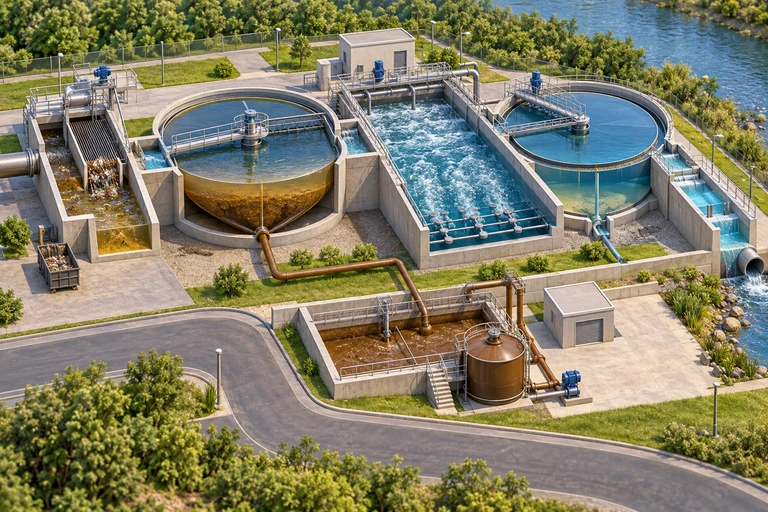 Screens, settling, biological processing and advanced treatment target different contaminants. Organic carbon can become CO₂ or biomass, while residual contaminants remain in effluent.
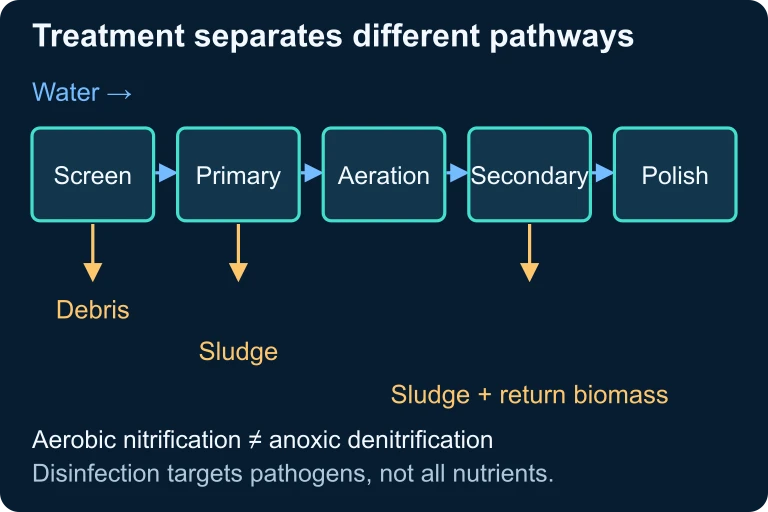 Screens, settling, biological processing and advanced treatment target different contaminants. Organic carbon can become CO₂ or biomass, while residual contaminants remain in effluent.
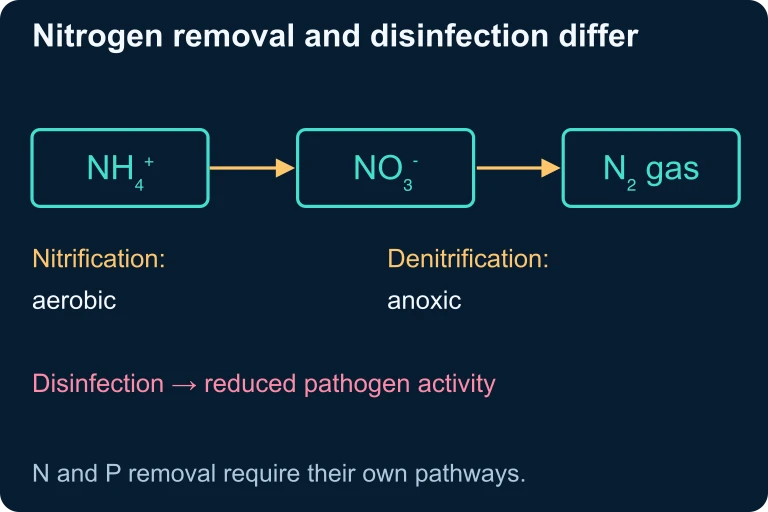 Aerobic nitrification converts ammonium to nitrate; anoxic denitrification can remove nitrogen as N₂. Disinfection instead targets pathogens and does not substitute for nutrient removal.
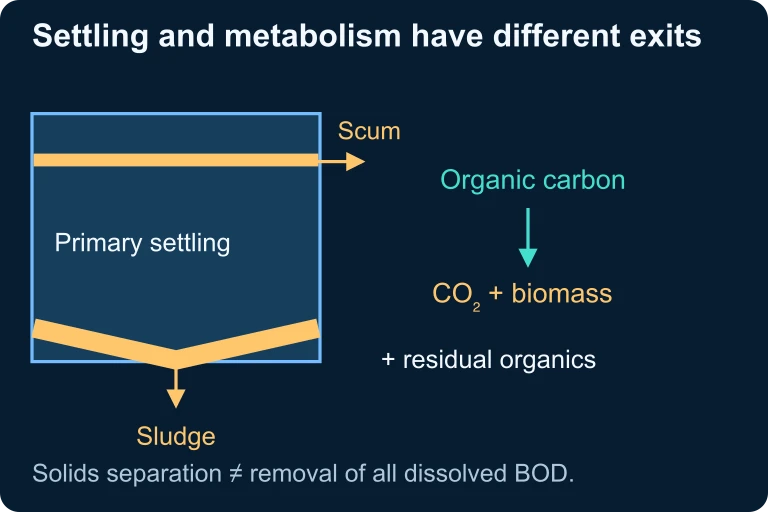 Settling separates scum and sludge. Biological processing divides organic carbon among CO₂, new biomass and residual effluent; solids and carbon follow different exit routes.
SECTION 4
Mathematical Framework — BOD & Percent Removal
Quantifying the effectiveness of sewage treatment requires understanding two primary calculations: percent removal efficiency and BOD loading. These calculations appear frequently on the AP exam, both in multiple-choice questions and in FRQ calculations.
PERCENT REMOVAL EFFICIENCY
Influent concentration = pollutant level entering a treatment stage (mg/L). Effluent concentration = pollutant level leaving. This formula applies to BOD, TSS, nitrogen, phosphorus, or any measured parameter.
BOD LOADING RATE
Q = volumetric flow rate (m³/day); C = BOD concentration (mg/L, equivalent to g/m³); 10⁻³ converts g to kg. This is critical for sizing treatment plant capacity.
POPULATION EQUIVALENT (PE)
One population equivalent is defined as 60 g BOD₅ per day, the average organic waste produced by one person. Used to express industrial waste loads in comparable human terms.
SECTION 5
Detailed Breakdown of Treatment Stages
Primary Treatment in Detail
During primary treatment, wastewater first passes through bar screens that remove large debris such as rags, sticks, and plastic, followed by a grit chamber where sand and gravel settle out at reduced flow velocities. The wastewater then enters a large primary clarifier (sedimentation tank) where it is held for 1–2 hours to allow suspended solids to settle as primary sludge. Fats, oils, and grease float to the surface and are skimmed off as scum. This purely physical process removes approximately 60% of total suspended solids and 35% of BOD, but dissolved organic compounds pass through unaffected.
Secondary Treatment in Detail
The biological heart of the treatment plant is secondary treatment. The most common approach is the activated sludge process, in which primary effluent is mixed with a dense community of aerobic microorganisms in an aeration tank. Compressed air is continuously pumped into the tank to maintain dissolved oxygen levels between 1–3 mg/L, fueling microbial respiration. The microbes metabolize dissolved organic compounds into CO₂, H₂O, and new biomass. An alternative method is the trickling filter, where wastewater is sprayed over a bed of rocks or plastic media coated with a biofilm of decomposing organisms. Both methods reduce BOD by approximately 85–90%, bringing the combined primary and secondary removal to about 90% or better.
Tertiary Treatment & Disinfection
Where receiving water bodies are sensitive to eutrophication—such as the Chesapeake Bay or the Gulf of Mexico hypoxic zone—tertiary treatment is required. Biological nutrient removal (BNR) uses alternating anoxic and aerobic zones to drive nitrification (NH₃ → NO₃⁻) and denitrification (NO₃⁻ → N₂ gas), effectively removing nitrogen from the water column. Phosphorus is removed through chemical precipitation using aluminum sulfate (alum) or ferric chloride, which forms insoluble phosphate salts that settle out. Finally, disinfection using chlorination, ozonation, or UV radiation eliminates remaining pathogens before the effluent is discharged. UV disinfection is increasingly favored because it avoids introducing disinfection byproducts like trihalomethanes (THMs) into the effluent.
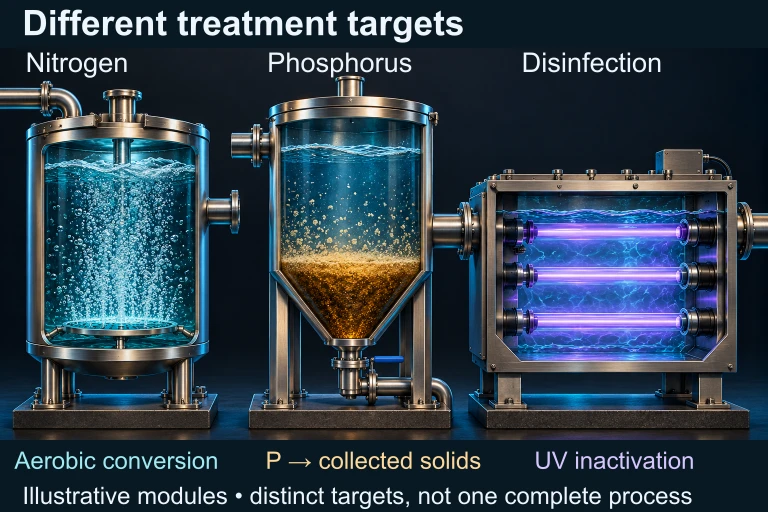 Distinct treatment modules illustrate aerobic nitrogen conversion, phosphorus transfer into collected solids, and UV inactivation of susceptible organisms. The companion separates aerobic ammonium-to-nitrite-to-nitrate conversion from anoxic nitrate-to-nitrogen-gas conversion. Phosphorus is retained in collected solids rather than destroyed; UV inactivation alone does not remove dissolved nutrient mass. The apparatus is illustrative, and its violet UV glow is a visibility cue; it is not a complete treatment train or a performance guarantee.
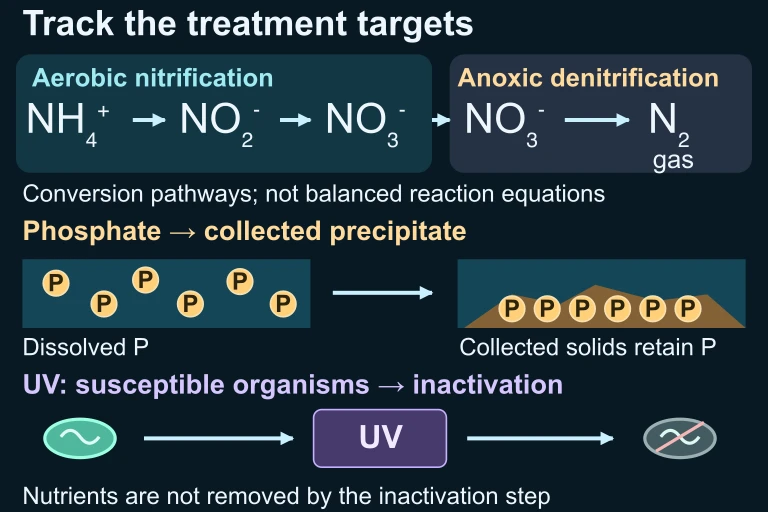 Nitrogen transformation and removal, phosphorus transfer to solids, and UV inactivation are different treatment outcomes.
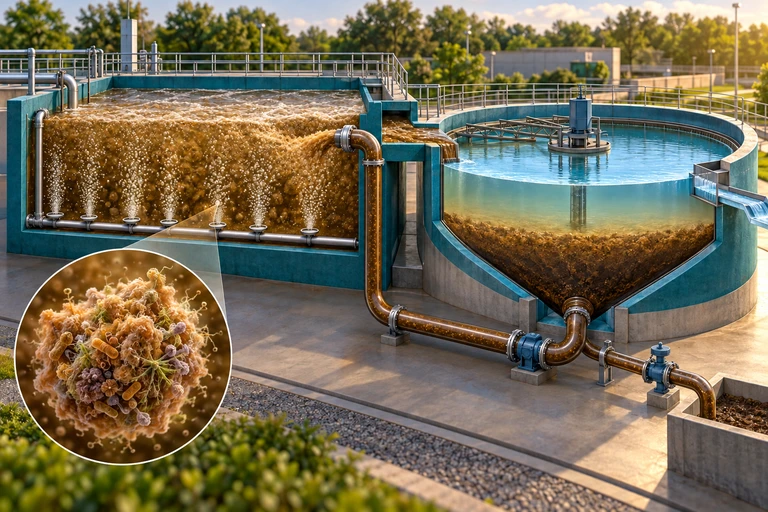 In activated-sludge treatment, settled biomass returns from the clarifier to aeration while effluent and wasted sludge leave. Hydraulic retention time tracks liquid volume and external flow; solids retention time tracks solids inventory and solids losses.
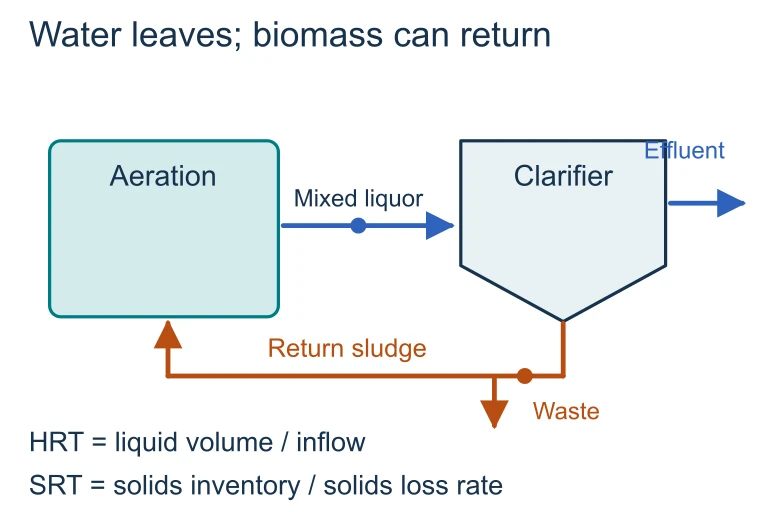 In activated-sludge treatment, settled biomass returns from the clarifier to aeration while effluent and wasted sludge leave. Hydraulic retention time tracks liquid volume and external flow; solids retention time tracks solids inventory and solids losses.
SECTION 6
Worked Example — BOD Removal Calculation
Worked example
- 1
Step 1 — Identify Given Values
A municipal wastewater treatment plant receives influent with a BOD₅ of 250 mg/L. After secondary treatment, the effluent BOD₅ is 20 mg/L. The plant processes 15,000 m³ of wastewater per day. - 2
Step 2 — Calculate Percent BOD Removal
% Removal = [(Influent − Effluent) ÷ Influent] × 100 = [(250 − 20) ÷ 250] × 100 = (230 ÷ 250) × 100% Removal = 92% - 3
Step 3 — Calculate Influent BOD Load
BOD Load = Q × C × 10⁻³ = 15,000 m³/day × 250 mg/L × 10⁻³ = 15,000 × 250 × 0.001Influent Load = 3,750 kg BOD/day - 4
Step 4 — Calculate Effluent BOD Load
Effluent Load = 15,000 × 20 × 0.001 = 300 kg BOD/day. The plant removes 3,750 − 300 = 3,450 kg of BOD daily.BOD Removed = 3,450 kg/day - 5
Step 5 — Calculate Population Equivalent
PE = Total influent BOD load (g/day) ÷ 60 g/person/day = 3,750,000 g/day ÷ 60 = 62,500. This plant serves a population equivalent of 62,500 people.PE = 62,500 people
SECTION 7
Comparing Treatment Approaches — Strengths & Limitations
| Treatment Stage | Strengths | Limitations |
|---|---|---|
| Primary | Low cost, simple technology, no energy for aeration, removes large solids and 35% BOD | Does not remove dissolved organics, nutrients, or pathogens; insufficient alone to protect aquatic ecosystems |
| Secondary (Activated Sludge) | Removes ~90% BOD; well-established and reliable; can be optimized for partial nutrient removal | High energy demand for aeration; generates large volumes of sludge; sensitive to toxic industrial discharges |
| Secondary (Trickling Filter) | Lower energy than activated sludge; simpler operation; good for smaller communities | Lower BOD removal efficiency (80–85%); can produce odors; requires more land area |
| Tertiary / Advanced | Removes N, P, trace contaminants, and pathogens; prevents eutrophication; produces near-potable effluent | Most expensive; requires skilled operators; chemical inputs generate secondary waste streams |
| Septic Systems (Decentralized) | No connection to sewer infrastructure needed; natural soil filtration; low operating cost | Can contaminate groundwater if poorly maintained; no nutrient removal; not viable for high-density populations |
Comparison of sewage treatment approaches tested on the AP Environmental Science exam.
SECTION 8
Connections to Broader Environmental Topics
| Sewage Treatment Concept | Connected AP Topic |
|---|---|
| BOD and dissolved oxygen depletion | Eutrophication, hypoxic dead zones (e.g., Gulf of Mexico), oxygen sag curves in streams |
| Nitrogen and phosphorus in effluent | Cultural eutrophication, algal blooms, biogeochemical N and P cycles |
| Chlorination disinfection byproducts (THMs) | Safe Drinking Water Act, human health risk assessment, endocrine disruptors |
| Anaerobic digestion and biogas | Renewable energy, methane as a greenhouse gas, waste-to-energy systems |
| Biosolids land application | Soil contamination, heavy metal bioaccumulation, nutrient recycling in sustainable agriculture |
| Septic systems and groundwater | Groundwater contamination, nitrate in well water, aquifer vulnerability |
How sewage treatment intersects with other AP Environmental Science units.
Looking beyond the AP exam, modern wastewater engineering increasingly incorporates resource recovery as a design principle. Cutting-edge facilities recover phosphorus as struvite fertilizer, capture methane for on-site electricity generation, and produce reclaimed water for irrigation and industrial reuse. Some cities, including Singapore and parts of Southern California, have implemented direct potable reuse, treating wastewater to drinking water standards using membrane bioreactors, reverse osmosis, and advanced oxidation. These developments reframe the wastewater treatment plant not as a disposal facility but as a water resource recovery facility (WRRF)—a concept aligned with circular economy principles and sustainable development goals.
SECTION 9
Practice Problems
Question 1: CONCEPTUAL
- A. Secondary treatment uses chemical precipitation to bind dissolved organic molecules into settleable solids.
- B. Secondary treatment employs aerobic microorganisms that metabolize dissolved organic compounds, which primary sedimentation cannot remove.
- C. Secondary treatment operates at higher temperatures, which causes dissolved organics to evaporate from the water.
- D. Secondary treatment filters wastewater through activated carbon, adsorbing all remaining pollutants.
Show answer (B)
Question 2: BASIC CALCULATION
- A. 25%
- B. 35%
- C. 65%
- D. 90%
Show answer (B)
Question 3: INTERMEDIATE
- A. Adding more primary clarifiers to increase sedimentation capacity
- B. Implementing biological nutrient removal (BNR) with alternating anoxic/aerobic zones and chemical phosphorus precipitation
- C. Increasing the chlorine dose during disinfection to kill algae in the effluent before discharge
- D. Replacing the activated sludge system with a larger trickling filter
Show answer (B)
Question 4: APPLIED
Show answer
Question 5: CRITICAL THINKING