

SECTION 1
Historical Context & Motivation
Humans have battled agricultural pests for as long as they have cultivated crops. Ancient civilizations used sulfur compounds and plant-derived extracts to ward off insects, but systematic pest control emerged only with industrialization and the growth of monoculture farming. The twentieth century brought a dramatic escalation: synthetic chemical pesticides promised unprecedented crop protection, yet their ecological costs became impossible to ignore within a few decades. Understanding this historical arc is essential because the AP Environmental Science exam frequently tests the trade-offs between short-term agricultural productivity and long-term environmental sustainability.
1939 • DDT's Insecticidal Power Discovered
1962 • Silent Spring Published
1972 • U.S. Bans DDT
1996 • Food Quality Protection Act
2000s–Present • Rise of IPM and Genetic Approaches
The central question driving modern pest management is: How can we protect crops effectively while minimizing harm to non-target species, ecosystems, and human health? This lesson examines the full spectrum of pest control strategies—from broad-spectrum chemical pesticides to finely targeted biological and integrated approaches—and evaluates their environmental trade-offs.
SECTION 2
Core Principles & Definitions
Before diving into specific methods, it is important to establish the foundational vocabulary and principles that underpin pest management science. A pest is any organism—insect, weed, fungus, rodent, or pathogen—that competes with humans for resources, damages crops or structures, or threatens health. Not every organism that feeds on crops qualifies; the designation depends on population density and economic impact, which is why the concept of an economic threshold (the pest density at which control costs are justified by the prevented crop loss) is central to modern practice.
Pesticides & Chemical Control
Biological Control
Genetic & Cultural Control
Integrated Pest Management (IPM)
KEY TAKEAWAY
SECTION 3
Visual Explanation: The IPM Pyramid
The pyramid encapsulates the core philosophy of IPM: prevention forms the foundation. Cultural practices such as crop rotation break pest life cycles before infestations begin, while resistant crop varieties reduce vulnerability at the genetic level. Mechanical controls—traps, row covers, hand removal—provide a next line of defense. Biological controls introduce or conserve natural enemies to maintain pest populations below economically damaging levels. Only when monitoring reveals that pest numbers have surpassed the economic threshold despite lower-tier interventions does the IPM framework sanction the targeted, judicious use of chemical pesticides—ideally narrow-spectrum formulations applied at precise timing to minimize collateral damage.
SECTION 4
How Pesticides Move Through Ecosystems
To understand why chemical pesticides pose environmental risks, you must grasp two related processes: bioaccumulation and biomagnification. Bioaccumulation occurs when an individual organism absorbs a substance faster than it can metabolize or excrete it, so the chemical concentration in its tissues increases over its lifetime. Biomagnification is the process by which these concentrations increase at each successive trophic level in a food chain. Persistent, fat-soluble pesticides like DDT are particularly prone to biomagnification because they dissolve in lipid tissues and resist metabolic breakdown.
BIOACCUMULATION FACTOR (BAF)
Where Corganism = concentration of the chemical in the organism's tissue (mg/kg) and Cenvironment = concentration in the surrounding environment (mg/L or mg/kg). A BAF > 1 indicates net accumulation.
BIOMAGNIFICATION FACTOR (BMF)
Where Cpredator = concentration in the predator's tissue and Cprey = concentration in the prey's tissue. A BMF > 1 means the toxin becomes more concentrated as it moves up the food chain. For DDT, BMFs of 10–100× per trophic level were documented.
Another critical mechanism is pesticide resistance, which arises through natural selection. When a broad-spectrum pesticide is applied repeatedly, it kills susceptible individuals but spares those with genetic mutations conferring resistance. Over successive generations, the resistant allele increases in frequency, creating a population that the pesticide can no longer control—a phenomenon sometimes called the pesticide treadmill. Farmers must then apply higher doses or switch to new chemicals, escalating costs and environmental harm. This evolutionary feedback loop is a major argument in favor of IPM, which diversifies control methods to slow resistance development.
AP EXAM TIP
SECTION 5
Classification of Pest Control Methods
The chart above highlights how each pest control category serves a distinct ecological niche in the management framework. Chemical methods offer rapid knockdown of severe infestations but carry risks of resistance, non-target toxicity, and persistence. Biological methods harness existing trophic relationships but can be slow-acting and may introduce new ecological risks if non-native species are released. Cultural and genetic controls are inherently preventive and generally have the smallest ecological footprint, though they require careful planning and may not respond quickly to acute outbreaks. Mechanical controls are labor-intensive and best suited for small-scale or targeted applications.
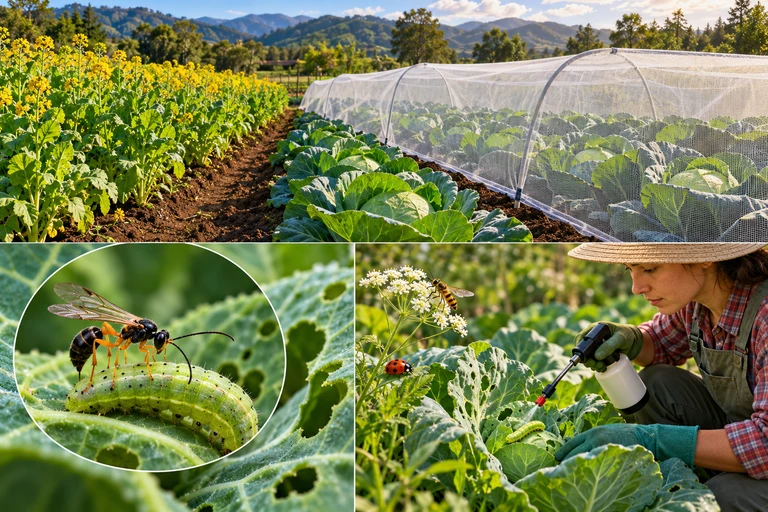 Pest controls can interrupt host availability, exclude pests physically, use natural enemies, or apply a directed treatment. Effective choices depend on the pest, host, timing and non-target effects.
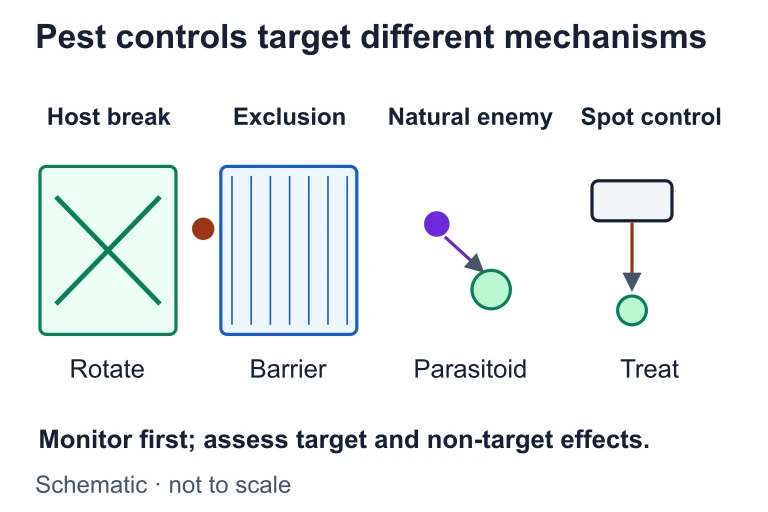 Pest controls can interrupt host availability, exclude pests physically, use natural enemies, or apply a directed treatment. Effective choices depend on the pest, host, timing and non-target effects.
SECTION 6
Worked Example: Biomagnification Calculation
The following example demonstrates how to calculate pesticide concentration at successive trophic levels—a common quantitative task on the AP Environmental Science exam.
DDT Biomagnification in an Aquatic Food Chain
- 1
Step 1 — Identify Given Values
A lake contains DDT at a concentration of 0.003 ppm in the water. Phytoplankton (trophic level 1) bioaccumulate DDT to a concentration of 0.04 ppm. Small fish (trophic level 2) have a biomagnification factor (BMF) of 10. Large fish (trophic level 3) have a BMF of 8. Osprey (trophic level 4) have a BMF of 25. We need to find the DDT concentration in the osprey. - 2
Step 2 — Calculate Trophic Level 2 (Small Fish)
Csmall fish = BMF × Cphytoplankton = 10 × 0.04 ppm = 0.4 ppm.C(small fish) = 0.4 ppm - 3
Step 3 — Calculate Trophic Level 3 (Large Fish)
Clarge fish = BMF × Csmall fish = 8 × 0.4 ppm = 3.2 ppm.C(large fish) = 3.2 ppm - 4
Step 4 — Calculate Trophic Level 4 (Osprey)
Cosprey = BMF × Clarge fish = 25 × 3.2 ppm = 80 ppm.C(osprey) = 80 ppm - 5
Step 5 — Interpret the Result
The DDT concentration increased from 0.003 ppm in the water to 80 ppm in the osprey—a factor of roughly 26,667×. This dramatic amplification across just four trophic levels explains why top predators like the bald eagle and peregrine falcon were disproportionately affected by DDT and experienced catastrophic eggshell thinning. This type of calculation illustrates why persistent, lipophilic pesticides are considered high-risk environmental contaminants.Overall magnification ≈ 26,667×
SECTION 7
Strengths & Limitations of Each Method
| Method | Strengths | Limitations |
|---|---|---|
| Chemical Pesticides | Fast-acting; effective against large infestations; relatively inexpensive per unit area | Bioaccumulation/biomagnification; pesticide resistance; kills non-target species including pollinators; water contamination |
| Biological Control | Targets specific pests; self-sustaining once established; low chemical input | Slow to establish; introduced species may become invasive; not effective for all pest types; may require continuous monitoring |
| Cultural / Genetic | Preventive; no toxic residues; supports biodiversity; reduces long-term costs | Requires advanced planning; may reduce short-term yield; GMO varieties face public resistance and regulatory hurdles |
| Mechanical / Physical | No chemicals; immediately effective locally; simple technology | Labor-intensive; not practical at large scale; tillage can cause soil erosion |
| IPM (Integrated) | Holistic; reduces chemical use; slows resistance; environmentally sustainable | Knowledge-intensive; requires ongoing monitoring; higher initial training cost; slower results than pure chemical approach |
Comparison of pest control methods by strengths and limitations
KEY TAKEAWAY
SECTION 8
Connections to Broader Environmental Science
Pest control methods intersect with nearly every major topic area in AP Environmental Science. Understanding these connections strengthens your ability to craft comprehensive FRQ responses and identify cross-topic relationships in multiple-choice questions.
| AP Topic Connection | How Pest Control Relates |
|---|---|
| Biodiversity (Ecosystems) | Broad-spectrum pesticides reduce species richness. Monoculture reliance on chemical control diminishes habitat heterogeneity. Biological control leverages existing biodiversity. |
| Water Pollution | Pesticide runoff is a major nonpoint-source pollutant. Herbicides and insecticides contaminate surface water and groundwater, causing eutrophication, toxicity to aquatic organisms, and contaminated drinking water. |
| Evolution & Natural Selection | Pesticide resistance is a textbook example of directional selection. Pest populations evolve rapidly under strong selective pressure from repeated chemical applications. |
| Soil Health (Land Use) | Pesticides can kill soil organisms essential for nutrient cycling. Cultural practices like crop rotation and cover cropping both manage pests and improve soil structure. |
| Human Health (Toxicology) | Chronic pesticide exposure is linked to cancers, endocrine disruption, and neurological damage. Farmworker exposure and residues on food are key environmental justice issues. |
| Legislation (FIFRA, FQPA) | The Federal Insecticide, Fungicide, and Rodenticide Act (FIFRA) regulates pesticide registration and use. The Food Quality Protection Act (FQPA) sets safety standards for pesticide residues in food. |
Looking forward, emerging technologies are reshaping pest control. Gene drive technology could potentially suppress entire pest populations by spreading deleterious alleles, while precision agriculture uses drone-mounted sensors and GPS-guided sprayers to apply pesticides only where pest densities exceed thresholds, dramatically reducing total chemical input. RNA interference (RNAi) sprays that silence specific pest genes without persisting in the environment represent another frontier. These technologies promise greater precision but raise new regulatory and ethical questions about unintended ecological consequences—themes that are increasingly appearing in AP exam scenarios.
SECTION 9
Practice Problems
Question 1: CONCEPTUAL
- A. The pesticide has chemically degraded over time in storage, reducing its potency.
- B. Individual corn borers have learned to avoid areas treated with the pesticide.
- C. Natural selection has increased the frequency of pesticide-resistant alleles in the corn borer population.
- D. Soil nutrient depletion has weakened the corn plants, making them more attractive to pests.
Show answer (C)
Question 2: BASIC CALCULATION
- A. 8.5 ppm
- B. 15.0 ppm
- C. 0.42 ppm
- D. 2.5 ppm
Show answer (B)
Question 3: INTERMEDIATE
- A. Rotating wheat with legumes to disrupt pest life cycles and improve soil nitrogen
- B. Releasing parasitoid wasps that target wheat stem sawflies
- C. Using sticky traps to monitor aphid populations and determine if they exceed the economic threshold
- D. Applying broad-spectrum insecticide on a fixed calendar schedule regardless of observed pest levels
Show answer (D)
Question 4: APPLIED
4 ptsShow answer
Question 5: CRITICAL THINKING
5 ptsShow answer
SUMMARY
Lesson Summary
Summary
Pest control methods range from chemical pesticides (insecticides, herbicides, fungicides, rodenticides) to biological controls (natural predators, parasitoids, Bt bacteria), cultural and genetic methods (crop rotation, intercropping, GMO resistant varieties), and mechanical controls (traps, barriers, tillage). Chemical pesticides act fast but cause bioaccumulation and biomagnification, harm non-target species, contaminate water, and drive the pesticide treadmill of evolutionary resistance.
Integrated Pest Management (IPM) is the gold standard approach, combining multiple strategies in a tiered framework that uses chemical pesticides only as a last resort when pest populations exceed the economic threshold. Key legislation includes FIFRA (regulates pesticide registration) and the FQPA (sets health-based residue standards). Rachel Carson's Silent Spring catalyzed the shift from broad-spectrum chemical reliance toward sustainable, ecologically informed pest management. For the AP exam, master the trade-offs of each method, know how to calculate biomagnification, and be prepared to design experiments evaluating biological or integrated control strategies.