

SECTION 1
Historical Context & Motivation
The twentieth century witnessed an unprecedented expansion in synthetic chemical production, driven largely by the demands of industrial agriculture and public health campaigns against insect-borne diseases. Among the most consequential classes of these synthetic compounds are persistent organic pollutants (POPs) — carbon-based chemicals that resist environmental degradation, accumulate in living tissues, and travel vast distances through air and water. Early enthusiasm for chemicals like DDT gave way to alarm as scientists documented thinning eggshells in raptors, endocrine disruption in wildlife, and elevated cancer risks in human populations. The story of POPs illustrates a recurring environmental lesson: chemical persistence and biological accumulation can transform an apparent technological triumph into an ecological crisis.
1939 • DDT's Insecticidal Properties Discovered
1962 • Silent Spring Published
1972 • U.S. Bans DDT
2001 • Stockholm Convention Adopted
2019 • PFAS Additions & Ongoing Expansion
The central question that POPs raise — and the one this lesson addresses — is: why do certain organic chemicals persist in the environment, how do they concentrate as they move through food webs, and what regulatory frameworks exist to mitigate their effects? Understanding the answers requires examining chemical properties, ecological processes like bioaccumulation and biomagnification, and the architecture of international environmental agreements.
SECTION 2
Core Principles & Defining Characteristics
POPs are defined by a convergence of four properties that make them uniquely hazardous. Unlike pollutants that break down relatively quickly, POPs combine chemical stability with ecological mobility, ensuring that even trace quantities can inflict widespread biological damage over time. The Stockholm Convention formally identifies a substance as a POP if it meets criteria across all four of the following categories.
Persistence
Bioaccumulation
Long-Range Transport
Toxicity
SECTION 3
Biomagnification Through a Food Web
The ecological danger of POPs is best understood through the concept of biomagnification — the progressive increase in pollutant concentration at each successive trophic level of a food web. While bioaccumulation describes the build-up within a single organism over its lifetime, biomagnification describes the amplification that occurs when a predator consumes many contaminated prey items. The diagram below illustrates how a trace concentration of a POP in water can become lethally concentrated in top predators.
Notice that the concentration factor between adjacent trophic levels is roughly 5–12×, but the cumulative effect from water to top predator spans several orders of magnitude. This is precisely why top predators such as bald eagles, polar bears, and orcas serve as sentinel species for POP contamination — their tissue concentrations reveal ecosystem-wide pollution levels that would be undetectable in water sampling alone.
SECTION 4
Mechanisms of Persistence & Transport
Why POPs Resist Degradation
The molecular stability of most POPs stems from their halogenated aromatic ring structures. Chlorine atoms bonded to carbon backbones create very strong C–Cl bonds (bond energy ≈ 328 kJ/mol) that resist photolysis and enzymatic attack. The aromatic rings further stabilize the molecule through electron delocalization. These properties explain why chlorinated pesticides (DDT, dieldrin) and industrial chemicals (PCBs, dioxins) can persist in soils and sediments for decades.
The Grasshopper Effect (Global Distillation)
Many POPs are semi-volatile, meaning they exist in a vapor–particle equilibrium that is temperature-dependent. In warmer tropical and temperate regions, POPs volatilize from soil and water surfaces into the atmosphere. Wind currents transport these vapors toward the poles, where cooler temperatures cause them to condense and deposit onto land and water. This cycle can repeat — the chemical re-volatilizes during a warm spell and condenses again further poleward — hence the term grasshopper effect. The net result is a global redistribution that concentrates POPs in Arctic and sub-Arctic ecosystems, far from any industrial or agricultural source.
Quantifying Bioaccumulation
BIOCONCENTRATION FACTOR (BCF)
Where Corganism is the concentration of a chemical in an organism's tissue (mg/kg) and Cwater is the concentration in surrounding water (mg/L). A BCF > 5,000 typically indicates a strong bioaccumulator.
BIOMAGNIFICATION FACTOR (BMF)
A BMF > 1 indicates that the chemical is biomagnifying — i.e., its concentration increases as it moves up the food web. For many POPs, BMF values range from 2 to 20 per trophic level.
HALF-LIFE DECAY
C(t) = concentration remaining after time t; C₀ = initial concentration; t1/2 = environmental half-life. This equation allows estimation of how long a POP persists in a given medium.
 For suitable semi-volatile persistent pollutants, repeated volatilization, transport and deposition can redistribute contamination toward colder regions. Chemical properties determine whether this mechanism applies.
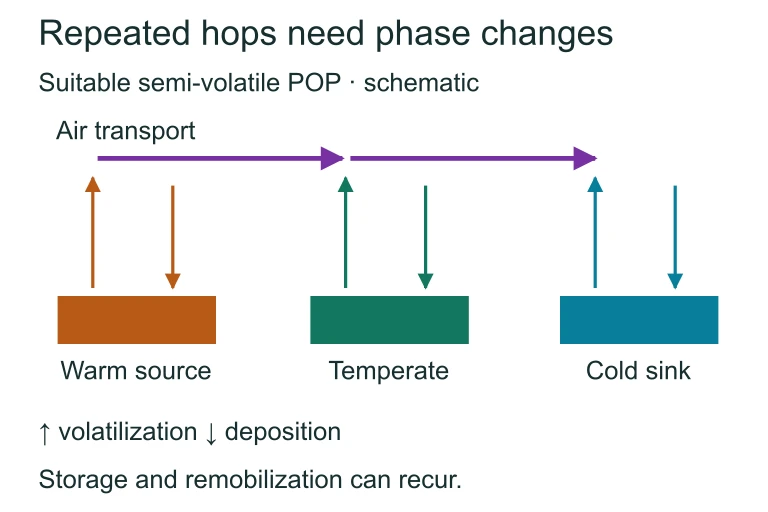 For suitable semi-volatile persistent pollutants, repeated volatilization, transport and deposition can redistribute contamination toward colder regions. Chemical properties determine whether this mechanism applies.
SECTION 5
Major Categories of POPs
The Stockholm Convention initially targeted twelve chemicals — collectively known as the Dirty Dozen — but the list has since expanded to over 30 substances. POPs fall into three broad functional categories based on their origins and uses, as outlined in the table below.
| Category | Examples | Primary Pathway | Key Concern |
|---|---|---|---|
| Pesticides | DDT, aldrin, dieldrin, chlordane, heptachlor, toxaphene | Sprayed on crops and for vector control; enter soil and runoff into aquatic systems | Eggshell thinning in raptors; endocrine disruption in amphibians and fish |
| Industrial Chemicals | PCBs, HCB, PBDEs, PFOS, PFOA | Used in transformers, flame retardants, non-stick coatings; released via manufacturing waste and product disposal | Carcinogenicity (PCBs); thyroid disruption (PBDEs); immune suppression |
| Unintentional By-products | Dioxins (PCDDs), furans (PCDFs) | Formed during incomplete combustion, waste incineration, and certain industrial processes | Extremely toxic even at parts-per-trillion; classified as known human carcinogens (IARC Group 1) |
Three major categories of POPs as classified under the Stockholm Convention
SECTION 6
Worked Example — Biomagnification & Half-Life
The following problem integrates biomagnification factors and half-life calculations, both of which appear frequently on the AP Environmental Science exam.
Worked example
- 1
Step 1 — Identify Given Values
A lake is contaminated with a chlorinated pesticide at a concentration of 0.005 ppm in the water. The bioconcentration factor (BCF) from water to phytoplankton is 1,000. The biomagnification factor (BMF) between each subsequent trophic level is 10. The food chain has four trophic levels: phytoplankton → zooplankton → small fish → osprey. The pesticide's environmental half-life is 8 years. - 2
Step 2 — Calculate Concentration in Phytoplankton
Using the BCF: Cphytoplankton = BCF × Cwater = 1,000 × 0.005 ppmC(phytoplankton) = 5 ppm - 3
Step 3 — Apply BMF Up the Food Chain
Zooplankton: 5 ppm × 10 = 50 ppm. Small fish: 50 ppm × 10 = 500 ppm. Osprey: 500 ppm × 10 = 5,000 ppm.C(osprey) = 5,000 ppm — a 1,000,000× increase from the water concentration - 4
Step 4 — Calculate Persistence After 24 Years
If the source is removed, how much remains in the environment after 24 years? Using C(t) = C₀ × (1/2)(t/t₁/₂): Number of half-lives = 24 ÷ 8 = 3. C(24) = C₀ × (1/2)³ = C₀ × 1/8 = 0.125 × C₀.After 24 years, 12.5% of the original concentration remains - 5
Step 5 — Interpret the Result
Even after three half-lives (24 years), one-eighth of the original pesticide persists in the environment. Because it continues to bioaccumulate, top predators like the osprey would still carry concentrations high enough to cause reproductive harm. This illustrates why simple source removal is insufficient — active remediation or decades of waiting may be required.
SECTION 7
Regulatory Frameworks & Remediation Approaches
Because POPs cross national boundaries through atmospheric and oceanic transport, effective regulation demands international cooperation. The table below contrasts the major regulatory approaches and remediation strategies.
| Approach | Strengths | Limitations |
|---|---|---|
| Stockholm Convention (global treaty) | Binding targets for elimination or restriction; 186 parties; regular review to add new POPs; financial assistance for developing nations | Major emitters (e.g., the U.S.) have signed but not ratified; enforcement relies on national implementation; legacy contamination remains |
| National bans (e.g., U.S. EPA ban on DDT) | Rapid, enforceable within jurisdiction; demonstrated success in raptor population recovery | Does not address transboundary transport; may shift production to less-regulated countries |
| Bioremediation | Uses microorganisms or plants to degrade or sequester POPs; lower cost than incineration | Slow; effectiveness varies with site conditions; may not fully dehalogenate compounds |
| High-temperature incineration | Can destroy POPs at >1,100°C; effective for stockpile elimination | Expensive; incomplete combustion can generate dioxins and furans as by-products |
Comparison of regulatory and remediation strategies for POPs
SECTION 8
Connections to Broader Environmental Science
POPs intersect with nearly every major topic in AP Environmental Science. Understanding them in isolation is insufficient; the exam frequently tests how POPs connect to concepts like trophic dynamics, environmental justice, and climate change. The table below maps these connections.
| APES Topic | Connection to POPs |
|---|---|
| Ecosystem Ecology & Trophic Levels | Biomagnification is the primary mechanism by which POPs inflict damage on apex predators; quantified via BCF and BMF |
| Biogeochemical Cycles | POPs interact with the carbon cycle (stored in organic matter), and the grasshopper effect uses atmospheric and hydrological transport pathways |
| Climate Change | Warming temperatures may remobilize POPs locked in permafrost and glacial ice, releasing legacy pollutants into ecosystems |
| Environmental Justice | Indigenous Arctic communities bear disproportionate body burdens of POPs due to traditional diets rich in marine mammals high on the food chain |
| Endocrine Disruptors | Many POPs mimic or block hormones; links to reproductive failure in wildlife (e.g., alligators in Lake Apopka, FL) and human health effects at low doses |
SECTION 9
Practice Problems
Question 1: CONCEPTUAL
- A. Arctic organisms have faster metabolic rates that concentrate chemicals more rapidly.
- B. POPs undergo global distillation (the grasshopper effect), volatilizing in warm regions and condensing in cold polar regions, where they bioaccumulate in food webs.
- C. Ocean currents exclusively transport POPs to the poles, where they are trapped under sea ice.
- D. Arctic soils are more acidic than temperate soils, which prevents the breakdown of organic pollutants.
Show answer (B)
Question 2: BASIC CALCULATION
- A. 100 mg/kg
- B. 50 mg/kg
- C. 25 mg/kg
- D. 12.5 mg/kg
Show answer (C)
Question 3: INTERMEDIATE
- A. 12.3 ppm
- B. 122.9 ppm
- C. 1,228.8 ppm
- D. 9,830.4 ppm
Show answer (C)
Question 4: APPLIED
Show answer
Question 5: CRITICAL THINKING