

SECTION 1
Historical Context & Motivation
The quest for nuclear power grew from early-twentieth-century discoveries in atomic physics and the geopolitical pressures of World War II. Once scientists demonstrated that splitting a heavy atomic nucleus could release enormous quantities of energy, attention quickly shifted from weaponry to the tantalizing prospect of cheap, virtually limitless electricity. The first experimental reactors proved that a controlled, sustained chain reaction was achievable, and by the mid-1950s commercial plants were feeding power grids. Understanding this history is essential for the AP Environmental Science exam because it reveals why nuclear energy occupies a uniquely contested position — championed as a low-carbon alternative to fossil fuels yet shadowed by catastrophic accidents and unresolved waste issues.
1942 • Chicago Pile-1
1954 • Obninsk Power Plant
1979 • Three Mile Island
1986 • Chernobyl Disaster
2011 • Fukushima Daiichi
These milestones frame a central question in environmental science: can nuclear power's extraordinarily high energy density and negligible greenhouse-gas emissions during operation outweigh the risks of catastrophic accidents, long-lived radioactive waste, and the potential for weapons proliferation? The remainder of this lesson examines the science, math, benefits, and drawbacks you need to master for the AP exam.
SECTION 2
Core Principles of Nuclear Energy
Nuclear power converts mass into energy through nuclear fission — the splitting of heavy nuclei (typically uranium-235 or plutonium-239) into lighter fragments, releasing kinetic energy and additional neutrons. Those neutrons can go on to split neighboring nuclei, sustaining a chain reaction. In a commercial reactor, the rate of this chain reaction is carefully moderated so that heat is produced steadily, converted to steam, and used to spin turbines — the same thermodynamic cycle employed by coal and natural-gas plants, but without combustion.
Nuclear Fission
Chain Reaction & Criticality
Fuel Enrichment
Radioactive Waste
SECTION 3
How a Nuclear Reactor Works — Visual Overview
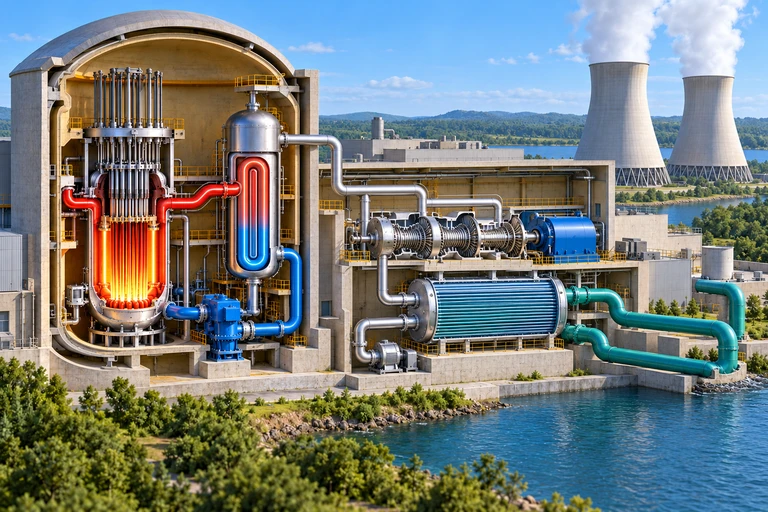
The diagram above illustrates the dominant commercial reactor design — the pressurized water reactor (PWR), which accounts for roughly two-thirds of the world's operating reactors. Notice the physical separation between the primary coolant loop (which directly contacts the reactor core) and the secondary steam loop (which drives the turbine). This separation is a key safety feature: if a fuel rod develops a leak, radioactive material remains confined within the containment building and the primary loop, reducing the chance of environmental release. The control rods — shown in pink — can be inserted deeper into the core to absorb more neutrons and slow the reaction, or withdrawn to increase power output. The overall thermal efficiency of a PWR is typically about 33%, meaning roughly one-third of the fission heat becomes electricity, with the rest rejected through the cooling system.
 In a pressurized water reactor, heat crosses intact exchanger walls while the primary, steam and cooling-water circuits remain separate. Control rods reduce fission power, while decay heat continues to require cooling.
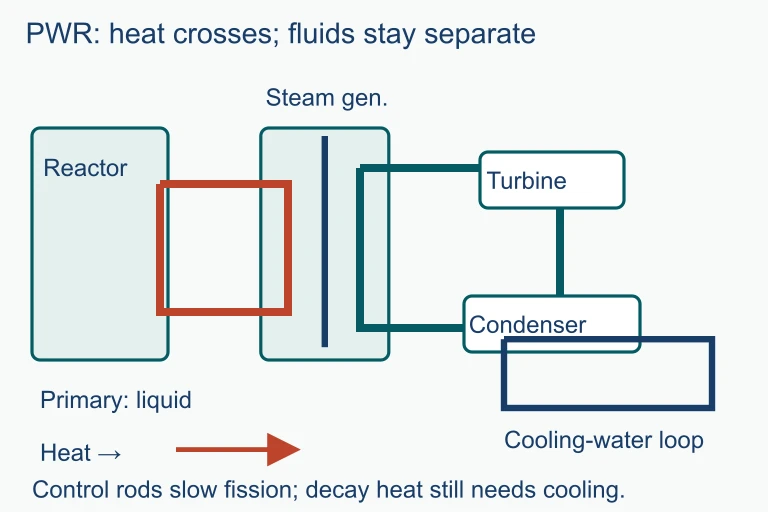 In a pressurized water reactor, heat crosses intact exchanger walls while the primary, steam and cooling-water circuits remain separate. Control rods reduce fission power, while decay heat continues to require cooling.
SECTION 4
Mathematical Framework — Energy from Fission
The extraordinary energy density of nuclear fuel ultimately derives from Einstein's mass-energy equivalence. In every fission event, a small amount of mass disappears — converted entirely into kinetic energy of the fission products and radiation. Understanding the quantitative relationships below is essential for AP-level calculations involving fuel consumption, electricity output, and capacity factor.
MASS-ENERGY EQUIVALENCE
E = energy released (joules), m = mass defect (kg), c = speed of light ≈ 3.0 × 10⁸ m/s. A single U-235 fission converts ~0.09% of the atom's mass into ~200 MeV (~3.2 × 10⁻¹¹ J) of energy.
ELECTRICAL ENERGY OUTPUT
E = electrical energy (kWh or MWh), P = power rating of the plant (kW or MW), t = time of operation (h). A 1,000 MW plant running for 24 hours produces 24,000 MWh.
CAPACITY FACTOR
Nuclear plants typically achieve capacity factors of 90–93%, far exceeding wind (~35%) and solar (~25%). Maximum possible output = rated capacity × total hours in the period.
HALF-LIFE DECAY
N(t) = amount remaining at time t, N₀ = initial amount, t₁/₂ = half-life. This equation governs how long radioactive waste remains hazardous — e.g., Pu-239 has a t₁/₂ of ~24,100 years.
SECTION 5
The Nuclear Fuel Cycle & Waste Classification
The nuclear fuel cycle encompasses every step from mining uranium ore through final disposal of radioactive waste. Each stage carries distinct environmental and health implications that the AP exam expects you to evaluate. The front end of the cycle involves mining, milling, conversion, enrichment, and fuel fabrication. The back end involves interim storage of spent fuel, possible reprocessing, and permanent disposal — the last step remaining politically unresolved in the United States, where the proposed Yucca Mountain repository in Nevada has been shelved indefinitely.
| Waste Category | Examples | Half-Life Range | Disposal Method |
|---|---|---|---|
| Low-level | Contaminated clothing, tools, filters | Seconds to ~30 years | Shallow land burial |
| Intermediate-level | Reactor components, resins, chemical sludges | Varies; may contain long-lived isotopes | Solidified and placed in near-surface or intermediate-depth facilities |
| High-level | Spent fuel rods, vitrified reprocessing waste | Thousands to hundreds of thousands of years (e.g., Pu-239 ≈ 24,100 yr) | Deep geologic repository (proposed; none fully operational in the U.S.) |
Radioactive Waste Classification
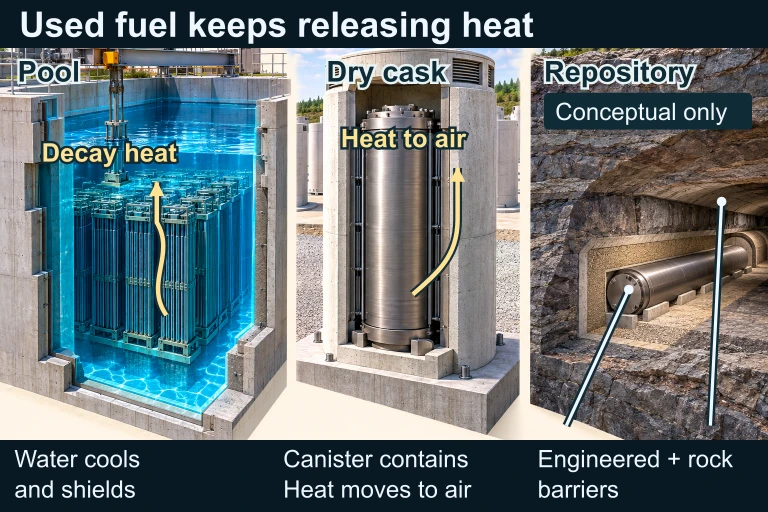 Used nuclear fuel continues to release decay heat. Large physical cutaways distinguish pool water that cools and shields, a canister and dry cask that contain fuel and pass heat to air, and conceptual disposal using engineered and surrounding-rock barriers. Heat arrows and barrier leaders are illustrative, at separate scales; this is not an operating sequence, a time-to-transfer prescription, or a claim that a particular repository is operating.
SECTION 6
Worked Example — Capacity Factor Calculation
Worked example
- 1
Step 1 — Identify Given Values
A nuclear power plant has a rated (nameplate) capacity of 1,200 MW. Over the course of one year (365 days), it produced 9,460,800 MWh of electricity. - 2
Step 2 — Calculate Maximum Possible Output
Maximum possible output = rated capacity × total hours in one year. Total hours = 365 days × 24 h/day = 8,760 h. Therefore, maximum output = 1,200 MW × 8,760 h = 10,512,000 MWh.Max output = 10,512,000 MWh - 3
Step 3 — Apply the Capacity Factor Formula
Capacity factor = (Actual output ÷ Maximum possible output) × 100% = (9,460,800 ÷ 10,512,000) × 100%. - 4
Step 4 — Solve and Interpret
Capacity factor = 0.90 × 100% = 90%. This means the plant operated at 90% of its maximum potential over the year, which is typical for a well-maintained nuclear facility. The remaining 10% represents downtime for refueling, maintenance, or regulatory inspections.Capacity factor = 90%
SECTION 7
Advantages and Disadvantages of Nuclear Power
No energy source is free of trade-offs, and nuclear power exemplifies this tension more starkly than most. For the AP exam, you must be prepared to articulate specific advantages and disadvantages — and, in FRQ responses, propose or evaluate policy solutions that weigh these factors against one another.
| Advantages | Disadvantages |
|---|---|
| Extremely low greenhouse-gas emissions during operation — comparable to wind per kWh on a life-cycle basis. | High-level radioactive waste requires isolation for tens of thousands of years; no permanent U.S. repository exists. |
| Very high energy density: one uranium fuel pellet (~7 g) yields as much energy as ~1 ton of coal. | Catastrophic accident risk (meltdowns) with severe, long-lasting environmental contamination. |
| Reliable baseload power with ~90% capacity factor, unaffected by weather or time of day. | Extremely high upfront capital costs ($6–12 billion per plant) and long construction timelines (10–15 years). |
| Small land footprint relative to equivalent solar or wind installations. | Uranium mining produces tailings with radioactive and toxic residues; water use for cooling is substantial. |
| Fuel supply is relatively abundant and geographically distributed. | Enrichment and reprocessing technology can be diverted for nuclear weapons proliferation. |
Nuclear Power — Advantages vs. Disadvantages
Key takeaway
SECTION 8
Emerging Technologies & the Nuclear Debate
The conventional large-scale reactor designs that dominate today's fleet are not the end of nuclear innovation. Several emerging technologies are frequently referenced in AP-level discussions of sustainable energy portfolios, and understanding the distinction between current-generation fission and advanced concepts gives you an edge on synthesis questions.
| Feature | Conventional Reactors (Gen II/III) | Advanced / Emerging Technologies |
|---|---|---|
| Scale | Large (>1,000 MW); built on-site | Small Modular Reactors (SMRs): 50–300 MW; factory-built, shipped to site |
| Coolant | Pressurized or boiling water | Molten salt, liquid sodium, helium gas, or supercritical water |
| Safety approach | Active systems (pumps, backup generators) | Passive safety designs — gravity, convection, and negative temperature coefficients shut the reactor down without human intervention |
| Waste | Once-through cycle (U.S.); long-lived transuranics in spent fuel | Some designs can consume existing spent fuel or use thorium, reducing long-lived waste volume |
| Nuclear fusion | Not applicable — all commercial reactors use fission | Fusion (combining light nuclei, e.g., deuterium + tritium) promises near-limitless fuel and minimal long-lived waste, but remains decades from commercial viability |
Conventional vs. Advanced Nuclear Technologies
For the AP exam, the most important takeaway is the distinction between nuclear fission (splitting heavy atoms — commercially mature) and nuclear fusion (combining light atoms — still experimental). Both release energy via E = mc², but their fuel sources, waste profiles, and engineering challenges are fundamentally different. Fusion would use isotopes of hydrogen abundantly found in seawater and would produce helium as a primary byproduct rather than long-lived radioactive waste. However, achieving and sustaining the extreme temperatures and pressures needed for fusion (>100 million °C) on Earth remains one of the great engineering challenges of our time.
SECTION 9
Practice Problems
Question 1: CONCEPTUAL
- A. They provide additional neutrons to sustain the chain reaction.
- B. They absorb excess neutrons to regulate the rate of fission.
- C. They convert kinetic energy of fission products into electricity.
- D. They enrich uranium-238 into fissile uranium-235 inside the core.
Show answer (B)
Question 2: BASIC CALCULATION
- A. 70%
- B. 78%
- C. 87.5%
- D. 95%
Show answer (C)
Question 3: INTERMEDIATE
- A. 100 g
- B. 50 g
- C. 25 g
- D. 12.5 g
Show answer (C)
Question 4: APPLIED
Show answer
Question 5: CRITICAL THINKING