

SECTION 1
Historical Context & Motivation
Mining is among the oldest human industrial activities, stretching back thousands of years to when early civilizations extracted copper, tin, and gold from shallow deposits. As societies advanced through the Bronze Age and Iron Age, the scale of extraction expanded dramatically, and the ecological consequences grew in proportion. The Industrial Revolution marked a turning point: steam-powered machinery enabled deeper excavations and higher throughput, while the demand for coal, iron, and later petroleum transformed entire landscapes. By the twentieth century, the environmental toll of mining—deforested mountainsides, acid-laden rivers, and displaced communities—became impossible to ignore, catalyzing a wave of environmental legislation that continues to evolve today.
~3000 BCE • Early Metal Extraction
1848 • California Gold Rush
1970 • U.S. Clean Air Act & NEPA
1977 • Surface Mining Control & Reclamation Act (SMCRA)
2015 • Gold King Mine Spill
These historical episodes raise a central question for environmental science: how can societies meet their demand for mineral and energy resources while minimizing ecological degradation, water contamination, and habitat loss? Answering that question requires an understanding of the different mining methods, the specific environmental impacts each produces, and the regulatory and remediation strategies that can mitigate harm.
SECTION 2
Core Principles & Definitions
Before examining specific impacts, it is essential to define the major mining techniques and the environmental processes they set in motion. Mining methods vary based on the depth, geometry, and composition of the ore body, and each method carries a distinct environmental footprint. The AP Environmental Science curriculum emphasizes four broad categories of mining, along with the key ecological concepts that govern their impacts.
Surface (Strip / Open-Pit) Mining
Subsurface (Underground) Mining
Mountaintop Removal (MTR)
Placer & Solution Mining
Acid Mine Drainage (AMD)
KEY TAKEAWAY
SECTION 3
Visual Explanation — Mining Impact Pathways
The diagram above captures the three primary environmental spheres affected by mining: the lithosphere (land disturbance, erosion, subsidence), the hydrosphere (groundwater contamination, sedimentation of surface streams, acid mine drainage), and the atmosphere (particulate matter, sulfur dioxide emissions, and greenhouse gases from machinery and ore processing). Notice that these impact pathways are not isolated: sediment runoff from the open pit enters groundwater, which feeds surface streams, and airborne dust deposits on soils far from the mine site, creating a cascade of ecological effects that extends well beyond the mine's physical boundaries.
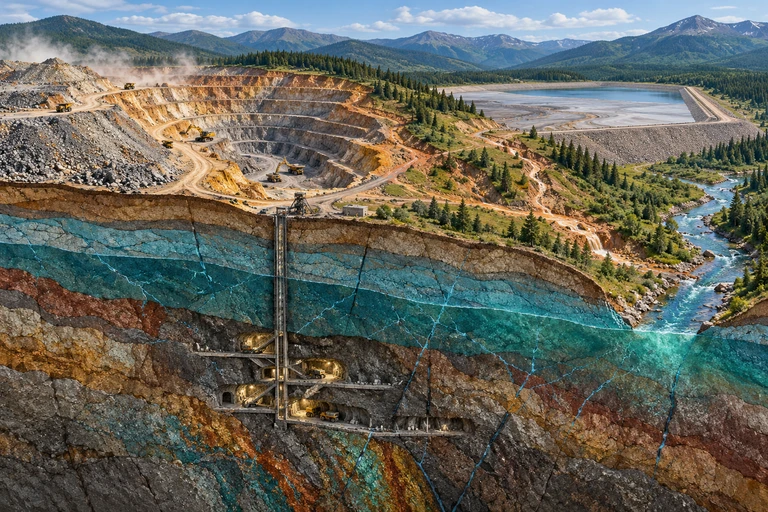 Mining can mobilize dust, sediment and dissolved material along different pathways. Mineralogy, water chemistry and hydrogeology determine how contaminants move and whether acid drainage forms.
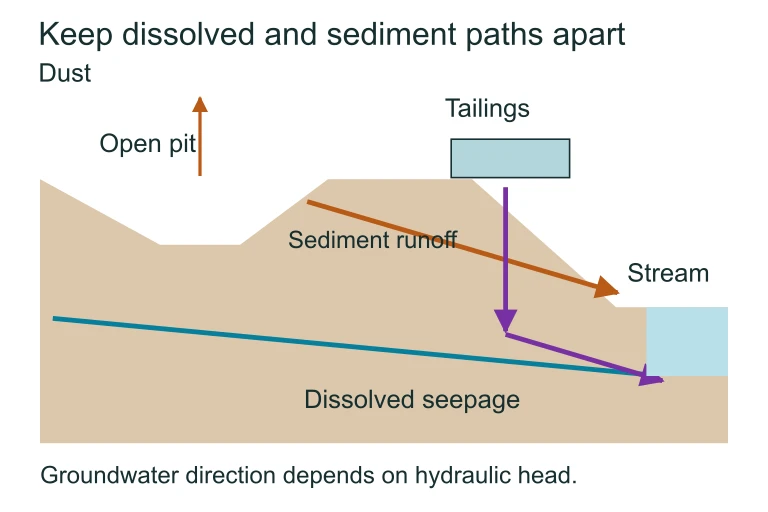 Mining can mobilize dust, sediment and dissolved material along different pathways. Mineralogy, water chemistry and hydrogeology determine how contaminants move and whether acid drainage forms.
SECTION 4
Mechanisms of Environmental Damage
Acid Mine Drainage — The Chemistry
Perhaps the most persistent and chemically complex consequence of mining is acid mine drainage (AMD). When mining operations expose sulfide-bearing minerals—most commonly pyrite (FeS₂)—to oxygen and water, a series of oxidation reactions produces sulfuric acid and dissolved iron. The resulting low-pH water then dissolves additional heavy metals (lead, arsenic, cadmium, mercury) from surrounding rock, creating a toxic solution that can devastate aquatic ecosystems for centuries.
PYRITE OXIDATION (SIMPLIFIED)
FeS₂ = pyrite; O₂ = atmospheric oxygen; Fe²⁺ = dissolved ferrous iron; SO₄²⁻ = sulfate ions; H⁺ = hydrogen ions (acid). The H⁺ ions lower pH, and dissolved iron further oxidizes to form the characteristic orange precipitate (yellow boy) that coats streambeds.
IRON HYDROXIDE PRECIPITATION
Fe(OH)₃ = ferric hydroxide precipitate (orange sediment). Note that this reaction produces additional H⁺ ions, creating a positive feedback loop that accelerates acidification—making AMD self-sustaining once initiated.
Other Key Mechanisms
Bioaccumulation and biomagnification represent a second critical mechanism by which mining contaminants damage ecosystems. Heavy metals released by AMD or tailings seepage (mercury, lead, cadmium) enter food webs at the base—absorbed by algae and aquatic invertebrates—and concentrate at each successive trophic level. Top predators such as raptors and large fish may accumulate toxin concentrations millions of times greater than ambient water levels, leading to reproductive failure, neurological damage, and population decline.
Habitat fragmentation is a third mechanism with far-reaching ecological consequences. Surface mining operations and their associated infrastructure—roads, processing plants, and waste dumps—divide continuous habitats into isolated patches. Species with large home ranges, limited dispersal ability, or dependence on interior habitat (e.g., forest-interior songbirds) experience reduced gene flow, smaller effective population sizes, and increased vulnerability to stochastic extinction events.
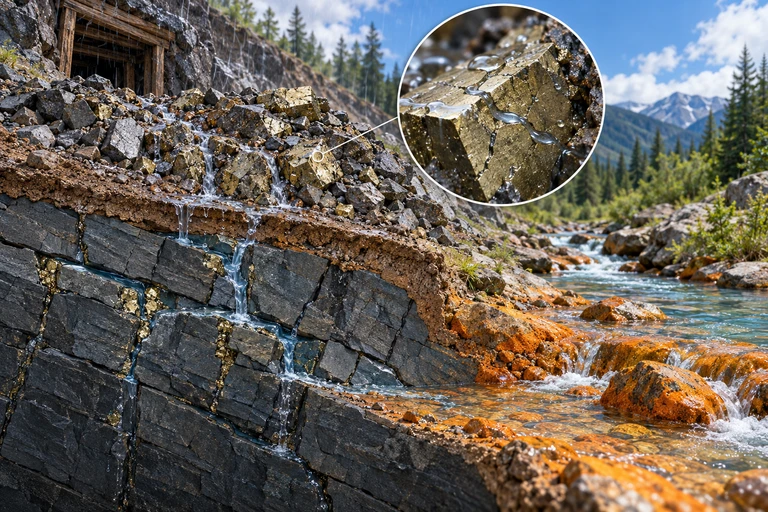 Pyrite oxidation and subsequent iron precipitation can generate acidity. Orange iron precipitate is a solid product; dissolved hydrogen ions determine acidity in the water.
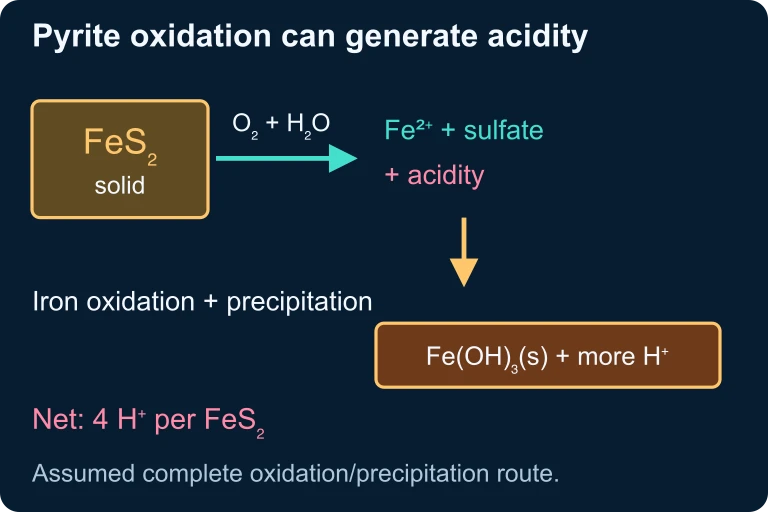 Pyrite oxidation and subsequent iron precipitation can generate acidity. Orange iron precipitate is a solid product; dissolved hydrogen ions determine acidity in the water.
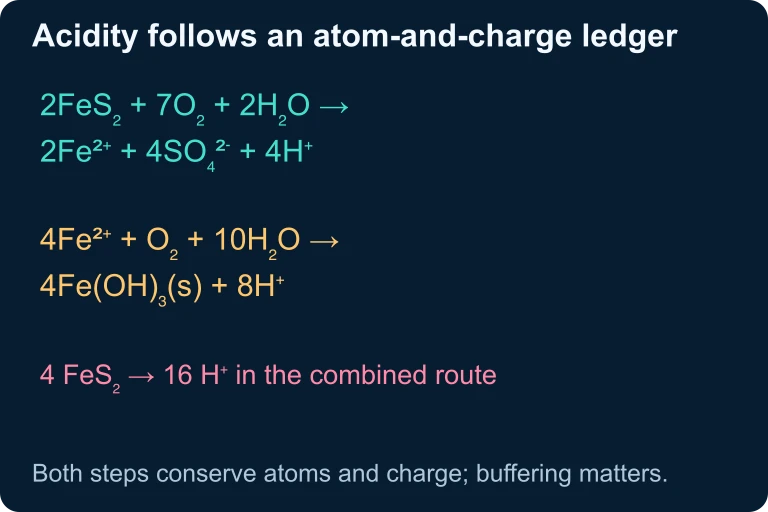 Separate pyrite oxidation from iron oxidation and precipitation. Following atoms and charge through these steps shows where hydrogen ions are produced.
SECTION 5
Detailed Breakdown of Mining Impacts
Mining impacts can be systematically organized into categories affecting the land, water, air, biodiversity, and human communities. The following diagram and table provide a comparative overview.
| Impact Domain | Primary Effects | Example / Case Study |
|---|---|---|
| Land | Deforestation, topsoil loss, erosion, subsidence, altered topography | Appalachian mountaintop removal has flattened >500 mountain peaks and filled >2,000 km of headwater streams with spoil. |
| Water | Acid mine drainage, heavy metal contamination, sedimentation, groundwater drawdown, thermal pollution | The Berkeley Pit in Butte, Montana—a former copper mine—holds 40 billion gallons of acidic, metal-laden water (pH ≈ 2.5). |
| Air | Fugitive dust (PM₁₀, PM₂.₅), SO₂ and NOₓ from smelting, CO₂ from fuel combustion, mercury vapor from gold processing | Artisanal gold mining releases ~400 metric tons of mercury to the atmosphere annually, the single largest source of anthropogenic mercury emissions. |
| Biodiversity | Habitat destruction and fragmentation, invasive species colonization of disturbed land, bioaccumulation of heavy metals through food webs | Nickel mining in New Caledonia threatens endemic plant species found nowhere else; the island's laterite mine sites have among the highest concentrations of endangered flora globally. |
| Human Communities | Displacement of indigenous peoples, respiratory disease from dust exposure, contaminated drinking water, loss of subsistence resources | The Ok Tedi copper mine in Papua New Guinea discharged tailings into the Fly River for decades, devastating fisheries that 50,000 people depended on for food. |
Summary of mining impacts across five environmental and social domains with illustrative case studies.
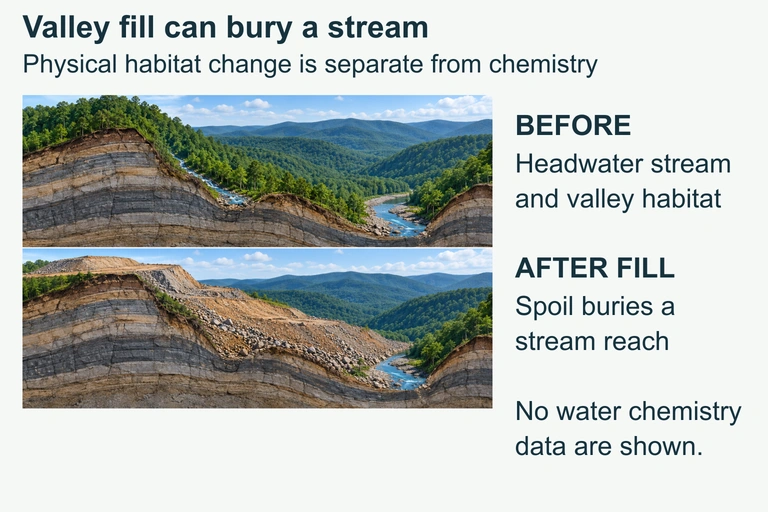 Valley fill can bury a headwater stream and remove habitat before drainage chemistry is measured. Physical habitat loss and chemical effects are separate questions.
SECTION 6
Worked Example — Calculating Acid Mine Drainage pH
Although the AP Environmental Science exam does not require college-level chemistry derivations, you should be comfortable interpreting pH values and performing basic calculations related to mining contamination. The following worked example demonstrates how to estimate the mass of sulfuric acid produced from pyrite oxidation and determine the resulting pH of a water body.
Estimating Acid Production from Pyrite Oxidation
- 1
Step 1 — State the Problem
A mining operation exposes a rock face containing 5.0 kg of pyrite (FeS₂). Assume all pyrite eventually oxidizes and the acid products dissolve into a 1.0 × 10⁶ L tailings pond. Estimate the resulting hydrogen ion concentration [H⁺] and pH. - 2
Step 2 — Convert Mass to Moles of Pyrite
Molar mass of FeS₂ = 55.85 + 2(32.07) = 119.99 g/mol ≈ 120 g/mol. Moles of FeS₂ = 5,000 g ÷ 120 g/mol = 41.7 mol.41.7 mol FeS₂ - 3
Step 3 — Determine Moles of H⁺ Produced
From the combined oxidation reactions (pyrite oxidation + iron hydroxide precipitation), each mole of FeS₂ ultimately produces 4 moles of H⁺. Total H⁺ = 41.7 mol × 4 = 166.8 mol.166.8 mol H⁺ - 4
Step 4 — Calculate [H⁺] Concentration
[H⁺] = moles of H⁺ ÷ volume = 166.8 mol ÷ 1.0 × 10⁶ L = 1.67 × 10⁻⁴ M.[H⁺] = 1.67 × 10⁻⁴ M - 5
Step 5 — Calculate pH
pH = −log₁₀[H⁺] = −log₁₀(1.67 × 10⁻⁴) ≈ 3.78. This pH is well below the range that most aquatic organisms can tolerate (typically pH 6.0–9.0), indicating severe ecological damage.pH ≈ 3.8 — severely acidic, lethal to most aquatic life
SECTION 7
Mitigation & Reclamation Strategies
While mining inevitably disrupts the environment, a range of mitigation and reclamation strategies can reduce long-term damage. The effectiveness of each approach depends on the type of mining, the specific contaminants involved, and the regulatory and economic context. The AP exam frequently asks students to compare mining methods and evaluate the trade-offs of different remediation strategies.
| Strategy | Strengths | Limitations |
|---|---|---|
| Reclamation / Regrading | Restores approximate original contour; replaces topsoil; allows revegetation and habitat recovery over time. | Cannot fully restore original soil microbial communities or biodiversity; expensive; topsoil quality is often degraded after years of storage. |
| Constructed Wetlands | Passive treatment of AMD; sulfate-reducing bacteria precipitate metals; low operational cost once established. | Requires large land area; may not handle high metal loads or extremely low pH (<3); performance varies seasonally. |
| Lime / Alkaline Addition | Rapidly neutralizes acid; precipitates dissolved metals; can be applied at point sources. | Generates large volumes of metal-laden sludge that requires disposal; ongoing cost; does not address root cause of acid generation. |
| Phytoremediation | Uses hyperaccumulator plants to extract heavy metals from soil; low cost; ecologically integrative. | Very slow (years to decades); limited to shallow contamination; harvested biomass must be treated as hazardous waste. |
| Regulatory Prevention (EIS, bonding) | Environmental Impact Statements identify risks before mining begins; financial bonds ensure cleanup funds exist even if companies go bankrupt. | Bond amounts often underestimate true cleanup costs; enforcement varies by jurisdiction; cannot address legacy mines permitted before regulations. |
Comparison of mining mitigation and reclamation strategies.
KEY TAKEAWAY
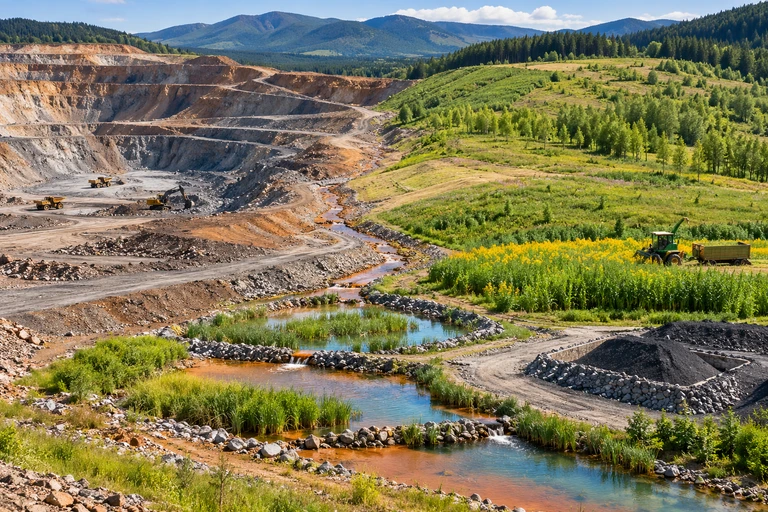 Regrading and revegetation can improve a mined surface while contaminated drainage continues to need treatment. Treatment transfers metals into managed residues or harvested biomass; it does not destroy them.
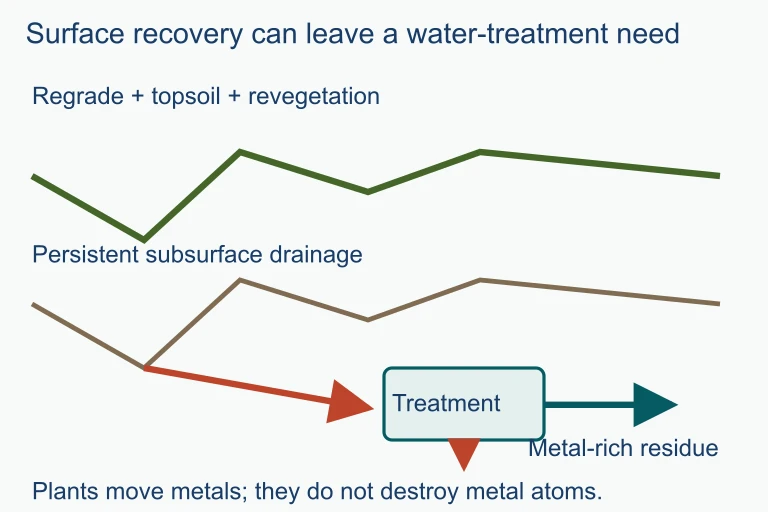 Regrading and revegetation can improve a mined surface while contaminated drainage continues to need treatment. Treatment transfers metals into managed residues or harvested biomass; it does not destroy them.
SECTION 8
Policy Frameworks & Emerging Challenges
Mining regulation in the United States operates under a patchwork of federal and state laws, including NEPA, SMCRA, the Clean Water Act, and the Comprehensive Environmental Response, Compensation, and Liability Act (CERCLA, or "Superfund"). Internationally, frameworks vary widely; nations rich in mineral resources but lacking regulatory infrastructure often face the severest environmental damage. The resource curse hypothesis suggests that mineral wealth can paradoxically hinder sustainable development by fueling corruption, conflict, and environmental exploitation.
| Traditional Mining Paradigm | Emerging Sustainable Practices |
|---|---|
| Extract → Process → Abandon: minimal post-closure planning | Life-of-mine planning: reclamation is integrated from the design phase and funded through closure bonds |
| Tailings stored in surface ponds behind earthen dams (high failure risk) | Dry-stack or paste tailings reduce water content, shrink footprint, and lower dam failure risk |
| Linear economy: ore → product → waste | Circular economy: emphasis on recycling, urban mining, and extending product lifetimes to reduce primary extraction |
| Environmental costs externalized to communities and taxpayers | Full-cost accounting internalizes environmental liabilities; voluntary certification (e.g., IRMA) provides third-party assurance |
Comparing traditional mining practices with emerging sustainable approaches.
Looking ahead, the global transition to renewable energy paradoxically increases demand for mined materials—lithium, cobalt, rare earth elements, and copper are essential for batteries, wind turbines, and solar panels. This creates a new tension in environmental policy: reducing fossil fuel dependence requires significant expansion of mining, which itself causes ecological harm. Addressing this challenge will require advances in recycling technology, development of less resource-intensive energy technologies, and more rigorous application of the precautionary principle in permitting decisions.
SECTION 9
Practice Problems
Question 1: CONCEPTUAL
- A. Abandoned mines continue to use heavy machinery that generates sulfuric acid.
- B. Exposed sulfide minerals undergo self-sustaining oxidation reactions that produce acid as long as oxygen and water are present.
- C. Bacteria in the mine break down organic matter to produce hydrochloric acid indefinitely.
- D. Rainwater naturally becomes acidic as it flows through any underground tunnel, regardless of mineral content.
Show answer (B)
Question 2: BASIC CALCULATION
- A. 800 m³
- B. 1,250 m³
- C. 3,200 m³
- D. 2,000 m³
Show answer (B)
Question 3: INTERMEDIATE
- A. Capping waste rock to limit oxygen exposure and installing a constructed wetland below the tailings storage facility
- B. Using hydraulic mining to disperse tailings widely and planting trees around the mine perimeter
- C. Shifting from surface mining to mountaintop removal to reduce the surface footprint
- D. Using heap-leach processing with cyanide to dissolve copper and allowing the leachate to dilute in the river
Show answer (A)
Question 4: APPLIED
4 ptsShow answer
Question 5: CRITICAL THINKING
4 ptsShow answer
SUMMARY
Summary — Impacts of Mining
Summary
Mining is an essential but environmentally destructive activity that affects all major Earth systems. Surface mining (including strip mining, open-pit mining, and mountaintop removal) creates the most visible landscape damage by removing overburden and destroying habitats, while subsurface mining produces tailings and risks land subsidence. The most persistent water quality threat is acid mine drainage (AMD), driven by the oxidation of pyrite (FeS₂) to produce sulfuric acid and dissolved heavy metals that can contaminate waterways for centuries.
Mitigation strategies include reclamation (restoring land contour and vegetation), constructed wetlands for passive AMD treatment, lime addition to neutralize acid, and phytoremediation using hyperaccumulator plants. Regulatory frameworks such as SMCRA and NEPA mandate environmental impact assessments and post-mining restoration, though enforcement and funding remain challenges. The growing demand for minerals used in renewable energy technologies (lithium, cobalt, rare earth elements) ensures that balancing resource extraction with environmental protection will remain a central challenge in environmental science and policy for decades to come.