

AP Environmental Science • Energy Resources and Consumption

Hydrogen Fuel Cell

Converting hydrogen's chemical energy directly into electricity with water as the only byproduct.

A sprouting plant framed by Earth and recycling symbols.
Inside this lesson 9 sections 5 questions 7 figures

SECTION 1

Historical Context & Motivation

The quest for cleaner energy conversion has driven engineers and scientists to look beyond combustion-based technologies. Burning fossil fuels releases carbon dioxide, particulate matter, and nitrogen oxides, contributing to climate change and degraded air quality. A hydrogen fuel cell offers a fundamentally different approach: it converts the chemical energy stored in hydrogen gas (H2) directly into electricity through an electrochemical reaction, producing only water vapor and heat as byproducts. This technology sits at the intersection of chemistry, engineering, and environmental policy, making it a recurring topic on the AP Environmental Science exam.

1839 • First Fuel Cell Demonstrated

Sir William Grove, a Welsh physicist, built the first crude fuel cell by reversing electrolysis, demonstrating that combining hydrogen and oxygen could generate an electric current.

1960s • NASA's Gemini & Apollo Programs

NASA adopted proton exchange membrane (PEM) fuel cells to power spacecraft, proving the technology could deliver reliable electricity—and drinkable water—in extreme conditions.

1990s • Automotive Prototypes Emerge

Major automakers including Daimler-Benz and Toyota developed prototype fuel cell vehicles, spurring research into cost reduction and hydrogen storage.

2015 • Commercial Fuel Cell Vehicles

The Toyota Mirai became the first mass-market hydrogen fuel cell sedan, while the Paris Climate Agreement heightened global interest in zero-emission transportation.

2020s • Green Hydrogen & Policy Push

Governments worldwide began investing in 'green hydrogen'—produced via renewable-powered electrolysis—as a key strategy for decarbonizing heavy industry, shipping, and aviation.

The central question that hydrogen fuel cells address is straightforward yet profound: Can we harness the energy in hydrogen without the pollution of combustion? As you will see, the answer is yes—but the environmental benefits depend critically on how the hydrogen itself is produced.

SECTION 2

Core Principles & Definitions

Understanding hydrogen fuel cells requires familiarity with several interconnected concepts from chemistry and thermodynamics. The device is classified as an electrochemical cell—a system that converts chemical energy directly into electrical energy without an intermediate combustion step, which is why its theoretical efficiency can exceed that of heat engines governed by the Carnot limit.

1

Electrochemical Conversion

Fuel cells bypass combustion entirely. Hydrogen is oxidized at the anode and oxygen is reduced at the cathode, producing an electron flow (electricity) and water.
2

Proton Exchange Membrane (PEM)

The most common type for vehicles, PEM cells use a thin polymer membrane that allows only protons (H⁺) to pass, forcing electrons through an external circuit.
3

Catalyst Requirement

Platinum-group catalysts on each electrode lower the activation energy for splitting H₂ and combining O₂, which is a major factor driving fuel cell costs.
4

Hydrogen as an Energy Carrier

Hydrogen is not an energy source but an energy carrier—it must be produced from water, natural gas, or biomass, each method carrying distinct environmental trade-offs.
5

Zero Tailpipe Emissions

At the point of use, the only outputs are water vapor and heat. Life-cycle emissions depend on the hydrogen production pathway ('gray,' 'blue,' or 'green').

SECTION 3

Inside a PEM Fuel Cell

PEM Hydrogen Fuel Cell — Cross-SectionANODE (−)PEMCATHODE (+)H₂(fuel in)O₂(air in)H⁺ ionse⁻ (external circuit)LOADH₂O(water out)H₂ → 2H⁺ + 2e⁻½O₂ + 2H⁺ + 2e⁻ → H₂OPt catalyst layers coat both sides of the membrane
Hydrogen enters at the anode (left, violet), where a platinum catalyst splits H2 into protons and electrons. Protons (green arrows) migrate through the proton exchange membrane (gold center), while electrons travel through the external circuit (orange dashed path) to do useful work. At the cathode (right, cyan), oxygen combines with protons and electrons to form water—the sole chemical byproduct.

The diagram above illustrates the essential architecture of a proton exchange membrane fuel cell. Notice that no combustion occurs—there is no flame or high-temperature gas expansion. The electron flow through the external circuit is what powers a motor, light, or any other electrical load. Because the process is electrochemical rather than thermal, PEM fuel cells can theoretically achieve higher efficiencies than internal combustion engines, which are constrained by the second law of thermodynamics and the Carnot efficiency limit.
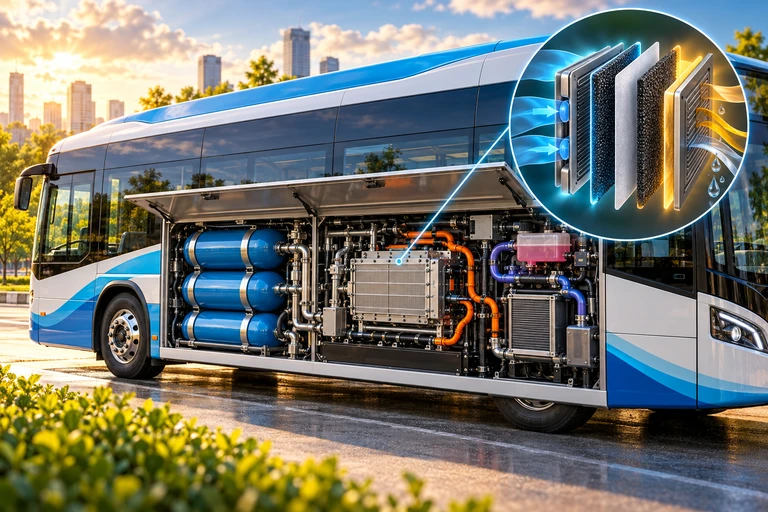
A bus with an opened power-module bay and a magnified layered fuel-cell assembly.A PEM fuel cell sends protons through the membrane and electrons through an external load. Hydrogen and oxygen combine into water; the separated charge routes permit useful electrical work.
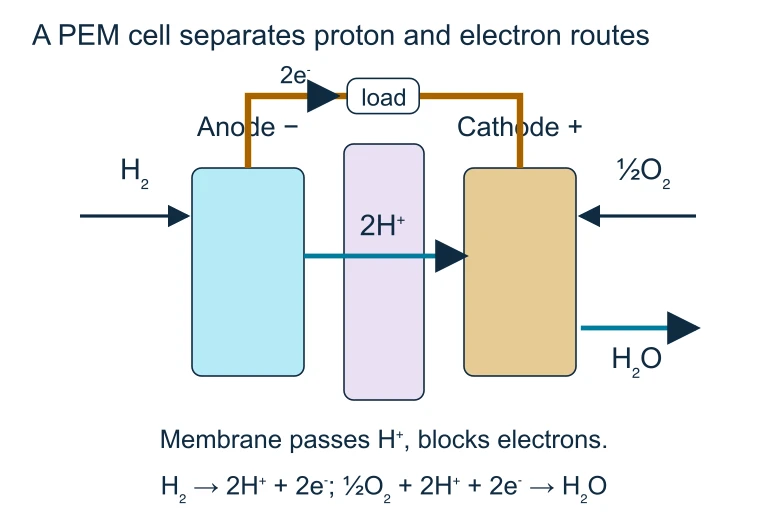
A PEM cell separates proton and electron routes. A PEM fuel cell sends protons through the membrane and electrons through an external load. Hydrogen and oxygen combine into water; the separated charge routes permit useful electrical work.A PEM fuel cell sends protons through the membrane and electrons through an external load. Hydrogen and oxygen combine into water; the separated charge routes permit useful electrical work.

SECTION 4

Energy & Efficiency Calculations

While AP Environmental Science emphasizes conceptual understanding over derivations, several quantitative relationships appear on the exam. Knowing how to calculate efficiency and compare energy densities strengthens your ability to evaluate hydrogen as an energy strategy.

OVERALL CELL REACTION

2H2+O2→2H2O+energy2 H₂ + O₂ → 2 H₂O + energy

This is the reverse of water electrolysis. The energy released is 286 kJ per mole of H2 under standard conditions (higher heating value).

FUEL CELL EFFICIENCY

η=(Electricalenergyoutput÷Chemicalenergyinput)×100η = (Electrical energy output ÷ Chemical energy input) × 100%

Typical PEM fuel cells achieve 40–60% electrical efficiency, significantly higher than the 20–35% of gasoline internal combustion engines. When waste heat is captured (combined heat and power), overall efficiency can exceed 80%.

ENERGY DENSITY OF HYDROGEN

Energydensity=120MJ/kg(bymass)or≈5.6MJ/Lat700bar(byvolume)Energy density = 120 MJ/kg (by mass) or ≈ 5.6 MJ/L at 700 bar (by volume)

Hydrogen has the highest energy density per unit mass of any fuel, roughly three times that of gasoline (≈ 46 MJ/kg). However, its volumetric energy density is low even at high compression, which creates storage and transport challenges.

ℹ
AP Exam Tip

SECTION 5

Hydrogen Production Pathways

The environmental promise of hydrogen fuel cells is inseparable from the method used to produce the hydrogen itself. The AP exam expects you to distinguish among production pathways and evaluate their life-cycle impacts. The industry uses a color-coded labeling system to classify these methods.

Hydrogen Production Pathways — Color ClassificationGray HydrogenSteam methane reforming(SMR) of natural gas~10 kg CO₂ / kg H₂~95% of current productionBlue HydrogenSMR + carbon captureand storage (CCS)~2–5 kg CO₂ / kg H₂Depends on CCS efficiencyGreen HydrogenElectrolysis powered byrenewable energy~0 kg CO₂ / kg H₂Currently most expensiveHydrogen Fuel Cell VehicleTailpipe emissions: H₂O onlyLife-Cycle ImpactHigh CO₂Moderate CO₂Near-zero CO₂
The three dominant hydrogen production pathways differ dramatically in their carbon intensity. Gray hydrogen (steam methane reforming) accounts for roughly 95% of current global production and emits ~10 kg CO2 per kg H2. Blue hydrogen adds carbon capture and storage. Green hydrogen uses renewable-powered electrolysis for near-zero life-cycle emissions.

For the AP exam, the critical insight is that labeling a fuel cell vehicle 'zero-emission' is technically accurate at the tailpipe but potentially misleading in a life-cycle analysis. If the hydrogen comes from gray production, the overall CO2 footprint may rival or even exceed that of a conventional gasoline vehicle. Only green hydrogen delivers the full climate benefit, and its current cost premium remains a significant barrier to widespread adoption.

SECTION 6

Worked Example: Comparing CO₂ Emissions

Worked example

  1. 1

    Step 1 — Identify Given Values

    A city transit agency wants to replace a diesel bus that travels 60,000 km/year and emits 1.2 kg CO2 per km. The proposed hydrogen fuel cell bus consumes 8 kg H2 per 100 km. The hydrogen will be produced via electrolysis using wind power (green hydrogen, ≈ 0 kg CO2 per kg H2).
  2. 2

    Step 2 — Calculate Diesel Bus Emissions

    Annual CO2 = 60,000 km × 1.2 kg CO2/km
    = 72,000 kg CO₂/year (72 metric tons)
  3. 3

    Step 3 — Calculate Fuel Cell Bus Emissions

    H2 consumed = (8 kg/100 km) × 60,000 km = 4,800 kg H2/year. Since the hydrogen is green, production-phase CO2 ≈ 0. Tailpipe CO2 = 0.
    Total fuel cell bus CO₂ ≈ 0 kg CO₂/year
  4. 4

    Step 4 — Determine Annual Savings

    CO2 savings = 72,000 − 0 = 72,000 kg CO2/year.
    Annual reduction: 72 metric tons CO₂
  5. 5

    Step 5 — Interpret the Result

    Switching one bus eliminates 72 metric tons of CO2 per year—equivalent to removing roughly 15 average passenger cars from the road. If the same hydrogen were instead gray hydrogen (~10 kg CO2/kg H2), the bus would emit 4,800 × 10 = 48,000 kg CO2/year, saving only 24 metric tons—a 67% reduction instead of 100%.

SECTION 7

Advantages & Limitations of Hydrogen Fuel Cells

CriterionAdvantageLimitation
Emissions at point of useZero CO₂, zero criteria pollutants; only water vapor exits the tailpipeLife-cycle emissions depend on hydrogen source; gray H₂ negates most benefit
Efficiency40–60% electrical efficiency; up to 80% with cogeneration (CHP)Round-trip efficiency (electricity → H₂ → electricity) is only ~25–35%, lower than batteries
Refueling & rangeRefueling takes 3–5 minutes; vehicles achieve 300–400 miles per tankRefueling infrastructure is extremely limited; fewer than 100 public stations in the U.S. (as of 2024)
Resource requirementsHydrogen is the most abundant element in the universe; water is the feedstock for green H₂Platinum catalysts are expensive and mined under significant environmental impact; large water inputs required for electrolysis
ApplicationsScalable from laptops to power plants; especially suited for heavy transport (buses, trucks, ships)For light-duty passenger cars, battery EVs are often more cost-effective due to better round-trip efficiency

Advantages and limitations of hydrogen fuel cells for AP Environmental Science

SECTION 8

Hydrogen in the Broader Energy Transition

Hydrogen fuel cells do not exist in isolation. They represent one node in a larger web of renewable energy technologies, energy storage solutions, and policy frameworks aimed at reducing greenhouse gas emissions. Understanding how fuel cells compare with and connect to other clean energy strategies is essential for the AP exam and for evaluating real-world energy proposals.

FeatureHydrogen Fuel CellBattery Electric (Li-ion)Biofuel Combustion
Energy conversionElectrochemical (H₂ → electricity)Electrochemical (stored ions → electricity)Combustion (biofuel → heat → motion)
Tailpipe CO₂ZeroZeroCO₂ released but considered carbon-neutral if sustainably sourced
Round-trip efficiency25–35%80–90%20–30%
Best use caseHeavy-duty transport, long-range, grid storageLight-duty vehicles, short-to-mid rangeAviation, marine, rural heating
Key environmental concernH₂ production emissions; platinum miningLithium/cobalt mining; end-of-life recyclingLand use change; monoculture; food vs. fuel debate

Comparison of hydrogen fuel cells with other clean transportation technologies

Looking ahead, the concept of a hydrogen economy envisions hydrogen serving not only as a transport fuel but also as a medium for long-duration energy storage, industrial feedstock (e.g., green steel production), and a replacement for natural gas in heating. Several AP-relevant policy connections include the U.S. Inflation Reduction Act's production tax credits for green hydrogen, the European Union's hydrogen strategy targeting 10 million tons of domestic green hydrogen by 2030, and the role hydrogen can play in addressing intermittency of solar and wind power by storing surplus electricity.

SECTION 9

Practice Problems

Question 1: CONCEPTUAL

A hydrogen fuel cell vehicle is often described as a 'zero-emission vehicle.' Under which condition is this description most accurate from a life-cycle perspective?
  • A. When the hydrogen is produced via steam methane reforming of natural gas
  • B. When the hydrogen is produced via electrolysis powered by coal-fired electricity
  • C. When the hydrogen is produced via electrolysis powered by renewable energy sources
  • D. When the hydrogen is produced via partial oxidation of petroleum
Show answer (C)
C is correct. Green hydrogen—produced by electrolysis powered by renewable energy—results in near-zero life-cycle CO₂ emissions. A is wrong because steam methane reforming releases ~10 kg CO₂ per kg H₂ (gray hydrogen). B is wrong because coal-fired electrolysis would produce even more CO₂ than gray hydrogen due to coal's high carbon intensity plus the energy losses during electrolysis. D is wrong because partial oxidation of petroleum is a fossil-fuel-based process that still releases CO₂.

Question 2: BASIC CALCULATION

A fuel cell bus consumes 9 kg of hydrogen per 100 km and travels 50,000 km per year. If the hydrogen is gray (producing 10 kg CO₂ per kg H₂), what are the total annual life-cycle CO₂ emissions from hydrogen production alone?
  • A. 4,500 kg CO₂
  • B. 45,000 kg CO₂
  • C. 90,000 kg CO₂
  • D. 450,000 kg CO₂
Show answer (B)
B is correct. Annual H₂ consumption = (9 kg / 100 km) × 50,000 km = 4,500 kg H₂. CO₂ = 4,500 kg H₂ × 10 kg CO₂/kg H₂ = 45,000 kg CO₂. A is wrong because it only calculates the hydrogen consumed, not the CO₂. C is wrong—it doubles the correct answer, perhaps by mistakenly using 18 kg H₂/100 km. D is wrong because it multiplies by 100 instead of 10.

Question 3: INTERMEDIATE

A PEM fuel cell has an electrical efficiency of 50%. If 1 kg of hydrogen contains 120 MJ of chemical energy, how many MJ of electrical energy does the fuel cell produce from 2 kg of hydrogen?
  • A. 60 MJ
  • B. 120 MJ
  • C. 240 MJ
  • D. 180 MJ
Show answer (B)
B is correct. Chemical energy input = 2 kg × 120 MJ/kg = 240 MJ. At 50% efficiency: 240 × 0.50 = 120 MJ of electrical output. A is wrong because it applies the 50% efficiency to only 1 kg. C is wrong because it ignores the efficiency loss entirely (uses 100% conversion). D is wrong—it would correspond to a 75% efficiency, which is not the stated value.

Question 4: APPLIED

A school district is evaluating whether to replace 10 diesel buses with hydrogen fuel cell buses. Each diesel bus travels 40,000 km/year and emits 1.1 kg CO₂/km. Each fuel cell bus uses 7 kg H₂ per 100 km. The district can choose green hydrogen (0 kg CO₂/kg H₂) at $8/kg or gray hydrogen (10 kg CO₂/kg H₂) at $3/kg. (a) Calculate the annual CO₂ reduction for the fleet if green hydrogen is used. (b) Calculate the annual hydrogen fuel cost for the fleet under each option. (c) Identify one environmental trade-off—other than CO₂ emissions—of scaling up green hydrogen production. (d) Propose one policy mechanism the district could use to offset the higher cost of green hydrogen.
Show answer
(a) Diesel fleet CO₂ = 10 buses × 40,000 km × 1.1 kg CO₂/km = 440,000 kg = 440 metric tons CO₂/year. Green H₂ fleet CO₂ ≈ 0. Annual reduction = 440 metric tons CO₂. (b) H₂ per bus = 7 kg/100 km × 40,000 km = 2,800 kg/year. Fleet total = 28,000 kg. Green: 28,000 × $8 = $224,000/year. Gray: 28,000 × $3 = $84,000/year. (c) Electrolysis requires large volumes of purified water, which could strain local water supplies, especially in arid regions. Additionally, the renewable energy installations needed (solar or wind farms) demand land and have their own ecological impacts. (d) The district could advocate for federal or state production tax credits for green hydrogen (similar to the Inflation Reduction Act's $3/kg credit), which would narrow or close the cost gap with gray hydrogen.

Question 5: CRITICAL THINKING

A researcher proposes that the best strategy for reducing transportation emissions is to mandate that all new city buses use hydrogen fuel cells powered by green hydrogen. (a) Describe one experimental approach the researcher could use to compare the life-cycle environmental impacts of green-hydrogen fuel cell buses versus battery-electric buses in a specific city. (b) Identify at least two variables that should be controlled in the investigation. (c) Describe one potential source of error or confounding variable. (d) Explain why the results might differ between a city in a water-scarce region and a city with abundant freshwater resources.
Show answer
(a) The researcher could run a year-long controlled pilot deploying equal numbers of green-hydrogen fuel cell buses and battery-electric buses on the same routes within a single city, tracking energy consumption per km, total life-cycle CO₂ (including upstream production), water use, and operating costs. A standardized life-cycle analysis framework (e.g., ISO 14040) would ensure consistent system boundaries. (b) Controlled variables should include: (1) identical route distance and terrain profile for both bus types, and (2) comparable passenger loading and scheduling to eliminate differences in energy demand per trip. (c) A confounding variable could be seasonal temperature variation—PEM fuel cells lose efficiency in extreme cold, while lithium-ion batteries lose range. If the study period captures only one season, results may not generalize to a full year. (d) Green hydrogen production via electrolysis consumes roughly 9–10 liters of purified water per kg of H₂. In a water-scarce region, this demand creates an environmental and economic burden (desalination energy, competition with agriculture) that battery-electric buses do not impose. Thus, battery-electric buses may have a lower overall environmental footprint in arid settings, whereas in water-abundant cities, the water cost is negligible, potentially tipping the balance toward fuel cells if other factors (range, refueling time) favor them.

Varsity Tutors • AP Environmental Science • Hydrogen Fuel Cell