

SECTION 1
Historical Context & Motivation
Human civilization's trajectory has been profoundly shaped by the fuels it harnesses. For most of recorded history, societies relied on biomass—wood, charcoal, and animal dung—to cook food, heat dwellings, and smelt metals. The transition to fossil fuels beginning in the eighteenth century unleashed unprecedented industrial capacity but also initiated the large-scale release of carbon dioxide and other pollutants into the atmosphere. Understanding the characteristics, advantages, and environmental consequences of different fuel types is therefore central to both the AP Environmental Science curriculum and to contemporary policy debates about climate change, energy security, and sustainable development.
~10,000 BCE • Biomass Era Begins
1769 • Watt's Steam Engine
1859 • Drake's Oil Well
1942 • First Nuclear Reactor
2015 • Paris Climate Agreement
This historical arc raises a fundamental question: given that all fuels ultimately convert stored chemical or nuclear energy into useful work, what distinguishes one fuel type from another in terms of energy density, efficiency, cost, and environmental impact? The answer lies in each fuel's origin, chemical composition, and the byproducts of its combustion or conversion—themes that this lesson explores in depth.
SECTION 2
Core Principles & Definitions
Before examining specific fuels, it is essential to establish the foundational concepts that govern how energy is stored, released, and measured. A fuel is any material that stores potential energy in chemical bonds (or, in the case of nuclear fuels, in atomic nuclei) and releases that energy through combustion, fission, or another conversion process. The utility of a fuel depends on its energy density, the efficiency with which its energy can be captured, and the nature of its waste products.
Energy Density
Combustion & Byproducts
Nonrenewable vs. Renewable
Net Energy Analysis
KEY TAKEAWAY
SECTION 3
Visual Explanation — Energy Density Comparison
The diagram above illustrates a critical principle in energy resource selection: energy density varies enormously among fuel types. Crude oil and natural gas, both hydrocarbons with high hydrogen-to-carbon ratios, pack the most chemical energy per kilogram among fossil fuels. Bituminous coal, despite being widely available and historically cheap, delivers only about 25 MJ/kg because its molecular structure contains more carbon relative to hydrogen and includes significant mineral impurities (ash). Wood, a form of biomass, has even lower energy density due to its high moisture content and the oxygen already bound in cellulose molecules. The outlier is uranium-235, whose energy comes not from chemical bonds but from nuclear fission—the splitting of heavy atomic nuclei—yielding roughly 80 million MJ per kilogram, approximately six orders of magnitude more than any chemical fuel.
SECTION 4
Mathematical Framework — Combustion & Energy Calculations
Although the AP Environmental Science exam is not primarily a math-intensive test, several quantitative relationships are tested and are essential for free-response questions that require calculations. The most important involve the energy released during combustion, carbon dioxide emissions per unit of energy, and conversions between energy units.
GENERAL COMBUSTION OF A HYDROCARBON
where x = number of carbon atoms, y = number of hydrogen atoms. For methane (CH₄): x = 1, y = 4, so CH₄ + 2 O₂ → CO₂ + 2 H₂O.
ENERGY OUTPUT
where E = total energy released (in MJ or kWh), m = mass of fuel burned (kg), and q = specific energy or heat of combustion (MJ/kg). This simple relationship is the basis for calculating how much fuel is needed for a given energy demand.
CO₂ EMISSION FACTOR
where m = mass or volume of fuel consumed and EF = the emission factor for that fuel (kg CO₂ per unit fuel). Typical values: coal ≈ 2.42 kg CO₂ per kg, gasoline ≈ 2.31 kg CO₂ per L, natural gas ≈ 2.75 kg CO₂ per m³ (at STP).
UNIT CONVERSION
These conversions appear frequently in AP APES calculations. A kilowatt-hour is the energy consumed when a 1,000-watt device runs for one hour.
AP Exam Tip
SECTION 5
Detailed Breakdown — Fuel Classification & Environmental Impacts
Fuels can be classified along several axes: their physical state (solid, liquid, gas), their origin (fossil, nuclear, biological), and whether they are renewable or nonrenewable on human timescales. The table below provides a systematic comparison of the major fuel types tested on the AP Environmental Science exam, including their primary uses, typical efficiency ranges, and key environmental concerns.
| Fuel Type | Primary Uses | Energy Density (MJ/kg) | Key Environmental Concerns |
|---|---|---|---|
| Coal | Electricity generation, steel production, cement manufacturing | 15–30 (varies by rank) | Highest CO₂ per unit energy; SO₂ → acid rain; mercury; mountaintop removal; coal ash disposal |
| Petroleum (Oil) | Transportation fuels (gasoline, diesel, jet fuel), petrochemicals, plastics | ~45 | CO₂ emissions; oil spills; groundwater contamination; geopolitical conflict |
| Natural Gas | Electricity, heating, cooking, industrial feedstock | ~44 (as CH₄) | Lowest CO₂ of fossil fuels per unit energy; methane leaks (potent GHG); hydraulic fracturing (fracking) risks |
| Uranium (Nuclear) | Electricity generation via nuclear fission | ~80,000,000 | Radioactive waste; risk of meltdown; thermal water pollution; uranium mining impacts |
| Biomass / Wood | Heating, cooking, electricity (especially developing nations) | 10–18 | Deforestation if unsustainable; indoor air pollution; CO₂ (theoretically carbon-neutral if regrown) |
| Ethanol / Biodiesel | Transportation fuel (blended with gasoline or diesel) | ~27 (ethanol) / ~37 (biodiesel) | Land-use change; competition with food crops; water-intensive; net energy debate |
Comparison of major fuel types, their uses, energy densities, and environmental concerns
Several distinctions in this classification deserve emphasis. First, coal ranks among four types—peat, lignite, bituminous, and anthracite—each representing a progressive stage of geological compression (coalification). Anthracite has the highest carbon content (~95%) and energy density, while lignite ("brown coal") has the lowest. Second, natural gas is considered the "cleanest" fossil fuel because methane (CH₄) has a 4:1 hydrogen-to-carbon ratio, producing more water and less CO₂ per unit of energy than coal or oil. However, methane itself is a potent greenhouse gas with a global warming potential roughly 80 times that of CO₂ over a 20-year time horizon, meaning that fugitive emissions during extraction and transport can offset its combustion advantage. Third, biomass is classified as renewable only when harvest rates do not exceed regrowth rates; deforestation for fuel wood in developing nations often exceeds sustainable yield.
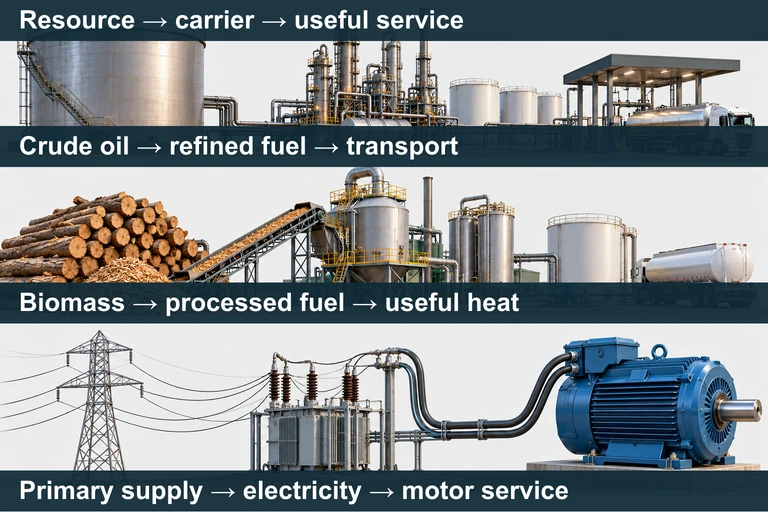 Primary resources, processed fuels and electricity occupy different supply-chain roles. Conversion losses occur before useful services are delivered.
SECTION 6
Worked Example — Comparing CO₂ Emissions
A common AP APES calculation involves determining how much CO₂ is produced when a certain amount of energy is generated from different fuels. The following worked example walks through this process step by step.
How much CO₂ is emitted by burning coal vs. natural gas to generate 1,000 kWh of electricity?
- 1
Step 1 — Convert energy to MJ
We need a common energy unit. Since 1 kWh = 3.6 MJ, the total energy required is 1,000 kWh × 3.6 MJ/kWh = 3,600 MJ.Energy needed = 3,600 MJ - 2
Step 2 — Account for plant efficiency
Power plants do not convert 100% of fuel energy into electricity. Assume a coal plant operates at 33% thermal efficiency and a natural gas combined-cycle plant at 50% efficiency. The total fuel energy input required is: Coal: 3,600 MJ ÷ 0.33 ≈ 10,909 MJ. Natural gas: 3,600 MJ ÷ 0.50 = 7,200 MJ.Coal input ≈ 10,909 MJ | Gas input = 7,200 MJ - 3
Step 3 — Calculate mass of fuel
Using E = m × q, rearrange to m = E ÷ q. For bituminous coal (q ≈ 25 MJ/kg): m = 10,909 ÷ 25 ≈ 436.4 kg. For natural gas (q ≈ 55 MJ/kg for methane): m = 7,200 ÷ 55 ≈ 130.9 kg.Coal mass ≈ 436 kg | Gas mass ≈ 131 kg - 4
Step 4 — Apply CO₂ emission factors
Coal emission factor ≈ 2.42 kg CO₂ per kg coal. Natural gas emission factor ≈ 2.75 kg CO₂ per kg CH₄. Coal CO₂ = 436.4 × 2.42 ≈ 1,056 kg CO₂. Natural gas CO₂ = 130.9 × 2.75 ≈ 360 kg CO₂.Coal ≈ 1,056 kg CO₂ | Natural Gas ≈ 360 kg CO₂ - 5
Step 5 — Interpret the result
For the same 1,000 kWh of electricity, coal produces approximately 2.9 times as much CO₂ as natural gas. This difference arises from two compounding factors: coal's lower plant efficiency and its higher carbon-to-hydrogen ratio, which yields more CO₂ per unit of energy released.Coal emits ~2.9× more CO₂ than natural gas per kWh
SECTION 7
Strengths, Limitations & Tradeoffs of Major Fuels
No single fuel is ideal in all contexts. The choice of fuel involves weighing energy density, cost, availability, infrastructure requirements, and environmental externalities. The table below organizes these tradeoffs for the fuel types most commonly tested on the AP exam.
| Fuel | Strengths | Limitations |
|---|---|---|
| Coal | Abundant globally; cheap to mine (especially surface mining); well-established infrastructure for electricity generation | Highest CO₂ per unit energy; SO₂ and NOₓ cause acid deposition; mercury bioaccumulation; particulate matter harms health; mountaintop removal destroys ecosystems; coal ash contains heavy metals |
| Petroleum | Very high energy density (liquid); easy to transport via pipeline and tanker; versatile (fuels, plastics, chemicals) | Finite reserves; price volatility; oil spills devastate marine ecosystems; extraction (offshore, tar sands) has high ecological footprint; CO₂ emissions |
| Natural Gas | Lowest CO₂ per unit energy of fossil fuels; versatile; high efficiency in combined-cycle plants; cleaner combustion (less PM, SO₂) | Methane leaks (potent GHG); fracking linked to water contamination, induced seismicity; still a fossil fuel with finite supply |
| Nuclear (U-235) | Extremely high energy density; negligible CO₂ during operation; reliable baseload power; small land footprint per kWh | Radioactive waste persists for thousands of years; catastrophic accident risk (Chernobyl, Fukushima); high capital costs; thermal pollution; uranium mining impacts |
| Biomass / Biofuels | Renewable if sustainably harvested; can be carbon-neutral (CO₂ absorbed during regrowth); reduces waste (crop residues, manure) | Low energy density; deforestation risk; indoor air pollution from traditional biomass; biofuels compete with food production for land and water; lower EROEI |
Strengths and limitations of major fuel types
KEY TAKEAWAY
SECTION 8
Connection to Global Energy Trends & Policy
The contemporary energy landscape is undergoing a profound transition. While fossil fuels still account for approximately 80% of global primary energy consumption, their share is gradually declining as renewable sources—solar, wind, and modern bioenergy—expand. Understanding fuel types and uses in isolation is necessary but insufficient; the AP exam also expects students to connect these topics to broader themes of sustainability, international energy policy, and environmental justice.
| Concept This Lesson | Advanced / Related Topic |
|---|---|
| CO₂ emission factors for individual fuels | Life-cycle assessment (LCA) that includes extraction, refining, transport, and end-use emissions |
| Energy density comparisons | Net energy analysis (EROEI) and energy return curves as resources become harder to extract |
| Coal ranks and their properties | Carbon capture and sequestration (CCS) technology and its economic feasibility |
| Biomass as renewable fuel | Second- and third-generation biofuels (cellulosic ethanol, algae-based fuels) and land-use change emissions |
| Nuclear fission fuel | Nuclear fusion research (ITER) and the prospect of virtually limitless clean energy |
Connecting fuel types to advanced environmental science topics
Looking ahead, the concept of energy transition frames the global shift from a fossil-fuel-dominated energy system toward one increasingly powered by renewables and, potentially, advanced nuclear technologies. The pace of this transition depends on technological innovation, economic incentives (such as carbon pricing), governmental regulation, and public acceptance. For the AP exam, students should be prepared to evaluate proposals for energy system changes using the principles of fuel energy density, emission factors, EROEI, and environmental tradeoffs discussed throughout this lesson.
SECTION 9
Practice Problems
Question 1: CONCEPTUAL
- A. Natural gas is extracted using hydraulic fracturing, which filters out carbon before combustion.
- B. Methane (CH₄) has a higher hydrogen-to-carbon ratio than coal, so more energy is released from hydrogen oxidation (forming H₂O) rather than carbon oxidation (forming CO₂).
- C. Natural gas power plants operate at 100% efficiency, meaning no waste heat is produced and therefore less fuel is burned.
- D. Natural gas contains no carbon atoms and therefore cannot produce CO₂ when burned.
Show answer (B)
Question 2: BASIC CALCULATION
- A. 200 kg
- B. 484 kg
- C. 5,000 kg
- D. 1,210 kg
Show answer (B)
Question 3: INTERMEDIATE
- A. Coal: 60,606 kg/day; Natural gas: 22,727 kg/day
- B. Coal: 20,000 kg/day; Natural gas: 11,364 kg/day
- C. Coal: 60,606 kg/day; Natural gas: 11,364 kg/day
- D. Coal: 20,000 kg/day; Natural gas: 22,727 kg/day
Show answer (A)
Question 4: APPLIED
4 ptsShow answer
Question 5: CRITICAL THINKING
4 ptsShow answer
SUMMARY
Lesson Summary
Summary
This lesson examined the major fuel types that power human civilization: coal, petroleum, natural gas, nuclear fuel (uranium-235), and biomass/biofuels. Each fuel is characterized by its energy density (MJ/kg), its combustion byproducts (CO₂, SO₂, PM, etc.), and whether it is renewable or nonrenewable. Coal has the highest CO₂ emissions per unit of energy; natural gas has the lowest among fossil fuels but still contributes to climate change; and nuclear fuel has extraordinarily high energy density with negligible operational CO₂ but poses waste disposal and safety challenges.
Quantitatively, the key relationships are E = m × q for total energy output and CO₂ = m × EF for emissions calculations, both of which must account for plant efficiency when computing real-world electricity generation. The broader theme is that no fuel is without environmental cost, and the ongoing energy transition requires evaluating fuels through the lens of net energy analysis (EROEI), life-cycle emissions, and sustainability—concepts that appear repeatedly across the AP Environmental Science curriculum.