

SECTION 1
Historical Context & Motivation
Long before humanity harnessed fossil fuels or split the atom, biomass — organic material derived from living or recently living organisms — served as the primary energy source for cooking, heating, and rudimentary industry. The controlled burning of wood was arguably the first deliberate energy technology, dating back hundreds of thousands of years to the mastery of fire by early hominids. For the vast majority of human history, biomass was not merely one option among many; it was essentially the only option, and its combustion fundamentally shaped patterns of settlement, deforestation, and land use across every inhabited continent.
The Industrial Revolution shifted the dominant energy paradigm toward coal and later petroleum, yet biomass never disappeared from the energy mix. In the developing world, traditional biomass — firewood, charcoal, crop residues, and animal dung — still supplies a substantial fraction of household energy. Meanwhile, industrialized nations have revisited biomass through modern technologies such as ethanol production, anaerobic digestion, and co-firing in power plants. Understanding the historical trajectory of biomass energy is essential for evaluating its environmental trade-offs and its potential contribution to a more sustainable energy future.
~400,000 BCE • Control of Fire
1826 • First Ethanol Engine
1970s • Oil Crises Spur Biofuel Research
2005 • U.S. Renewable Fuel Standard
2020s • Advanced Biofuels & Biogas
The central question driving modern biomass energy policy is this: can biomass truly function as a carbon-neutral energy source, or do the land-use changes, processing inputs, and combustion emissions associated with its production negate its theoretical renewability? Addressing this question requires a firm grasp of the principles, technologies, and environmental trade-offs explored in the sections that follow.
SECTION 2
Core Principles & Definitions
At its most fundamental level, biomass energy is a form of solar energy stored in the chemical bonds of organic molecules through photosynthesis. Plants, algae, and certain bacteria capture radiant energy from the sun and convert carbon dioxide and water into glucose and other carbohydrates. When those organisms or their residues are later combusted, digested, or chemically processed, the stored chemical energy is released — ideally in amounts that can be harnessed for useful work. Because the carbon released during combustion was originally removed from the atmosphere during plant growth, biomass is often classified as a potentially carbon-neutral fuel, though the actual carbon balance depends heavily on harvesting practices, transportation, and processing energy inputs.
Biomass Feedstocks
Biofuels
Carbon Neutrality Concept
Net Energy Analysis
Co-firing & Combined Heat and Power
KEY TAKEAWAY
SECTION 3
The Biomass Energy Cycle
The cycle depicted above reveals why biomass occupies a unique position among energy sources: it is simultaneously renewable (plants regrow) and carbon-based (combustion produces CO₂). The critical distinction from fossil fuels is the timescale of the carbon cycle: fossil carbon accumulated over millions of years and, once released, represents a net addition to the atmospheric carbon pool, whereas biomass carbon cycles on the scale of years to decades. However, this theoretical neutrality breaks down when forests are cleared for energy crops without adequate replanting, when fossil-fuel-intensive fertilizers and transport are required, or when peatlands and old-growth forests — which store vast quantities of carbon — are converted to biomass plantations.
SECTION 4
Mathematical Framework
Quantitative analysis of biomass energy systems centers on two key metrics: the energy content of the feedstock and the energy return on investment (EROI). These measures help determine whether a particular biomass pathway is energetically viable and environmentally defensible. Additionally, calculating CO₂ emissions per unit of energy produced allows comparison with fossil fuels.
ENERGY RETURN ON INVESTMENT
Where Eout = total usable energy produced (in joules or BTUs) and Ein = total energy invested in production (cultivation, harvesting, processing, transport). An EROI > 1 indicates a net energy gain; corn ethanol typically has an EROI of 1.3–1.6, while sugarcane ethanol reaches 5–8.
EFFICIENCY OF BIOMASS POWER GENERATION
Typical biomass-fired power plants achieve thermal-to-electrical efficiencies (η) of 20–25%. Combined heat and power (CHP) systems can reach total energy efficiencies above 80% by capturing waste heat.
NET CO₂ EMISSIONS
CO₂combustion is the carbon dioxide released when biomass burns; CO₂sequestered is the amount absorbed during the growth of the feedstock; CO₂lifecycle accounts for emissions from fertilizers, machinery, and transport. True carbon neutrality requires the first two terms to cancel and the third to approach zero.
AP Exam Tip
SECTION 5
Biomass Feedstocks & Conversion Technologies
Biomass energy encompasses a wide variety of feedstocks and conversion pathways, each with distinct environmental implications. Understanding the classification of these feedstocks and the technologies used to convert them into usable energy is critical for evaluating their sustainability. The following diagram and table organize the major categories.
| Feedstock Type | Examples | Primary Conversion | Key Product |
|---|---|---|---|
| Woody biomass | Logging residues, wood chips, sawdust | Direct combustion, gasification | Heat, electricity, syngas |
| Agricultural residues | Corn stover, rice husks, wheat straw | Combustion, cellulosic fermentation | Heat, cellulosic ethanol |
| Energy crops | Corn, sugarcane, switchgrass, miscanthus | Fermentation | Ethanol |
| Animal waste | Cattle manure, poultry litter | Anaerobic digestion | Biogas (methane) |
| Algae | Microalgae, macroalgae (seaweed) | Transesterification, pyrolysis | Biodiesel, bio-oil |
| Municipal solid waste | Food scraps, paper, yard trimmings | Incineration, anaerobic digestion | Electricity, biogas |
Major biomass feedstock categories and their primary conversion pathways
The distinction between first-generation biofuels (derived from food crops such as corn and sugarcane) and second-generation biofuels (derived from non-food lignocellulosic materials such as switchgrass and agricultural waste) is a frequent topic on the AP exam. First-generation biofuels raise concerns about the food vs. fuel debate, since diverting cropland to ethanol production can increase food prices and incentivize deforestation. Second-generation feedstocks avoid direct competition with food production but require more energy-intensive processing to break down cellulose and lignin. Third-generation biofuels from algae offer very high per-area productivity and do not require arable land, but remain expensive to produce at commercial scale.
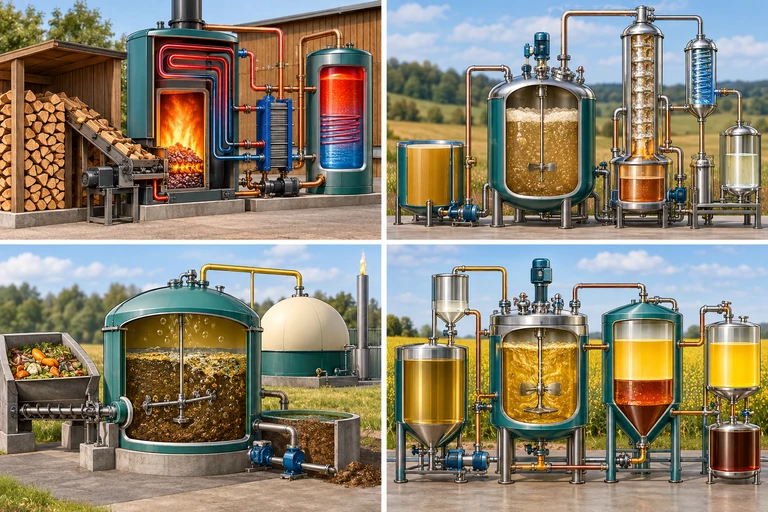 Different biomass feedstocks require different conversion processes. Anaerobic digestion produces biogas containing methane and CO₂; fermentation and transesterification follow different pathways, and cellulosic materials require preparation before their sugars can be fermented.
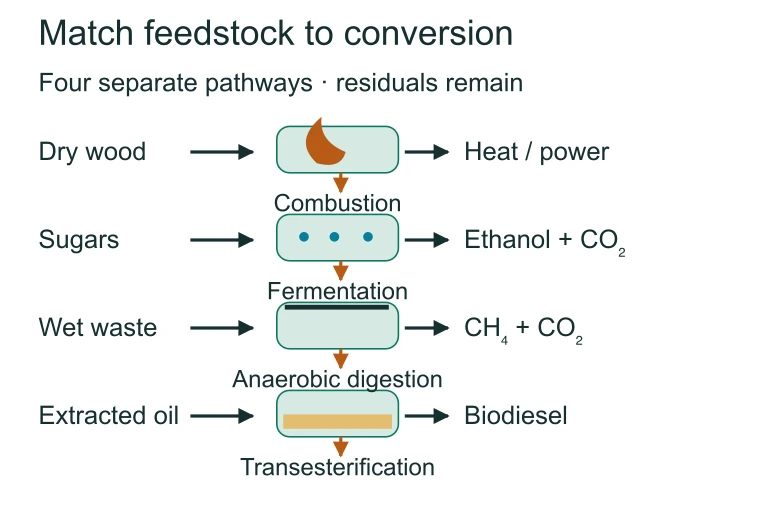 Different biomass feedstocks require different conversion processes. Anaerobic digestion produces biogas containing methane and CO₂; fermentation and transesterification follow different pathways, and cellulosic materials require preparation before their sugars can be fermented.
SECTION 6
Worked Example: EROI & Efficiency Calculation
The following worked example demonstrates how to calculate the EROI and the net electrical energy output of a biomass power plant, incorporating the type of quantitative reasoning the AP exam expects.
Biomass Power Plant Analysis
- 1
Step 1 — Identify Given Values
A biomass power plant burns 500 metric tons of wood chips per day. The energy content of wood chips is approximately 15 MJ/kg. The energy required for harvesting, processing, and transporting the wood chips totals 1,800 GJ per day. The plant's thermal-to-electrical efficiency is 22%. - 2
Step 2 — Calculate Total Chemical Energy Input
Convert the mass of wood chips to kilograms: 500 metric tons × 1,000 kg/ton = 500,000 kg. Multiply by the energy content: 500,000 kg × 15 MJ/kg = 7,500,000 MJ = 7,500 GJ per day of chemical energy in the fuel.Chemical energy in fuel = 7,500 GJ/day - 3
Step 3 — Calculate Electrical Energy Output
Apply the thermal efficiency: Electrical output = 7,500 GJ × 0.22 = 1,650 GJ/day. To convert to more familiar units: 1,650 GJ ÷ 3.6 GJ/MWh ≈ 458 MWh of electricity per day.Electrical output ≈ 458 MWh/day - 4
Step 4 — Calculate EROI
EROI = Eout / Ein = 1,650 GJ / 1,800 GJ = 0.92. Wait — an EROI below 1 means the plant consumes more energy in its supply chain than it produces as electricity. This indicates the operation is not energetically viable in isolation.EROI = 0.92 (net energy loss — not viable) - 5
Step 5 — Interpret & Improve
The low EROI is driven by the high transport and processing costs of 1,800 GJ/day. If the plant sourced feedstock locally, reducing supply-chain energy to 900 GJ/day, the EROI would improve to 1,650/900 = 1.83 — now a net energy gain. Alternatively, capturing waste heat via a CHP system could raise total useful energy output and improve the overall energy return. This example illustrates why life-cycle energy analysis is essential for evaluating biomass energy systems.With reduced transport: EROI = 1.83 (viable)
SECTION 7
Environmental Advantages & Limitations
Biomass energy is neither an unequivocal environmental savior nor a straightforward villain. Its desirability depends critically on the feedstock, the conversion technology, the geographic context, and the land-use patterns it engenders. The following table summarizes the major environmental advantages and drawbacks that the AP exam expects you to evaluate.
| Advantages | Limitations |
|---|---|
| Potentially carbon-neutral if regrowth matches harvest; short carbon cycle compared to fossil fuels. | Combustion still releases CO₂, particulate matter (PM₂.₅), NOₓ, and volatile organic compounds, degrading air quality. |
| Reduces dependence on imported fossil fuels; can use locally sourced waste materials. | Large-scale energy-crop cultivation competes with food production (food vs. fuel dilemma) and can drive deforestation. |
| Diverts organic waste from landfills, reducing methane emissions from decomposition. | Low energy density compared to fossil fuels means larger volumes of feedstock must be transported and stored. |
| Can be dispatched (turned on/off) unlike solar and wind, providing reliable baseload or peaking power. | Water-intensive: irrigation for energy crops and cooling water for power plants increase water demand. |
| Supports rural economies through agricultural and forestry employment. | Low EROI for some pathways (e.g., corn ethanol) questions whether the net energy benefit justifies the investment. |
| Anaerobic digestion captures methane that would otherwise be a potent greenhouse gas. | Monoculture energy-crop plantations reduce biodiversity and deplete soil nutrients without proper management. |
Environmental advantages and limitations of biomass energy
KEY TAKEAWAY
SECTION 8
Biomass in the Broader Energy Landscape
To situate biomass within the full spectrum of energy sources tested on the AP Environmental Science exam, it is useful to compare key parameters — renewability, carbon impact, EROI, and land-use intensity — across biomass and other major energy technologies. The table below synthesizes these comparisons.
| Parameter | Biomass | Fossil Fuels (Coal/Gas) | Solar / Wind |
|---|---|---|---|
| Renewability | Renewable if harvested sustainably; regrowth on years-to-decades timescale. | Non-renewable; formed over millions of years. | Renewable; virtually inexhaustible on human timescales. |
| Net CO₂ impact | Potentially carbon-neutral; depends on life-cycle analysis. | High net CO₂ emissions; releases ancient sequestered carbon. | Near-zero operational emissions; some embodied carbon in manufacturing. |
| EROI | Low to moderate (1.3–8 depending on feedstock and pathway). | High (coal ≈ 30; natural gas ≈ 10–30). | Moderate to high (solar PV ≈ 10–20; wind ≈ 18–25). |
| Land use intensity | Very high for energy crops; moderate for waste-based feedstocks. | Moderate for mining/drilling; low per unit energy. | High for utility-scale solar; low-moderate for wind (dual-use land). |
| Dispatchability | Dispatchable — can be burned on demand. | Dispatchable — primary baseload and peaking sources. | Intermittent — dependent on weather and time of day. |
Comparison of biomass with fossil fuels and solar/wind across key energy parameters
Looking forward, biomass energy is likely to play a niche but important role in the broader energy transition. Its greatest value lies in applications where other renewables struggle: providing dispatchable power to complement intermittent solar and wind, processing organic waste streams that would otherwise release methane, and producing liquid fuels for sectors that are difficult to electrify, such as aviation and heavy freight. The emerging concept of bioenergy with carbon capture and storage (BECCS) represents a frontier technology that could theoretically achieve negative carbon emissions — capturing the CO₂ released during biomass combustion and storing it underground, effectively removing carbon from the atmosphere. However, BECCS remains unproven at scale and carries its own set of environmental and economic challenges.
SECTION 9
Practice Problems
Question 1: CONCEPTUAL
- A. Biomass combustion does not release carbon dioxide into the atmosphere.
- B. The carbon released during biomass combustion was recently absorbed from the atmosphere through photosynthesis, so no net carbon is added if regrowth replaces the harvested biomass.
- C. Biomass fuels contain less carbon per unit mass than fossil fuels, resulting in lower total emissions.
- D. Biomass energy systems use carbon capture and storage technology to prevent CO₂ from reaching the atmosphere.
Show answer (B)
Question 2: BASIC CALCULATION
- A. 167 MWh
- B. 833 MWh
- C. 600 MWh
- D. 3,000 MWh
Show answer (A)
Question 3: INTERMEDIATE
- A. Both facilities have EROI values above 5, making them equally viable.
- B. The corn facility has an EROI of approximately 1.5, while the sugarcane facility has an EROI of approximately 6.7, making sugarcane ethanol far more energetically favorable.
- C. The corn facility's higher energy input means it generates more net energy overall.
- D. The sugarcane facility's lower energy input indicates that it produces lower-quality ethanol.
Show answer (B)
Question 4: APPLIED
4 ptsShow answer
Question 5: CRITICAL THINKING
4 ptsShow answer
SUMMARY
Summary
Summary
Biomass energy harnesses the chemical energy stored in organic matter through photosynthesis. Feedstocks range from woody biomass and agricultural residues to dedicated energy crops, animal manure, municipal solid waste, and algae. These feedstocks can be converted via thermochemical (combustion, pyrolysis, gasification), biochemical (fermentation, anaerobic digestion), or chemical (transesterification) pathways to produce heat, electricity, ethanol, biodiesel, or biogas.
Biomass is classified as potentially carbon-neutral because the CO₂ released during combustion was recently absorbed during plant growth, but this neutrality depends on sustainable harvest rates and minimal lifecycle emissions from processing and transport. Key quantitative tools include the EROI (energy return on investment) and thermal efficiency calculations. Environmental trade-offs include the food vs. fuel debate, potential deforestation, air pollution from combustion, and biodiversity loss from monoculture plantations. When properly managed — using waste feedstocks, local sourcing, and CHP systems — biomass can serve as a valuable dispatchable renewable complement to intermittent solar and wind energy.