

SECTION 1
Historical Context & Motivation
The story of endocrine disruptors begins not in a toxicology laboratory but in the field observations of wildlife biologists who noticed alarming reproductive anomalies in animal populations exposed to industrial and agricultural chemicals. As early as the 1950s, researchers documented eggshell thinning in raptors exposed to DDT, but the mechanistic link to hormonal disruption took decades to establish. Rachel Carson's 1962 book Silent Spring catalyzed public awareness of how persistent pesticides accumulate through food webs, though the specific endocrine-disrupting mechanisms were not yet understood. By the 1990s, the concept of endocrine disruption had coalesced into a recognized field of environmental toxicology, prompting legislative action and large-scale screening programs.
1962 • Silent Spring Published
1991 • Wingspread Conference
1996 • Our Stolen Future & FQPA
2006 • EU REACH Regulation
2012–Present • BPA Bans & Ongoing Research
The central question driving this field is deceptively simple: how can chemicals present at parts-per-billion or even parts-per-trillion concentrations exert profound biological effects on organisms? The answer lies in the exquisite sensitivity of the endocrine system, which regulates development, reproduction, metabolism, and behavior through chemical messengers that operate at vanishingly low concentrations.
SECTION 2
Core Principles & Definitions
An endocrine disruptor is any exogenous substance or mixture that alters the function of the endocrine system and consequently causes adverse health effects in an intact organism, its progeny, or subpopulations. The endocrine system relies on hormones—chemical messengers such as estrogen, testosterone, and thyroid hormone—that bind to specific receptor proteins to trigger cellular responses. Endocrine disruptors interfere with this signaling through several distinct mechanisms, and their effects can manifest at doses far below those causing acute toxicity.
Hormone Mimicry (Agonism)
Hormone Blocking (Antagonism)
Altered Synthesis & Metabolism
Bioaccumulation & Biomagnification
Non-Monotonic Dose Response
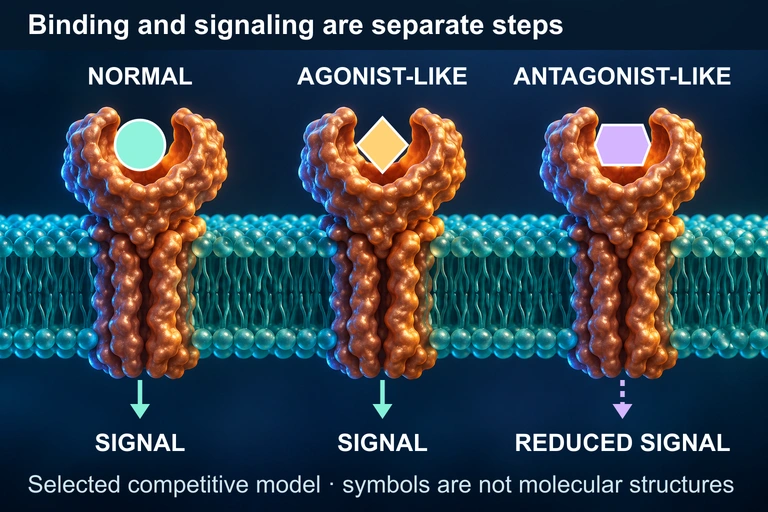 In the selected receptor model, an agonist-like mimic activates signaling while an antagonist-like blocker reduces it. Endocrine disruption also occurs through other mechanisms.
SECTION 3
Visual Explanation — Mechanisms of Endocrine Disruption
The diagram above illustrates why endocrine disruptors are so insidious. A single chemical may operate through more than one mechanism simultaneously—for example, atrazine both alters hormone synthesis by upregulating aromatase and mimics estrogenic activity. Furthermore, because these compounds are often persistent organic pollutants (POPs), they resist degradation and biomagnify through trophic levels, meaning apex predators receive exponentially higher doses than primary producers.
SECTION 4
Quantitative Framework — Bioaccumulation & Dose-Response
While the AP Environmental Science exam does not require advanced pharmacokinetic modeling, understanding two key quantitative concepts—bioaccumulation factor and biomagnification factor—helps explain why trace-level pollutants become hazardous at higher trophic levels. Additionally, the concept of LD₅₀ (lethal dose for 50% of test organisms) remains relevant, though endocrine disruptors challenge this metric because sub-lethal effects at low doses can be more consequential than acute toxicity.
BIOACCUMULATION FACTOR (BAF)
Where Corganism = concentration of the chemical in organism tissues (mg/kg), and Cenvironment = concentration in the surrounding water or soil (mg/L or mg/kg). A BAF > 1 indicates the organism accumulates the substance faster than it can excrete or metabolize it.
BIOMAGNIFICATION FACTOR (BMF)
Where Cpredator = concentration in the predator's tissues and Cprey = concentration in the prey's tissues. A BMF > 1 means the chemical magnifies up the food chain. Highly lipophilic endocrine disruptors like PCBs and DDT routinely have BMFs of 10–70 per trophic level.
CONCENTRATION AT TROPHIC LEVEL n
Where Cn = concentration at trophic level n, C1 = concentration at the first trophic level (producers), and BMF is assumed constant across trophic transfers. This exponential relationship explains how nanogram-per-liter water concentrations can produce milligram-per-kilogram tissue levels in top predators.
SECTION 5
Major Endocrine Disruptors — Classification & Sources
Endocrine-disrupting chemicals span a wide range of industrial, agricultural, and pharmaceutical sources. The AP exam frequently tests students on specific examples, their mechanisms, and the environmental contexts in which they appear. The table below summarizes the most commonly tested disruptors.
| Chemical / Class | Primary Source | Mechanism | Key Ecological / Health Effect |
|---|---|---|---|
| DDT / DDE | Pesticide (banned in U.S. 1972, still used for malaria control) | Estrogen agonist; anti-androgen | Eggshell thinning in raptors (bald eagles, peregrine falcons); bioaccumulates in fatty tissue |
| PCBs | Electrical equipment, coolants (banned under Stockholm Convention) | Thyroid hormone disruption; estrogen mimicry | Immune suppression in marine mammals; developmental delays in children |
| BPA (Bisphenol A) | Polycarbonate plastics, epoxy resin linings in cans | Estrogen receptor agonist | Reproductive abnormalities; early puberty; ubiquitous in waterways |
| Atrazine | Herbicide widely used on corn; common water contaminant | Upregulates aromatase (converts testosterone → estrogen) | Feminization of male frogs (Tyrone Hayes research); hermaphroditism |
| Phthalates | Plasticizers in PVC, personal care products | Anti-androgen; disrupts testosterone synthesis | Reduced sperm count; genital malformations in males |
| Dioxins | Byproducts of incineration, bleaching, herbicide manufacture | Binds aryl hydrocarbon receptor; disrupts multiple hormone pathways | Chloracne; immune suppression; carcinogenic; extremely persistent |
Common endocrine disruptors tested on the AP Environmental Science exam
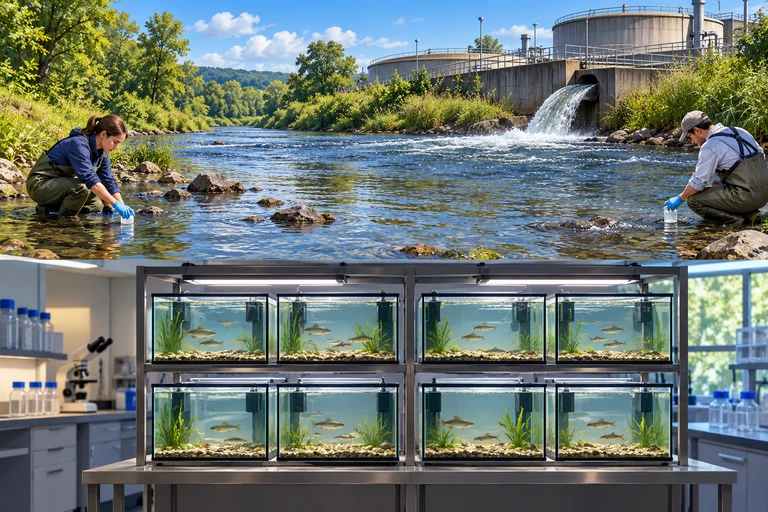 Field samples can reveal an association between exposure and reproductive endpoints. In a controlled comparison with three tanks per group, tanks are the independent treatment units; fish within a tank share the treatment environment.
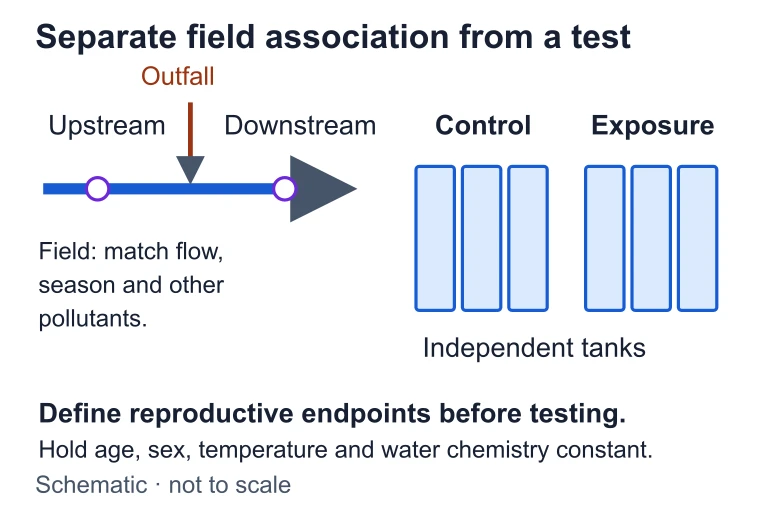 Field samples can reveal an association between exposure and reproductive endpoints. In a controlled comparison with three tanks per group, tanks are the independent treatment units; fish within a tank share the treatment environment.
SECTION 6
Worked Example — Biomagnification Calculation
A common AP exam calculation involves tracing the concentration of a persistent endocrine disruptor through a food chain. Let us work through a realistic scenario involving DDT in a freshwater lake ecosystem.
Worked example
- 1
Step 1 — Identify Given Values
The DDT concentration in lake water is 0.003 ppm. Phytoplankton bioaccumulate DDT to 0.04 ppm. The biomagnification factor (BMF) at each subsequent trophic transfer is approximately 10. The food chain is: Water → Phytoplankton (TL 1) → Zooplankton (TL 2) → Small fish (TL 3) → Large fish (TL 4) → Osprey (TL 5).Cwater = 0.003 ppm; C1 = 0.04 ppm; BMF = 10 - 2
Step 2 — Calculate BAF for Phytoplankton
The bioaccumulation factor for phytoplankton is: BAF = Corganism ÷ Cenvironment = 0.04 ÷ 0.003 ≈ 13.3. This means phytoplankton concentrate DDT about 13 times above the water concentration.BAF ≈ 13.3 - 3
Step 3 — Apply Biomagnification Formula
Using Cn = C1 × (BMF)(n−1), we calculate for each level: Zooplankton (n=2): 0.04 × 10¹ = 0.4 ppm. Small fish (n=3): 0.04 × 10² = 4 ppm. Large fish (n=4): 0.04 × 10³ = 40 ppm. Osprey (n=5): 0.04 × 10⁴ = 400 ppm. - 4
Step 4 — Interpret the Result
The osprey carries a DDT concentration of approximately 400 ppm—over 133,000 times the water concentration and 10,000 times the phytoplankton concentration. This explains why DDT caused catastrophic eggshell thinning in raptors even when water concentrations seemed negligible.C_osprey = 400 ppm (133,000× water concentration)
SECTION 7
Regulatory Approaches — Strengths & Limitations
Governments have adopted several regulatory frameworks to address endocrine disruptors, but each comes with trade-offs between scientific rigor, economic feasibility, and the pace of chemical innovation. Understanding these policy tools is essential for the AP exam, particularly for FRQ questions that ask you to propose environmental solutions.
| Regulatory Tool | Strengths | Limitations |
|---|---|---|
| EPA Endocrine Disruptor Screening Program (EDSP) | Two-tier screening identifies chemicals with endocrine activity; mandated by law | Slow pace (only ~50 chemicals fully screened in 20+ years); relies on animal testing |
| EU REACH Regulation | Precautionary principle; burden of proof on manufacturer; can restrict or ban substances | High compliance costs for industry; definitions of 'endocrine disruptor' debated politically |
| Stockholm Convention on POPs | International treaty targeting persistent organic pollutants; global cooperation | Slow to add new chemicals; enforcement varies by nation; legacy contamination persists |
| Product Bans (e.g., BPA in baby bottles) | Direct, rapid reduction in consumer exposure; public confidence | 'Regrettable substitution'—replacements (BPS, BPF) may be equally disruptive; narrow scope |
Comparison of major regulatory approaches to endocrine disruptors
SECTION 8
Connections to Broader APES Topics
Endocrine disruptors intersect with many other topics tested on the AP Environmental Science exam. Recognizing these connections strengthens your ability to write integrated FRQ responses and identify cross-cutting themes in multiple-choice questions.
| Related APES Topic | Connection to Endocrine Disruptors |
|---|---|
| Biogeochemical Cycles | Persistent disruptors cycle through water, soil, and air compartments; global distillation transports POPs to polar regions |
| Biodiversity Loss | Reproductive failure from endocrine disruption (e.g., intersex fish, declining amphibian populations) reduces population viability and species richness |
| Water Pollution & Treatment | Conventional wastewater treatment does not remove many endocrine disruptors; advanced oxidation and activated carbon are needed |
| Environmental Justice | Low-income communities disproportionately exposed to industrial sources of endocrine disruptors (proximity to factories, contaminated water) |
| Toxicology & Risk Assessment | Non-monotonic dose responses challenge LD₅₀-based risk models; windows of susceptibility (prenatal, puberty) are critical |
Cross-topic connections for AP Environmental Science
Looking ahead, emerging research is investigating the role of epigenetic changes—heritable alterations in gene expression without changes to DNA sequence—induced by endocrine disruptors. Studies in rodent models have shown that exposure to BPA or vinclozolin during pregnancy can produce reproductive abnormalities in offspring for multiple generations, even when those offspring were never directly exposed. This transgenerational inheritance transforms the conversation from individual health effects to multi-generational ecological consequences, a frontier that will likely reshape toxicology and environmental policy in the coming decades.
SECTION 9
Practice Problems
Question 1: CONCEPTUAL
- A. They are highly reactive chemicals that destroy cell membranes on contact.
- B. They mimic or block hormones, which naturally function at very low concentrations in the body.
- C. They cause acute poisoning of nerve cells similar to organophosphate pesticides.
- D. They are radioactive isotopes that damage DNA through ionizing radiation.
Show answer (B)
Question 2: BASIC CALCULATION
- A. 50
- B. 250
- C. 500
- D. 5,000
Show answer (C)
Question 3: INTERMEDIATE
- A. Elevated nitrogen from fertilizer runoff causes direct mutagenesis.
- B. Atrazine in runoff upregulates aromatase, converting testosterone to estrogen and feminizing males.
- C. Warmer water temperatures near agricultural areas accelerate genetic mutations during embryonic development.
- D. Increased phosphorus causes eutrophication, and the resulting hypoxia triggers sex reversal.
Show answer (B)
Question 4: APPLIED
Show answer
Question 5: CRITICAL THINKING