

SECTION 1
Historical Context & Motivation
Understanding Earth's atmosphere has been a progressive endeavor spanning centuries, driven by questions about why the sky is blue, why temperatures drop at altitude, and how gases interact with radiation. Early natural philosophers recognized that air had weight and composition, but the modern picture of a multilayered, dynamic atmosphere emerged only through systematic scientific investigation. The atmosphere is the thin gaseous shell surrounding Earth that makes the planet habitable—regulating temperature, filtering harmful ultraviolet radiation, and redistributing energy through weather and climate systems.
1643 • Torricelli's Barometer
1774 • Composition Revealed
1896 • Arrhenius & the Greenhouse Effect
1958 • Keeling Curve Begins
1985 • Ozone Hole Discovered
These milestones illustrate a central theme: the atmosphere is not a static backdrop but a chemically and thermally dynamic system that human activities can measurably alter. The AP Environmental Science course asks you to understand the atmosphere's structure, composition, energy balance, and the environmental consequences of disrupting any of these.
SECTION 2
Core Principles & Definitions
Several foundational ideas govern how the atmosphere behaves. These principles reappear across topics in APES—from air pollution and climate change to the water cycle and biome distribution—so internalizing them here will pay dividends throughout the course.
Atmospheric Composition
Vertical Temperature Structure
Greenhouse Effect
Energy Balance
Atmospheric Circulation
KEY TAKEAWAY
SECTION 3
Layers of the Atmosphere — Visual Explanation
For the AP exam, the most critical layer is the troposphere because it contains roughly 75% of the atmosphere's mass, virtually all water vapor, and is where weather and most air pollution reside. The environmental lapse rate—the average decrease of about 6.5 °C per kilometer of altitude gain—drives convection that produces clouds and precipitation. The stratosphere is environmentally significant because it houses the ozone layer, which absorbs 97–99% of incoming UV-B and UV-C radiation. Temperature inversion in the stratosphere (temperature rising with altitude) makes it very stable, suppressing vertical mixing—an important factor in understanding why CFCs can persist there for decades.
 Temperature changes direction across atmospheric layers because the dominant absorption and heating processes differ. Layer boundaries are associated with those changes in the temperature profile.
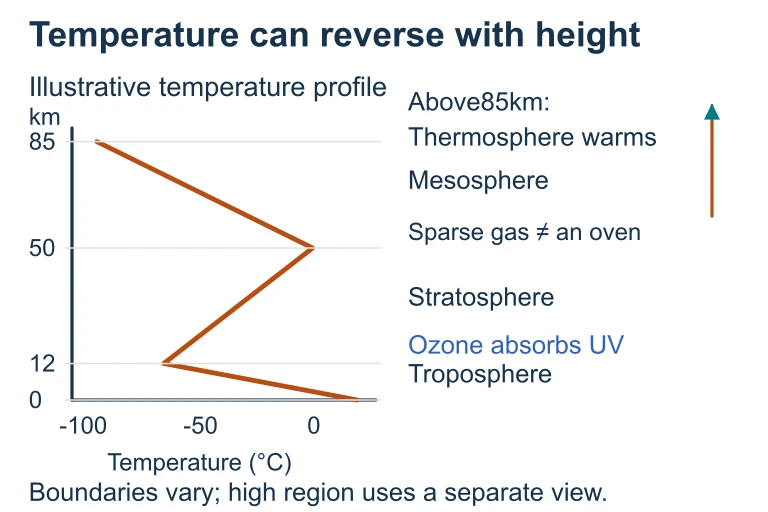 Temperature changes direction across atmospheric layers because the dominant absorption and heating processes differ. Layer boundaries are associated with those changes in the temperature profile.
SECTION 4
Mathematical Framework — Energy Balance & Radiation
Earth's atmospheric temperature and climate are governed by the balance between incoming solar radiation and outgoing terrestrial radiation. Several equations capture these relationships quantitatively and appear in AP-level problems.
SOLAR FLUX INTERCEPTED
S = solar constant ≈ 1361 W/m²; r = Earth's radius ≈ 6.371 × 10⁶ m; α = planetary albedo ≈ 0.30. The term (1 − α) accounts for the fraction of sunlight absorbed rather than reflected.
STEFAN-BOLTZMANN EMISSION
σ = Stefan-Boltzmann constant = 5.67 × 10⁻⁸ W·m⁻²·K⁻⁴; T = effective radiating temperature (K). Earth radiates from its entire surface area (4πr²), yielding the factor of 4.
EQUILIBRIUM TEMPERATURE
Setting Energy In = Energy Out and solving for T yields Earth's effective radiating temperature ≈ 255 K (−18 °C). The observed surface average of ~288 K (15 °C) is 33 °C warmer due to the greenhouse effect.
ENVIRONMENTAL LAPSE RATE
In the troposphere, temperature drops on average 6.5 °C for every 1 km increase in altitude. Actual lapse rates vary; when the rate is less steep than the adiabatic rate, the atmosphere is stable and pollution can become trapped (a temperature inversion).
PHYSICAL INTUITION
SECTION 5
Atmospheric Composition & Greenhouse Gases
While nitrogen and oxygen dominate the atmosphere by volume, the trace gases exert outsized influence on climate. Understanding the global warming potential (GWP) of each greenhouse gas—a measure of how much heat a gas traps relative to CO₂ over a given time horizon—is essential for evaluating the climate impact of different emissions.
| Gas | Formula | Concentration | GWP (100-yr) | Primary Sources |
|---|---|---|---|---|
| Carbon dioxide | CO₂ | ≈ 424 ppm | 1 (reference) | Fossil fuel combustion, deforestation, cement production |
| Methane | CH₄ | ≈ 1.92 ppm | 28–36 | Livestock, wetlands, rice paddies, natural gas leaks |
| Nitrous oxide | N₂O | ≈ 336 ppb | 265–298 | Agricultural fertilizers, combustion, industrial processes |
| Water vapor | H₂O | 0–4% (variable) | N/A (feedback) | Evaporation; acts as a positive feedback amplifier |
| Ozone (tropospheric) | O₃ | 20–100 ppb | ≈ 62 | Secondary pollutant from NOₓ + VOCs + sunlight |
Major greenhouse gases, their concentrations, 100-year global warming potentials, and primary sources.
The energy budget diagram is a staple of APES. Note that the numbers must balance: incoming absorbed radiation (≈ 240 W/m²) equals outgoing longwave radiation at the top of the atmosphere. If greenhouse gas concentrations increase, more IR is temporarily trapped, creating a positive radiative forcing that warms the surface until a new equilibrium is reached at a higher temperature.
SECTION 6
Worked Example — Equilibrium Temperature & Greenhouse Warming
Calculating Earth's Effective Radiating Temperature
- 1
Step 1 — Identify Given Values
Solar constant S = 1361 W/m²; albedo α = 0.30; Stefan-Boltzmann constant σ = 5.67 × 10⁻⁸ W·m⁻²·K⁻⁴. - 2
Step 2 — Write the Equilibrium Equation
Setting absorbed incoming energy equal to emitted energy: S(1 − α)/4 = σTₑ⁴. The factor of 4 arises because Earth intercepts sunlight as a disk (πr²) but radiates from its entire sphere (4πr²). - 3
Step 3 — Substitute Values
1361 × (1 − 0.30) / 4 = 5.67 × 10⁻⁸ × Tₑ⁴. This gives 1361 × 0.70 / 4 = 952.7 / 4 = 238.2 W/m².238.2 = 5.67 × 10⁻⁸ × Tₑ⁴ - 4
Step 4 — Solve for Tₑ
Tₑ⁴ = 238.2 / (5.67 × 10⁻⁸) = 4.201 × 10⁹. Taking the fourth root: Tₑ = (4.201 × 10⁹)¹ᐟ⁴ ≈ 254.6 K.Tₑ ≈ 255 K (−18 °C) - 5
Step 5 — Interpret the Result
The calculated effective temperature (255 K) is 33 °C colder than Earth's observed mean surface temperature of 288 K (15 °C). This 33 °C difference is entirely attributable to the natural greenhouse effect. Without greenhouse gases, Earth's surface would be frozen solid—well below the freezing point of water.
SECTION 7
Anthropogenic Impacts — Strengths & Vulnerabilities of the Atmosphere
The atmosphere provides critical ecosystem services—thermal regulation, UV protection, and the hydrological cycle—but it is remarkably thin relative to Earth's radius (less than 2% by mass lies above 30 km). Human activities have introduced perturbations that exploit this thinness, altering both the composition and the energy balance of the atmosphere.
| Issue | Mechanism | Consequences |
|---|---|---|
| Enhanced greenhouse effect | Burning fossil fuels and land-use changes add CO₂, CH₄, and N₂O, increasing atmospheric IR absorption and back-radiation. | Global mean temp rise of ~1.2 °C since pre-industrial; sea-level rise, shifting precipitation patterns, coral bleaching. |
| Ozone depletion | CFCs and halons release Cl and Br atoms in the stratosphere that catalytically destroy O₃; each Cl atom can destroy ~100,000 O₃ molecules. | Increased UV-B at surface → skin cancer, cataracts, suppressed immune response, harm to phytoplankton and crops. |
| Acid deposition | SO₂ and NOₓ from combustion react with water vapor to form H₂SO₄ and HNO₃, which fall as acid rain (pH < 5.0). | Acidification of lakes and soils, leaching of nutrients, damage to forests and buildings, reduced biodiversity. |
| Photochemical smog | NOₓ + VOCs + UV sunlight → tropospheric O₃ and PAN; trapped by temperature inversions in urban basins. | Respiratory illness, reduced crop yields, visibility impairment; worsened by stagnant high-pressure systems. |
| Particulate matter (PM) | Primary emissions (soot, dust) and secondary formation (sulfate/nitrate aerosols) scatter or absorb radiation and serve as cloud condensation nuclei. | Health impacts (cardiovascular and respiratory); aerosol cooling can partially mask greenhouse warming; altered precipitation. |
Major anthropogenic perturbations to the atmosphere.
CONTEXT CHECK
SECTION 8
Connection to Advanced Topics — Climate Feedbacks & Modeling
The basic atmospheric principles covered in this lesson feed directly into more advanced APES topics such as climate change, global wind and ocean circulation, El Niño–Southern Oscillation (ENSO), and policy frameworks like the Paris Agreement. The table below maps foundational concepts to their advanced extensions.
| Foundational Concept | Advanced Extension |
|---|---|
| Greenhouse effect & energy balance | Climate sensitivity (°C per CO₂ doubling); positive feedbacks (ice-albedo, water vapor) and negative feedbacks (increased longwave emission); General Circulation Models (GCMs) |
| Atmospheric circulation cells | Hadley cell expansion under warming; jet stream meandering; ENSO teleconnections; monsoon disruption |
| Lapse rate & inversions | Urban heat islands; industrial smog episodes (e.g., 1952 London, Donora); adiabatic processes in orographic rainfall |
| Ozone chemistry | Stratospheric vs. tropospheric ozone ('good up high, bad nearby'); interaction of ozone depletion with climate change; Kigali Amendment (HFCs) |
| Albedo & aerosols | Geoengineering proposals (stratospheric aerosol injection, marine cloud brightening); black carbon on ice; land-use change and surface albedo |
On the AP exam, expect FRQs that integrate atmospheric concepts with other units. For instance, you may be asked to explain how deforestation simultaneously increases CO₂ (greenhouse effect), decreases evapotranspiration (water cycle), and changes surface albedo (energy balance). Mastering the foundational material in this lesson positions you to construct those multi-step, interconnected arguments.
SECTION 9
Practice Problems
Question 1: CONCEPTUAL
- A. Convective heating from the troposphere below warms the upper stratosphere
- B. The stratosphere is closer to the sun so it receives more direct solar radiation
- C. Ozone absorbs incoming ultraviolet radiation, releasing heat that warms the upper stratosphere
- D. Higher air pressure in the upper stratosphere compresses gas molecules and raises temperature
Show answer (C)
Question 2: BASIC CALCULATION
- A. −8.5 °C
- B. 8.5 °C
- C. 15.0 °C
- D. 21.5 °C
Show answer (B)
Question 3: INTERMEDIATE
- A. A temperature inversion has formed, trapping pollutants near the surface
- B. Increased wind speed is concentrating pollutants from surrounding areas
- C. A steeper-than-normal environmental lapse rate is suppressing convection
- D. Heavy precipitation is dissolving airborne pollutants and depositing them at ground level
Show answer (A)
Question 4: APPLIED
5 ptsShow answer
Question 5: CRITICAL THINKING
4 ptsShow answer
SUMMARY
Lesson Summary
Summary
Earth's atmosphere is a layered gaseous envelope composed primarily of N₂ (78%) and O₂ (21%), with trace greenhouse gases (CO₂, CH₄, N₂O, H₂O) that drive the natural greenhouse effect, warming Earth's surface by approximately 33 °C above its effective radiating temperature of 255 K. The four thermal layers — troposphere, stratosphere, mesosphere, and thermosphere — are defined by alternating temperature trends and control where weather forms, where the ozone layer resides, and where pollutants accumulate.
Human activities have disrupted atmospheric systems through the enhanced greenhouse effect (fossil fuel CO₂), ozone depletion (CFCs), acid deposition (SO₂ and NOₓ), and photochemical smog (tropospheric O₃). Understanding the energy balance equation (S(1 − α)/4 = σT⁴), the environmental lapse rate (−6.5 °C/km), temperature inversions, and global warming potential will equip you to analyze climate scenarios, design investigations, and propose evidence-based solutions on the AP exam.