

SECTION 1
Historical Context & Motivation
For millennia, human societies have harvested forests for fuel, building materials, and agricultural expansion. As demand for timber grew during the Industrial Revolution, logging operations scaled dramatically, and clearcutting—the practice of felling every tree in a designated stand—became the dominant harvest method in North America and Northern Europe. Its efficiency made it attractive to commercial timber operations, but repeated large-scale clearcuts exposed entire watersheds to erosion, fragmented wildlife habitat, and sparked intense public debate about the stewardship of public lands. Understanding the history of clearcutting is essential for evaluating contemporary forest management and the policy frameworks that now regulate timber harvests.
1800s • Industrial-Scale Logging Begins
1891 • Forest Reserve Act
1960–1970s • Environmental Movement & NEPA
1976 • National Forest Management Act (NFMA)
1990s–Present • Certification & Best Practices
This trajectory raises a central question in environmental science: under what ecological and economic conditions is clearcutting a defensible management strategy, and when do its environmental costs—soil erosion, biodiversity loss, disruption of nutrient cycling—outweigh its short-term gains? The sections that follow unpack the principles, mechanisms, and quantitative dimensions of clearcutting to equip you for rigorous analysis on the AP exam.
SECTION 2
Core Principles & Definitions
Clearcutting sits within a broader taxonomy of timber harvest methods that range from removing individual trees to stripping an entire stand. To evaluate it objectively, you must first understand the foundational concepts that govern forest management decisions, including the distinction between even-aged and uneven-aged management, the ecological concept of succession, and the economics of timber yield.
Even-Aged vs. Uneven-Aged Management
Primary Succession Reset
Sustained Yield & Rotation Period
Nutrient Export & Soil Impact
KEY TAKEAWAY
SECTION 3
Visual Explanation: Clearcutting vs. Selective Logging
The diagram above highlights the two most ecologically significant consequences of clearcutting: the complete removal of canopy cover and the degradation of soil structure. Without an intact canopy, precipitation reaches the forest floor at full force rather than being intercepted and redistributed by leaves and branches. This dramatically increases surface runoff and sheet erosion, stripping the nutrient-rich O- and A-horizons. The loss of root systems further destabilizes slopes, raising the risk of mass wasting events such as landslides. Note how the soil profile comparison shows a substantially thinner organic layer post-harvest—this translates to reduced cation exchange capacity and diminished water retention, both of which impair long-term site productivity.
SECTION 4
Ecological Mechanisms & Environmental Impacts
How Clearcutting Disrupts Ecosystem Processes
Clearcutting simultaneously perturbs multiple interconnected ecosystem processes. To analyze these impacts rigorously, it helps to trace the mechanisms through distinct biogeochemical and ecological pathways. First, the removal of the transpiration pathway eliminates the dominant mechanism by which water cycles from soil back to the atmosphere. Living trees in a temperate forest may transpire 200–400 mm of water annually; after clearcutting, this water instead contributes to raised water tables, increased stream discharge, and elevated nutrient leaching. The famous Hubbard Brook Experimental Forest study demonstrated that deforested watersheds experienced stream flow increases of roughly 40% and nitrate concentrations in stream water that were 50 times greater than in control watersheds.
SOIL EROSION ESTIMATE (USLE)
A = estimated soil loss (tons/acre/year), R = rainfall erosivity factor, K = soil erodibility, LS = slope length & steepness, C = cover management factor (approaches 1.0 on bare clearcut soil vs. ≈0.001–0.01 under intact forest), P = support practice factor. The dramatic increase in C after clearcutting is the primary driver of elevated erosion.
Second, the removal of canopy and understory eliminates habitat structure. Species dependent on closed-canopy conditions—interior forest birds, shade-tolerant amphibians, lichens, and mycorrhizal fungi—experience immediate population declines. The creation of abrupt forest edges increases edge effects: altered microclimate (higher wind speeds, lower humidity, increased light penetration) that extends 50–300 meters into adjacent intact forest, compounding fragmentation impacts well beyond the clearcut boundary.
Third, clearcutting disrupts the carbon cycle at the stand level. A mature forest acts as a net carbon sink or is roughly carbon-neutral; clearcutting converts it into a significant carbon source. Decomposition of residual slash, roots, and disturbed soil organic matter releases CO2 for years to decades after harvest. Some of the harvested carbon is stored long-term in lumber products, but a substantial fraction (especially pulpwood and paper) returns to the atmosphere relatively quickly.
NET ECOSYSTEM CARBON BALANCE
NEP = net ecosystem productivity, GPP = gross primary productivity (photosynthetic carbon fixation), Recosystem = total ecosystem respiration. After clearcutting, GPP drops to near zero while Recosystem remains substantial due to decomposition, so NEP becomes strongly negative (the site is a net CO₂ source).
 Canopy removal changes interception, transpiration, soil exposure and runoff pathways. Rainfall, slope, roads, residual cover and management affect the outcome; a connected riparian buffer can retain shade and intercept some flows.
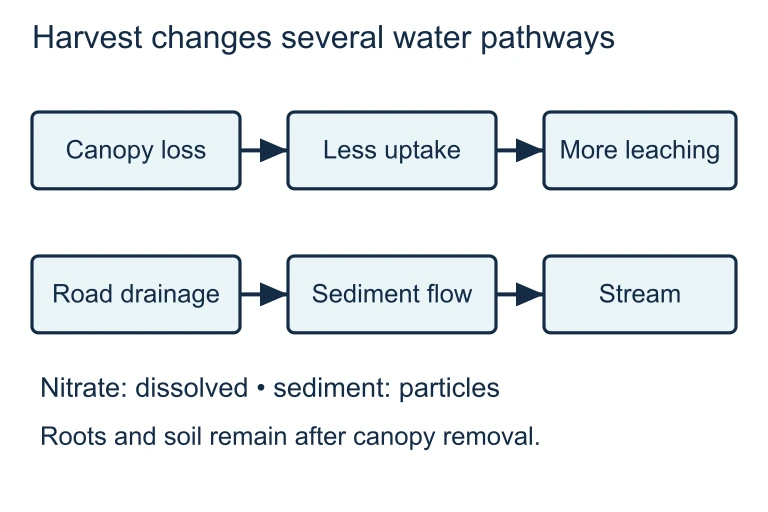 Canopy removal changes interception, transpiration, soil exposure and runoff pathways. Rainfall, slope, roads, residual cover and management affect the outcome; a connected riparian buffer can retain shade and intercept some flows.
SECTION 5
Classification of Timber Harvest Methods
Clearcutting is only one of several timber harvest strategies, and the AP exam expects you to compare it with alternatives such as selective cutting, shelterwood cutting, and seed-tree cutting. Each method represents a different balance between economic return, operational simplicity, and ecological disturbance. The diagram below illustrates all four methods side by side, and the table that follows provides a structured comparison of their key attributes.
| Attribute | Clearcutting | Seed-Tree | Shelterwood | Selective |
|---|---|---|---|---|
| Trees Removed | All (100%) | Most (≈90–95%) | Staged (≈50–70% initially) | Individual trees (10–30%) |
| Stand Age Structure | Even-aged | Even-aged | Even-aged | Uneven-aged |
| Erosion Risk | Very high | High | Moderate | Low |
| Biodiversity Impact | Severe habitat loss; favors edge/pioneer species | High; minimal cover for wildlife | Moderate; partial shelter maintained | Low; canopy gaps mimic natural disturbance |
| Economic Efficiency | Highest (lowest per-unit harvest cost) | High | Moderate (multiple entries) | Lowest (labor-intensive selection) |
| Best Suited For | Shade-intolerant species (e.g., Douglas fir, jack pine) | Species with wind-dispersed seeds | Species needing some shade as seedlings | Shade-tolerant species (e.g., sugar maple, hemlock) |
Comparison of major timber harvest methods across ecological and economic dimensions.
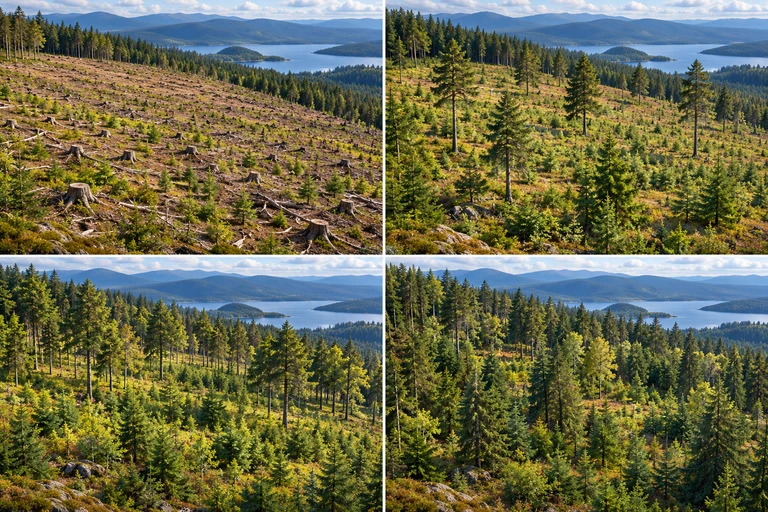 Harvest methods differ in retained canopy and regeneration. Shelterwood uses staged removal; selection can maintain several age classes when species and site conditions support it.
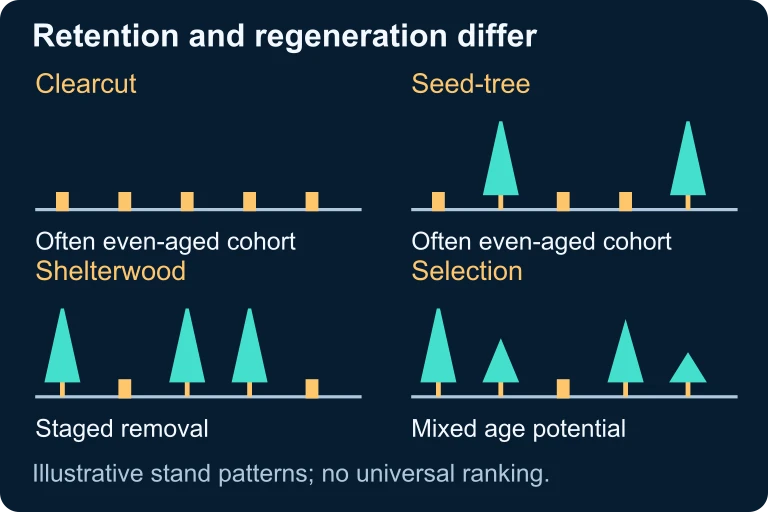 Harvest methods differ in retained canopy and regeneration. Shelterwood uses staged removal; selection can maintain several age classes when species and site conditions support it.
SECTION 6
Worked Example: Estimating Erosion Increase After Clearcutting
A forest manager needs to estimate how soil erosion rates will change if a 50-hectare tract of temperate forest is clearcut on a moderate slope. We will use the Universal Soil Loss Equation (USLE) to compare estimated erosion under forest cover versus post-clearcut conditions.
Erosion Change After Clearcutting a 50-Hectare Stand
- 1
Step 1 — Identify Given Values
The USLE is A = R × K × LS × C × P. For this site: R (rainfall erosivity) = 200, K (soil erodibility) = 0.30, LS (slope/length factor) = 1.5, P (support practices, no terracing) = 1.0. Under intact forest, C = 0.004. After clearcutting with no residual cover, C = 0.90. - 2
Step 2 — Calculate Erosion Under Forest Cover
Aforest = 200 × 0.30 × 1.5 × 0.004 × 1.0 = 0.36 tons/acre/year. This is a very low rate, typical of undisturbed forested land.A_forest = 0.36 tons/acre/year - 3
Step 3 — Calculate Erosion After Clearcutting
Aclearcut = 200 × 0.30 × 1.5 × 0.90 × 1.0 = 81 tons/acre/year. The enormous increase is driven entirely by the change in the cover management factor C.A_clearcut = 81 tons/acre/year - 4
Step 4 — Compute the Factor of Increase
Factor increase = Aclearcut ÷ Aforest = 81 ÷ 0.36 = 225. Soil erosion increases by a factor of 225—more than two orders of magnitude—simply from removing the vegetative cover.Erosion increases by a factor of 225× - 5
Step 5 — Interpret & Mitigate
This dramatic increase underscores why best management practices (BMPs) such as leaving riparian buffer zones, constructing water bars on skid trails, and prompt replanting are critical. If the manager installs silt fences and seeds erosion-control grasses (reducing C to ≈0.10), the revised erosion drops to A = 200 × 0.30 × 1.5 × 0.10 × 1.0 = 9.0 tons/acre/year—still 25× higher than the forested baseline, but a substantial improvement over the unmitigated clearcut.BMPs can reduce post-clearcut erosion by ~89%
SECTION 7
Strengths, Limitations, & Ecological Trade-offs
Clearcutting is neither universally destructive nor universally beneficial—its appropriateness depends on species ecology, site conditions, scale, and management practices. The AP exam frequently tests your ability to evaluate environmental trade-offs rather than simply categorize practices as "good" or "bad." The table below organizes the primary arguments for and against clearcutting.
| Potential Advantages | Potential Disadvantages |
|---|---|
| Maximizes timber yield per harvest entry, reducing the frequency of road building and heavy equipment use in the forest | Eliminates canopy cover, drastically increasing erosion, surface runoff, and sedimentation of waterways |
| Creates ideal regeneration conditions for shade-intolerant species (e.g., Douglas fir, longleaf pine, aspen) that require full sunlight | Devastates interior-forest species and creates abrupt edge effects that alter microclimate 50–300 m into adjacent stands |
| Simplifies replanting and stand management because all trees are the same age class | Exports large quantities of nutrients in biomass; repeated rotations without nutrient inputs can deplete soil fertility |
| Can benefit certain wildlife species (e.g., deer, rabbits, grouse) that thrive in early-successional habitat | Converts the site from a carbon sink to a carbon source for 10–20+ years until regrowth compensates |
| Lowest per-unit cost of any harvest method, making forestry economically viable in marginal markets | Aesthetically damaging; reduces recreation, tourism, and non-timber ecosystem service values |
Ecological and economic trade-offs of clearcutting.
KEY TAKEAWAY
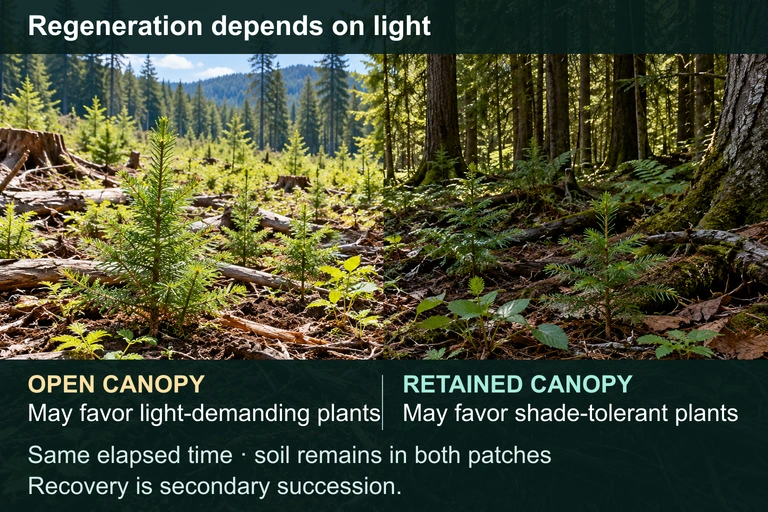 Canopy opening favors some regeneration strategies and disadvantages others. When soil remains after harvest, recovery is secondary succession.
SECTION 8
Policy Frameworks & Sustainable Forestry
Because clearcutting can impose significant externalities on ecosystems and communities, regulatory and voluntary frameworks have evolved to constrain its use. Understanding these governance mechanisms is essential for free-response questions that ask you to propose solutions or evaluate management strategies.
| Regulatory / Voluntary Framework | Key Provisions Relevant to Clearcutting |
|---|---|
| National Forest Management Act (1976) | Clearcutting on U.S. national forests only when "optimum method"; limits clearcut size; mandates reforestation within 5 years and environmental review |
| Endangered Species Act (1973) | Prohibits habitat destruction for listed species; has blocked clearcuts in old-growth spotted owl and marbled murrelet habitat in the Pacific Northwest |
| Forest Stewardship Council (FSC) | Voluntary certification; restricts clearcutting to ecologically appropriate situations, requires riparian buffers, biodiversity set-asides, and monitoring plans |
| Best Management Practices (BMPs) | State-level guidelines requiring riparian buffer zones, controlled road drainage, slash management, and prompt replanting to minimize erosion and water quality impacts |
| REDD+ (International) | UN program providing financial incentives to developing nations to reduce deforestation and forest degradation, indirectly discouraging large-scale clearcutting in tropical forests |
Key regulatory and voluntary frameworks governing clearcutting practices.
Looking forward, the concept of sustainable forestry integrates ecological, economic, and social dimensions. Modern approaches increasingly favor ecosystem-based management, which uses natural disturbance regimes as a template for harvest design. In fire-adapted ecosystems where stand-replacing fires historically occurred, small-scale clearcuts can mimic natural patch dynamics. In forests shaped by gap-phase dynamics (individual tree falls), selective logging is more ecologically appropriate. The AP exam may ask you to match a harvest method to a given ecosystem type and justify your reasoning with ecological principles.
SECTION 9
Practice Problems
Question 1: CONCEPTUAL
- A. Clearcutting introduces synthetic nitrogen fertilizers to the soil during replanting operations.
- B. Without living tree roots to absorb dissolved nitrogen, nitrate leaches through the soil and enters groundwater and streams.
- C. Removal of the canopy increases photolysis of atmospheric nitrogen, converting N₂ gas into nitrate at the soil surface.
- D. Heavy logging machinery compresses nitrogen gas in the soil, releasing nitrate ions into stream runoff.
Show answer (B)
Question 2: BASIC CALCULATION
- A. 0.375 tons/acre/year
- B. 30 tons/acre/year
- C. 60 tons/acre/year
- D. 75 tons/acre/year
Show answer (C)
Question 3: INTERMEDIATE
- A. Leaving an unharvested riparian buffer zone of at least 30 meters along the river to filter sediment and maintain stream temperature
- B. Replanting the entire clearcut with fast-growing non-native eucalyptus to restore canopy cover as quickly as possible
- C. Harvesting during the winter months when salmon are not actively feeding in the river
- D. Increasing the clearcut area to 400 hectares so that the operation is completed in a single season rather than over multiple years
Show answer (A)
Question 4: APPLIED
4 ptsShow answer
Question 5: CRITICAL THINKING
4 ptsShow answer
SUMMARY
Clearcutting — Key Concepts Review
Summary
Clearcutting is the harvest method in which all trees in a stand are removed in a single operation, producing an even-aged stand upon regeneration. It is the most economically efficient harvest method but carries the highest ecological cost: removal of the canopy triggers accelerated soil erosion (quantified via the USLE, where the cover management factor C jumps from ≈0.004 to nearly 1.0), increased nutrient leaching (as demonstrated by the Hubbard Brook study), loss of biodiversity through habitat destruction and edge effects, and conversion of the site from a carbon sink to a carbon source (negative NEP) for years to decades.
Alternatives such as selective cutting, shelterwood cutting, and seed-tree cutting retain varying degrees of canopy structure and reduce ecological disturbance. Regulatory frameworks including the National Forest Management Act and voluntary certification programs like the Forest Stewardship Council constrain when and how clearcutting may be applied. On the AP exam, remember to evaluate harvest methods in context: match the method to the species ecology and site conditions, quantify impacts where possible using the USLE, and recommend best management practices (riparian buffers, prompt replanting, erosion controls) as evidence-based mitigation strategies.