
SECTION 1
Historical Context & Motivation
The question of why organisms seem so perfectly suited to their environments has occupied naturalists for centuries. Early observers such as Aristotle attributed the fit between organisms and their habitats to inherent purpose, a teleological view that persisted through the medieval period. The emergence of natural theology in the 18th century, championed by William Paley, argued that the exquisite match between form and function was evidence of divine design. It was not until the 19th century that a mechanistic, evidence-based explanation for adaptation emerged — one grounded in variation, inheritance, and differential reproductive success.
1809 • Lamarck's Inheritance of Acquired Traits
1859 • Darwin's On the Origin of Species
1930s–40s • The Modern Synthesis
1973 • Dobzhansky's Famous Dictum
For AP Environmental Science, the key question that adaptation addresses is: How do populations develop traits that allow them to survive, reproduce, and thrive in specific ecological niches, and what happens when environments change faster than populations can adapt? Understanding adaptation is foundational to topics ranging from biodiversity loss to the impacts of climate change on species distributions.
SECTION 2
Core Principles & Definitions
An adaptation is a heritable trait — structural, physiological, or behavioral — that increases an organism's fitness (its ability to survive and reproduce) within a particular environment. Adaptations arise through the process of natural selection acting on genetic variation within a population over many generations. Crucially, organisms do not choose to adapt; rather, those individuals whose inherited traits happen to confer an advantage in a given environment leave more offspring, gradually shifting the population's trait distribution.
Structural Adaptations
Physiological Adaptations
Behavioral Adaptations
Fitness & Selection Pressure
SECTION 3
Visual Explanation: How Adaptations Arise
The diagram above captures the core mechanism: adaptation is a population-level phenomenon driven by differential reproduction, not a process of individual transformation. No single organism "becomes" adapted during its lifetime; rather, the relative proportion of individuals carrying advantageous alleles increases across successive generations. This distinction is critical on the AP exam — answer choices that suggest individual organisms adapt to their environment within a single lifetime reflect a common Lamarckian misconception.
SECTION 4
How Adaptations Develop: The Mechanism
Requirements for Natural Selection
For adaptation to occur through natural selection, four conditions must be met simultaneously. First, there must be variation in traits among individuals in the population. Second, that variation must be at least partly heritable — passed from parents to offspring through genetic mechanisms. Third, the population must produce more offspring than the environment can support, creating a struggle for existence. Fourth, individuals with certain heritable traits must have differential fitness — they survive and reproduce at higher rates. When all four conditions hold, the frequency of advantageous alleles increases over generations, producing adaptation.
Selection Pressures in Environmental Science
In the AP Environmental Science context, selection pressures are the environmental factors that drive adaptive change. These include abiotic factors such as temperature, precipitation, soil chemistry, and light availability, as well as biotic factors such as predation, competition, parasitism, and mutualistic relationships. For example, in a desert ecosystem, intense solar radiation and water scarcity exert abiotic selection pressures that favor plants with thick cuticles, reduced leaf surface area, and CAM photosynthesis. Meanwhile, biotic pressures from herbivores may further favor the evolution of spines or toxic secondary compounds.
Quantifying Selection: A Simplified View
ALLELE FREQUENCY CHANGE
Where p = frequency of the favored allele, q = frequency of the alternative allele (q = 1 − p), s = selection coefficient (strength of selection, 0 to 1), and h = dominance coefficient. While the AP exam does not require this formula, understanding that stronger selection (higher s) and higher genetic variation (intermediate p and q) accelerate adaptation is conceptually important.
SECTION 5
Types of Adaptations in Ecosystems
Convergent vs. Divergent Adaptation
When unrelated species facing similar selection pressures independently evolve analogous traits, the result is convergent evolution. Sharks (fish) and dolphins (mammals) both evolved streamlined bodies and fins for efficient movement through water, despite sharing no recent common ancestor. In contrast, divergent evolution occurs when a single ancestral population splits into different environments and evolves distinct adaptations. Darwin's finches on the Galápagos Islands illustrate divergent evolution beautifully: from a common ancestor, different species evolved beak shapes suited to seeds, insects, or cactus fruits. A related concept is coevolution, in which two or more species reciprocally drive each other's adaptations — for instance, flowering plants and their pollinators, or predators and prey engaged in an evolutionary arms race.
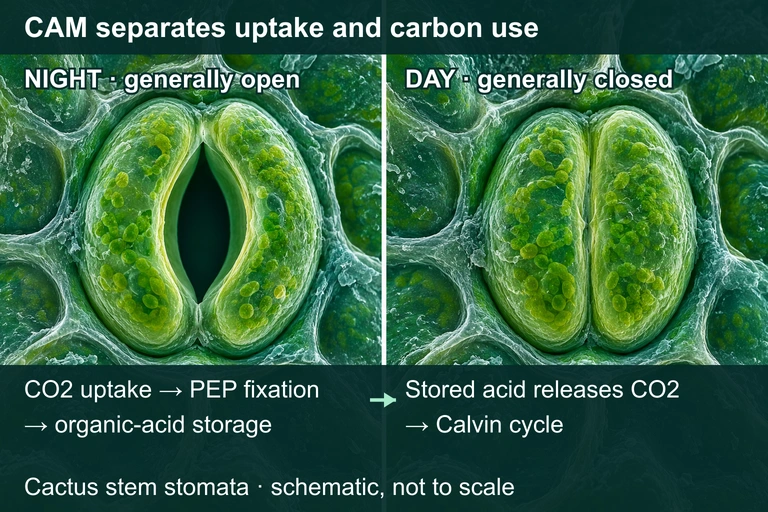 Cactus stem stomata generally open at night and close by day, though CAM is flexible and conditions matter. Night CO2 uptake and PEP carboxylation support organic-acid storage; daytime CO2 release supports the Calvin cycle. The guard-cell views are schematic and not to scale.
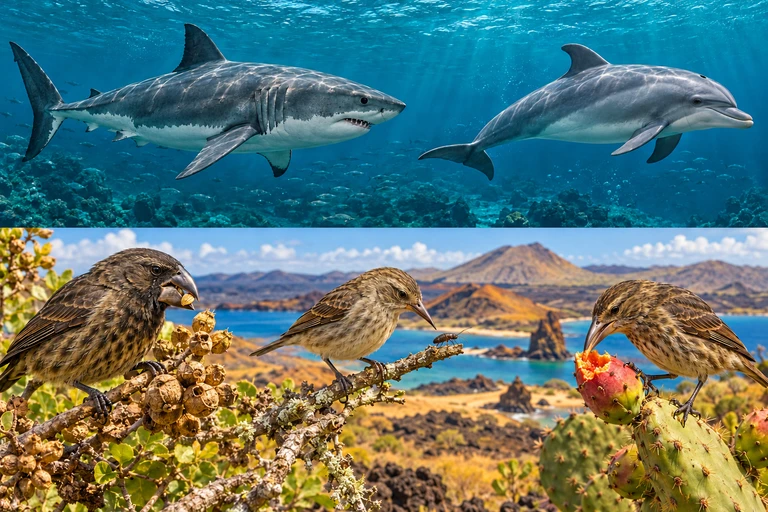 Streamlined aquatic body shapes evolved independently in the distinct shark and dolphin lineages. Finch beak differences instead illustrate divergence among descendants of a common ancestor.
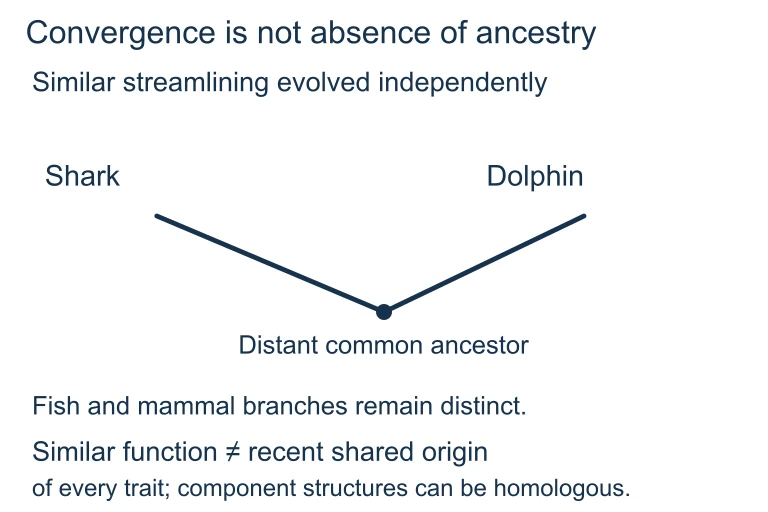 Streamlined aquatic body shapes evolved independently in the distinct shark and dolphin lineages. Finch beak differences instead illustrate divergence among descendants of a common ancestor.
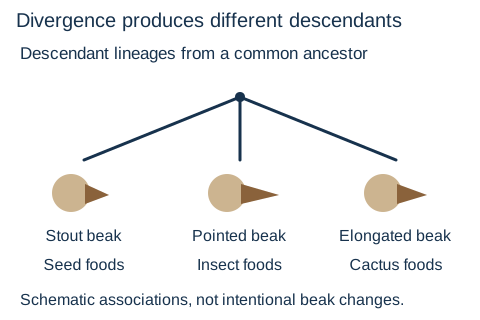 Descendant finch lineages from a common ancestor can differ in inherited beak traits associated with different foods. These differences arise through variation and differential reproduction across generations.Open full diagram
SECTION 6
Worked Example: Identifying Adaptations in a Scenario
The following worked example mirrors the type of reasoning required on AP Environmental Science FRQs, where you must identify adaptations, link them to environmental pressures, and explain the mechanism of natural selection.
Worked example
- 1
Step 1 — Identify the Environmental Pressures
Mangroves grow in coastal intertidal zones characterized by high salinity, anaerobic (oxygen-poor) soil, tidal flooding, and intense sunlight. The key selection pressures are salt stress, oxygen-poor substrate, and unstable substrate due to shifting sediments. - 2
Step 2 — Identify the Adaptations by Type
Structural: Prop roots and aerial roots (pneumatophores) anchor the tree and project above the waterline. Physiological: Salt-excreting glands on leaves and the ability to filter salt at root membranes via ultrafiltration. Behavioral (functional): Vivipary — seeds germinate while still on the parent tree, allowing propagules to establish quickly once they drop into water. - 3
Step 3 — Explain the Selective Mechanism
Ancestral coastal plants exhibited genetic variation in root architecture and salt tolerance. Individuals with slightly more efficient salt exclusion or more extensive aerial roots survived and reproduced at higher rates in saline, anaerobic environments. Over many generations, alleles coding for these traits increased in frequency, producing the suite of adaptations we observe in modern mangroves. - 4
Step 4 — Connect to Broader Environmental Science
Mangrove adaptations are ecologically significant: their root systems stabilize coastlines, reduce erosion, and serve as nursery habitat for commercially important fish species. When mangroves are removed, coastal ecosystems lose these ecosystem services, demonstrating how species-level adaptations underpin landscape-scale ecological functions.Mangrove adaptations illustrate how structural, physiological, and reproductive traits evolve together in response to multiple simultaneous selection pressures, with direct consequences for ecosystem health.
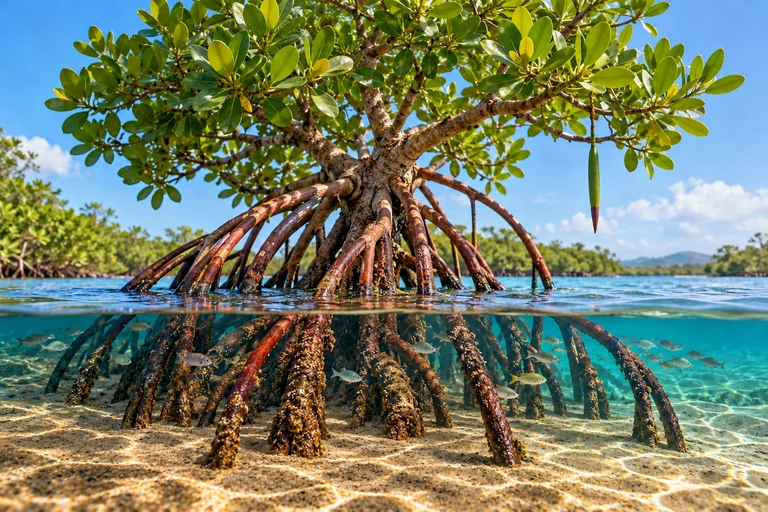 This red-mangrove-type example combines connected prop roots with an attached developing propagule. Mangrove species vary in root architecture and salt handling; vivipary is a developmental trait.
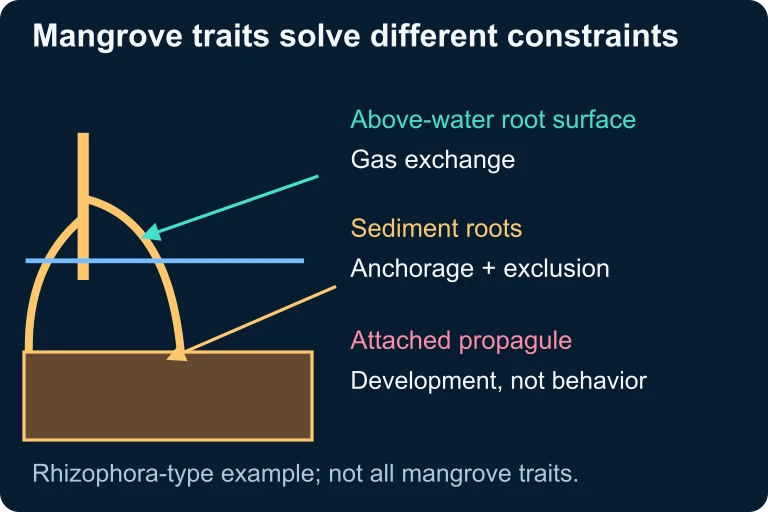 This red-mangrove-type example combines connected prop roots with an attached developing propagule. Mangrove species vary in root architecture and salt handling; vivipary is a developmental trait.
SECTION 7
Tradeoffs & Limitations of Adaptations
Adaptations are not perfect solutions. Every adaptation involves tradeoffs — benefits in one dimension that come at a cost in another. Understanding these tradeoffs is essential for predicting how species respond to environmental change and for answering AP exam questions that require nuanced ecological reasoning.
| Adaptation | Benefit | Tradeoff / Cost |
|---|---|---|
| Large antlers in elk | Success in mate competition; sexual selection advantage | Energetically expensive to grow; increases vulnerability to predators in dense forest |
| Sickle cell trait (heterozygous) | Resistance to malaria in tropical regions | Homozygous individuals suffer sickle cell disease; maintained by balancing selection |
| Deep taproot in desert shrubs | Access to deep groundwater | Slow establishment; vulnerable during seedling stage; limited lateral water capture |
| Bright coloration (aposematism) | Warns predators of toxicity; reduces predation | High visibility makes organism conspicuous to predators that haven't learned the signal |
Examples of adaptive tradeoffs in diverse organisms
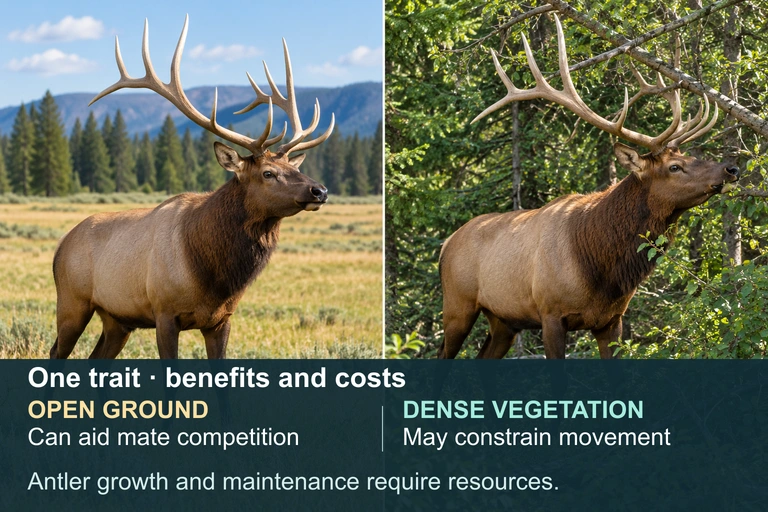 The same antlers can aid mate competition while imposing growth costs and movement constraints. Benefits and costs depend on the setting.
SECTION 8
Adaptations in the Context of Rapid Environmental Change
One of the most pressing questions in modern environmental science is whether organisms can adapt fast enough to keep pace with anthropogenic climate change, habitat destruction, and pollution. The concept of adaptive lag describes the mismatch between the rate of environmental change and the rate at which populations can evolve adaptive responses. Species with short generation times and large population sizes — such as bacteria and insects — can adapt relatively quickly, which is why antibiotic resistance and pesticide resistance emerge within years. In contrast, species with long generation times and small populations — such as large mammals, sea turtles, and old-growth trees — are far more vulnerable to rapid change.
| Factor | Favors Rapid Adaptation | Limits Adaptation |
|---|---|---|
| Generation time | Short (bacteria: minutes; insects: weeks) | Long (elephants: ~22 years; trees: decades) |
| Population size | Large (more genetic variation) | Small (genetic drift, bottlenecks) |
| Genetic diversity | High standing variation for selection to act on | Low diversity (inbreeding, founder effects) |
| Rate of env. change | Slow, gradual shifts | Rapid, unprecedented shifts (current climate change) |
Factors influencing a population's ability to adapt to environmental change
When adaptation cannot keep pace with change, populations may respond via range shifts (migrating to newly suitable habitat), phenotypic plasticity (non-genetic responses such as altered flowering time), or they face population decline and potential extinction. This connects adaptation directly to the broader AP Environmental Science themes of biodiversity loss and conservation biology. Understanding adaptive capacity helps environmental scientists prioritize conservation efforts toward species least capable of evolutionary rescue.
SECTION 9
Practice Problems
Question 1: CONCEPTUAL
- A. Individual beetles gradually darken their body color to match the bark during their lifetimes.
- B. The dark bark causes mutations in beetle DNA that produce darker pigmentation.
- C. Darker beetles have higher survival rates due to camouflage, passing their alleles to more offspring over generations.
- D. Random genetic drift eliminates lighter-colored beetles from the population in a single generation.
Show answer (C)
Question 2: BASIC CALCULATION
- A. 0.64
- B. 0.82
- C. 0.56
- D. 0.88
Show answer (B)
Question 3: INTERMEDIATE
- A. High-altitude individuals have a higher density of stomata on their leaf undersides.
- B. Genetic analysis reveals significant allele frequency differences between high- and low-elevation populations.
- C. Wind speeds are significantly higher at higher elevations.
- D. In controlled high-altitude conditions, otherwise comparable plants with small, compact leaves lose more water per unit leaf area and have lower survival than plants with broader leaves.
Show answer (D)
Question 4: APPLIED
Show answer
Question 5: CRITICAL THINKING