

SECTION 1
Historical Context & Motivation
The phenomenon of acid rain—precipitation with a pH significantly below the natural baseline of approximately 5.6—has been recognized as a major environmental threat since the height of industrialization. Although natural processes such as volcanic emissions and lightning-generated nitrogen oxides have always contributed small quantities of acidic compounds to the atmosphere, the widespread combustion of fossil fuels during the Industrial Revolution dramatically amplified these inputs. The Scottish chemist Robert Angus Smith first coined the term "acid rain" in 1872 after observing that rainfall near Manchester's factories corroded buildings and stunted vegetation. Yet more than a century passed before coordinated international action addressed the issue, illustrating the slow pace at which atmospheric science translates into environmental policy.
1872 • Smith Coins "Acid Rain"
1963 • Scandinavian Fish Kills
1970 • U.S. Clean Air Act
1990 • Title IV — Acid Rain Program
2010s • Recovery and Ongoing Challenges
The history of acid rain raises a central question for environmental scientists: how do gaseous pollutants emitted at point sources undergo atmospheric transformation, travel hundreds of kilometers, and alter the chemistry of distant ecosystems? Understanding this chain—from emission to deposition to ecological response—is essential for evaluating policy tools and predicting recovery timelines, two themes that recur throughout the AP Environmental Science curriculum.
SECTION 2
Core Principles & Definitions
Acid rain is best understood through a set of interconnected chemical and ecological principles. At its foundation lies the concept of pH, the negative base-ten logarithm of the hydrogen-ion concentration in solution. Normal ("clean") rain is slightly acidic with a pH of roughly 5.6 because atmospheric CO₂ dissolves to form weak carbonic acid (H₂CO₃). Acid rain is formally defined as precipitation with a pH below 5.0, indicating that additional strong acids—primarily sulfuric acid (H₂SO₄) and nitric acid (HNO₃)—are present. Because the pH scale is logarithmic, each whole-unit decrease represents a tenfold increase in hydrogen-ion concentration, which means that rain at pH 4.0 is ten times more acidic than rain at pH 5.0 and roughly forty times more acidic than unpolluted rain.
Primary Precursors
Wet vs. Dry Deposition
Buffering Capacity
Long-Range Transport
KEY TAKEAWAY
SECTION 3
Visual Explanation — The Acid Rain Cycle
The diagram above illustrates the complete pathway of acid deposition. Emissions of SO₂ and NOₓ rise from combustion sources and enter the troposphere, where hydroxyl radicals (OH·) and other oxidants catalyze their conversion into sulfuric acid (H₂SO₄) and nitric acid (HNO₃). These strong acids dissolve into cloud droplets and precipitate as wet deposition, or settle as particulate sulfates and nitrates in dry deposition. The distinction matters ecologically: dry deposition can accumulate on leaf surfaces and soil during dry periods, only mobilizing in a concentrated acidic pulse during the first rainfall—a phenomenon known as acid shock—which is especially damaging to aquatic organisms during spring snowmelt.
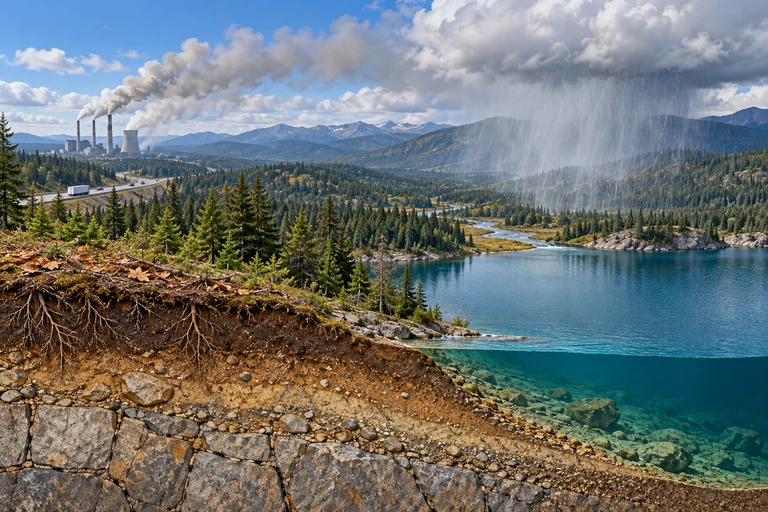 Atmospheric oxidation produces acids and sulfate or nitrate products. Wet deposition and dry gas or particle deposition both deliver material to watersheds; later rain can mobilize dry deposits.
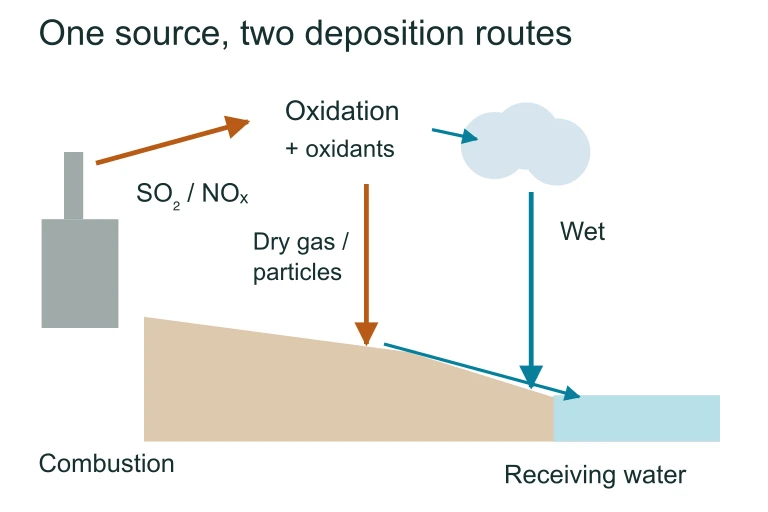 Atmospheric oxidation produces acids and sulfate or nitrate products. Wet deposition and dry gas or particle deposition both deliver material to watersheds; later rain can mobilize dry deposits.
SECTION 4
Chemical Mechanism & pH Framework
The chemistry of acid rain centers on the atmospheric oxidation of sulfur and nitrogen gases into their corresponding strong acids. Understanding these reactions—and the logarithmic pH scale used to quantify their impact—provides the analytical backbone for evaluating deposition data on the AP exam.
SULFURIC ACID FORMATION (SIMPLIFIED)
SO₂ is oxidized in the gas phase by hydroxyl radicals or in the aqueous phase within cloud droplets. The product, sulfuric acid, is a strong diprotic acid that fully dissociates in water, contributing two H⁺ ions per molecule.
NITRIC ACID FORMATION (SIMPLIFIED)
Nitrogen monoxide (NO) first oxidizes to NO₂, which then reacts with water vapor to yield nitric acid. HNO₃ is a strong monoprotic acid.
pH DEFINITION
Because the scale is logarithmic, each unit decrease in pH represents a tenfold increase in H⁺ concentration. Unpolluted rain ≈ pH 5.6 (due to dissolved CO₂); acid rain is formally pH < 5.0.
CARBONATE BUFFERING REACTION
Limestone bedrock reacts with sulfuric acid, consuming H⁺ ions and releasing CO₂. This buffering reaction explains why calcareous watersheds resist acidification far longer than granitic ones.
On the AP exam, you may be asked to calculate how many times more acidic one sample is compared to another. The key relationship is: if sample A has a pH of a and sample B has a pH of b, then the ratio of their H⁺ concentrations equals 10(b − a). For example, rain at pH 4.0 is 10(5.6 − 4.0) ≈ 40 times more concentrated in H⁺ than unpolluted rain.
SECTION 5
Ecological & Human Impacts
The effects of acid deposition cascade across abiotic and biotic components of ecosystems. These impacts vary in severity based on the sensitivity of the receiving environment, making geological substrate and pre-existing soil chemistry critical factors in vulnerability assessments.
In aquatic ecosystems, acid deposition lowers lake and stream pH, which directly harms acid-sensitive species such as brook trout and mayfly larvae. Equally damaging is the indirect effect: as soil pH falls, aluminum ions (Al³⁺) are released from clay minerals into solution. Even at low concentrations, dissolved aluminum damages fish gills by stimulating excess mucus production, which impairs gas exchange and causes suffocation. In terrestrial ecosystems, acid inputs leach base cations—calcium, magnesium, and potassium—from the soil's cation exchange complex, reducing nutrient availability for forest trees. High-elevation red spruce forests in the Appalachians have experienced severe dieback linked to calcium depletion exacerbated by acid fog. For human infrastructure, the dissolution of calcium carbonate in marble and limestone monuments (including the Parthenon and numerous statues across Europe) represents irreversible cultural heritage loss.
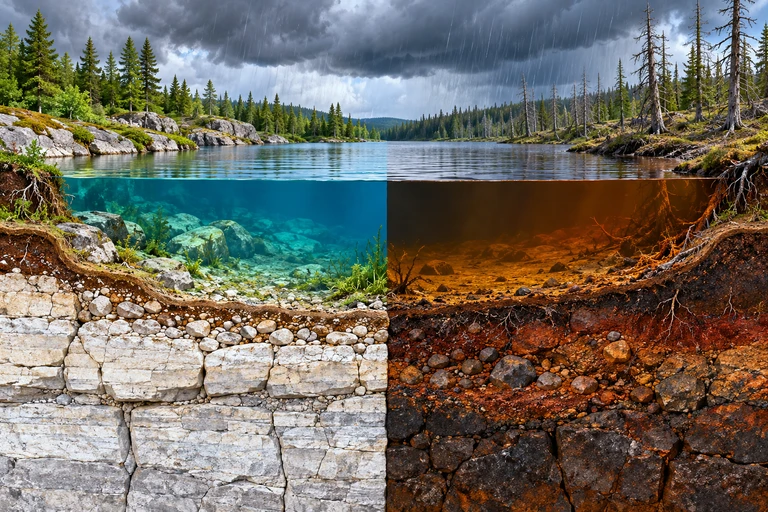 Equal acid deposition can produce different responses because buffering capacity differs. Carbonate minerals can neutralize hydrogen ions, while acidification can mobilize aluminum and leach soil nutrients.
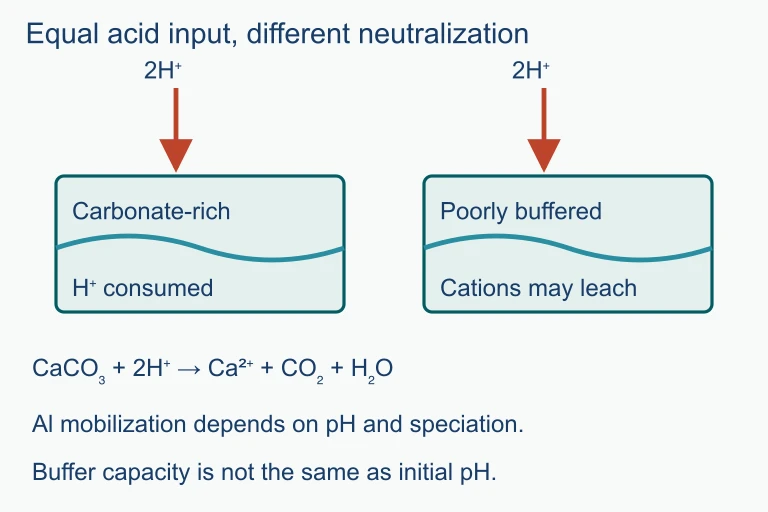 Equal acid deposition can produce different responses because buffering capacity differs. Carbonate minerals can neutralize hydrogen ions, while acidification can mobilize aluminum and leach soil nutrients.
SECTION 6
Worked Example — pH Comparison & Acidity Factor
A common AP Environmental Science calculation involves comparing the acidity of two water samples. Below, we work through a representative problem involving acid rain data.
How Many Times More Acidic Is the Acid Rain Sample?
- 1
Step 1 — Identify Given Values
A monitoring station in the Adirondacks records rainfall with a pH of 4.2. Normal (unpolluted) rain has a pH of 5.6. Determine how many times more acidic the acid rain sample is compared to normal rain. - 2
Step 2 — Calculate the pH Difference
ΔpH = pHnormal − pHacid = 5.6 − 4.2 = 1.4ΔpH = 1.4 - 3
Step 3 — Apply the Logarithmic Relationship
Because each pH unit represents a tenfold change in [H⁺], the acidity factor = 10ΔpH = 101.4. Using a calculator: 101.4 ≈ 25.1.Acidity factor ≈ 25 times - 4
Step 4 — Interpret the Result
The acid rain sample contains approximately 25 times more hydrogen ions per liter than unpolluted rain. For context, this means the H⁺ concentration is about 6.3 × 10⁻⁵ M compared to normal rain's 2.5 × 10⁻⁶ M. Such elevated acidity would stress acid-sensitive organisms in poorly buffered lakes.The acid rain is ≈ 25× more acidic than normal rain
SECTION 7
Mitigation Strategies & Policy Approaches
Addressing acid rain requires a combination of emission reduction at the source, atmospheric interventions, and ecological restoration at the receiving end. The table below compares the major strategies, their mechanisms, and their limitations—a frequent topic on AP Environmental Science free-response questions.
| Strategy | Mechanism | Limitations |
|---|---|---|
| Flue-gas desulfurization (scrubbers) | Wet limestone slurry reacts with SO₂ in exhaust gas, forming CaSO₄ (gypsum); removes 90–99% of SO₂ | High installation cost; generates solid waste (gypsum); does not address NOₓ |
| Catalytic converters | Platinum/rhodium catalysts in vehicle exhaust reduce NOₓ to N₂ and oxidize CO to CO₂ | Only effective at operating temperature; metals are finite resources; does not affect stationary sources |
| Cap-and-trade (SO₂) | Sets a declining emissions cap; allows firms to buy/sell allowances, incentivizing cheapest reductions first | Requires monitoring infrastructure; may create pollution hot spots near disadvantaged communities |
| Fuel switching | Switching from high-sulfur coal to natural gas or renewables reduces SO₂ and NOₓ at the source | Natural gas still produces some NOₓ; transition costs can be high for existing infrastructure |
| Liming (remediation) | Adding CaCO₃ or Ca(OH)₂ to acidified lakes/soils to neutralize acidity and restore base cations | Treats symptoms, not cause; must be repeated; can alter natural aquatic chemistry |
Major acid rain mitigation strategies and their trade-offs
KEY TAKEAWAY
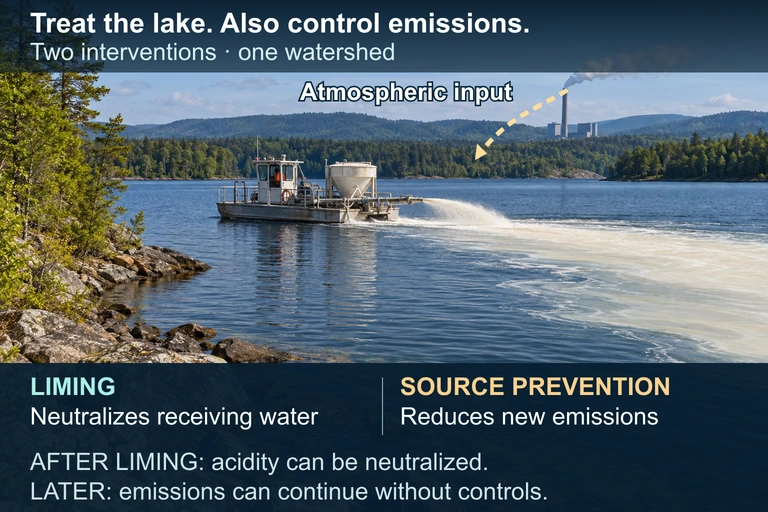 Liming can neutralize acidity in receiving water, but emission controls address the atmospheric source. No fixed recovery time is implied.
SECTION 8
Connections to Broader APES Topics
Acid rain does not exist in isolation within the APES curriculum; it intersects with multiple units and provides a powerful case study for understanding interconnected environmental systems. The table below maps acid rain concepts to related topics, showing how mastery of this material reinforces understanding across the exam.
| Acid Rain Concept | Related APES Topic | Connection |
|---|---|---|
| SO₂ / NOₓ emissions from combustion | Fossil fuel energy (Unit 6) | Coal combustion is the primary SO₂ source; natural gas produces less SO₂ but still emits NOₓ |
| Transboundary pollution | Global environmental policy (Unit 9) | Acid rain exemplifies the need for international agreements; parallels ozone and climate treaties |
| Lake acidification and biodiversity loss | Aquatic ecosystems and biodiversity (Units 2 & 3) | pH stress reduces species richness; Al³⁺ toxicity disrupts food webs |
| Soil nutrient leaching | Soil science and biogeochemical cycles (Unit 4) | Cation exchange disruption links acid deposition to the calcium and nitrogen cycles |
| Cap-and-trade for SO₂ | Environmental economics and legislation (Unit 9) | Serves as the textbook example of a successful market-based environmental policy |
How acid rain integrates across the APES curriculum
Looking ahead, the decline of traditional acid rain in North America—thanks largely to successful SO₂ regulations—does not mean the issue is fully resolved. Atmospheric nitrogen deposition remains stubbornly high because vehicle and agricultural NOₓ emissions are harder to regulate than point-source SO₂. Moreover, the concept of nitrogen saturation in soils—where excess nitrogen overwhelms an ecosystem's capacity to assimilate it—links acid deposition to eutrophication and coastal dead zones, demonstrating that atmospheric pollution problems cascade into water-quality crises. In rapidly industrializing regions of Asia, particularly China and India, acid rain remains a growing concern as coal consumption continues to expand.
SECTION 9
Practice Problems
Question 1: CONCEPTUAL
- A. Natural emissions of SO₂ from volcanic activity dissolve in rain to form sulfuric acid.
- B. Atmospheric CO₂ dissolves in rainwater to form carbonic acid (H₂CO₃).
- C. Ozone (O₃) in the troposphere reacts with water to produce hydrogen peroxide, which acidifies rain.
- D. Nitrogen gas (N₂) in the atmosphere slowly hydrolyzes in water to form nitric acid.
Show answer (B)
Question 2: BASIC CALCULATION
- A. 2 times greater
- B. 20 times greater
- C. 100 times greater
- D. 1,000 times greater
Show answer (C)
Question 3: INTERMEDIATE
- A. Both watersheds show the same decline in lake pH because they receive the same deposition.
- B. Watershed A shows greater pH decline because granite lacks carbonate minerals to buffer acid inputs.
- C. Watershed B shows greater pH decline because limestone dissolves readily, depleting bedrock and removing buffering capacity.
- D. Watershed A recovers more quickly because silicate minerals in granite slowly neutralize the acid.
Show answer (B)
Question 4: APPLIED
4 ptsShow answer
Question 5: CRITICAL THINKING
4 ptsShow answer
SUMMARY
Acid Rain — Key Concepts Review
Summary
Acid rain results when sulfur dioxide (SO₂) and nitrogen oxides (NOₓ) from fossil fuel combustion undergo atmospheric oxidation to form sulfuric acid (H₂SO₄) and nitric acid (HNO₃), which return to Earth's surface through wet deposition (rain, snow, fog) and dry deposition (particulate settling). The logarithmic pH scale means each unit decrease represents a tenfold increase in H⁺ concentration, making even small pH drops ecologically significant. The severity of impact depends on an ecosystem's buffering capacity, determined largely by the presence of limestone (CaCO₃) in the bedrock.
Ecological effects include lake acidification, aluminum mobilization toxic to aquatic organisms, soil nutrient leaching, and forest decline. Mitigation strategies range from scrubbers and catalytic converters (engineering controls) to the cap-and-trade program established under Title IV of the Clean Air Act (a market-based policy approach), to liming as remediation. Remember that recovery is not instantaneous: depleted soil cations, stored sulfur in wetlands, and ongoing NOₓ emissions mean that ecosystem restoration lags behind emission reductions by decades.