
SECTION 1
Historical Context & Motivation
The notion that every program should have a clearly articulated purpose might seem obvious today, but for much of computing's early history, software was written as an ad-hoc response to immediate hardware capabilities rather than as a designed artifact meant to solve a well-defined problem. As machines evolved from room-sized calculators into ubiquitous personal devices, the discipline of software engineering emerged precisely because programs without a clear purpose tended to fail — they shipped late, exceeded their budgets, or simply did not meet the needs of the people they were built for. Understanding how the idea of program function and purpose became central to computing helps us appreciate why the AP Computer Science Principles framework treats it as a foundational concept.
1940s • Hardwired Programs
1960s • The Software Crisis
1970s • Structured Design Methods
2001 • Agile Manifesto
2016–Present • AP CSP Framework
This historical trajectory reveals a recurring theme: when developers lose sight of a program's purpose, they produce software that is technically functional yet practically useless. The AP CSP exam operationalizes this insight by requiring students to distinguish between a program's function — the specific behavior it exhibits when executed — and its purpose — the real-world problem or creative goal it was built to address. This distinction, simple as it sounds, drives clear thinking throughout the entire development process.
SECTION 2
Core Principles & Definitions
Before diving into examples and diagrams, it is essential to establish precise definitions for the vocabulary the AP CSP exam expects you to command. The College Board draws careful lines between related but distinct ideas — purpose, function, input, output, and behavior — and exam questions frequently test whether a student can identify which concept a given description refers to. The following grid lays out the four foundational ideas you need to internalize.
Program Purpose
Program Function
Inputs & Outputs
Program Behavior
KEY TAKEAWAY
SECTION 3
Visual Explanation — From Purpose to Output
The relationship between purpose, function, inputs, and outputs is best understood as a layered pipeline. At the outermost layer sits the human need (purpose); at the innermost layer sit the computational mechanics (function). The following diagram illustrates this pipeline, showing how a program translates a real-world purpose into concrete computational actions.
Notice that the diagram places purpose above and separate from the computational core. This is intentional: purpose is not something a computer executes — it is a human-defined intention that guides every design decision. Two programs can have the same purpose (e.g., 'help users manage their finances') but very different functions (one tracks expenses via manual entry; the other imports bank data automatically). Conversely, the same function — say, sorting a list of numbers — can serve wildly different purposes depending on the context in which it is deployed.
SECTION 4
How Programs Express Function & Purpose
While 'Program Function and Purpose' is not a math-heavy topic, it does have an internal logic that benefits from structured decomposition. A program's function can be modeled as a transformation: given some set of inputs, the program applies a sequence of operations — selection, iteration, and sequencing — to produce outputs. The AP CSP framework specifies several mechanisms through which programs express their function, and understanding these mechanisms helps you describe programs with the precision the exam demands.
The Input → Process → Output Model
Every program, no matter how complex, follows the Input → Process → Output (IPO) model at a fundamental level. Inputs can be explicit — typed text, mouse clicks, file uploads — or implicit, such as the current time, a device's GPS coordinates, or data retrieved from a database. The process is the set of algorithms and logic structures the program uses to transform inputs into meaningful results. Outputs are the program's deliverables: a displayed message, a saved file, an updated database record, a sound, or even a command sent to hardware like a robotic arm.
AP EXAM TIP
Events as Inputs
In event-driven programming — which is the paradigm behind most modern applications, from mobile apps to web pages — the program does not simply run from top to bottom and stop. Instead, it waits for events to occur. An event might be a button click, a timer firing, a network response arriving, or a sensor reading exceeding a threshold. When an event occurs, the program executes a corresponding event handler — a block of code associated with that event. This model means that the same program can exhibit very different behaviors depending on the sequence and timing of events, even though its underlying function (the code itself) does not change. Understanding events is essential because the AP CSP exam treats them as a key category of program input.
Describing Program Behavior
Program behavior is best described by specifying what happens under particular conditions. A strong behavioral description takes the form: "When the user does X, the program does Y, resulting in Z." For instance: "When the user enters a search term and clicks the 'Search' button, the program filters the database of recipes to find matches and displays the titles and thumbnails of up to ten results." This kind of description connects input (the search term and button click), function (filtering and matching), and output (the displayed results) in a single coherent statement. On the exam, you may be asked to write descriptions like this or to choose the most accurate one from a set of options.
SECTION 5
Classifying Programs by Purpose
Programs serve a wide range of purposes, and being able to classify a program's purpose helps you analyze its design decisions and evaluate whether its function aligns with its goals. The AP CSP framework does not prescribe a rigid taxonomy, but recognizing common categories of purpose will sharpen your ability to discuss programs on the exam and in your Create Performance Task.
It is worth emphasizing that the same underlying function can serve different purposes depending on context. A sorting algorithm, for example, is a function that arranges elements in a specified order. Embedded in a music streaming app, its purpose is to help users browse their library efficiently; embedded in a hospital system, its purpose is to prioritize patients by severity. The function is identical, but the purpose — and therefore the design decisions around user interface, error handling, and performance requirements — differs dramatically. This distinction is precisely what the AP CSP exam probes when it asks about program function versus purpose.
SECTION 6
Worked Example — Analyzing a Weather App
Let us walk through a complete analysis of a hypothetical program to practice identifying its purpose, function, inputs, outputs, and behavior. This mirrors the kind of reasoning the AP exam expects.
SCENARIO
Identifying Function and Purpose
- 1
Step 1 — Identify the Purpose
Ask: "Why does this program exist? What human need does it serve?" The app exists to help users plan their activities by providing accurate and timely weather information. The purpose is to inform users about current and upcoming weather conditions so they can make better decisions.Purpose: Help users plan activities by providing timely, accurate weather information. - 2
Step 2 — Identify the Inputs
Ask: "What data does the program receive, and from where?" There are multiple input sources: (1) the user types a city name — this is explicit user input; (2) the device's GPS sensor provides latitude and longitude — this is sensor/device input; (3) the app retrieves forecast data from an online weather API — this is data from another program or service.Inputs: City name (user), GPS coordinates (sensor), weather data (API). - 3
Step 3 — Identify the Function
Ask: "What does the program do computationally?" The program takes a location (from user input or GPS), sends a request to a weather API, receives structured weather data (typically in JSON format), parses that data to extract temperature, humidity, and forecast values, formats them for display, and evaluates whether any severe weather alerts are present. If severe weather is predicted within 24 hours, it triggers a push notification.Function: Retrieve, parse, and display weather data; evaluate for severe weather alerts. - 4
Step 4 — Identify the Outputs
Ask: "What does the program produce or display?" The outputs are: (1) a visual display of current temperature and humidity on screen; (2) a five-day forecast shown as a series of icons and numbers; (3) a push notification to the user's device if severe weather is detected.Outputs: Current conditions display, five-day forecast, push notification (conditional). - 5
Step 5 — Describe a Specific Behavior
Combine the above into a behavioral description: "When the user opens the app and grants GPS access, the program retrieves the device's coordinates, sends them to the weather API, parses the returned data, and displays the current temperature (72°F), humidity (58%), and a five-day forecast. Because a thunderstorm is predicted for tomorrow, the program also sends a push notification warning the user." This description ties a specific input scenario to concrete outputs, which is exactly what the exam looks for.Behavior: For a given GPS input, display formatted weather data and conditionally send a severe weather alert.
 A weather app’s purpose is to help people plan. Its functions receive location and forecast data, process a response and display information or an alert.
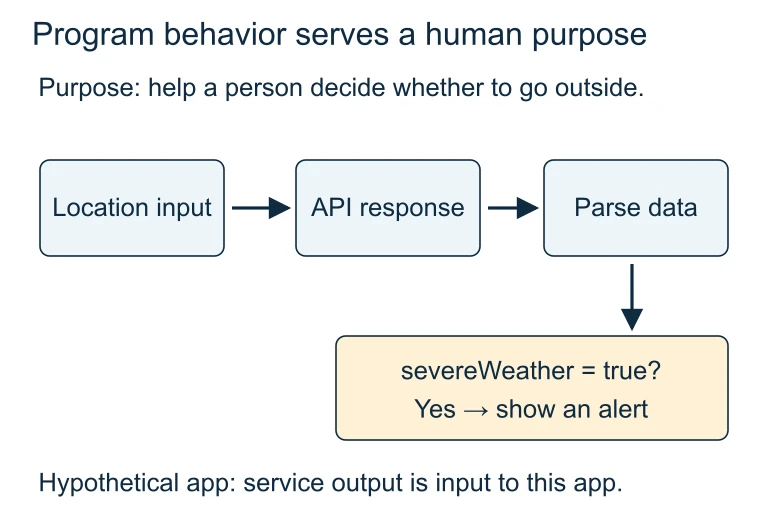 The person wants to plan an outdoor activity. The app receives location and a weather-service response, parses the data and checks severeWeather before displaying an alert. The service’s output is an input to the app.
SECTION 7
Purpose vs. Function — Common Confusions
Students frequently conflate purpose and function, and exam distractors are specifically designed to exploit this confusion. The table below presents several program scenarios and contrasts correct purpose statements with correct function statements. Study the phrasing carefully — on the AP exam, the difference often comes down to whether a statement describes what the code does (function) versus why it was created (purpose).
| Program | Purpose (Why?) | Function (What?) |
|---|---|---|
| Fitness Tracker | Help users monitor their physical activity and reach health goals | Collects step count data from an accelerometer, calculates calories burned, and displays daily/weekly summaries |
| Online Quiz | Assess student understanding of a topic and provide immediate feedback | Presents questions, accepts user-selected answers, compares them to a stored answer key, and displays a score |
| Photo Filter App | Allow users to express creativity by applying visual effects to their photos | Loads an image, applies pixel-level color transformations based on a selected filter, and saves or shares the modified image |
| Ride-Share App | Provide convenient, affordable transportation by connecting riders with nearby drivers | Collects pickup/drop-off locations from the user, matches the rider with the nearest available driver using location data, calculates fare, and processes payment |
Purpose vs. Function for four common applications
KEY TAKEAWAY
SECTION 8
Connecting to the Create Performance Task & Beyond
The concepts of program function and purpose are not confined to multiple-choice questions — they also form the backbone of the Create Performance Task (CPT), which constitutes 30% of the AP CSP exam score. In the CPT, you must develop a program and submit written responses that explicitly describe your program's purpose, the problem it solves, and how it functions. Understanding the distinction between purpose and function at a deep level will directly improve the quality of your CPT submission, because the scoring rubric specifically awards points for correctly articulating both.
| Concept | Multiple-Choice Application | Create Task Application |
|---|---|---|
| Purpose | Identify purpose from a program description or distinguish it from function in distractors | Written Response 3a: 'State the overall purpose of the program' |
| Function | Trace code to determine what a program does given specific inputs | Written Response 3b: 'Describe the functionality of your program demonstrated in the video' |
| Input / Output | Identify inputs and outputs from code snippets, including events | Written Response 3b: 'Describe the input and output of your program' |
| Behavior | Predict program output for given inputs; identify edge cases | Video demonstration: show your program running with at least one input that produces a visible output |
How function and purpose concepts appear on both parts of the AP CSP exam
Looking ahead, the ability to clearly separate purpose from function connects to professional software engineering practices such as requirements engineering and user-centered design. In industry, product managers define purpose through user stories and market research, while engineers implement function through code. Miscommunication between these roles — where an engineer builds what was specified but not what was needed — is one of the most common causes of software project failure. Mastering this distinction now prepares you not just for the AP exam but for effective collaboration in any computing career.
SECTION 9
Practice Problems
Question 1: CONCEPTUAL
- A. The program compares user-entered ingredients to a database of recipes and filters for matches.
- B. The program helps users decide what to cook based on the ingredients they already have, reducing food waste and saving time.
- C. The program accepts text input from the user and displays formatted text output on screen.
- D. The program uses a list data structure to store ingredients and a filtering algorithm to identify matching recipes.
Show answer (B)
Question 2: BASIC
- A. Input: the participation counter; Output: the student's name
- B. Input: the tap on a student's name; Output: the seat is highlighted in green
- C. Input: the date and time; Output: the seating chart
- D. Input: the program's algorithm; Output: the participation counter
Show answer (B)
Question 3: INTERMEDIATE
- A. The purpose of the program is to help users discover new music they are likely to enjoy.
- B. The purpose of the program is to analyze user listening data and apply a recommendation algorithm.
- C. A function of the program is to compare a user's listening patterns to those of other users with similar tastes and generate a ranked list of suggested songs.
- D. An output of the program is the user's listening history.
Show answer (AC)
Question 4: APPLIED
3 ptsShow answer
Question 5: CRITICAL THINKING
4 ptsShow answer
SUMMARY
Summary
Summary
Every program has both a purpose and a function. Purpose describes the real-world problem or creative goal the program was designed to address — it answers "Why does this program exist?" and is framed from the perspective of the user or stakeholder. Function describes the program's observable computational behavior — how it takes inputs (user data, events, sensor readings, API responses), processes them through algorithms and logic, and produces outputs (displays, sounds, files, notifications). Behavior is the dynamic, run-time manifestation of function for a given set of inputs.
On the AP CSP exam, you must distinguish purpose from function in multiple-choice questions and articulate both clearly in the Create Performance Task. Remember the heuristic: purpose sounds like a marketing pitch ('help users...'), while function sounds like a technical spec ('accepts input X, processes it using algorithm Y, and outputs Z'). Events like button clicks and timer ticks count as inputs. The same data can serve different roles in different programs — what matters is the function applied to it and the purpose that function serves.