
SECTION 1
Historical Context & Motivation
Writing software has never been a solitary act of spontaneous creation. From the earliest days of computing, engineers recognized that building reliable programs required deliberate design processes—structured ways of thinking about a problem before writing a single line of code. The history of program design mirrors the growing complexity of software itself: as programs scaled from a few hundred instructions to millions of lines of code, ad-hoc approaches gave way to formal methodologies that emphasized planning, documentation, and teamwork.
1968 • The Software Crisis
1970 • Waterfall Model Published
2001 • Agile Manifesto
2010s • DevOps & Continuous Integration
The central question these decades of evolution address is deceptively simple: How do you move from a vague idea to a correct, maintainable program? The answer, as the AP Computer Science Principles framework articulates, involves iterative development, collaboration, and systematic documentation—concepts we will explore throughout this lesson.
SECTION 2
Core Principles of Program Design
Program design and development in the AP CSP framework rests on several foundational ideas that recur across every Big Idea in the course. Understanding these principles before you write code is analogous to drafting blueprints before constructing a building: the upfront investment in planning saves exponentially more time during implementation.
Incremental & Iterative Development
Collaboration
Program Documentation
Testing & Debugging
Acknowledging Contributions
SECTION 3
Visualizing the Development Life Cycle
The iterative development life cycle is best understood as a loop rather than a straight line. The diagram below illustrates how a developer cycles through investigation, design, prototyping, and testing—returning to earlier stages whenever new information or errors demand revision.
Notice that the cycle is not strictly linear. A developer might move from testing directly back to design if the prototype reveals a fundamental flaw in architecture, or from prototyping back to investigation if user feedback changes the requirements. This flexibility is the hallmark of iterative development and distinguishes it from rigid waterfall approaches.
SECTION 4
How Program Design Works in Practice
From Problem Statement to Pseudocode
The AP CSP exam expects you to trace the connection between a problem statement and the code that solves it. The mechanism that bridges the two is decomposition—breaking a complex problem into smaller, manageable sub-problems. Each sub-problem is then expressed in pseudocode or a flowchart before translating to a programming language. Decomposition is not merely a suggestion; it is the primary strategy the College Board emphasizes for managing complexity.
Procedural Abstraction
Once sub-problems are identified, developers create procedures (also called functions or methods) that encapsulate each sub-solution. A procedure has a name, may accept parameters, and returns a result. By calling a procedure by name, other parts of the program can use its functionality without knowing the internal details—this is procedural abstraction. For example, a procedure calculateAverage(scores) hides the summation and division logic behind a simple call.
Managing Complexity with Lists and Procedures
The AP CSP Create Performance Task rubric explicitly asks how your program manages complexity. Two primary mechanisms are relevant: using a list (or other collection type) to store related data under a single name, and using a student-developed procedure with a parameter that generalizes a task. Without the list, you would need dozens of individual variables; without the procedure, you would repeat identical code blocks throughout your program. Both strategies reduce redundancy and make programs easier to debug.
SECTION 5
Documentation & Collaboration Strategies
Effective documentation is the connective tissue of any collaborative software project. At the AP CSP level, documentation primarily takes the form of in-line comments within source code and external documents that describe program behavior, but the underlying principles apply to every scale of software development.
Types of Program Documentation
| Documentation Type | Purpose | Example |
|---|---|---|
| In-line Comments | Explain the purpose of a code segment for future readers | // Calculate the average of all scores in the list |
| Specification Doc | Define what the program should do, its inputs and expected outputs | "The app accepts a CSV of student grades and outputs a report card PDF." |
| Pseudocode | Describe algorithms in plain language before coding | FOR EACH student IN roster: compute average, DISPLAY grade |
| API / Library Docs | Describe how to use external code components | Function signature, parameter types, return values |
Common documentation types and their roles in program development
 The driver edits the program while the navigator checks its behavior against the intended result. Switching roles lets both collaborators examine the code and its tests.
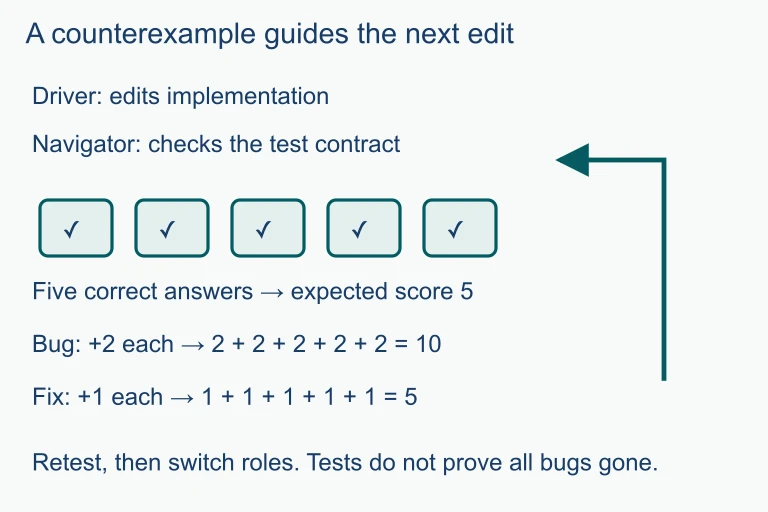 For five correct answers, the expected score is 5. An erroneous increment of 2 produces 10; changing the increment to 1 produces 5 for this test. The navigator checks the contract while the driver makes the edit, then they switch roles.
SECTION 6
Worked Example: Designing a Quiz App
Suppose you are tasked with creating a simple quiz application that presents five multiple-choice questions, records the user's answers, and displays a score at the end. The following worked example demonstrates how to apply the design principles we have studied to this scenario.
Worked example
- 1
Step 1 — Investigate Requirements
Identify the inputs (user answer selections), outputs (final score and feedback), and constraints (exactly five questions, four choices each). Determine which data must persist across the program (the list of questions, the list of correct answers, and the user's score).Requirements documented: 5 questions, 4 choices each, score displayed at end. - 2
Step 2 — Decompose into Sub-Problems
Break the application into logical components: (a) store questions and answers, (b) display a question and collect input, (c) check whether the input matches the correct answer, (d) update the score, and (e) display the final result. Each component will become a procedure or a clearly defined code segment.Five sub-problems identified → five candidate procedures. - 3
Step 3 — Design with Pseudocode
Write pseudocode for the main loop:score ← 0; FOR EACH question IN questionList: display(question); userAnswer ← getInput(); IF userAnswer = correctAnswer(question): score ← score + 1; DISPLAY("Your score: " + score + "/5"). Notice how the listquestionListmanages complexity by storing all questions in a single data structure, andcorrectAnswer(question)abstracts the lookup into a procedure.Pseudocode captures the complete algorithm before any language-specific coding. - 4
Step 4 — Prototype & Add Comments
Translate pseudocode into your chosen language. Add in-line comments explaining the purpose of each procedure and any non-obvious logic. For example, a comment above the scoring conditional might read# Check if user's selection matches the stored correct answer for this question.Working prototype with documented code ready for testing. - 5
Step 5 — Test & Iterate
Run the program with known inputs. Test edge cases: What if the user enters an invalid choice? What if all answers are correct? What if all are wrong? Log each test case and its result. If a bug is found—say the score increments twice—return to Step 3 to revise the pseudocode, then update the code accordingly.Tested, debugged quiz app that meets all original requirements.
SECTION 7
Development Approaches: Strengths & Limitations
While the AP CSP framework emphasizes iterative development, it is useful to understand how it compares to other common approaches. Recognizing the trade-offs will help you evaluate design decisions on the exam and in your own projects.
| Approach | Strengths | Limitations |
|---|---|---|
| Iterative / Agile | Flexible; accommodates changing requirements; bugs caught early through frequent testing; promotes collaboration | Scope can drift if requirements are not periodically re-evaluated; requires disciplined documentation |
| Waterfall | Clear milestones; well-suited for projects with fixed, unchanging requirements; easy to manage progress | Inflexible; late discovery of errors is costly; no working software until the end |
| Top-Down Design | Clear hierarchy; aligns well with decomposition; each module has a defined role | Can be slow to produce runnable code; lower-level details may expose flaws in high-level design |
| Bottom-Up Design | Reusable low-level components built first; good for libraries and APIs | Integration challenges when combining components; harder to see the big picture early |
Comparison of common development approaches
SECTION 8
Connection to Advanced Software Engineering
The design principles you learn in AP CSP form the foundation for more advanced courses in software engineering, systems design, and project management. The table below maps AP CSP concepts to their professional counterparts, giving you a preview of how these ideas scale.
| AP CSP Concept | Advanced / Professional Version |
|---|---|
| In-line comments | Automated documentation generators (Javadoc, Sphinx); README files; architecture decision records (ADRs) |
| Iterative development | Scrum sprints, Kanban boards, CI/CD pipelines with automated testing on every commit |
| Collaboration & peer review | Pull requests, code reviews, pair programming, formal design reviews |
| Procedural abstraction | Object-oriented design patterns, microservices architecture, API design (REST, GraphQL) |
| Testing edge cases | Unit testing frameworks (JUnit, pytest), integration tests, load testing, fuzzing |
AP CSP concepts mapped to professional software engineering practices
As you progress beyond AP CSP, you will encounter formal design patterns such as Model-View-Controller (MVC), dependency injection, and event-driven architectures. Each of these is ultimately an extension of the same core insight you are mastering now: managing complexity through abstraction, decomposition, and disciplined collaboration.
SECTION 9
Practice Problems
Question 1: CONCEPTUAL
- A. It ensures that all features are fully planned before any code is written, preventing any later changes.
- B. It allows the student to build and test one feature at a time, catching errors early and adapting the design based on feedback.
- C. It eliminates the need for program documentation because each iteration is self-explanatory.
- D. It guarantees that the final program will have no bugs because every possible input is tested during each iteration.
Show answer (B)
Question 2: BASIC
findMax(numList) that takes a list of numbers as a parameter and returns the largest value. Which of the following best explains how this procedure manages complexity?- A. It stores the numbers in a database, reducing memory usage.
- B. It allows other parts of the program to find the maximum value without knowing the comparison logic inside the procedure.
- C. It prevents the list from ever containing invalid data.
- D. It automatically documents itself, so no comments are needed.
Show answer (B)
findMax(numList) without understanding the internal comparison algorithm—this is exactly how procedures manage complexity. A is wrong because the procedure does not inherently involve a database. C is wrong because input validation is a separate concern not guaranteed by the procedure's existence. D is wrong because procedures still require documentation; abstraction reduces complexity but does not replace the need for comments.Question 3: INTERMEDIATE
- A. Both developers work on the same file simultaneously without any coordination tool.
- B. They agree on a shared specification that defines the data format returned by the API, so the UI developer knows what to expect.
- C. They use a version control system so changes from both contributors are tracked and can be merged.
- D. One developer writes all the code first, then the other reviews and rewrites everything from scratch.
Show answer (B,C)
Question 4: APPLIED
Show answer
computeAverage(responseList) takes a list of integers as a parameter and returns the arithmetic mean. This abstracts the summation and division logic so it can be reused for any student's responses. Rubric Point 3: Storing each student's 20 responses in a single list (e.g., studentResponses) eliminates the need for 20 separate variables (response1, response2, … response20). The list can be iterated over with a loop, making the code shorter, less error-prone, and easier to modify if the number of questions changes.Question 5: CRITICAL THINKING
Show answer
findDriver(riderLocation, preference), adding the vehicle-type parameter means modifying only that procedure. The rest of the application calls findDriver without knowing how matching works internally, so no other code needs to change. This exemplifies how abstraction isolates the impact of design changes.