
SECTION 1
Historical Context & Motivation
The rapid expansion of computing technology throughout the late twentieth and early twenty-first centuries created entirely new categories of human interaction, commerce, and creativity—yet legal systems, designed for a physical world, struggled to keep pace. Early programmers operated in a largely unregulated space, but as software became integral to daily life, questions about intellectual property, data privacy, and digital ethics demanded formal answers. Landmark legislation and court cases emerged in response to incidents that exposed gaps between what technology could do and what society believed it should do.
1976 • Copyright Act Revision
1986 • Computer Fraud and Abuse Act
1998 • DMCA & COPPA
2018 • GDPR Takes Effect
2023 • AI Regulation Debates
Each of these milestones responded to a gap: technology outpaced the legal and ethical norms that governed it. The central question this lesson addresses is straightforward yet profound—how do societies balance innovation with the protection of individual rights, fairness, and public welfare in an increasingly digital world?
SECTION 2
Core Principles & Definitions
Legal and ethical concerns in computing revolve around a set of foundational ideas that the AP CSP exam expects you to articulate clearly. While laws are enforceable rules established by governments, ethics refers to broader moral principles that guide behavior even where no specific law applies. Understanding the interplay between these two dimensions is essential for analyzing real-world computing scenarios.
Intellectual Property (IP)
Open-Source & Creative Commons
Data Privacy & Security
Algorithmic Bias & Fairness
Digital Divide & Access
SECTION 3
Visualizing the Legal & Ethical Landscape
Notice that the two domains are not identical. A company might legally collect vast amounts of user data under a vague terms-of-service agreement, yet doing so without meaningful informed consent raises serious ethical concerns. Conversely, a security researcher who exposes a vulnerability without authorization may violate the CFAA yet act in ways many would consider ethically justified. The AP CSP exam expects you to reason about these gray areas, recognizing that legality and morality do not always align.
SECTION 4
How Legal Protections Work in Computing
Intellectual Property Mechanisms
Intellectual property law provides several distinct mechanisms for protecting digital creations. Copyright automatically protects original works of authorship—including source code, images, music, and written content—from the moment they are fixed in a tangible medium. The creator does not need to register the work or include a © symbol, though registration strengthens enforcement. Patents protect novel inventions or processes for a limited time (typically 20 years), and software patents cover specific algorithmic methods rather than abstract ideas. Trademarks protect brand identifiers like logos and names, preventing consumer confusion in the marketplace.
Licensing Models
| License Type | Key Feature | Example |
|---|---|---|
| Proprietary | Source code is closed; users pay for a license to use the software. | Microsoft Office, Adobe Photoshop |
| Open-Source (Permissive) | Code can be used, modified, and redistributed with minimal restrictions. | MIT License, Apache 2.0 |
| Open-Source (Copyleft) | Derivative works must also be open-source under the same license. | GNU GPL |
| Creative Commons | A spectrum of licenses for creative content—from free reuse to no derivatives. | CC BY, CC BY-NC-SA |
Common software and content licensing models
Data Privacy Mechanisms
Privacy laws regulate how organizations collect, store, process, and share personally identifiable information (PII). PII includes any data that can identify an individual—names, email addresses, Social Security numbers, IP addresses, and biometric data. Under regulations like the EU's GDPR, individuals have the right to access their data, request its deletion, and be informed about how it is used. In the United States, COPPA specifically protects children under 13 by requiring verifiable parental consent before collecting their data. Technical safeguards like encryption convert readable data into coded form, while organizational safeguards like privacy policies and data minimization practices limit the scope of data collection.
SECTION 5
Classifying Ethical Concerns in Computing
When the AP exam asks you to describe the impact of a computing innovation, a reliable strategy is to map it against these four categories. For instance, consider a social media platform: it raises privacy concerns because it collects extensive PII, IP concerns when users share copyrighted content, bias concerns if its content-recommendation algorithm amplifies certain viewpoints, and access concerns if it requires high bandwidth that not all users have. Thinking in terms of multiple stakeholders—users, creators, society, and companies—ensures a comprehensive analysis.
 Suppose a ride service retains location logs and shares copies with another recipient. Ending the ride or deleting one local copy leaves those other data paths to be addressed.
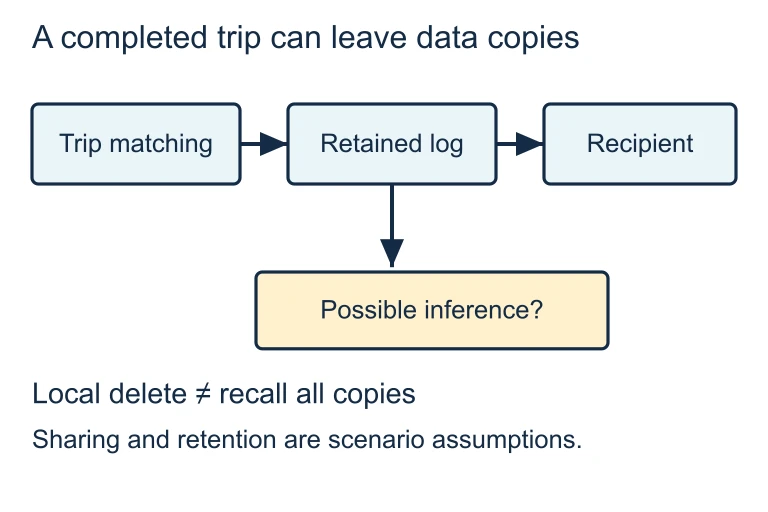 In this service scenario, a retained location log can be copied to a downstream recipient and support further inferences. Changing permissions or deleting one copy must be considered separately from copies already retained elsewhere.
SECTION 6
Worked Example: Analyzing a Computing Innovation
Suppose you are asked: A ride-sharing app collects real-time GPS location, payment information, and ride history. Identify one beneficial effect and one harmful effect, and describe a legal or ethical concern related to the app. This mirrors the style of the AP CSP exam. Let us walk through a structured response.
Worked example
- 1
Step 1 — Identify the Innovation and Data
The computing innovation is the ride-sharing app itself. It collects PII including GPS coordinates, credit card numbers, names, email addresses, and ride history—all of which can be linked to specific individuals.Data identified: GPS, payment info, ride history → all PII - 2
Step 2 — Describe a Beneficial Effect
The app increases transportation access for people without personal vehicles, reduces the need for parking infrastructure, and provides flexible income opportunities for drivers. GPS data enables efficient routing, reducing wait times and fuel consumption.Benefit: Increased transportation access and efficiency - 3
Step 3 — Describe a Harmful Effect
Continuous GPS tracking creates a detailed movement profile of every user. If this data is breached or shared with third parties without meaningful consent, it could enable stalking, discrimination by insurers, or government surveillance.Harm: Surveillance risk from detailed location tracking - 4
Step 4 — Identify a Legal or Ethical Concern
An ethical concern is that the app's pricing algorithm may engage in surge pricing during emergencies (e.g., natural disasters), disproportionately affecting lower-income users. While surge pricing may be legal, it raises fairness questions. A legal concern involves compliance with data privacy laws like GDPR: users must be informed about what data is collected and have the right to request its deletion.Ethical: Surge pricing fairness; Legal: GDPR data rights compliance
SECTION 7
Tradeoffs & Tensions
Legal and ethical concerns in computing rarely have clean solutions—they involve tradeoffs between competing values. A government might argue that backdoor access to encrypted devices is necessary for national security, while privacy advocates insist that weakening encryption endangers everyone's data. Understanding these tensions is essential for the AP exam, where questions often present scenarios with multiple defensible perspectives.
| Tension | Side A | Side B |
|---|---|---|
| Security vs. Privacy | Surveillance and data collection improve public safety and national security. | Mass surveillance infringes on civil liberties and chills free expression. |
| Open Access vs. IP Protection | Open-source fosters innovation, collaboration, and equitable access to tools. | Strong IP protections incentivize creators by ensuring they profit from their work. |
| Personalization vs. Manipulation | Algorithms tailoring content improve user experience and relevance. | Hyper-personalization can create filter bubbles, spread misinformation, and exploit psychological vulnerabilities. |
| Innovation Speed vs. Regulation | Minimal regulation allows rapid development and market-driven solutions. | Regulation prevents harm, ensures safety, and protects vulnerable populations. |
Key tensions in computing ethics
SECTION 8
Connection to Emerging Issues
The legal and ethical frameworks you have studied so far were largely designed for a world of traditional software and websites. Emerging technologies—particularly artificial intelligence, machine learning, and generative AI—are pushing these frameworks to their limits. Understanding how current principles extend to new technologies prepares you for both exam questions and real-world citizenship.
| Traditional Concern | Emerging AI Extension |
|---|---|
| Copyright protects original creative works | Who owns content generated by AI trained on copyrighted data? Can AI output be copyrighted? |
| Algorithmic bias in simple recommendation systems | Large language models can reproduce and amplify societal biases at massive scale, making auditing far more complex. |
| Privacy concerns with data collection | AI systems infer sensitive attributes (health, political views) from seemingly non-sensitive data, circumventing traditional privacy protections. |
| Accountability for software errors | When an autonomous vehicle causes harm, liability is unclear—is it the developer, the manufacturer, or the owner? |
How traditional concerns scale with AI
These emerging challenges highlight a recurring theme in computing ethics: technology evolves faster than the laws and norms designed to govern it. The AP CSP framework emphasizes that students should be able to evaluate the beneficial and harmful effects of computing innovations even when clear legal precedent does not yet exist. Ethical reasoning becomes especially important in these gray areas, serving as a compass when the map of law has not yet been drawn.
SECTION 9
Practice Problems
Question 1: CONCEPTUAL
- A. The code is in the public domain and can be freely used.
- B. The code is automatically protected by copyright, and using it without permission may constitute infringement.
- C. The absence of a license means the developer implicitly grants open-source permissions.
- D. The code can be legally used as long as the developer credits the original author.
Show answer (B)
Question 2: BASIC
- A. Digital Millennium Copyright Act (DMCA)
- B. Computer Fraud and Abuse Act (CFAA)
- C. Children's Online Privacy Protection Act (COPPA)
- D. General Data Protection Regulation (GDPR)
Show answer (C)
Question 3: INTERMEDIATE
- A. The training data may reflect historical discrimination, causing the model to perpetuate biased outcomes.
- B. The bank violated copyright law by using the machine learning model without proper licensing.
- C. Applicants who are denied may have no way to understand or challenge the automated decision, undermining transparency and accountability.
- D. The model's source code should be released under an open-source license to prevent bias.
Show answer (A,C)
Question 4: APPLIED
Show answer
Question 5: CRITICAL THINKING