

SECTION 1
Historical Context & Motivation
Long before the internet existed, organizations recognized the power of tapping large, distributed groups of people to solve challenging problems. In 1714, the British government offered the Longitude Prize to anyone who could devise an accurate method for determining a ship's longitude at sea—a classic example of seeking solutions from outside the traditional expert community. The fundamental insight was simple: when a problem is broadcast to a sufficiently large and diverse audience, the probability of finding a novel, high-quality solution increases dramatically. The modern term crowdsourcing was coined by journalist Jeff Howe in a 2006 Wired magazine article, combining "crowd" and "outsourcing" to describe the practice of obtaining services, ideas, or content from a large, open group—typically via the internet.
1714 • Longitude Prize
2001 • Wikipedia Launches
2005 • Amazon Mechanical Turk
2006 • Term "Crowdsourcing" Coined
2011–Present • Citizen Science & Open Data
What transformed crowdsourcing from an occasional strategy into a pervasive paradigm was the rise of internet connectivity and platforms that could coordinate millions of participants asynchronously. The core question the AP CSP curriculum asks is: How do computing innovations leverage distributed human participation to generate knowledge, solve problems, and create value—and what are the trade-offs?
SECTION 2
Core Principles & Definitions
At its essence, crowdsourcing uses the internet to delegate tasks to a large, distributed group of people rather than relying on a small team of designated employees or experts. The College Board's AP CSP framework emphasizes that crowdsourcing allows problems to be solved that could not be solved by a single person or even a single organization. Understanding crowdsourcing requires grasping several foundational ideas.
Open Participation
Distributed Problem-Solving
Collective Intelligence
Scalability via the Internet
SECTION 3
Visual Explanation: How Crowdsourcing Works
The diagram above captures the three essential phases of any crowdsourcing system. First, the problem owner decomposes a challenge—labeling images, translating text, mapping roads after a disaster—into discrete micro-tasks. Second, the platform broadcasts these tasks to a global pool of contributors who work independently and often asynchronously. Third, the platform aggregates responses—often using majority voting, statistical weighting, or machine-learning filters—to produce a reliable consolidated output. This pipeline is what distinguishes modern, internet-enabled crowdsourcing from older open-call models: the platform automates coordination at a scale that would overwhelm any human manager.
SECTION 4
How Crowdsourcing Works: Mechanisms & Models
Crowdsourcing is not a monolithic activity—it encompasses several distinct models, each with different coordination mechanisms and incentive structures. The AP CSP exam expects you to recognize how computing innovations use these models and to reason about their benefits and limitations. Below we explore the principal mechanisms through which crowdsourcing platforms operate.
Contribution Models
- Collaborative Creation — Contributors build a shared artifact together. Wikipedia is the canonical example: editors add, revise, and verify articles, producing an encyclopedia that no single author could write. Quality control relies on community norms and revision histories.
- Distributed Computation (Human-in-the-Loop) — A platform assigns micro-tasks—image labeling, audio transcription, sentiment tagging—to many workers. Amazon Mechanical Turk and reCAPTCHA are key examples. Redundant assignments and majority voting help filter errors.
- Citizen Science — Volunteers contribute observations or analyses to scientific research. Galaxy Zoo asks users to classify galaxy shapes; eBird collects bird-sighting data. Researchers provide training materials so non-experts can contribute meaningfully.
- Crowdfunding — Instead of labor, the crowd contributes money. Platforms like Kickstarter aggregate many small financial pledges to fund projects that traditional investors might overlook.
Quality Assurance Mechanisms
A critical design challenge in crowdsourcing is ensuring quality when contributors are anonymous and vary in expertise. Platforms employ several strategies: redundancy (assigning the same task to multiple workers and taking the majority answer), gold-standard questions (embedding tasks with known answers to filter low-quality workers), and reputation systems (weighting contributions by a worker's track record). These mechanisms mirror error-correction techniques in computing—much like parity bits detect data corruption, redundant human judgments detect contributor error.
SECTION 5
Real-World Examples & Classification
Crowdsourcing manifests in remarkably diverse domains. To classify these applications and understand what the AP exam might test, the following table organizes prominent examples by their crowdsourcing model, the nature of contributions, and the scale of participation.
| Platform / Project | Model | Contribution Type | Scale |
|---|---|---|---|
| Wikipedia | Collaborative creation | Writing, editing, fact-checking | 300K+ active editors |
| OpenStreetMap | Collaborative creation | Mapping, geo-data annotation | 10M+ registered users |
| Foldit | Citizen science | Solving protein-folding puzzles | 800K+ players |
| Kickstarter | Crowdfunding | Financial pledges | $7B+ pledged |
| Waze | Distributed sensing | Real-time traffic & hazard reports | 150M+ users |
| reCAPTCHA | Human computation | Text/image recognition verification | Millions daily |
Representative crowdsourcing projects across different models
SECTION 6
Worked Example: Analyzing a Crowdsourcing Scenario
AP CSP questions about crowdsourcing often present a scenario and ask you to identify how crowdsourcing is being used, what benefits it provides, and what concerns arise. Let's walk through a realistic exam-style scenario step by step.
Worked example
- 1
Step 1 — Read the Scenario
After a major earthquake, a humanitarian organization launches a web-based mapping tool. Volunteers worldwide log in, view satellite images of affected areas, and mark damaged buildings, blocked roads, and open shelters. The platform overlays all volunteer annotations onto a single map that relief workers use to plan rescue routes. - 2
Step 2 — Identify the Crowdsourcing Elements
The key elements are: (a) an open call to volunteers worldwide, (b) a computing platform that distributes satellite images and collects annotations, and (c) aggregation of individual contributions into a single useful artifact (the crisis map).This is crowdsourcing because distributed humans contribute via the internet to solve a problem no single person could handle quickly. - 3
Step 3 — Analyze Benefits
Speed: thousands of volunteers can annotate images simultaneously, producing a usable map in hours rather than days. Diversity: contributors across time zones ensure 24/7 coverage. Scale: the volume of satellite imagery would overwhelm any single team. Cost: volunteer labor drastically reduces expenses compared to hiring professional analysts.Crowdsourcing enables faster, broader, and cheaper disaster response. - 4
Step 4 — Analyze Concerns and Limitations
Quality: untrained volunteers may misidentify damage, leading to inaccurate annotations. The platform must implement quality controls such as requiring multiple independent annotations per image. Bias: if most volunteers are in one region, images from less "visible" areas may receive less attention. Access: communities without reliable internet cannot contribute, potentially skewing the dataset. Privacy: satellite imagery may reveal sensitive information about affected individuals.Crowdsourcing introduces quality, bias, access, and privacy concerns that must be mitigated by platform design. - 5
Step 5 — Formulate a Complete AP-Style Response
A complete response would state: 'The humanitarian organization uses crowdsourcing by distributing satellite image annotation tasks to volunteers via an online platform. This enables rapid, large-scale map creation because many contributors work in parallel. However, the organization must implement quality assurance—such as redundant annotations and expert review—because untrained volunteers may introduce errors. Additionally, the digital divide means that affected communities with limited internet access may be underrepresented as contributors, potentially creating blind spots in the map.'This response covers: definition, benefit, quality concern, and equity concern—all elements the AP exam rewards.
 Crowdsourcing combines many contributions into one map. Reports need verification, and unverified areas must remain distinguishable from confirmed information.
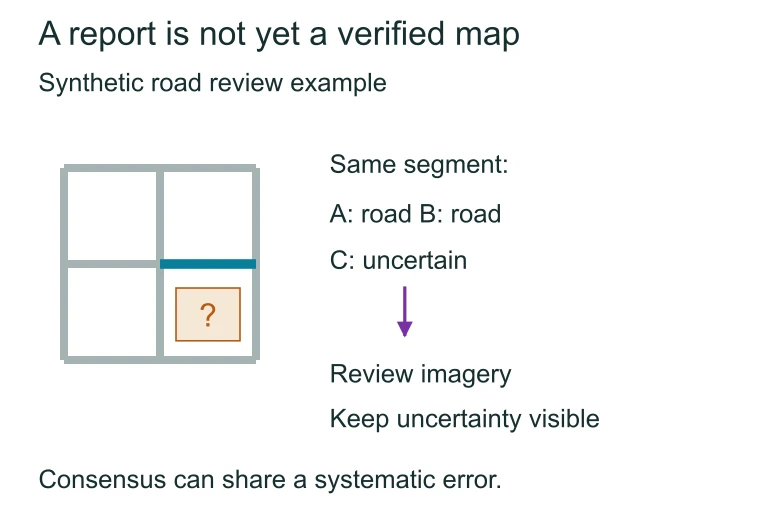 Suppose a road segment receives two road reports and one uncertain report. Agreement triggers imagery review; the uncertain coverage remains marked until it is verified.
SECTION 7
Benefits, Limitations, and Ethical Concerns
The AP CSP exam frequently requires students to evaluate both the positive and negative impacts of crowdsourcing. The following table summarizes the most exam-relevant benefits and concerns.
| Benefits | Limitations & Concerns |
|---|---|
| Diverse perspectives lead to more creative and robust solutions. | Quality control is difficult when contributors vary in skill and motivation. |
| Scalability: can process vast quantities of data through parallel human effort. | The digital divide limits who can participate, potentially biasing results. |
| Cost-effective: volunteer or micro-paid labor is far cheaper than hiring experts. | Ethical concerns about fair compensation for micro-task workers. |
| Speed: tasks completed in parallel can yield results in hours. | Deliberate misinformation or vandalism can corrupt shared resources. |
| Democratizes participation: anyone with internet access can contribute to science, art, or policy. | Privacy risks when contributors unknowingly share personal or sensitive data. |
Key benefits and concerns of crowdsourcing for AP CSP
SECTION 8
Connections to Advanced Topics & Related Concepts
Crowdsourcing does not exist in isolation—it connects to several other AP CSP Big Ideas and to more advanced computing topics. Understanding these connections strengthens your ability to answer questions that cross conceptual boundaries.
| Related Concept | Connection to Crowdsourcing |
|---|---|
| Distributed Computing | Both distribute work across many nodes. Crowdsourcing uses humans; distributed computing uses machines. Some systems (reCAPTCHA) blend both. |
| Machine Learning / AI | Crowdsourced labels (e.g., image tags) serve as training data for supervised ML models. Many AI advances depend on human-labeled datasets. |
| The Digital Divide | Populations without internet access or devices cannot participate in or benefit from crowdsourcing, raising equity concerns. |
| Open-Source Software | Open-source development (e.g., Linux) is a form of crowdsourced software engineering where global volunteers contribute code. |
| Data Privacy & Security | Crowdsourced platforms collect data from and about contributors, creating privacy risks that require careful data governance. |
As you study for the AP exam, remember that crowdsourcing intersects with questions about the internet (Big Idea 5: Impact of Computing), data (Big Idea 2: Data), and algorithms (Big Idea 3: Algorithms and Programming). A question might present a scenario where a navigation app uses crowdsourced traffic data and ask you to identify how the data was collected, what algorithmic processing occurs, and what societal impact results. Thinking across these Big Ideas is essential for the most challenging multiple-choice questions.
SECTION 9
Practice Problems
Question 1: CONCEPTUAL
- A. The website uses a distributed network of servers to process the images.
- B. The research team outsources image classification to a contracted company.
- C. The project uses contributions from a large number of people via the internet to accomplish a task that would be impractical for the research team alone.
- D. The website automatically classifies images using a machine learning algorithm trained on previous data.
Show answer (C)
Question 2: BASIC
- A. The app guarantees that all potholes in the city will be reported within 24 hours.
- B. The app eliminates the need for any city employees to be involved in road maintenance.
- C. The app allows the city to gather data from across a wide geographic area much faster than a small inspection team could.
- D. The app ensures that reported potholes are always accurately located because GPS is perfectly precise.
Show answer (C)
Question 3: INTERMEDIATE
- A. Translations may vary in quality because volunteer translators have different levels of language proficiency.
- B. The platform will be unable to translate materials into more than three languages simultaneously.
- C. Communities with limited internet access may not be represented among the translators, leading to potential cultural bias in translations.
- D. Using volunteers for translation always violates copyright law.
Show answer (A,C)
Question 4: APPLIED
Show answer
Question 5: CRITICAL THINKING