
SECTION 1
Historical Context & Motivation
Long before the digital age, decision-making systems embedded human biases—credit scoring models, insurance tables, and standardized testing all reflected the assumptions and prejudices of their creators. When computing became the backbone of institutional decision-making in the late twentieth century, these biases did not disappear; instead, they scaled. Computing bias refers to systematic and repeatable errors in a computer system that create unfair outcomes, such as privileging one group of users over another. The term encompasses biases that emerge from training data, algorithmic design, and the social contexts in which technology is deployed. Understanding computing bias is essential not only for the AP CSP exam but also for any practitioner who wants to build technology responsibly.
1988 • St. George's Hospital Algorithm
2006 • COMPAS Recidivism Tool Deployed
2015 • Google Photos Mislabeling Incident
2018 • Amazon Scraps Biased Hiring Tool
2020 • UK A-Level Algorithm Controversy
These episodes reveal a persistent pattern: when algorithms are designed, trained, or deployed without careful attention to fairness, they can amplify existing social inequalities at computational speed and scale. The central question this lesson addresses is: Where does computing bias originate, how does it manifest, and what strategies can developers and policymakers employ to mitigate it?
SECTION 2
Core Principles & Definitions
Computing bias is not a single phenomenon; it is a family of related problems that can enter a system at any stage of its lifecycle—from the initial framing of a problem, through data collection and model training, all the way to deployment and user interaction. The seminal framework by Friedman and Nissenbaum (1996) identifies three primary categories: pre-existing bias, technical bias, and emergent bias. These categories are not mutually exclusive; a single system can—and often does—exhibit all three simultaneously.
Pre-existing Bias
Technical Bias
Emergent Bias
Data Bias
Confirmation Bias in Design
KEY TAKEAWAY
SECTION 3
The Bias Pipeline — A Visual Explanation
The following diagram illustrates how bias can be introduced, amplified, and propagated through the computing pipeline—from problem formulation to real-world impact. Each stage represents a potential entry point for bias, and the feedback loop at the bottom shows how biased outputs can reinforce the very conditions that caused the bias in the first place.
Notice the feedback loop at the bottom of the diagram. This is one of the most dangerous aspects of computing bias: a system trained on historical data that reflects societal inequities will produce outputs that reinforce those same inequities. For instance, if a predictive policing algorithm directs officers disproportionately to minority neighborhoods, more arrests occur there—not necessarily because more crime happens there, but because more policing occurs there. The new arrest data is then fed back into the algorithm, creating a self-reinforcing cycle that is difficult to break without deliberate intervention. The AP CSP framework emphasizes understanding these feedback loops as a key aspect of responsible computing.
SECTION 4
How Computing Bias Works in Practice
Sources of Bias in Machine Learning Systems
While computing bias is not exclusively a machine learning problem—any decision-making software can embed bias—the rapid adoption of ML systems has made this the most consequential domain. A machine learning model is only as fair as the data it learns from and the objective function it optimizes. The mechanism by which bias propagates can be understood through three interconnected processes.
1. Sampling Bias in Training Data
When the training dataset does not proportionally represent the population the model will serve, the model's accuracy varies across groups. Sampling bias occurs when certain demographics, geographies, or use cases are overrepresented or underrepresented. A landmark 2018 study by Joy Buolamwini and Timnit Gebru (the Gender Shades project) demonstrated that three commercial facial recognition systems had error rates below 1% for lighter-skinned men but up to 34.7% for darker-skinned women. The root cause was a training dataset dominated by lighter-skinned faces.
2. Proxy Variables and Feature Selection
Even when sensitive attributes like race or gender are excluded from a model's features, other variables can serve as proxy variables that are highly correlated with those attributes. Zip code, for example, is often a strong proxy for race due to historical residential segregation. An algorithm that uses zip code in a lending decision may effectively discriminate by race without ever explicitly encoding racial data. This phenomenon means that simply removing protected attributes—a practice sometimes called "fairness through unawareness"—is insufficient to prevent bias.
3. Optimization Objective Misalignment
Every algorithm optimizes for some objective—maximizing engagement, minimizing error, or increasing profit. When that objective does not incorporate fairness constraints, the algorithm may find solutions that are globally optimal but locally harmful. A content recommendation system optimizing for engagement may surface sensationalist or divisive content because it generates more clicks. The system is not "broken" from a technical standpoint; it is fulfilling its objective. The bias lies in the choice of what to optimize, which is ultimately a human decision.
AP CSP CONNECTION
SECTION 5
Classifying Bias — Types, Domains, and Effects
Computing bias manifests across a wide range of application domains, from criminal justice to healthcare, from hiring to social media. The following diagram organizes the most commonly cited types of computing bias alongside the real-world domains in which they have been documented, helping you see both the variety of bias types and the breadth of their impact.
| Bias Type | Definition | Example |
|---|---|---|
| Sampling Bias | Training data does not represent the target population | Facial recognition trained mostly on light-skinned faces fails on darker skin tones |
| Historical Bias | Data reflects past societal discrimination | A hiring algorithm penalizes female candidates because past hires were predominantly male |
| Proxy Variable Bias | Neutral-seeming features correlate with protected attributes | Zip code used in lending decisions correlates with race due to housing segregation |
| Algorithmic Bias | Design choices in the algorithm favor certain outcomes | A search engine ranking algorithm amplifies popular content, marginalizing minority viewpoints |
| Interaction Bias | User behavior during deployment skews the system | A chatbot learns offensive language from users who deliberately teach it slurs |
| Confirmation Bias | Developers' assumptions shape system design | A health app defaults to male physiology because the development team was entirely male |
Summary of major computing bias types with definitions and examples
SECTION 6
Worked Example — Analyzing Bias in a Hiring Algorithm
Consider the following scenario: a technology company develops an automated résumé screening tool to streamline its hiring process. The tool is trained on ten years of historical hiring data from the company. After deployment, external auditors discover that the tool disproportionately filters out female applicants. Let us walk through a structured analysis of where bias entered this system and what could be done about it.
Identifying and Mitigating Bias in a Résumé Screening Tool
- 1
Step 1 — Identify the Data Source
The training data consists of ten years of hiring decisions made by human recruiters. During this period, the tech industry was heavily male-dominated, meaning the successful candidates in the dataset are disproportionately male. This represents historical bias—the data faithfully reflects past inequities but does not represent an ideal or equitable hiring process.Bias Type: Historical Bias (pre-existing) - 2
Step 2 — Identify Proxy Variables
Upon investigation, the model assigns negative weight to terms like "women's" (as in "women's chess club" or "women's college") and to names of all-women colleges. These features serve as proxy variables for gender. Even though gender is not a direct input feature, the model has learned to penalize résumés associated with female applicants through these correlated terms.Bias Type: Proxy Variable Bias (technical) - 3
Step 3 — Assess the Feedback Loop
If the tool is deployed without correction, it will filter out female applicants, resulting in a continued male-dominated workforce. Future training data derived from this workforce will further reinforce the bias. This creates a self-reinforcing feedback loop where the algorithm's output becomes its future input.Mechanism: Feedback Loop Amplification - 4
Step 4 — Propose Mitigation Strategies
Several strategies could reduce this bias. First, the training data could be re-balanced to include equal representation of successful male and female candidates. Second, proxy variable detection could be used to identify and remove features that correlate with protected attributes. Third, the company could implement fairness constraints in the optimization function—for example, requiring that the acceptance rate be approximately equal across genders. Fourth, the algorithm could be subject to regular, independent auditing by external reviewers.Mitigations: Data re-balancing, proxy detection, fairness constraints, external auditing - 5
Step 5 — Evaluate Trade-offs
Each mitigation comes with trade-offs. Re-balancing data may reduce overall accuracy if the original dataset captured genuine skill patterns. Fairness constraints may slightly reduce the model's predictive power. However, the societal cost of perpetuating discrimination is far greater. Responsible computing requires weighing accuracy against equity and recognizing that a highly accurate but discriminatory system is not an acceptable outcome.Key Principle: Technical optimization must be balanced with ethical considerations
 A hiring system records later workplace outcomes for the applicants it selects. Outcomes for rejected applicants remain unobserved, which matters when those records are used for future decisions.
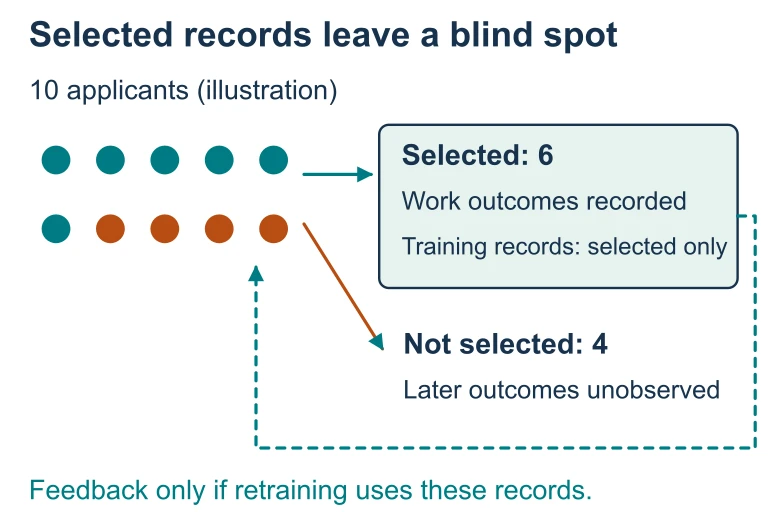 Suppose ten applicants are considered and six are selected. The system records workplace outcomes for those six; the other four outcomes remain unobserved. If later training uses only recorded outcomes, this selection boundary affects the available evidence.
SECTION 7
Mitigation Strategies — Strengths & Limitations
Addressing computing bias requires a multifaceted approach because no single strategy is sufficient. Researchers and practitioners have developed a range of techniques, each with its own strengths and limitations. The table below summarizes the most important approaches and their trade-offs, organized by whether they intervene before, during, or after model training.
| Strategy | Stage | Strengths | Limitations |
|---|---|---|---|
| Diverse Training Data | Pre-training | Directly addresses sampling bias; improves accuracy across all groups | Representative data may be difficult or expensive to collect; historical records may not exist |
| Proxy Variable Detection | Pre-training | Prevents indirect discrimination through correlated features | Difficult to detect all proxies; removing too many features can reduce model utility |
| Fairness-Aware Algorithms | During training | Mathematically enforces equality metrics within the model itself | Different fairness definitions can conflict; optimizing for one may violate another |
| Algorithmic Auditing | Post-deployment | Detects bias in real-world outcomes; provides accountability and transparency | Reactive—discovers bias only after harm has occurred; requires access to outcome data |
| Diverse Development Teams | All stages | Broader perspectives catch blind spots in design and testing | Does not guarantee bias-free outcomes; structural barriers limit diversity in tech |
| Regulation & Legislation | Governance | Provides legal accountability; sets industry-wide standards | Legislation lags behind technology; enforcement is challenging; may stifle innovation |
Comparison of bias mitigation strategies across the computing lifecycle
KEY TAKEAWAY
SECTION 8
Computing Bias in the Broader Ethical Landscape
Computing bias does not exist in isolation—it is one facet of a broader set of ethical questions that computing raises, including privacy, intellectual property, the digital divide, and the societal impact of automation. The AP CSP framework places computing bias within Big Idea 5 (Impact of Computing), alongside these related concerns. Understanding how bias connects to other ethical dimensions will deepen your analysis on the exam and in real-world practice.
| Concept | Relationship to Computing Bias | Example of Intersection |
|---|---|---|
| Digital Divide | Unequal access to technology means certain populations are underrepresented in data, amplifying bias | Rural communities with limited internet access are excluded from health research datasets, leading to medical algorithms that perform poorly for them |
| Privacy | Data collection needed for bias detection may conflict with user privacy | To audit a hiring algorithm for racial bias, an organization needs access to applicants' racial data, which raises privacy concerns |
| Intellectual Property | Proprietary algorithms make it difficult to audit for bias, as companies may claim trade secret protections | The COMPAS recidivism tool's proprietary nature prevented full public scrutiny of its scoring methodology |
| Crowdsourcing & Open Data | Crowdsourced data may reflect the biases of the contributing population | Wikipedia's editor base is predominantly male, leading to gender gaps in biographical coverage that cascade into AI language models |
| Algorithmic Accountability | Emerging legal frameworks aim to require transparency and fairness in automated decisions | The EU AI Act (2024) classifies high-risk AI systems and mandates bias testing and human oversight for systems used in hiring, lending, and law enforcement |
How computing bias intersects with other ethical dimensions in the AP CSP framework
Looking forward, the field of algorithmic fairness continues to evolve rapidly. Researchers are developing formal mathematical definitions of fairness—such as demographic parity, equalized odds, and individual fairness—though these definitions can be mutually incompatible. At the policy level, governments worldwide are beginning to mandate algorithmic impact assessments, analogous to environmental impact assessments for construction projects. For AP CSP students, the key takeaway is that bias is not a bug to be fixed once but an ongoing challenge that requires continuous monitoring, diverse perspectives, and institutional accountability structures. As computing systems become more powerful and pervasive, the stakes of getting bias wrong—and the value of getting it right—continue to grow.
SECTION 9
Practice Problems
Question 1: CONCEPTUAL
- A. Sampling bias caused by unrepresentative training data
- B. Historical bias reflecting past societal discrimination
- C. Algorithmic bias from the optimization objective favoring engagement
- D. Proxy variable bias using location as a stand-in for political affiliation
Show answer (C)
Question 2: BASIC APPLICATION
- A. Technical bias from hardware constraints in the hospital's computing infrastructure
- B. Pre-existing bias because the training data reflects historical disparities in healthcare access
- C. Emergent bias because the system encounters a new population after deployment
- D. Interaction bias because patients provide inaccurate information to the system
Show answer (B)
Question 3: INTERMEDIATE
- A. Removing neighborhood location data from the algorithm entirely
- B. Incorporating diverse data sources such as 911 calls, victim surveys, and community reports instead of relying solely on arrest data
- C. Implementing regular algorithmic auditing to detect and break the feedback loop
- D. Increasing the processing speed of the algorithm so it can analyze more data points
Show answer (B,C)
Question 4: APPLIED
3 ptsShow answer
Question 5: CRITICAL THINKING
4 ptsShow answer
SUMMARY
Summary
Summary
Computing bias refers to systematic errors in computer systems that produce unfair outcomes, and it can be classified into three major categories: pre-existing bias (originating from societal prejudices or historical data), technical bias (arising from design decisions and feature selection, including proxy variables that encode protected attributes), and emergent bias (appearing after deployment in unanticipated contexts). Bias can enter at any stage of the computing pipeline—from problem formulation through data collection, algorithm design, deployment, and real-world impact—and feedback loops can cause biased outputs to reinforce the conditions that produced them, creating self-amplifying cycles of inequity.
Mitigation requires layered interventions at every stage: collecting diverse and representative training data, detecting and removing proxy variables, incorporating fairness constraints into algorithm design, conducting regular algorithmic auditing, building diverse development teams, and supporting governance frameworks like algorithmic accountability legislation. No single strategy is sufficient; the most robust approach combines technical, organizational, and policy-level solutions. For the AP CSP exam, be prepared to identify sources of bias, explain feedback loops, evaluate mitigation strategies, and discuss the trade-offs between accuracy and equity in computing systems.