

SECTION 1
Historical Context & Motivation
Computing innovations have reshaped virtually every dimension of human life — from medicine to communication, from commerce to governance. Yet the history of technology reveals a persistent pattern: nearly every breakthrough that solves one problem simultaneously introduces new risks, inequities, or unintended consequences. The field of computing ethics and technology assessment emerged precisely because engineers, policymakers, and the public recognized that innovation without reflection can amplify harm at unprecedented scale. Understanding beneficial and harmful effects is not merely an academic exercise — it is a core competency the College Board expects every AP CSP student to demonstrate.
1969 • ARPANET Launch
1991 • World Wide Web Goes Public
2007 • Smartphone Revolution
2016 • Algorithmic Bias in Headlines
2023 • Generative AI Goes Mainstream
Each of these milestones illustrates a fundamental truth: the same innovation can be simultaneously beneficial and harmful depending on context, intent, and the populations affected. The central question this lesson addresses is: how do we systematically analyze the dual-edged nature of computing innovations, and what framework can guide responsible evaluation?
SECTION 2
Core Principles & Definitions
The AP CSP framework (Big Idea 5 — Impact of Computing) establishes several foundational principles regarding beneficial and harmful effects. A computing innovation includes any program, application, physical device, or computing concept that uses a computer program as part of its functionality. Innovations produce effects that can be categorized along multiple axes — intentional versus unintentional, beneficial versus harmful, and individual versus societal. Crucially, the same effect may be viewed differently by different stakeholders.
Beneficial Effects
Harmful Effects
Intended vs. Unintended
Context Dependence
SECTION 3
Visual Explanation — The Dual-Effect Framework
The diagram above captures the essential analytical structure the AP exam expects you to apply. When you encounter a free-response question asking you to identify a beneficial and a harmful effect of a computing innovation, you should consider all four quadrants: intended beneficial, unintended beneficial, intended harmful, and unintended harmful. The most sophisticated responses recognize that stakeholder perspective determines classification — an automated toll system benefits commuters with faster throughput but harms workers who lose toll-booth jobs.
SECTION 4
How Effects Propagate — Mechanisms of Impact
Computing innovations generate effects through several interconnected mechanisms. Understanding these mechanisms helps you predict and articulate impacts on the AP exam, where questions frequently ask you to trace how a specific feature of an innovation leads to a particular consequence.
Mechanism 1 — Scale Amplification
Software operates at a scale that humans cannot match manually. A single algorithm can process millions of loan applications, social media posts, or medical images per day. This scale amplification means that both benefits (faster diagnoses, broader access) and harms (systematic bias affecting millions, rapid spread of misinformation) are magnified enormously compared to their analog predecessors. A biased human loan officer might affect hundreds of applicants; a biased algorithm affects millions.
Mechanism 2 — Network Effects
Network effects occur when the value of a platform increases as more people use it. Social media platforms benefit users by connecting them to large communities, but the same network effects create monopolistic dynamics that reduce competition, amplify echo chambers, and make it nearly impossible for users to leave platforms that harm them. The beneficial and harmful effects are structurally inseparable — the same network that connects you to old friends also delivers targeted disinformation.
Mechanism 3 — Data Collection and Inference
Modern computing innovations collect and analyze vast quantities of data. Fitness trackers gather health metrics that empower users to improve their well-being, but the same data can be sold to insurance companies or used to deny coverage. Personally identifiable information (PII) — data that can be used to identify a specific individual — raises particular concerns. Even anonymized data can be re-identified by combining multiple datasets, an unintended harmful effect that undermines privacy protections.
Mechanism 4 — Automation and Displacement
Automation replaces repetitive human tasks with software, yielding efficiency gains and cost reductions (beneficial) while simultaneously displacing workers (harmful). The digital divide — the gap between those with access to modern computing resources and those without — exacerbates this effect. Communities with fewer resources to retrain workers bear a disproportionate share of automation's negative consequences, illustrating how harmful effects often concentrate among already disadvantaged populations.
 Suppose a ride service retains location logs and shares copies with another recipient. Ending the ride or deleting one local copy leaves those other data paths to be addressed.
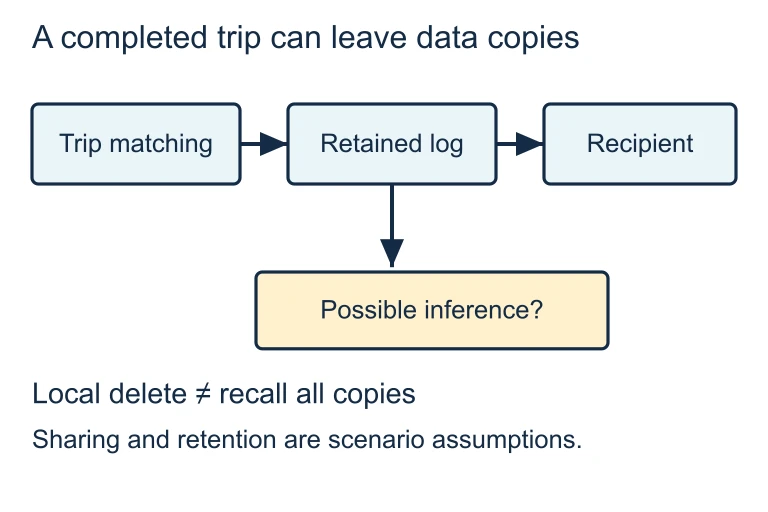 In this service scenario, a retained location log can be copied to a downstream recipient and support further inferences. Changing permissions or deleting one copy must be considered separately from copies already retained elsewhere.
SECTION 5
Case Studies — Classifying Real-World Effects
The AP CSP exam expects you to reason about specific computing innovations. The following table classifies the effects of several widely discussed innovations, demonstrating how the same technology yields both beneficial and harmful outcomes depending on context and stakeholder.
| Innovation | Intended Beneficial | Unintended Beneficial | Unintended Harmful |
|---|---|---|---|
| Social Media | Connect people globally; share information rapidly | Coordinate disaster relief; enable grassroots activism | Spread misinformation; increase anxiety and depression; enable cyberbullying |
| Autonomous Vehicles | Reduce accidents caused by human error; improve mobility for disabled individuals | Reduce traffic congestion through optimized routing | Displace professional drivers; raise liability questions; algorithmic bias in object detection |
| Facial Recognition | Unlock phones securely; find missing persons | Help diagnose genetic conditions from facial features | Enable mass surveillance; higher error rates for people with darker skin tones |
| Generative AI | Accelerate writing, coding, and research; make information more accessible | Enable rapid prototyping of creative ideas by non-experts | Produce deepfakes; threaten creative jobs; generate plausible-sounding misinformation |
Classification of effects for common computing innovations
SECTION 6
Worked Example — Analyzing a Computing Innovation
The AP CSP exam frequently presents a computing innovation and asks you to identify one beneficial and one harmful effect. Let's walk through a complete analysis of ride-sharing applications (e.g., Uber, Lyft) using the framework from Section 3.
Worked example
- 1
Step 1 — Identify the Innovation
A ride-sharing app is a computing innovation that uses GPS, routing algorithms, and a networked platform to match drivers with passengers in real time. It relies on programs running on smartphones and backend servers. - 2
Step 2 — Identify an Intended Beneficial Effect
The intended beneficial effect is providing convenient, on-demand transportation. Users in areas with limited public transit gain mobility, and the dynamic pricing algorithm helps balance supply and demand to ensure rides are generally available.Beneficial: Increased transportation access for underserved communities. - 3
Step 3 — Identify an Unintended Harmful Effect
An unintended harmful effect is the economic disruption to traditional taxi drivers, many of whom invested heavily in taxi medallions (licenses) that plummeted in value. Additionally, studies have shown that ride-sharing algorithms sometimes exhibit geographic discrimination, offering slower or more expensive service in lower-income neighborhoods.Harmful: Economic displacement of taxi industry workers and potential geographic bias. - 4
Step 4 — Consider Stakeholder Perspectives
Passengers view the app as overwhelmingly beneficial. Drivers experience mixed effects — flexible work hours (benefit) but lack of employee benefits and variable pay (harm). City governments face reduced taxi tax revenue but lower drunk-driving rates. This analysis demonstrates that the same innovation is simultaneously beneficial and harmful depending on the stakeholder. - 5
Step 5 — Craft an Exam-Ready Response
A strong AP CSP response would state: "Ride-sharing applications provide a beneficial effect by increasing transportation access for people in areas with limited public transit options. However, a harmful effect is the economic displacement of traditional taxi drivers, whose livelihoods were disrupted by competition from drivers who face fewer regulatory requirements. This harmful effect was largely unintended by the app's creators."This response names both a benefit and a harm, specifies the affected groups, and notes the unintended nature — all key scoring elements.
SECTION 7
Tradeoffs and Mitigation Strategies
Recognizing that computing innovations have both beneficial and harmful effects naturally leads to questions about mitigation. While the AP CSP exam primarily tests your ability to identify and describe effects, understanding common tradeoffs and mitigation strategies deepens your analytical capacity and prepares you for the more nuanced multiple-choice questions.
| Tradeoff Dimension | Benefit Side | Harm Side |
|---|---|---|
| Convenience vs. Privacy | Personalized recommendations, faster service, location-based features | Data collection enables surveillance, profiling, and potential breaches |
| Efficiency vs. Employment | Automation reduces costs, increases speed, minimizes human error | Workers in automatable roles face job displacement and economic instability |
| Access vs. Equity | Online services reach global audiences regardless of geography | Digital divide means those without internet/devices are further marginalized |
| Free Speech vs. Safety | Open platforms empower diverse voices and democratic participation | Lack of moderation allows harassment, hate speech, and radicalization |
Common tradeoffs in computing innovation
SECTION 8
Connections to the Digital Divide, Privacy, and Security
The concept of beneficial and harmful effects does not exist in isolation on the AP CSP exam. It interconnects with several other Big Idea 5 topics — most notably the digital divide, data privacy and security, and intellectual property. Understanding these connections helps you craft more complete exam responses and anticipate how questions may weave multiple topics together.
| Related Topic | How It Connects to Beneficial/Harmful Effects | Example |
|---|---|---|
| Digital Divide | Beneficial effects of innovations often accrue to those with access; harmful effects (exclusion, further marginalization) fall on those without. | Telehealth benefits urban patients with broadband but leaves rural communities with poor connectivity further behind. |
| Data Privacy | Many beneficial features (personalization, security) require data collection that simultaneously creates privacy risks. | Location data enables navigation apps but also allows tracking of individuals without their informed consent. |
| Cybersecurity | Innovations that store sensitive data create targets for malicious actors, turning intended benefits into vehicles for harm. | Electronic health records improve care coordination but, when breached, expose patients' most sensitive information. |
| Intellectual Property | Open-source tools benefit developers (free access) but may harm creators whose proprietary work is incorporated without credit. | Generative AI trained on copyrighted works raises questions about fair use and creator compensation. |
As you advance in computer science — whether into ethics-focused courses, policy-oriented programs, or software engineering — the ability to reason about systemic effects across interconnected domains becomes even more critical. The AP CSP framework introduces this reasoning at a foundational level; upper-division courses in human-computer interaction, AI ethics, and technology policy extend it with formal methodologies like impact assessments, value-sensitive design, and algorithmic auditing.
SECTION 9
Practice Problems
Question 1: CONCEPTUAL
- A. Users improve their exercise habits based on the app's recommendations.
- B. The app's creators profit from selling the application.
- C. Insurance companies use the collected health data to increase premiums for certain users.
- D. The app requires a smartphone to function, limiting access to people who own one.
Show answer (C)
Question 2: BASIC
- A. The platform collects browsing data from students for use by third-party advertisers.
- B. Students discover courses aligned with their interests and skill level more efficiently.
- C. Students in underrepresented groups receive fewer recommendations for advanced courses due to historical data patterns.
- D. Students become overly reliant on algorithms and stop exploring courses independently.
Show answer (B)
Question 3: INTERMEDIATE
- A. The system reduces speeding-related accidents by deterring drivers from exceeding speed limits. (Intended beneficial)
- B. The system eliminates all traffic violations in the city. (Intended beneficial)
- C. The license plate data could be used to track individuals' movements without a warrant. (Unintended harmful)
- D. The cameras consume electricity, increasing the city's total energy usage by more than 50%. (Unintended harmful)
Show answer (A,C)
Question 4: APPLIED
Show answer
Question 5: CRITICAL THINKING