Implementing
2D Array Algorithms
Master row-major traversal, nested loops, and common patterns for processing two-dimensional arrays in Java.
What Is a 2D Array?
A 2D array in Java is an array of arrays: each element of the outer array is itself an array. You can think of it as a grid with rows and columns, where every cell holds a single value.
Declaring & Initializing
Java provides two common ways to create a 2D array: specifying dimensions only (filled with defaults), or providing an initializer list with explicit values.
// Method 1: Dimensions only (3 rows, 4 cols of 0s)
int[][] grid = new int[3][4];

// Method 2: Initializer list
int[][] grid = {
    {3, 7, 1, 9},
    {4, 2, 8, 5},
    {6, 0, 3, 7}
};
Why 2D Arrays Matter
Two-dimensional arrays model countless real-world structures. Understanding them is essential for the AP CSA exam and for building real software.
The Row-Major Traversal Pattern
Row-major order visits every element by going across each row from left to right, top to bottom. This is the standard traversal on the AP exam.
for (int r = 0; r < arr.length; r++) {
    for (int c = 0; c < arr[r].length; c++) {
        // process arr[r][c]
    }
}
Column-Major Traversal
In column-major order, the outer loop iterates over columns and the inner loop iterates over rows: you visit every element in column 0 first, then column 1, and so on.
for (int c = 0; c < arr[0].length; c++) {
    for (int r = 0; r < arr.length; r++) {
        // process arr[r][c]
    }
}
Row-Major vs Column-Major
| Row-Major | Column-Major | |
|---|---|---|
| Outer loop | rows (r) | columns (c) |
| Inner loop | columns (c) | rows (r) |
| Visit pattern | Left to right, top to bottom | Top to bottom, left to right |
| AP default? | ✓ Yes | Sometimes tested |
| Use case | Summing all elements, printing | Column averages, transposing |
Enhanced For-Each Loop
When you only need to read values (no index needed), the enhanced for loop is cleaner. The outer loop iterates over rows (each an int[]), and the inner loop iterates over values in that row.
for (int[] row : arr) {
    for (int val : row) {
        System.out.print(val + " ");
    }
}
Step-by-Step Algorithm Design
A restorer repairs a luminous pixel mosaic
 Grid algorithms turn a visual pattern into explicit row and column operations. Bounds checks determine which neighboring cells can be accessed.
Check neighboring cells
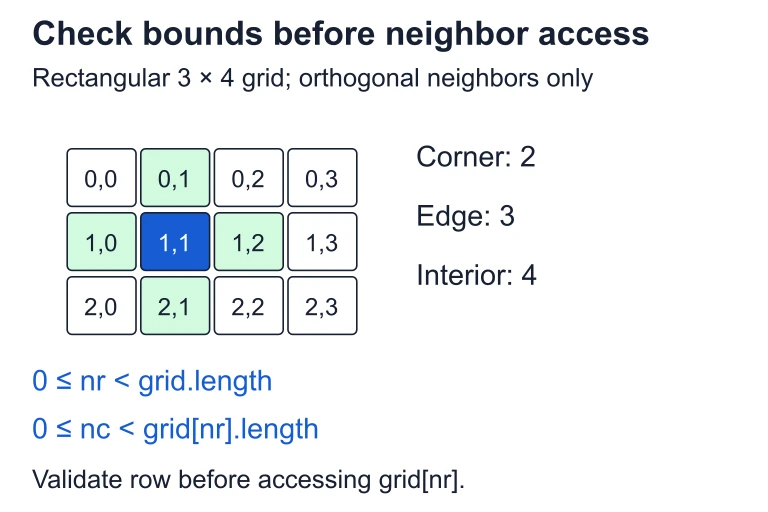 In this rectangular grid, an interior cell has four orthogonal neighbors, a noncorner edge cell has three, and a corner has two. Validate the target row before accessing that row’s length.
Example 1: Sum All Elements
Write a method that returns the sum of every element in a 2D integer array.
public static int totalSum(int[][] arr) {
    int sum = 0;
    for (int r = 0; r < arr.length; r++) {
        for (int c = 0; c < arr[r].length; c++) {
            sum += arr[r][c];
        }
    }
    return sum;
}
Example 2: Count Matches
Count how many times a target value appears in the 2D array.
public static int countOccurrences(int[][] arr, int target) {
    int count = 0;
    for (int[] row : arr) {
        for (int val : row) {
            if (val == target) {
                count++;
            }
        }
    }
    return count;
}
Example 3: Row Sums Array
Return a 1D array where each element is the sum of the corresponding row.
public static int[] rowSums(int[][] arr) {
    int[] sums = new int[arr.length];
    for (int r = 0; r < arr.length; r++) {
        for (int c = 0; c < arr[r].length; c++) {
            sums[r] += arr[r][c];
        }
    }
    return sums;
}
Example 4: Find the Maximum
Locate the largest value in a 2D array. Initialize the max with the first element, then compare every other cell.
public static int findMax(int[][] arr) {
    int max = arr[0][0];
    for (int r = 0; r < arr.length; r++) {
        for (int c = 0; c < arr[r].length; c++) {
            if (arr[r][c] > max) {
                max = arr[r][c];
            }
        }
    }
    return max;
}
Example 5: Modify In Place
Replace every negative value in the array with 0. This requires the standard indexed loop because we need to write to the array.
public static void replaceNegatives(int[][] arr) {
    for (int r = 0; r < arr.length; r++) {
        for (int c = 0; c < arr[r].length; c++) {
            if (arr[r][c] < 0) {
                arr[r][c] = 0;
            }
        }
    }
}
Common Mistakes
Algorithm Summary
| Algorithm | Pattern | Loop Type |
|---|---|---|
| Sum all elements | Accumulator += each cell | Either |
| Count matches | if (val == target) count++ | Either |
| Row/column sums | Reset accumulator per row/col | Indexed |
| Find max/min | Compare and update tracker | Either |
| Modify in place | arr[r][c] = newValue | Indexed only |
| Search (find location) | Return r, c when found | Indexed only |
Question 1 of 5
Given int[][] m = new int[3][5];, what does m.length return?
Question 2 of 5
int count = 0;
for (int[] row : arr) {
    for (int val : row) {
        if (val % 2 == 0) {
            count++;
        }
    }
}
What does this code compute?
Question 3 of 5
You want to replace every negative value in a 2D array with 0. Which loop type is required?
Question 4 of 5
int result = 0;
for (int c = 0; c < arr[0].length; c++) {
    for (int r = 0; r < arr.length; r++) {
        result += arr[r][c];
    }
}
This code traverses the array in which order?
Question 5 of 5
int max = arr[0][0];
for (int r = 0; r < arr.length; r++) {
    for (int c = 0; c < arr[r].length; c++) {
        if (arr[r][c] > max) {
            max = arr[r][c];
        }
    }
}
return max;
If the array is {{-5, -2}, {-8, -1}}, what does this method return?