Ethical & Social Issues
Around Data Collection
Explore the privacy, consent, and societal impacts of collecting, storing, and analyzing personal data in our increasingly connected world.
What Is Data Collection?
Data collection is the systematic process of gathering information from users, sensors, transactions, and public sources. Every time you browse the web, use an app, or swipe a card, data about your behavior is captured and stored.
Why Ethics in Data Matters
Data collection connects to four major ethical concerns: privacy violations, algorithmic bias, mass surveillance, and consent issues. As a programmer, every design decision can amplify or mitigate these risks.
Key Definitions You Need
The Core Ethical Principle
The Data Lifecycle
Ethical concerns exist at every stage of the data lifecycle. From the moment data is collected through its eventual deletion, developers and organizations must consider their responsibilities at each step.
Two collaborators work on one shared model
 Two variables can provide access to one shared object. Copying a reference creates another access path; it does not duplicate the object.
A new container can share its elements
 Copying the list creates a separate container while copying its element references. Both lists can still reach the same mutable Box. String and Integer values are immutable, so those elements cannot be mutated through either list.
A data-sharing trail that survives clearing the local list
 Clearing a local list affects that list’s defined scope. Copies retained by recipients or backups follow their own retention and deletion processes.
Local clearing and retained copies
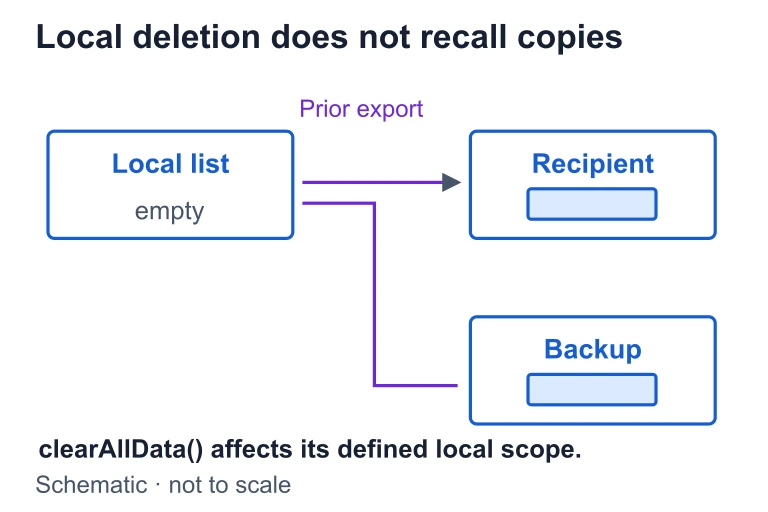 Suppose clearAllData() removes data in the local object. Recipient and backup copies remain separate objects or records and require their own deletion steps. Clearing fields and garbage collection do not by themselves securely erase every retained copy.
Privacy vs. Security
| Privacy | Security | |
|---|---|---|
| Definition | Right to control who sees your data | Measures to protect data from threats |
| Focus | Who has access and why | Preventing unauthorized access |
| Example | Opting out of ad tracking | Encrypting stored passwords |
| Without it | Data used without your knowledge | Data stolen by attackers |
How to Evaluate Data Practices
Example: Social Media Data
Example: Health App Data
A fitness tracking app collects heart rate, sleep patterns, exercise routes, and weight data. Consider the ethical implications:
Example: Algorithmic Bias
Check who enters the records
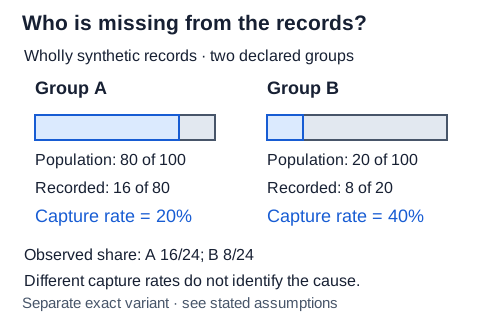 Suppose group A contains 80 people and group B 20. Recording 16 from A and 8 from B gives capture rates of 20% and 40%; the recorded sample is two-thirds A and one-third B. Compare these denominators before explaining why representation differs.Open full diagram
Legal Frameworks & Regulations
Scenario: School Database
A school district builds a student database that stores grades, attendance, disciplinary records, health information, and family income levels. The district wants to share this data with a third-party analytics company to "improve educational outcomes."
Scenario: Facial Recognition
A city installs facial recognition cameras across public spaces to "reduce crime." The system scans and identifies every person who walks by, storing their face data in a central database.
Common Mistakes in Ethical Reasoning
Summary: Ethical Data Practices
| Principle | Ethical Practice | Unethical Practice |
|---|---|---|
| Consent | Clear opt-in with plain language | Buried in 50-page ToS |
| Minimization | Collect only what is needed | Collect everything possible |
| Purpose | Use data only for stated purpose | Sell to third parties |
| Transparency | Users can see and delete their data | Data stored indefinitely, no access |
| Equity | Audit algorithms for bias | Deploy without bias testing |
Question 1 of 5
Which of the following best describes Personally Identifiable Information (PII)?
Question 2 of 5
A fitness app collects heart rate data to provide workout recommendations. It later sells this data to insurance companies without informing users. Which ethical principle is most directly violated?
Question 3 of 5
A hiring algorithm trained on 10 years of company data consistently ranks male applicants higher than female applicants. What is the root cause of this bias?
Question 4 of 5
Researchers demonstrated that combining zip code, birthdate, and gender can uniquely identify most Americans. This is an example of:
Question 5 of 5
Scenario: A school district stores student grades, attendance, health records, and family income data. They plan to share all of this with a third-party analytics company that promises to "improve educational outcomes." Parents receive a brief notification email but are not asked for explicit consent.
Which of the following best identifies the ethical problems in this scenario?