Abstraction &
Program Design
Master the art of hiding complexity, designing clean interfaces, and building programs that are modular, reusable, and easy to reason about.
What Is Abstraction?
Abstraction is the process of reducing complexity by focusing on the essential features of something while hiding unnecessary details. In computer science, it lets you use a tool without knowing exactly how it works internally.
Two Kinds of Abstraction
Why Abstraction Matters
Without abstraction, every piece of code can touch every other piece: a tangled mess. With abstraction, code is organized into layers with well-defined boundaries.
The Abstraction Principle
Clients interact only through the interface. The implementation can change without breaking any client code.
Interface vs Implementation
| Interface | Implementation | |
|---|---|---|
| Visibility | Public | Private |
| Answers | What does it do? | How does it do it? |
| Who sees it | Any client / caller | Only the class itself |
| Changes | Rarely (breaks clients) | Freely (hidden) |
| Java keyword | public | private |
One public counting interface, two hidden mechanisms
 Two implementations can provide the same public counting behavior while storing their internal state differently. A representation change must preserve the interface’s promised behavior.
Preserve public behavior across implementations
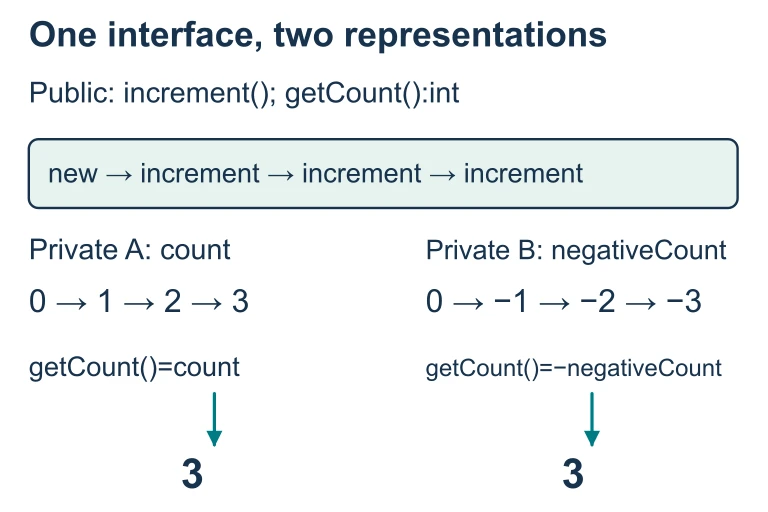 Starting at zero, one Counter stores count and increments it; another stores negativeCount and decrements it, returning its negation. Three increment calls make both getCount results 3. Their private representations differ while the public trace agrees.
Procedural Abstraction: Methods
A method is the primary unit of procedural abstraction in Java. It takes inputs (parameters), performs a task, and optionally returns an output.
Input: radius (double)
Output: area (double)
Data Abstraction: Classes
A class bundles related data (instance variables) and behavior (methods) into a single unit. The internal state is kept private; the world interacts through public methods.
Two collaborators work on one shared model
 Two variables can provide access to one shared object. Copying a reference creates another access path; it does not duplicate the object.
A new container can share its elements
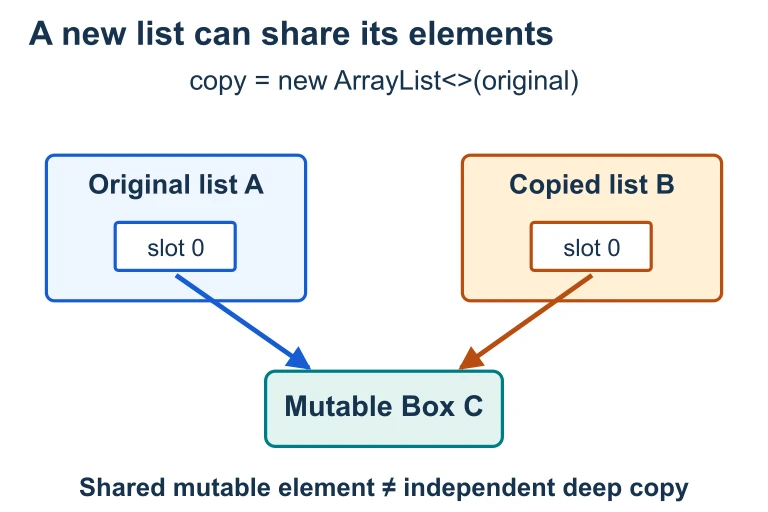 Copying the list creates a separate container while copying its element references. Both lists can still reach the same mutable Box. String and Integer values are immutable, so those elements cannot be mutated through either list.
How to Design a Class
Example: Student Class
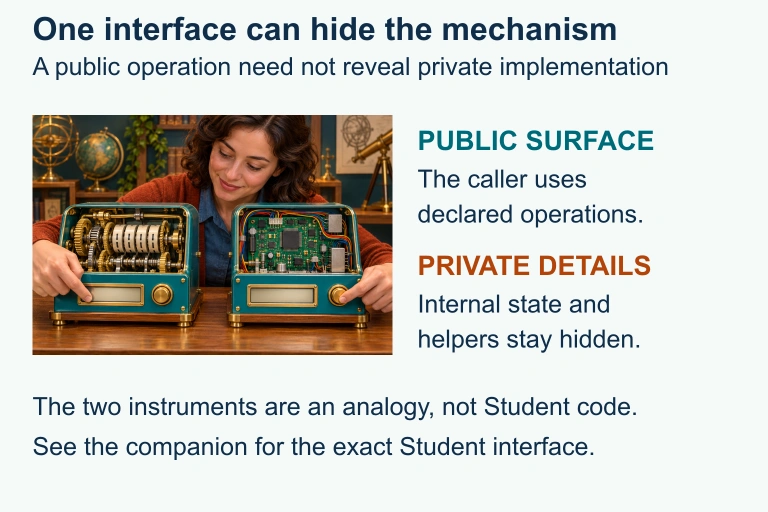
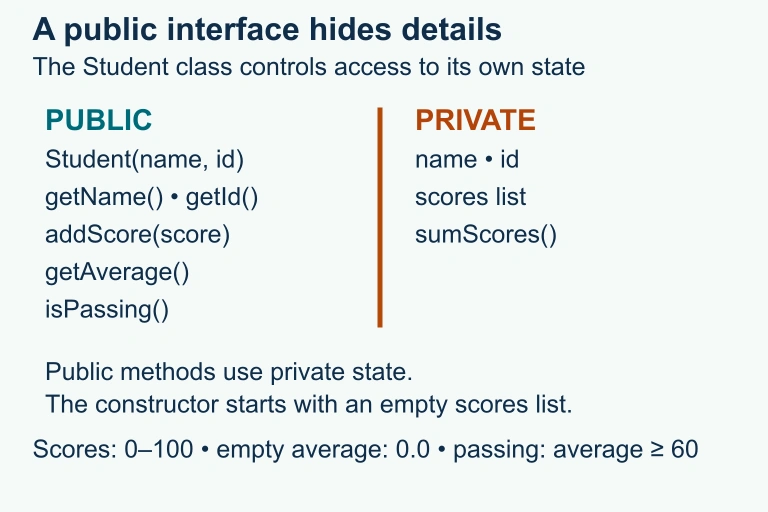
A separate Student interface
The release Student example has a name, id, scores list and named public methods. It is separate from the deck’s Student class with totalPoints and numAssignments.
Client Code: Using Student
Method Decomposition
Method decomposition breaks a complex task into smaller helper methods. Each method does one thing well: this is procedural abstraction in action.
Levels of Abstraction
Parameters and Return Values
Parameters are the inputs to a method: they let you generalize behavior. Return values are the outputs: they let the caller use the result without knowing how it was computed.
Common Mistakes
Summary of Key Concepts
| Concept | What It Means | Java Mechanism |
|---|---|---|
| Procedural Abstraction | Hide how a task is done | Methods |
| Data Abstraction | Hide internal state | Classes with private fields |
| Encapsulation | Bundle data + behavior | Private vars + public methods |
| Decomposition | Break complex into simple | Helper methods |
| Interface | Public contract | Public method signatures |
Question 1 of 5
Which of the following best describes the purpose of abstraction in program design?
Question 2 of 5
Consider the following class:
public class Counter {
    private int count;
    public Counter() { count = 0; }
    public void increment() { count++; }
    public int getCount() { return count; }
}
A client writes Counter c = new Counter();. Which statement would cause a compile-time error?
c.count = 10 cannot be accessed outside the class. This is data abstraction enforcing encapsulation.Question 3 of 5
Breaking a large method into several smaller helper methods is an example of which design principle?
Question 4 of 5
A class has a private ArrayList<String> items field and a public method getItems() that returns items directly. What is the problem?
Question 5 of 5
Which pair correctly matches the interface and implementation sides of abstraction?