
SECTION 1
Historical Context & Motivation
Long before modern programming languages existed, mathematicians recognized that many structures and functions could be defined in terms of themselves. Recursion as a formal concept traces its roots through mathematical logic, computability theory, and eventually into the design of programming languages themselves. The idea that a procedure might invoke itself—seemingly circular yet perfectly well-defined—was initially controversial, but it became one of the most powerful abstractions in computer science. Understanding this history illuminates why recursion occupies a central position in the AP Computer Science A curriculum and in software engineering at large.
1889 • Peano Axioms
1936 • Church & Turing
1958 • LISP & Practical Recursion
1995 • Java & the Call Stack
The core question recursion addresses is deceptively simple: how can we solve a problem when the solution depends on solving smaller instances of the same problem? Iteration can handle many such cases, but recursion provides a more natural mapping for problems with self-similar structure—searching through trees, traversing nested data, and dividing arrays for efficient sorting. The AP exam tests your ability to trace recursive calls, identify base cases, and reason about correctness and efficiency.
SECTION 2
Core Principles & Definitions
Every recursive method in Java rests on two structural requirements that together guarantee the method will terminate and produce a correct result. A base case provides the stopping condition—a scenario so simple that the answer is returned directly without further recursion. A recursive case breaks the current problem into one or more smaller subproblems and calls the method on those smaller inputs. Each recursive call must make progress toward a base case; otherwise, the method recurses infinitely and eventually throws a StackOverflowError.
Base Case
if (n == 0) return 1;Recursive Case
return n * factorial(n - 1);Call Stack
Progress Toward Base Case
SECTION 3
Visual Explanation — The Call Stack in Action
The diagram below traces the execution of factorial(4). On the left side, each downward arrow represents a new recursive call being placed on the call stack. On the right side, upward arrows show the return values unwinding as each frame completes. Observe how the base case factorial(0) = 1 anchors the entire chain of multiplications.
factorial(4): the left column shows five stack frames created by recursive calls, bottoming out at the pink base case. The right column shows return values propagating upward, each frame multiplying its n by the value returned from below.Notice that at the deepest point of recursion, five frames exist simultaneously on the call stack. Each frame holds its own copy of the parameter n. This is critical for AP exam tracing questions: the local variable n in factorial(3) is entirely separate from n in factorial(4). When the base case returns, the JVM pops frames in LIFO order, and each multiplication uses the n stored in that specific frame.
SECTION 4
How Recursion Works in Java
Anatomy of a Recursive Method
In Java, every method call—recursive or not—pushes a stack frame onto the call stack. A stack frame stores the method's parameters, local variables, and the return address (the point in code to resume after the method completes). For a recursive method, each invocation generates a new frame with its own independent copy of all local variables, even though the same method body is executing. This mechanism is what allows factorial(4) and factorial(3) to coexist without overwriting each other's data.
RECURSIVE FACTORIAL
The base case is n == 0, which returns 1. Each recursive call reduces n by 1, guaranteeing termination for non-negative integers.
Recurrence Relations & Complexity
TIME COMPLEXITY — LINEAR RECURSION
For factorial and similar single-branch recursions, each call does constant work and makes one recursive call, yielding linear time.
TIME COMPLEXITY — BINARY RECURSION (NAIVE FIBONACCI)
Two recursive calls per invocation creates a binary tree of calls. The naive Fibonacci method exhibits exponential growth, illustrating the importance of avoiding redundant computation.
SECTION 5
Common Recursive Patterns
Recursion appears in many forms on the AP exam and in real codebases. Recognizing these patterns lets you quickly classify a problem and reason about its behavior. The diagram below categorizes the most important recursive structures you need to master, organized by the number of recursive calls each invocation makes.
Recursion on Strings and ArrayLists
The AP exam frequently tests recursion on Strings and ArrayLists. A typical pattern passes an index as a parameter: the base case occurs when the index reaches the end (or beginning) of the structure, and the recursive case processes one element then advances the index. For strings, substring() is another common approach—the recursive call operates on a shorter string until length() == 0. Be careful: creating substrings generates new String objects each time, which is less memory-efficient than passing an index.
SECTION 6
Worked Example — Recursive Binary Search
Binary search is a classic divide-and-conquer algorithm that recursively narrows a sorted array to find a target value. Each call halves the search space, yielding O(log n) time. Let's trace through a complete example.
Worked example
- 1
Step 1 — Define the Method Signature
The method isint binarySearch(int[] arr, int target, int lo, int hi). The base case returns −1 whenlo > hi(target not found). Given:arr = {3, 7, 12, 19, 23, 31, 42}, target = 23, lo = 0, hi = 6. - 2
Step 2 — First Call: mid = 3
Computemid = (0 + 6) / 2 = 3. Element at index 3 is 19. Since 23 > 19, the target must be in the right half.Recurse with lo = 4, hi = 6 - 3
Step 3 — Second Call: mid = 5
Computemid = (4 + 6) / 2 = 5. Element at index 5 is 31. Since 23 < 31, the target must be in the left portion of this subarray.Recurse with lo = 4, hi = 4 - 4
Step 4 — Third Call: mid = 4
Computemid = (4 + 4) / 2 = 4. Element at index 4 is 23, which matches the target.Return 4 — the index of target 23 - 5
Step 5 — Unwinding
The return value 4 propagates back through the two previous frames unchanged. Total calls: 3, consistent with O(log₂ 7) ≈ 2.8, confirming logarithmic performance. Each call examined exactly one element and discarded roughly half the remaining array.Final answer: index 4
SECTION 7
Recursion vs. Iteration — Strengths & Limitations
Every recursive algorithm can be rewritten iteratively (and vice versa), but the choice between them involves trade-offs in clarity, performance, and memory usage. The AP exam expects you to understand when recursion is the natural choice and when iteration is more appropriate.
| Criterion | Recursion | Iteration |
|---|---|---|
| Readability | Excellent for tree/graph traversals and divide-and-conquer; mirrors mathematical definitions | Cleaner for simple loops, counters, and sequential scans |
| Memory | Each call adds a stack frame; deep recursion can cause StackOverflowError | Constant stack usage (O(1) extra space for a loop variable) |
| Performance | Method call overhead per frame; risk of redundant computation (e.g., naive Fibonacci) | Generally faster due to no call overhead; easier to optimize |
| Problem Fit | Naturally fits self-similar structures: trees, fractals, nested lists, backtracking | Best for flat data traversals, accumulation, and counting |
Recursion vs. Iteration comparison for AP CSCA
SECTION 8
Connection to Advanced Topics
Recursion in AP Computer Science A is your gateway to some of the most powerful ideas in computer science. While the exam focuses on tracing and writing recursive methods on arrays, strings, and ArrayLists, the underlying concept extends far beyond the AP syllabus into data structures like trees and graphs, advanced algorithms, and even language design.
| AP CSCA Topic | Advanced Extension |
|---|---|
| Recursive binary search on arrays | Tree traversals (inorder, preorder, postorder) using the same recursive pattern with left/right children |
| Merge sort (recursive splitting) | Quicksort, radix sort, and the Master Theorem for analyzing divide-and-conquer recurrences |
| Naive Fibonacci (exponential time) | Dynamic programming (memoization), where overlapping subproblems are cached to eliminate redundant calls |
| Recursive string manipulation | Backtracking algorithms (N-Queens, Sudoku solvers) that explore and prune decision trees recursively |
If you continue to AP Computer Science AB or a college data structures course, you will find that virtually every tree and graph algorithm relies on recursion. Mastering the fundamentals now—base cases, progress toward termination, and call stack reasoning—provides the scaffolding for these more complex applications.
SECTION 9
Practice Problems
Question 1: CONCEPTUAL
- A. It prevents the method from being called more than once.
- B. It provides the termination condition that stops recursive calls and begins returning values.
- C. It converts the recursive method into an iterative loop internally.
- D. It ensures the method always returns the same value regardless of input.
Show answer (B)
Question 2: BASIC CALCULATION
public int mystery(int n) {
  if (n <= 1) return n;
  return mystery(n - 1) + mystery(n - 2);
}
What is the value of mystery(5)?
A. 3
B. 5
C. 8
D. 15- A. 3
- B. 5
- C. 8
- D. 15
Show answer (B)
Question 3: INTERMEDIATE
public String recur(String s) {
  if (s.length() <= 1) return s;
  return recur(s.substring(1)) + s.charAt(0);
}
What does recur("ABCD") return?
A. "ABCD"
B. "DCBA"
C. "BCDA"
D. "DABC"- A. "ABCD"
- B. "DCBA"
- C. "BCDA"
- D. "DABC"
Show answer (B)
Question 4: APPLIED
public static int countOccurrences(ArrayList<String> list, String target, int index) that returns the number of times target appears in list starting from position index. Use recursion—no loops allowed.Show answer
public static int countOccurrences(ArrayList<String> list, String target, int index) {
  if (index >= list.size()) return 0;
  int match = list.get(index).equals(target) ? 1 : 0;
  return match + countOccurrences(list, target, index + 1);
}
Rubric: (1) Base case correctly returns 0 when index is at or beyond the list size. (2) Uses .equals() for String comparison—using == would compare references, not content, and would usually fail. (3) Recursive call correctly increments index by 1 and adds either 1 (match found) or 0 (no match) to the result of the recursive call on the rest of the list.Question 5: CRITICAL THINKING
public static int sumArray(int[] arr, int index) {
  if (index == arr.length) return 0;
  return arr[index] + sumArray(arr, index + 1);
}
(a) Trace the execution of sumArray(new int[]{5, 3, 8}, 0), showing every recursive call and its return value.
(b) The student's friend claims the method would work just as well if the base case were changed to if (index == arr.length - 1) return arr[index];. Is the friend correct? Explain whether the modified version produces the same results for all valid inputs, including edge cases.
(c) Rewrite the method so that it processes the array from the last element toward the first (i.e., the initial call is sumArray(arr, arr.length - 1) and the base case occurs at index 0).
(d) Explain the time and space complexity of this recursive approach and compare it to an iterative for-loop summing the same array.Show answer
public static int sumArray(int[] arr, int index) {
  if (index < 0) return 0;
  if (index == 0) return arr[0];
  return arr[index] + sumArray(arr, index - 1);
}
For a nonnull array, use the initial call sumArray(arr, arr.length - 1). An empty array starts at index -1 and returns 0. For a nonempty array, the base case at index 0 returns arr[0]; each recursive call decrements the index.
(d) Complexity: Both the recursive and iterative versions run in O(n) time because each element is visited exactly once. However, the recursive version requires O(n) space on the call stack (one frame per element), while a for-loop uses only O(1) extra space for the accumulator variable. For very large arrays, the iterative version is preferable to avoid stack overflow.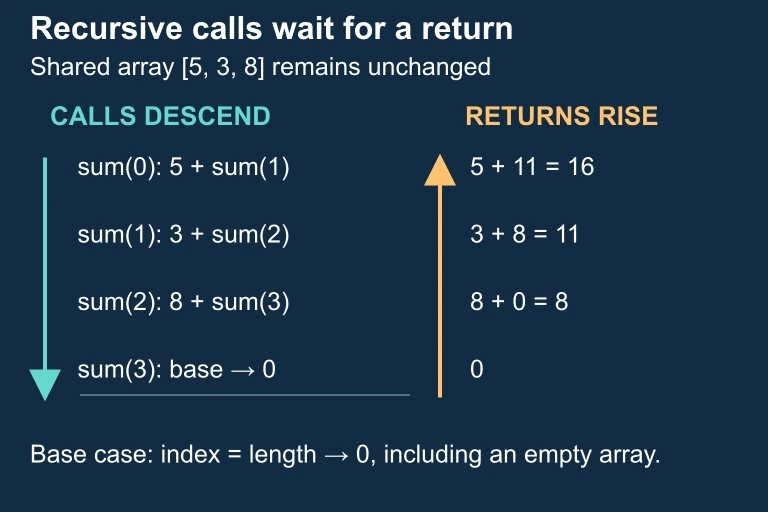 For sumArray([5,3,8],0), calls reach index 3 and return 0, then unwind through 8, 11 and 16.