

SECTION 1
Historical Context & Motivation
Before object-oriented programming became dominant, software developers organized code around procedures—sequences of instructions that operated on passive data structures. As programs grew in complexity during the 1960s and 1970s, this procedural paradigm struggled to manage the tangled interdependencies between data and the functions that manipulated it. The concept of instantiation—creating a living object from a class blueprint—emerged as a central mechanism in object-oriented programming, enabling developers to encapsulate state and behavior into self-contained entities. This idea changed how we reason about program architecture: rather than thinking in terms of global data flowing through functions, we think of autonomous objects that communicate by sending messages (calling methods) to one another.
1967 • Simula Introduces Classes and Objects
new keyword for object instantiation—the first language to treat data and behavior as a single unit.1972 • Smalltalk Refines Message-Passing
1983 • C++ Brings OOP to Systems Programming
1995 • Java Standardizes the Reference Model
new, and is accessed exclusively through reference variables—the exact model tested on the AP Computer Science A exam.2003 • AP CS A Adopts Java
The central question that object instantiation answers is deceptively simple: How does a static class definition become a dynamic, usable entity at runtime? The answer involves memory allocation, constructor invocation, and reference binding—three intertwined steps that you must understand deeply for both the multiple-choice and free-response sections of the AP exam.
SECTION 2
Core Principles & Definitions
Object instantiation in Java rests on a clean separation between the class (the template) and the object (the concrete instance). A class defines the structure—instance variables and methods—but by itself occupies no heap space for those fields. Only when you invoke the new keyword does the Java Virtual Machine allocate memory, initialize the fields, run the constructor, and return a reference to the newly minted object. The following foundational ideas underpin every instantiation you will encounter on the AP exam.
Class vs. Object
The new Keyword
new operator allocates heap memory for the object, initializes instance variables to default values, and then invokes the specified constructor. It returns a reference (memory address) to the newly created object.Reference Variable
null.Constructors
Null References
null. Calling a method on a null reference produces a NullPointerException at runtime—one of the most common bugs in Java programs.KEY TAKEAWAY
new is like hiring a contractor to actually build the house on a specific lot (heap memory). The address you write on your mail (the reference variable) tells you where the house is, but the address is not the house itself. Multiple people can have the same address written down, and they all reach the same house.SECTION 3
Visual Explanation: Memory Model
Understanding object instantiation requires a clear mental model of how Java organizes memory. The JVM divides runtime memory into two principal regions relevant to AP CS A: the stack, where local variables and reference variables live, and the heap, where objects created with new reside. The following diagram traces the execution of a single instantiation statement.
spot which holds address 0x7A2F. The heap (right, pink) stores the actual Dog object with its instance variables and methods. The dashed arrow shows the reference relationship.Notice the critical distinction illustrated in the diagram: the variable spot on the stack does not contain the Dog object itself—it contains a reference (conceptually, a memory address) that points to the actual object on the heap. This distinction matters profoundly when you pass objects to methods or assign one reference variable to another: you are copying the address, not the object. Two references can therefore point to the same object, and mutating the object through one reference makes the changes visible through the other.
SECTION 4
How Instantiation Works: Syntax & Semantics
The general syntax for declaring a reference variable and instantiating an object in Java follows a predictable pattern. Understanding each component of this pattern is essential for reading and writing AP exam code with confidence.
INSTANTIATION SYNTAX
ClassName (left of =) is the declared type of the reference variable. variableName is the identifier for the reference. new ClassName(arguments) allocates heap memory, invokes the matching constructor with the given arguments, and returns a reference to the new object.
This single line actually performs two distinct operations that can also be written separately. The declaration (ClassName variableName) creates a reference variable on the stack, initially holding null. The instantiation and assignment (= new ClassName(arguments)) creates the object on the heap and stores its address in the reference variable.
SPLIT DECLARATION AND INSTANTIATION
Splitting these steps is legal and common in conditional logic where you may want to instantiate different objects based on a condition.
Constructor Overloading
A class can define multiple constructors with different parameter lists—this is called constructor overloading. The compiler determines which constructor to call based on the number and types of arguments you pass. For instance, a Dog class might offer a two-argument constructor Dog(String name, int age) and a no-argument constructor Dog() that assigns default values. On the AP exam, you must match the arguments you provide with the constructor signature exactly; a mismatch causes a compile-time error.
DEFAULT INITIAL VALUES
When an object is created, its instance variables are automatically set to these defaults before the constructor body runs. The constructor then assigns meaningful values.
SECTION 5
Reference Semantics & Aliasing
One of the most nuanced—and most tested—aspects of object instantiation is what happens when you assign one reference variable to another. This operation copies the reference, not the object, producing what is called an alias. Aliasing means two or more variables refer to the exact same object on the heap. Changes made through one alias are immediately visible through the other because there is only one underlying object.
a and b point to the same Dog object, so a == b is true. Scenario B shows two separate calls to new, creating distinct objects even with identical field values, so c == d is false.This distinction between reference equality (tested with ==) and content equality (tested with the .equals() method) is one of the most commonly tested topics on the AP exam. The == operator compares the memory addresses stored in two reference variables, returning true only if both references point to the very same object. The .equals() method, when properly overridden, compares the actual state (field values) of the objects.
 Two variables can provide access to one shared object. Copying a reference creates another access path; it does not duplicate the object.
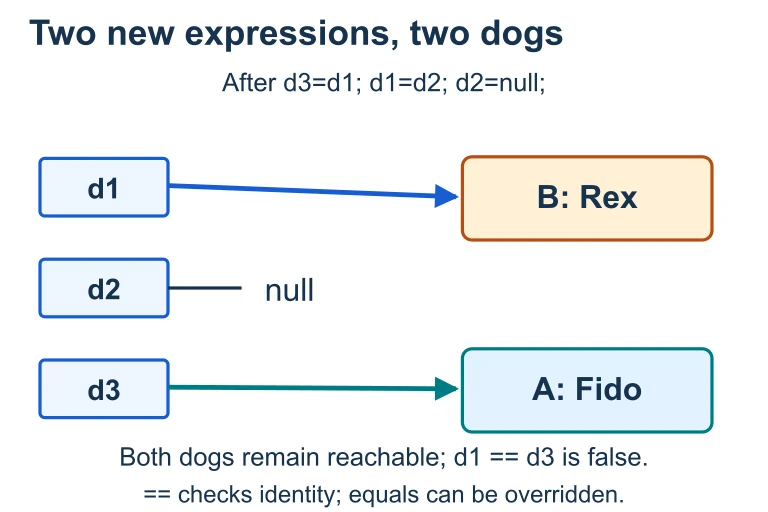 Two new expressions create Fido and Rex. After the assignments, d1 refers to Rex, d3 refers to Fido and d2 is null. Both objects remain reachable; == compares reference identity, while equals depends on the class’s implementation.
SECTION 6
Worked Example: Tracing Object Creation
Let us trace through a short program that creates and manipulates objects, predicting the output at each stage. This kind of step-by-step tracing is directly analogous to what you will need to do on multiple-choice questions that present code snippets and ask for printed output.
Tracing Instantiation, Aliasing, and Method Calls
- 1
Step 1 — Read the Code
Consider the following code. Assume aStudentclass with a constructorStudent(String name, int grade), a methodgetName()that returns the name, and a methodsetGrade(int g)that changes the grade.Student s1 = new Student("Alice", 90); Student s2 = new Student("Bob", 85); Student s3 = s1; s3.setGrade(95); System.out.println(s1.getName() + " " + s1.getGrade()); System.out.println(s2.getName() + " " + s2.getGrade()); System.out.println(s1 == s3); - 2
Step 2 — Trace Line 1
Student s1 = new Student("Alice", 90);— The JVM allocates a new Student object on the heap with name = "Alice" and grade = 90. The reference is stored ins1.s1 → Student("Alice", 90) at heap address, e.g., 0x100 - 3
Step 3 — Trace Line 2
Student s2 = new Student("Bob", 85);— A second, completely separate Student object is created on the heap.s2 → Student("Bob", 85) at heap address, e.g., 0x200 - 4
Step 4 — Trace the Alias
Student s3 = s1;— Nonewkeyword means no new object is created. The address stored ins1(0x100) is copied intos3. Both references now point to the same Student object.s3 → 0x100 (same object as s1) - 5
Step 5 — Trace the Mutation
s3.setGrade(95);— This callssetGradeon the object at 0x100, changing its grade from 90 to 95. Becauses1ands3point to the same object, accessings1.getGrade()will also return 95.Object at 0x100 now has grade = 95 - 6
Step 6 — Predict the Output
Line 1 prints:Alice 95(not 90, because s3 mutated the shared object). Line 2 prints:Bob 85(s2 references a completely separate object, unaffected). Line 3 prints:truebecause s1 and s3 hold the same memory address.Alice 95 Bob 85 true
SECTION 7
Common Pitfalls & Comparisons
AP exam questions are carefully designed to exploit common misconceptions about object creation. The table below summarizes the most frequent mistakes students make and contrasts them with the correct understanding.
| Common Mistake | Why It's Wrong | Correct Understanding |
|---|---|---|
Using == to compare object contents | == compares references (memory addresses), not the values of instance variables. | Use .equals() for content comparison. For Strings, .equals() checks character sequences. |
Forgetting that = copies the reference, not the object | Students expect b = a to create a separate copy. It doesn't—it creates an alias. | After b = a, both variables share one object. Mutating through b affects a. |
Calling a method on a null reference | Declaring Dog d; without instantiation leaves d as null. Calling d.bark() throws a NullPointerException. | Always ensure a reference has been assigned to a new object (or a non-null value) before calling methods on it. |
| Mismatched constructor arguments | Passing the wrong number or types of arguments does not cause a runtime error—it fails to compile. | Match argument count and types to a declared constructor signature. The compiler selects the constructor via overload resolution. |
| Thinking primitives are objects | int, double, boolean are not objects. They are stored directly in the variable, not by reference. | Primitive variables hold values directly. Object variables hold references. Use wrapper classes (Integer, Double) when you need an object. |
Common instantiation pitfalls on the AP CS A exam
KEY TAKEAWAY
b = a), think of handing someone a copy of a house key, not building them a new house. Both keys open the same front door, so any changes made inside by one person are visible to the other. A new house is only built when you see the new keyword.SECTION 8
Connection to Inheritance & Polymorphism
Object instantiation becomes considerably more nuanced once you encounter inheritance and polymorphism later in the AP curriculum. Java allows you to declare a variable of a superclass type and assign it an instance of a subclass. For example, Animal pet = new Dog("Buddy", 3); is valid if Dog extends Animal. The declared type (Animal) determines which methods can be called at compile time, while the actual type (Dog) determines which version of an overridden method runs at runtime. This principle, called polymorphism, builds directly on the reference model you learned in this lesson.
| Concept | Basic Instantiation (This Lesson) | Advanced (Inheritance Unit) |
|---|---|---|
| Declaration type | Same as the class being instantiated | Can be a superclass or interface type |
| Constructor chain | Single constructor executes | Superclass constructors called first via super() |
| Method binding | Declared type = actual type, so binding is straightforward | Dynamic dispatch: JVM calls the overridden method in the actual object's class |
| Casting | Not needed | Downcasting may be required to access subclass-specific methods |
How instantiation concepts extend with inheritance
Even though these advanced topics appear later, the reference model you have built in this lesson is the same: the new keyword always creates an object on the heap, and a reference variable always stores an address. What changes is only which methods the compiler lets you call (determined by the declared type) versus which method bodies actually execute (determined by the actual object type). Mastering basic instantiation now will make inheritance and polymorphism feel like natural extensions rather than entirely new ideas.
SECTION 9
Practice Problems
Question 1: CONCEPTUAL
Cat c1 = new Cat("Whiskers");
Cat c2 = c1;
Cat c3 = new Cat("Whiskers");
Which of the following expressions evaluates to true?- A.
c1 == c3 - B.
c2 == c3 - C.
c1 == c2 - D.
c1 == c2 && c2 == c3
Show answer (C)
c2 = c1 copies the reference, making c1 and c2 point to the same object, so c1 == c2 is true. A is incorrect because c3 was created with a separate new call, so it references a different object even though the constructor argument is the same. B is incorrect for the same reason—c2 aliases c1, not c3. D is incorrect because even though the first part (c1 == c2) is true, the second part (c2 == c3) is false, making the entire && expression false.Question 2: BASIC CALCULATION
Point p1 = new Point(2, 5);
Point p2 = p1;
p2.setX(10);
System.out.println(p1.getX());
What is printed? Assume Point has a constructor Point(int x, int y) and methods getX() and setX(int x).- A.
2 - B.
10 - C.
5 - D. A NullPointerException is thrown
Show answer (B)
p2 = p1 creates an alias (both reference the same Point object), calling p2.setX(10) modifies the shared object's x value to 10. Therefore p1.getX() returns 10. A is incorrect because it assumes p1 and p2 are separate objects. C is incorrect because getX() returns x, not y. D is incorrect because both references are properly initialized with new (no null reference exists).Question 3: INTERMEDIATE
String s1 = new String("hello");
String s2 = new String("hello");
String s3 = "hello";
String s4 = "hello";
Which of the following evaluates to true?- A.
s1 == s2 - B.
s1 == s3 - C.
s3 == s4 - D.
s2 == s4
Show answer (C)
"hello" as a literal, the JVM reuses the same String object from the pool. Thus s3 and s4 refer to the same object, making s3 == s4 true. A is incorrect because each new String("hello") forces creation of a distinct object on the heap, bypassing the pool. B is incorrect because s1 (created with new) is a different heap object from the pooled literal referenced by s3. D is incorrect because s2 (created with new) is a different heap object from the pooled literal referenced by s4.Question 4: APPLIED
4 ptsBankAccount with instance variables String owner and double balance. The class has the following constructors:
public BankAccount(String owner, double balance)
public BankAccount(String owner)
The second constructor sets the balance to 0.0.
Write a method public static BankAccount[] createAccounts(String[] names, double[] deposits) that creates and returns an array of BankAccount objects. For each index i, if deposits[i] > 0, use the two-argument constructor; otherwise, use the one-argument constructor. You may assume both arrays have the same length.Show answer
BankAccount[] accounts = new BankAccount[names.length];
Point 2 — Loop structure: Uses a loop that correctly iterates over all valid indices of the arrays (e.g., for loop from 0 to names.length − 1).
Point 3 — Conditional constructor selection: Uses an if statement to check deposits[i] > 0 and calls the two-argument constructor new BankAccount(names[i], deposits[i]) in the true branch and the one-argument constructor new BankAccount(names[i]) in the else branch.
Point 4 — Returns the array: Returns the populated accounts array.
Sample solution:
public static BankAccount[] createAccounts(String[] names, double[] deposits) {
    BankAccount[] accounts = new BankAccount[names.length];
    for (int i = 0; i < names.length; i++) {
        if (deposits[i] > 0) {
            accounts[i] = new BankAccount(names[i], deposits[i]);
        } else {
            accounts[i] = new BankAccount(names[i]);
        }
    }
    return accounts;
}
Question 5: CRITICAL THINKING
3 ptsDog objects in memory."
Dog d1 = new Dog("Fido");
Dog d2 = new Dog("Rex");
Dog d3 = d1;
d1 = d2;
d2 = null;
(a) Explain whether the student's claim is correct. State how many Dog objects exist in heap memory and how many reference variables point to each.
(b) Identify which object, if any, is eligible for garbage collection after this code executes, and explain why.
(c) State the result of evaluating d1 == d3 after this code and explain your reasoning.Show answer
new). After execution: the Fido object is referenced by d3 only (1 reference). The Rex object is referenced by d1 only (1 reference). d2 is null and references nothing.
Point 2 (Part b): No object is eligible for garbage collection. The Fido object is still reachable through d3, and the Rex object is still reachable through d1. Setting d2 to null removed one reference to Rex, but d1 was reassigned to point to Rex in the previous line, so Rex still has a live reference.
Point 3 (Part c):d1 == d3 evaluates to false. After d3 = d1 (when d1 pointed to Fido), d3 points to Fido. Then d1 = d2 reassigns d1 to point to Rex. Now d1 points to Rex and d3 points to Fido—they reference different objects, so == returns false.SUMMARY
Lesson Summary
Summary
In Java, object instantiation is the process of creating a concrete instance of a class using the new keyword. This operation allocates memory on the heap, initializes instance variables to default values, executes the matching constructor, and returns a reference to the newly created object. A reference variable stores the memory address of the object, not the object itself—this means assigning one reference to another creates an alias, not a copy.
Remember that the == operator compares reference addresses (not object contents), while .equals() compares state. A reference that has been declared but not assigned to a new object holds null, and calling a method on it produces a NullPointerException. These concepts form the foundation for every subsequent AP CS A topic—from arrays of objects to inheritance and polymorphism.